GYMNAST BALANCING ON RUBBLE
Balancing on the Ruins
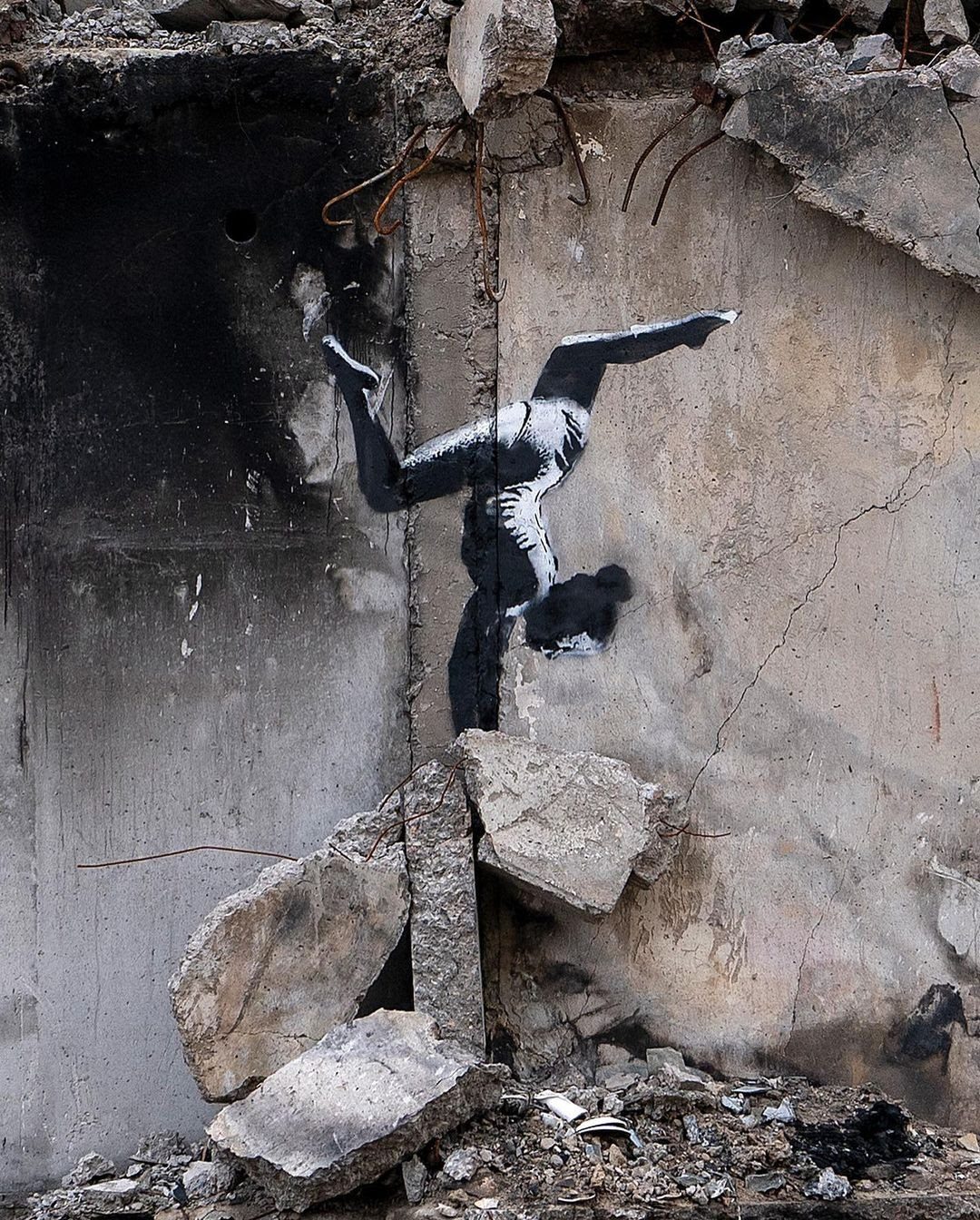
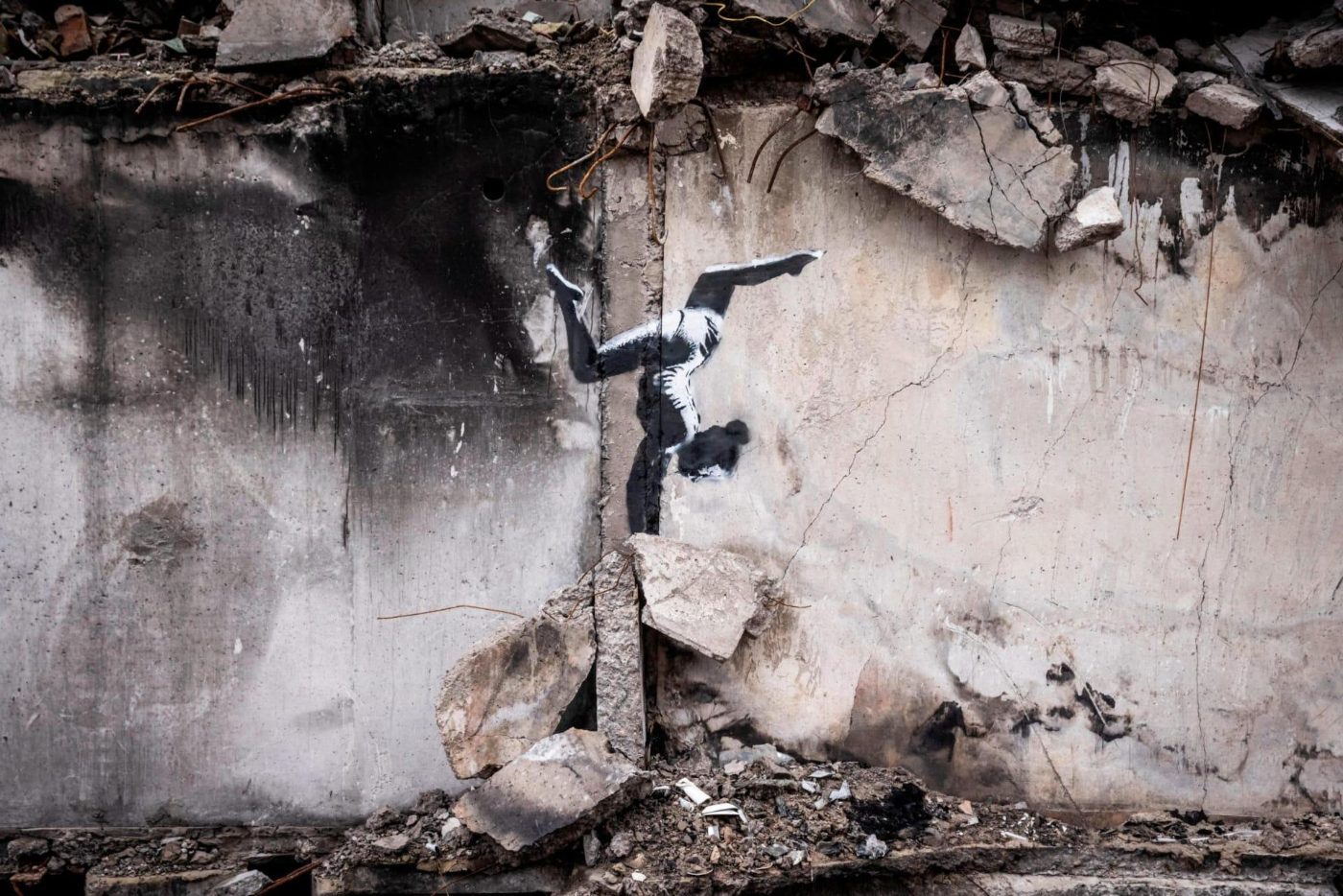
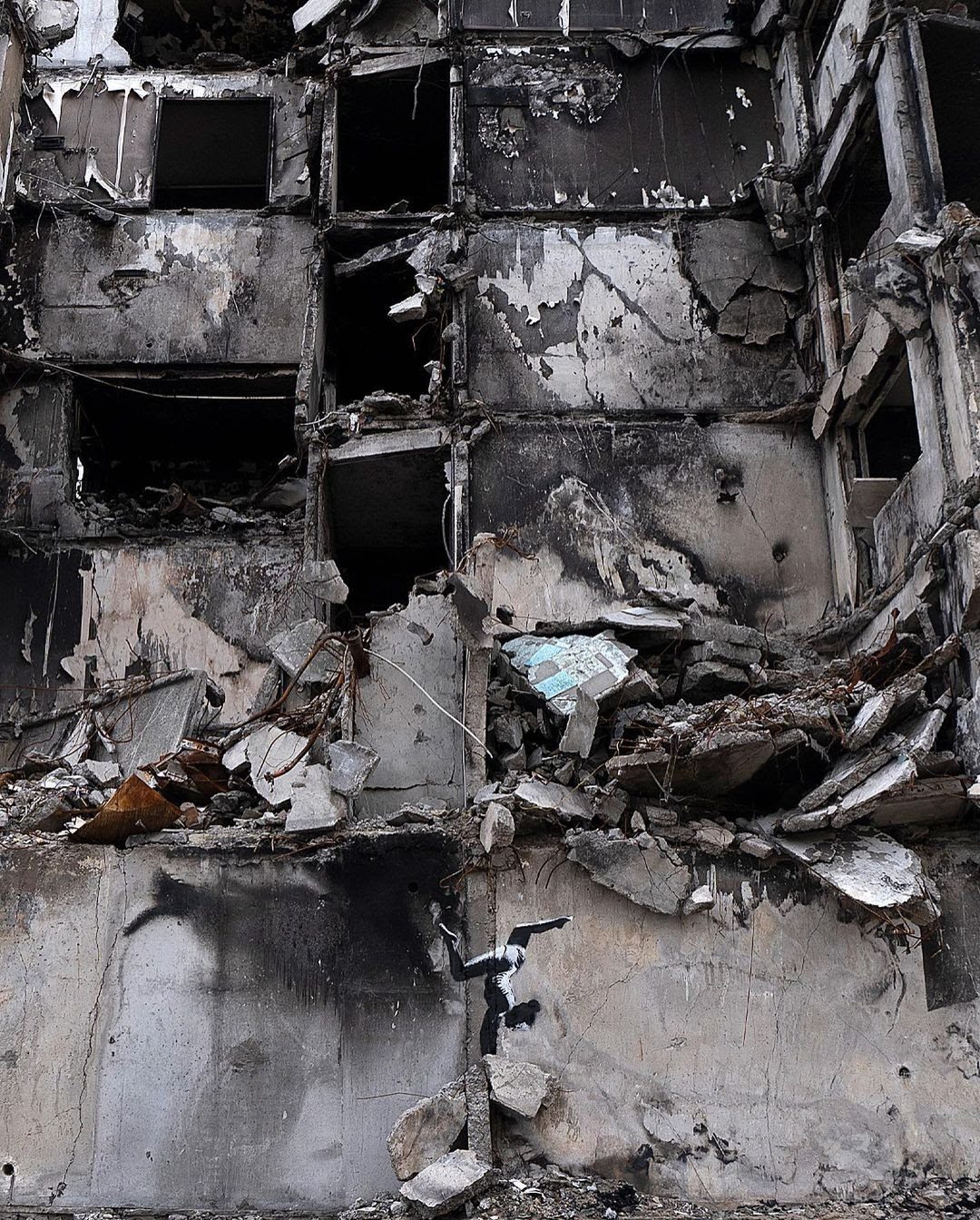
In November 2022, nine months after Russia launched its full-scale invasion of Ukraine, Banksy confirmed his presence in the country with an image from Borodyanka, a town northwest of Kyiv that had suffered devastating bombardment during the first weeks of the war. The mural depicts a female gymnast performing a handstand, her body apparently balanced upon the shattered remains of the building beneath her. Banksy posted three photographs of the work on 11 November with only the caption: “Borodyanka, Ukraine.”
It was the first work through which Banksy publicly announced the Ukraine intervention. Over the following days, he confirmed that he had created seven works across Borodyanka, Irpin, Horenka, Hostomel and Kyiv.
The composition is extraordinarily economical. The gymnast herself is rendered in the controlled black-and-white stencil language characteristic of Banksy's figures, but the most important part of the work was already there. Broken concrete, fractured masonry and the jagged edge of the wall form the surface upon which she appears to balance. The ruins are not a backdrop to the mural; they complete it.
Borodyanka
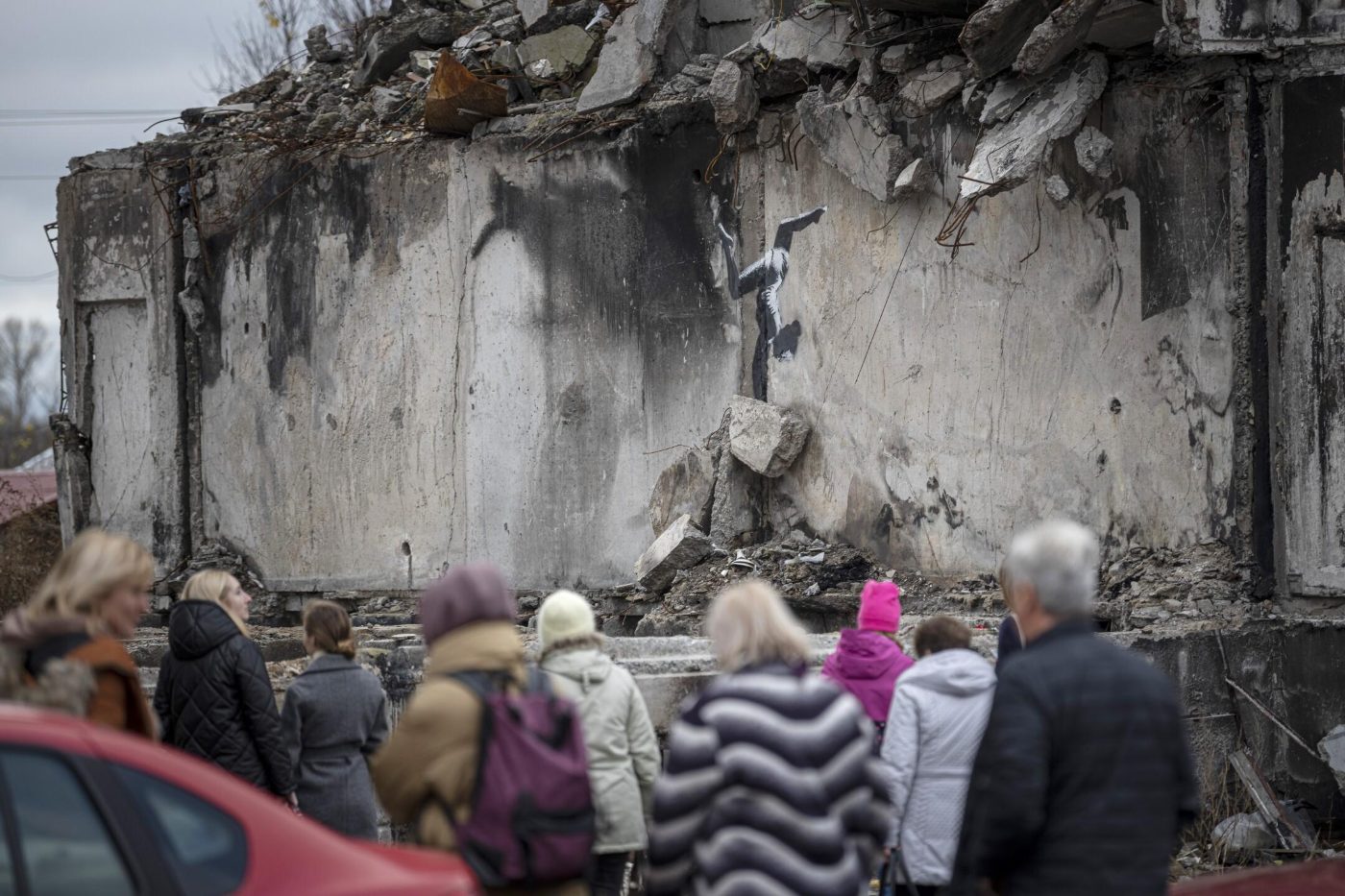
That distinction is particularly important in Borodyanka. Russian forces occupied the town during the opening phase of the invasion, and aerial bombardment destroyed or severely damaged large numbers of residential buildings. After Russian troops withdrew from the Kyiv region in April 2022, images of Borodyanka's collapsed apartment blocks became among the most recognizable visual records of the destruction around the Ukrainian capital.
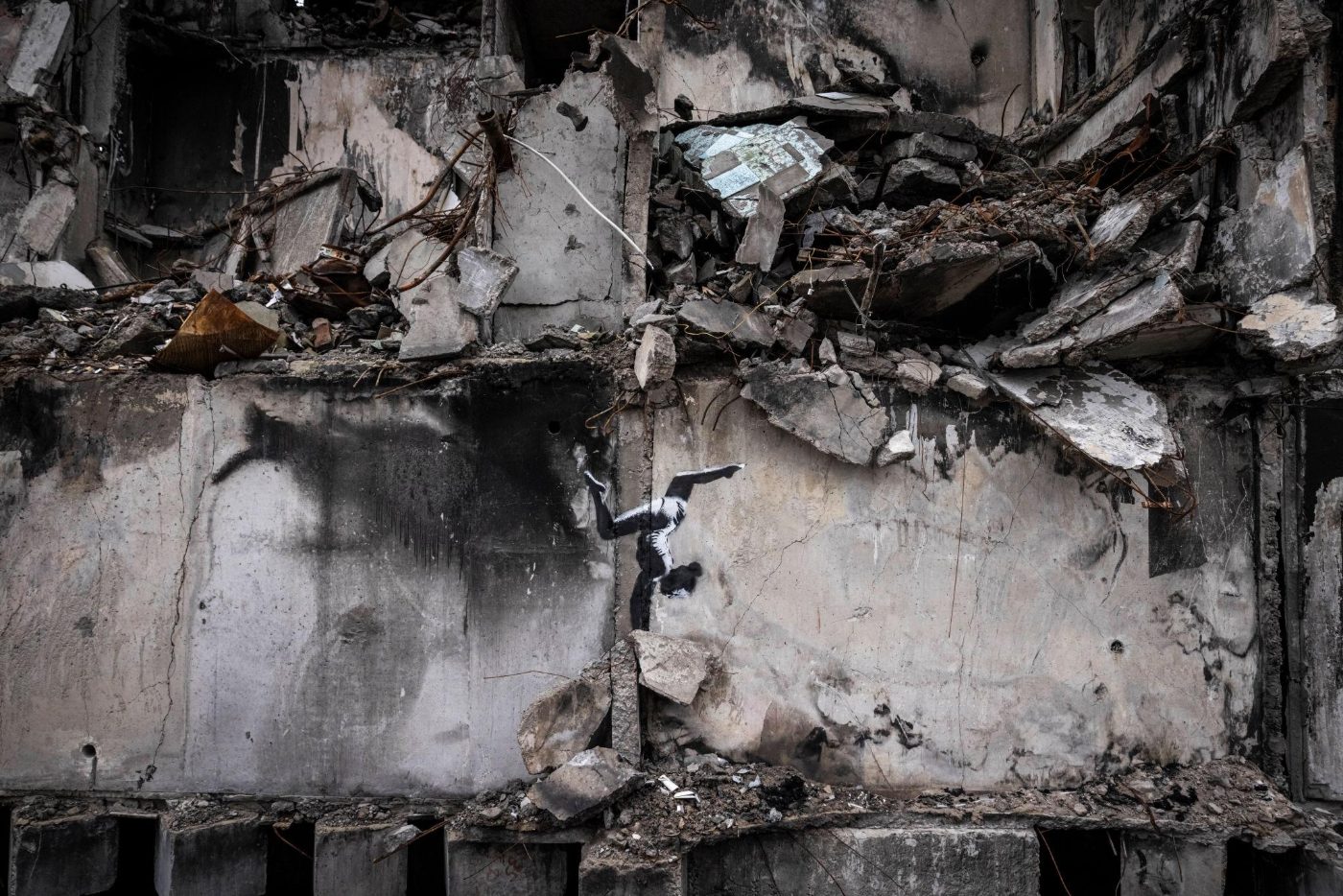
Banksy did not attempt to cover those scars. Instead, he used them.
The gymnast's controlled pose is set against architecture that has lost all stability. Her body is inverted but perfectly balanced; the building around her is upright but shattered. That opposition between physical destruction and bodily control gives the image much of its power.
Gymnastics also carries particular resonance in Ukraine and across the former Soviet world, where the sport has a long tradition and considerable cultural prestige. But the work does not require a specific athlete or sporting reference to function. The gymnast becomes a broader figure of resilience: precarious, exposed and surrounded by destruction, yet maintaining her equilibrium.
The Wall as Part of the Work
The mural is a particularly clear example of Banksy's ability to transform an existing architectural condition into part of an image. The figure alone would be elegant but relatively conventional. Painted precisely where the structure has been torn apart, it acquires an entirely different meaning.
The damaged masonry effectively becomes the gymnast's apparatus. She does not escape the ruins or stand heroically above them; she physically depends upon them. The violence inflicted upon Borodyanka is therefore embedded within the composition itself.
This distinguishes the Ukraine works from political images that could simply be transferred from one wall to another. Here, removing the figure from its surroundings risks removing part of its meaning. The destroyed architecture bears physical evidence of the event to which the artwork responds.
The same principle would recur throughout Banksy's Ukrainian intervention: children would turn a real anti-tank obstacle into a seesaw; a man would bathe within the exposed remains of a destroyed home; another gymnast would perform amid the ruins of Irpin. Banksy repeatedly made the material consequences of war participate in the image rather than merely surround it.
Preserving a Fragment of War
The condition of the building inevitably created a conservation dilemma. The structure was sufficiently damaged that demolition became necessary, while the Banksy had rapidly acquired cultural significance of its own. Academic research into the site consequently treated the mural and its substrate not simply as an artwork to be conserved but as a potential physical witness to the war.
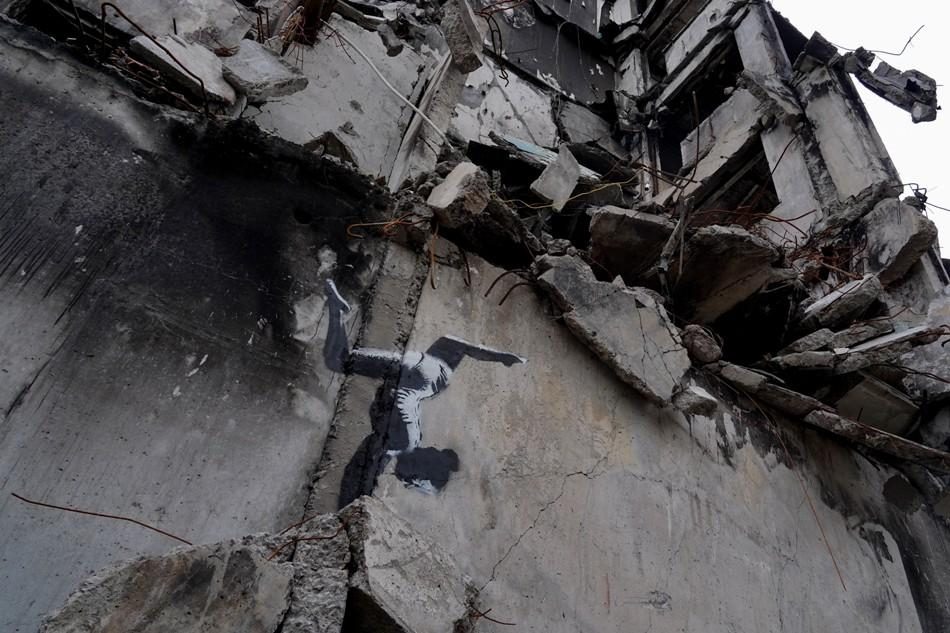
The relevant section of the structure was therefore preserved rather than simply disappearing with the damaged building. This creates an unusual problem for its future presentation. Conserving only the painted gymnast would protect Banksy's intervention, but the broken concrete against which she balances is integral to the composition. To preserve the work fully is, in some sense, to preserve part of the destruction itself.
That paradox makes Gymnast Balancing on Rubble an especially appropriate opening image for Banksy in Ukraine. Banksy did not depict a bomb, a soldier or a battle. He painted a human body achieving an almost impossible equilibrium on the physical remains of war.
The building had lost its balance. The gymnast had not.
STAY INFORMED
Receive the latest news, exhibitions, artworks and market updates on Banksy.