HAPPY CHOPPERS, 2002
Provenance
- Originally used as boarding surrounding a construction site at Whitecross Street Market, London
- Subsequently recovered from the site
- Private Collection
Documentation
Accompanied by a signed letter from Steve Lazarides, dated 24 July 2007, identifying the stencil as a work by Banksy and recording its discovery at Whitecross Street Market circa 2002.
Auction History
Prices are inclusive of buyer’s premium unless stated otherwise, as reported by the auction houses.
Where Happy Choppers Began
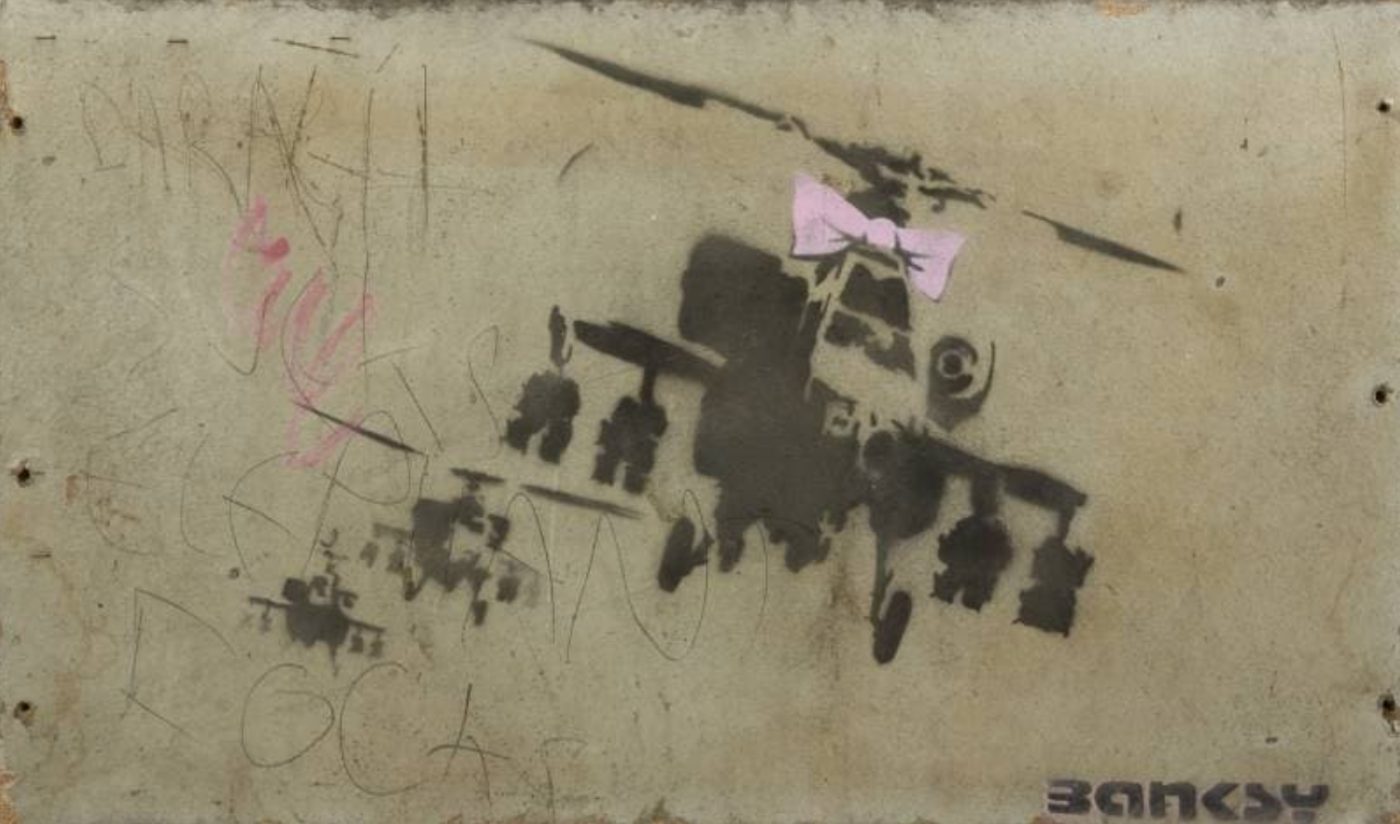
Executed around 2002, this remarkable street work takes us back to the beginning of one of Banksy's most enduring anti-war images. Happy Choppers first appeared at Whitecross Street Market in London in 2002, before subsequently migrating onto paintings, protest placards and prints and becoming one of the defining motifs of Banksy's early political vocabulary.
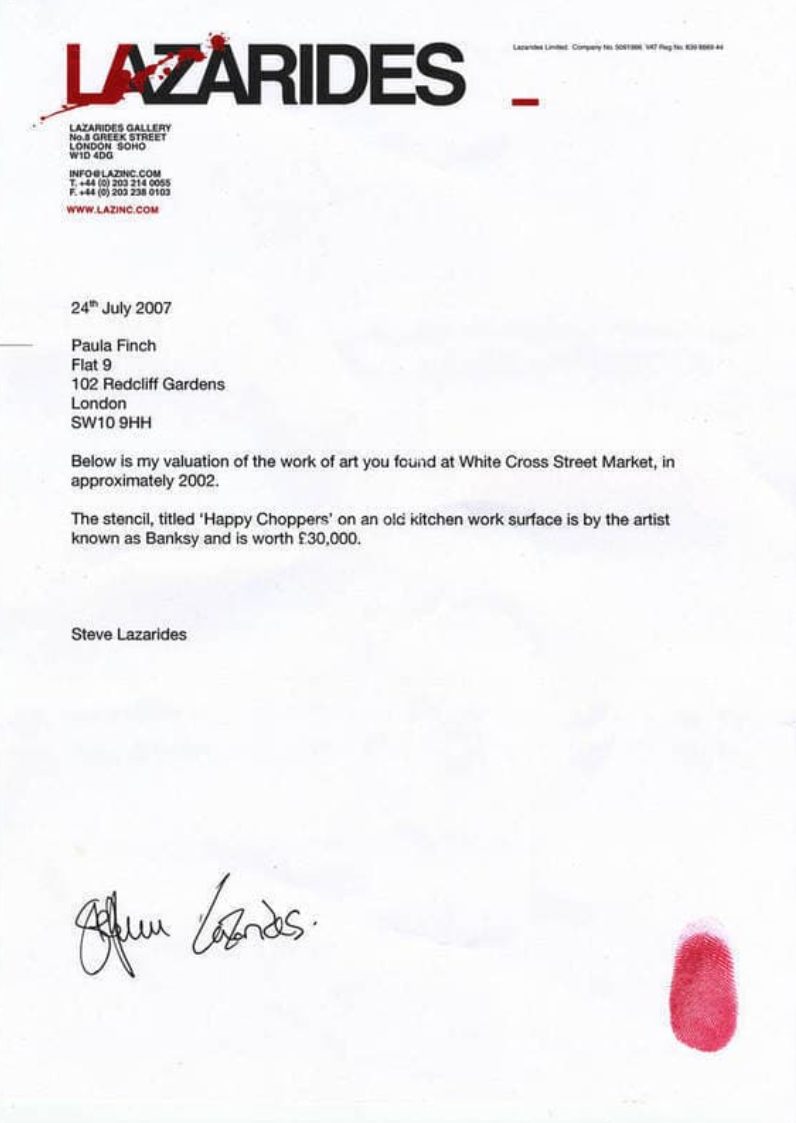
This particular example is especially compelling because its history is documented by Steve Lazarides, Banksy's early photographer, dealer and representative. In a signed letter dated 24 July 2007, Lazarides identifies the work as a Banksy stencil found at Whitecross Street Market around 2002 and describes its support, rather wonderfully, as an “old kitchen work surface.” The document provides an unusually direct connection between the surviving object and the urban environment in which the image originally appeared.
An Attack Squadron Wearing a Bow
A formation of armed military helicopters advances diagonally across the surface, increasing in scale until the lead aircraft dominates the composition. Banksy interrupts this threatening formation with one tiny and apparently ridiculous intervention: the principal helicopter wears a delicate pink bow.
The contradiction is extraordinarily economical. A machine engineered for violence has been decorated with something associated with childhood, innocence and celebration. The helicopter remains threatening and the bow remains cheerful, yet their combination makes both suddenly absurd. Military power has effectively been gift-wrapped, exposing the strange ways in which violence can be packaged, aestheticized and made culturally acceptable.
Formally, the work is equally efficient. The helicopters become progressively larger as they move across the surface, producing the sensation of a squadron approaching the viewer. Against the predominantly black stencil, the pink bow provides the only significant flash of colour. Physically tiny yet visually dominant, it demonstrates one of Banksy's great strengths: his ability to transform an entire image through a single unexpected detail.
From the Street to Wrong War
The historical timing is significant. Happy Choppers emerged against the background of military intervention in Afghanistan and shortly before the political confrontation that culminated in the 2003 invasion of Iraq. The image would soon acquire an even more explicitly political function when Banksy adapted it for the anti-war protest placards used during the London demonstrations of 2003, including the Wrong War example we have just examined.
This progression reveals how fluidly Banksy's imagery moved between different environments. At Whitecross Street, Happy Choppers confronted pedestrians unexpectedly on an urban surface. On the Wrong War placards, the same helicopters moved through London in the hands of protesters. Later, the motif entered Banksy's paintings and print editions. The image remained essentially unchanged, but each new context altered the way it operated.
An Old Kitchen Worktop Becomes Art
The physical support is one of the most fascinating aspects of this example. According to Lazarides' letter, the stencil was sprayed onto an old kitchen work surface that had been incorporated into temporary construction boarding. A discarded utilitarian object therefore became part of the architecture of the street before eventually becoming a transportable artwork.
The scratches, holes, graffiti and accumulated wear across the surface are consequently part of its history. They record an existence in public space that a pristine studio canvas could never possess. This is not simply an image of Happy Choppers; it is a surviving physical fragment of the environment in which early Banksy operated.
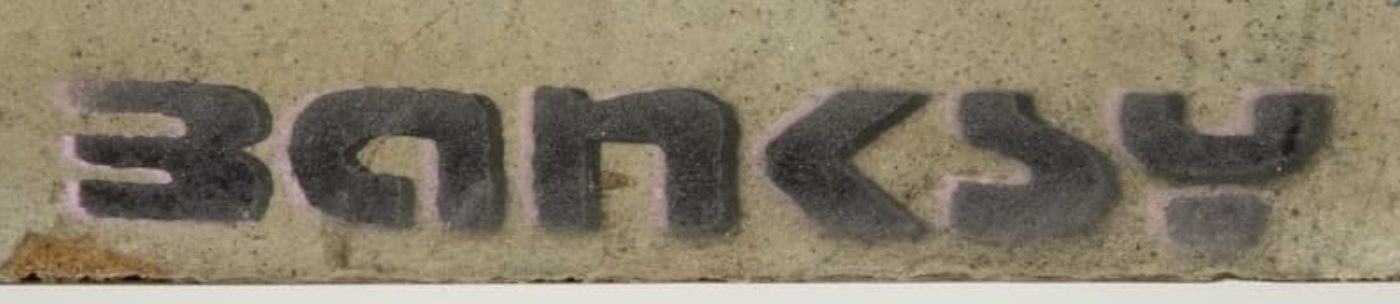
The prominent BANKSY stencil at the lower right further anchors the work in the artist's graffiti origins. Image and tag coexist on the same found urban surface, capturing a transitional moment when Banksy was developing increasingly sophisticated figurative stencils while remaining closely connected to the visual culture from which his practice emerged.
Why It Matters
Happy Choppers is important not simply because the image subsequently became famous, but because this surviving object brings us unusually close to the circumstances in which the motif first appeared. Before the screenprints, before the anti-war placards and before the increasingly valuable painted variations, there was a stencil sprayed onto makeshift construction boarding in a London market.
Its humble support is therefore central to its significance. The battered surface preserves something that a pristine canvas cannot: the physical environment of early Banksy and the transformation of an essentially disposable urban object into an artwork.
There is also a remarkable continuity with Wrong War. In 2002, the helicopters appeared unexpectedly on construction boarding at Whitecross Street Market. A year later, they were moving through London above the heads of anti-war protesters. Eventually they would migrate onto paper and canvas and into collections around the world.
The image became an icon, but this battered old kitchen worktop takes us back to the moment when it was still simply something Banksy had sprayed on the street.
STAY INFORMED
Receive the latest news, exhibitions, artworks and market updates on Banksy.