HAVE A NICE DAY, 2004
Auction History
Prices are inclusive of buyer’s premium unless stated otherwise, as reported by the auction houses.
HAVE A NICE DAY: POWER WITH A SMILE
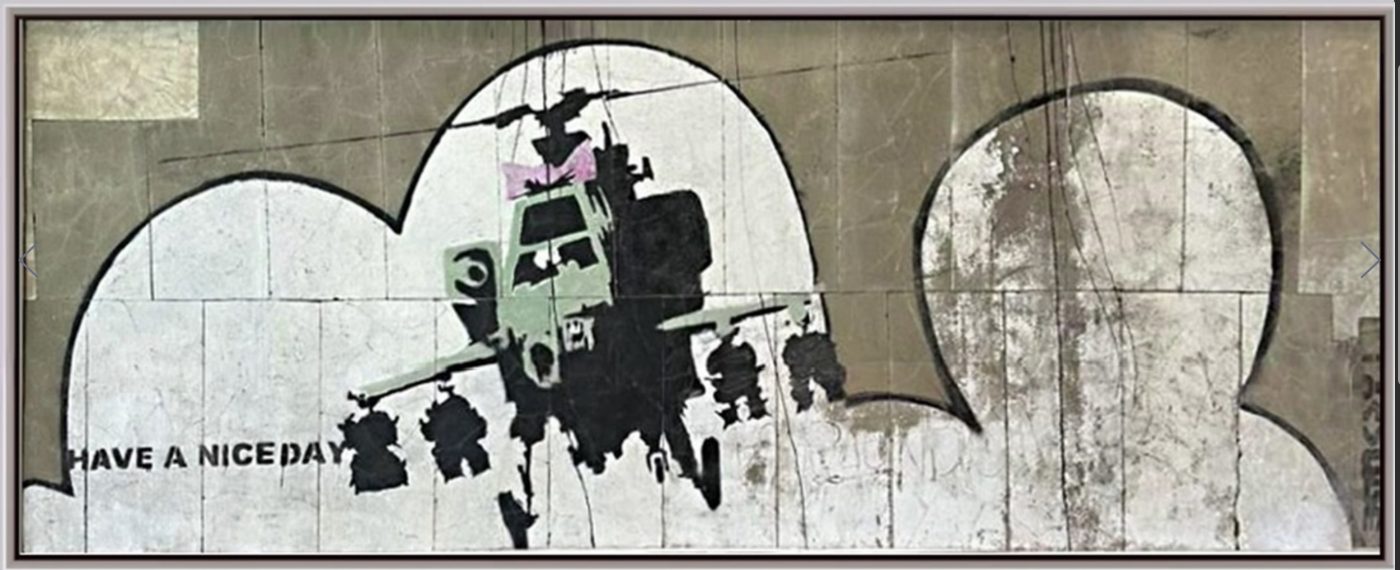
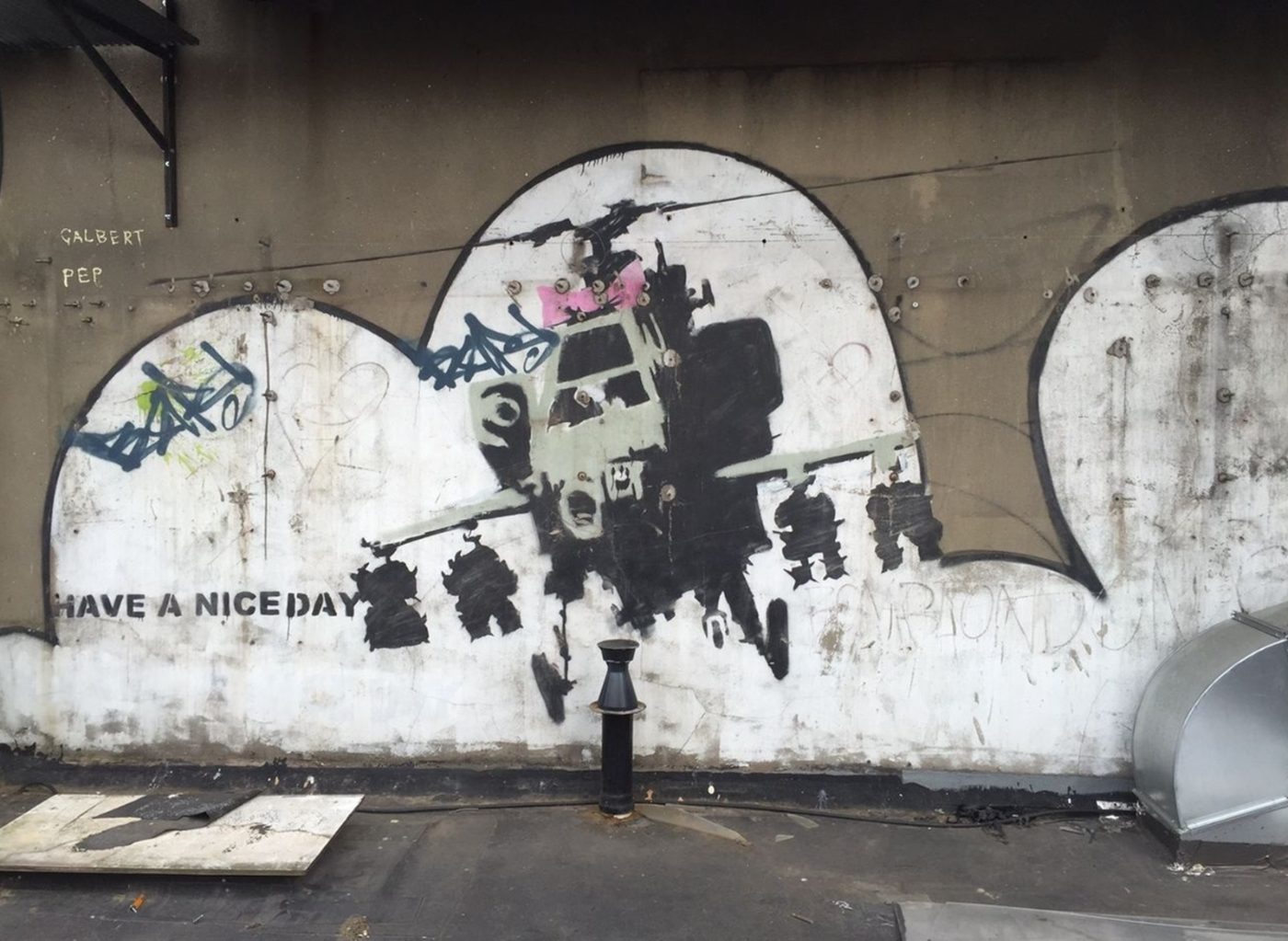
Created in Shoreditch in 2004, Have A Nice Day belongs to the formative period in which Banksy's interventions across London established many of the visual strategies that would define his mature practice. Extending approximately seven metres across a concrete structure, the work juxtaposes the machinery of military violence with an almost absurd gesture of reassurance: an American Apache attack helicopter is adorned with an oversized pink ribbon, accompanied by the apparently innocuous phrase “Have A Nice Day.” Hessink identifies the work as the large, Type III version of a composition Banksy produced in several variants.
The contradiction is quintessential Banksy. The helicopter remains immediately legible as a weapon of war, yet the pink bow transforms it momentarily into something resembling a gift. The phrase beside it performs a similar inversion. A conventional expression of commercial friendliness becomes sinister when placed alongside military hardware. Violence is not concealed; rather, it is cosmetically repackaged.
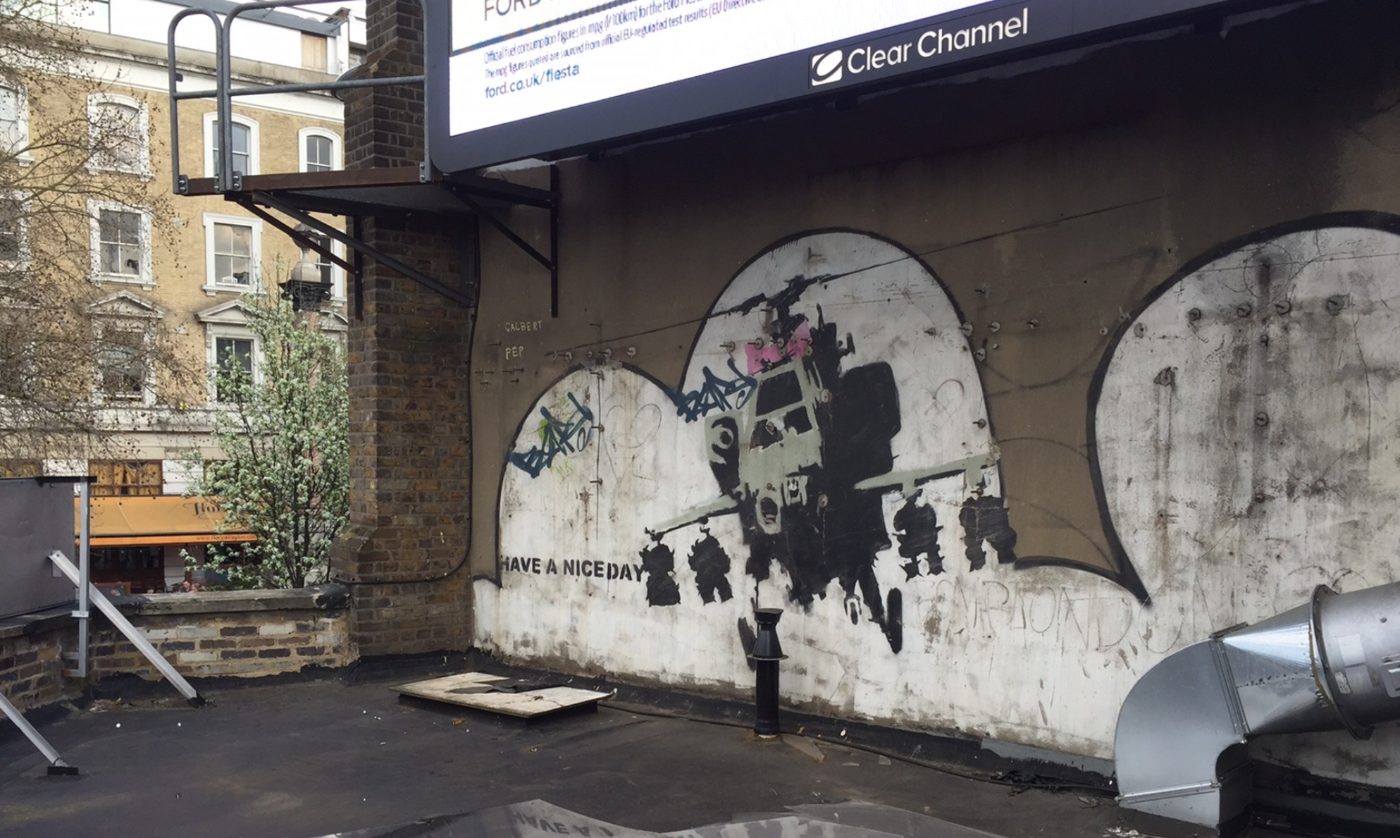
The work belongs to Banksy's broader early examination of the language surrounding contemporary warfare. Instead of representing combat directly, he repeatedly examined the imagery through which violence is normalized, marketed or rendered politically palatable. Here, the pink ribbon and cheerful salutation become instruments of satire: the aesthetics of reassurance have been grafted onto the machinery of destruction.
SHOREditch: THE ORIGINAL CONTEXT
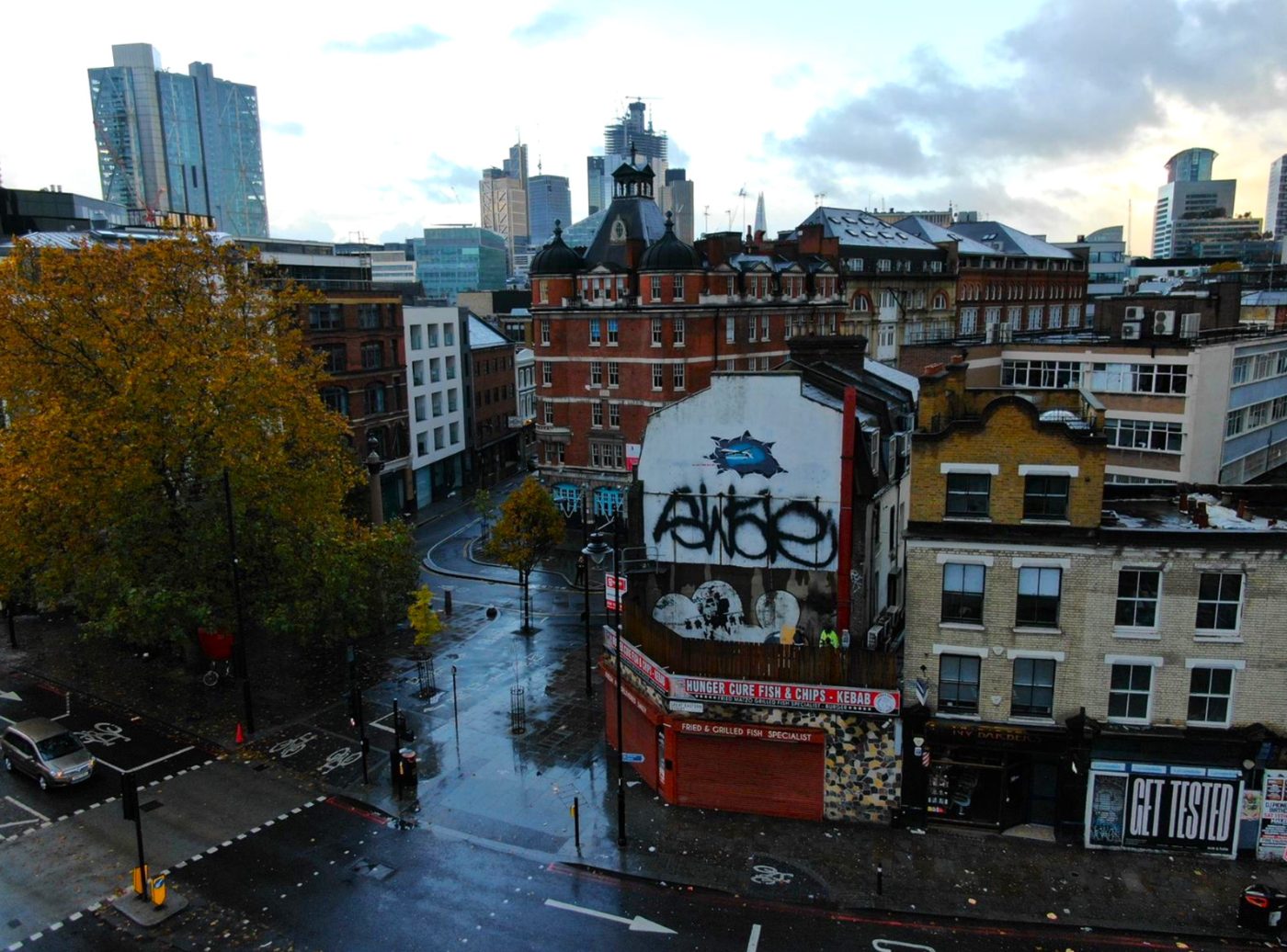
The location was integral to the intervention. Banksy's own account in Cut It Out describes working on a bridge facing Shoreditch Police Station, which he identifies as home to the SO19 firearms unit. He recalls creating an approximately seventy-foot-wide formation of armed riot police with smiley faces while attempting to work unnoticed beneath offices overlooking the bridge.
That contemporary account is particularly important because Cut It Out reproduces several states or interventions associated with the site, including banners reading “WRONG WAR,” “HAVE A NICE DAY,” “KEEP LEFT,” “JOY,” and “IT'S A FREE COUNTRY.” Stencil Archive The bridge therefore functioned less as the support for a single isolated image than as an evolving environment through which Banksy combined the language of authority, advertising and political protest.
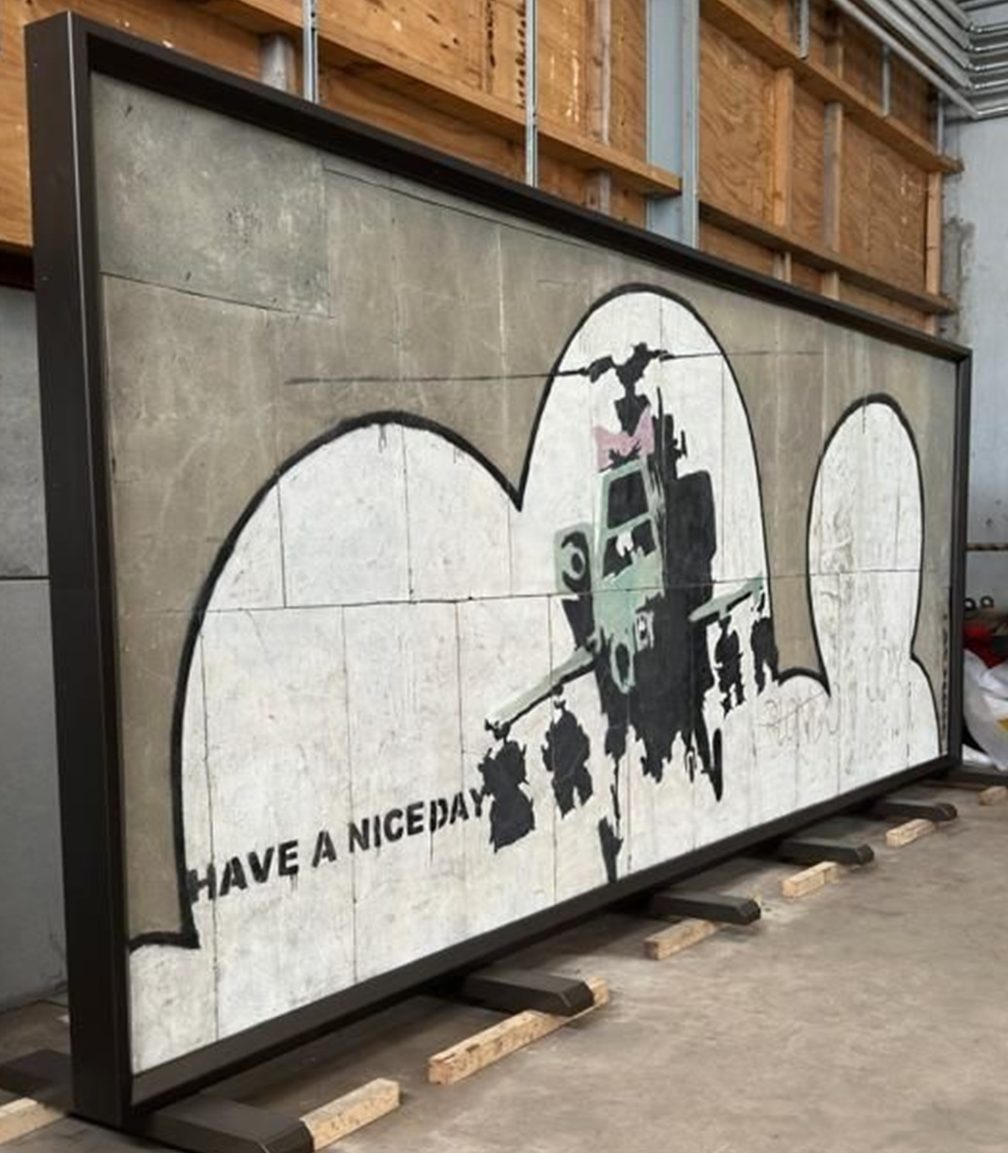
The surviving Have A Nice Day work needs to be understood within this early street context. Its physical support was never neutral. Concrete, architecture and location were constituents of the original intervention, giving the work a fundamentally different status from Banksy's studio paintings and prints.
WAR, SPECTACLE AND THE PINK RIBBON
The Apache helicopter was an especially charged motif in the early 2000s. Banksy's image emerged against the background of the wars in Afghanistan and Iraq and his increasingly explicit anti-war imagery of the period. Yet his approach avoids documentary representation. The helicopter is isolated and converted into an emblem, while the incongruous ribbon performs almost all of the conceptual work.
The device belongs to a recurrent Banksian strategy: placing two visual languages that should be incompatible into the same image. Military hardware meets gift wrapping; threat meets reassurance; institutional violence meets cheerful consumer graphics. Neither element is particularly ambiguous by itself. Meaning is produced through their collision.
This also explains why the image remained effective beyond its immediate political moment. Banksy is not simply commenting on one military campaign. He is addressing a broader mechanism through which power can be softened by presentation—how violence, authority and coercion acquire their own forms of branding.
FROM STREET TO OBJECT
The forthcoming Hessink sale raises a further question that has become increasingly important within Banksy's history: what happens when street art is physically detached from the street? According to the auction house, the surviving work consists of the original concrete blocks and weighs approximately 2.5 tonnes. Hessink describes it as one of Banksy's largest surviving murals and states that it remains in excellent original condition. The auction house also cites its publication in Cut It Out and Wall and Piece and its appearance on Banksy's official website.
Its appearance at auction therefore places Have A Nice Day within the complicated category of Banksy's removed street works. Unlike a studio canvas acquired from the artist, the object began as an intervention into public architecture. Its subsequent extraction preserves the physical surface on which Banksy worked while simultaneously removing the work from the urban context that originally gave it meaning.
AN IMPORTANT SURVIVAL
Nearly a quarter-century after Banksy's emergence, the survival of substantial early street works is increasingly unusual. Most were painted over, destroyed through redevelopment, deteriorated through exposure or became inseparable from buildings whose futures determined their own. At seven metres wide, Have A Nice Day represents an unusually substantial physical survival from this early period. Its documented appearance in Banksy's own publications strengthens its historical importance irrespective of the separate questions of ownership, removal and authentication that accompany street works entering the market.
Its appearance at Hessink's in October 2026 is therefore notable beyond the estimate of €1.5–2 million. The sale illustrates one of the central paradoxes surrounding Banksy's legacy: an artwork conceived through unauthorized intervention into public space has survived by becoming a transportable, 2.5-tonne commodity. That contradiction is not incidental to the work's history. It has become part of it.
STAY INFORMED
Receive the latest news, exhibitions, artworks and market updates on Banksy.