I MUST NOT COPY WHAT I SEE ON THE SIMPSONS

Banksy Meets Bart Simpson
Created during Banksy's 2008 intervention in New Orleans, I Must Not Copy What I See on The Simpsons recreates one of the most familiar rituals from the opening sequence of the American animated television series. A boy resembling Bart Simpson stands before a large blackboard, repeatedly writing the sentence “I must not copy what I see on The Simpsons.” A skateboard rests against the wall beside him, reinforcing the identification with Bart while allowing Banksy to translate the cartoon character into his own more naturalistic stencil language.

The image is based upon the celebrated “chalkboard gag” that has appeared near the beginning of The Simpsons since the series' earliest episodes. Bart is traditionally shown at Springfield Elementary School writing a sentence repeatedly as punishment for some unspecified act of misbehavior. Banksy preserves the familiar composition but changes the punishment into a comment about artistic appropriation itself. The boy is being disciplined for copying The Simpsons within an artwork that openly copies The Simpsons, creating a characteristically circular joke about originality, imitation and authorship.
The Art of Copying
Appropriation has always occupied an important place in Banksy's work. His images repeatedly borrow from art history, advertising, photography, popular culture and political iconography, while altering their context sufficiently to produce a different meaning. In this instance, the source is not disguised at all: it is explicitly acknowledged within the work itself.

The mural therefore treats copying less as artistic theft than as a mechanism through which culture develops. Banksy copies a globally recognizable television image, transforms it through the visual language of street art and places it on an unsanctioned wall in New Orleans. The sentence on the blackboard simultaneously admits the appropriation and mocks the idea that creative culture can easily be divided between original images and those derived from them. The work is particularly apt for an artist whose practice continually depends upon images circulating, being recognized and acquiring new meanings in different contexts.
From New Orleans to Springfield
The mural acquired additional significance two years later when Banksy was invited to create the opening sequence for The Simpsons episode MoneyBart, broadcast in October 2010. Banksy's sequence begins within the familiar visual universe of Springfield before moving into a dark fictional factory in which exhausted workers manufacture animation cells and Simpsons merchandise under grotesque conditions. The sequence turned one of the world's most successful entertainment franchises into a vehicle for criticism of the industrial processes and outsourced labor associated with the production of global popular culture.
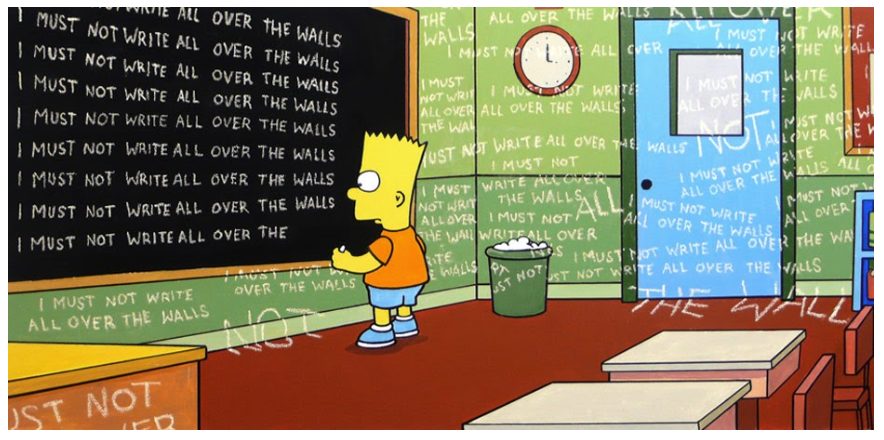
The relationship between the two works is particularly interesting because the New Orleans mural came first. In 2008, Banksy appropriated The Simpsons without permission as material for a street work; two years later, The Simpsons invited Banksy into the program itself and allowed him to appropriate—and criticize—the show's own imagery from within. The earlier mural can therefore be understood as an unexpected prelude to one of Banksy's most prominent interventions into mainstream television.
New Orleans, 2008
Within the broader New Orleans campaign, I Must Not Copy What I See on The Simpsons occupies a somewhat different position from works such as Nola, Abraham Lincoln or Boy on a Life Preserver Swing. It does not address Hurricane Katrina or the continuing reconstruction of the city as directly. Instead, it brings Banksy's longstanding interest in popular culture, copying and the circulation of images into the same urban intervention.

Its presence also broadens the character of the New Orleans campaign. Banksy did not approach the city with a single predetermined visual argument about Katrina; he responded to its walls with a mixture of political commentary, local references, interventions against the Gray Ghost and more playful explorations of his established themes. I Must Not Copy What I See on The Simpsons belongs to this wider vocabulary while acquiring, in retrospect, an unusually important place in Banksy's relationship with popular culture.
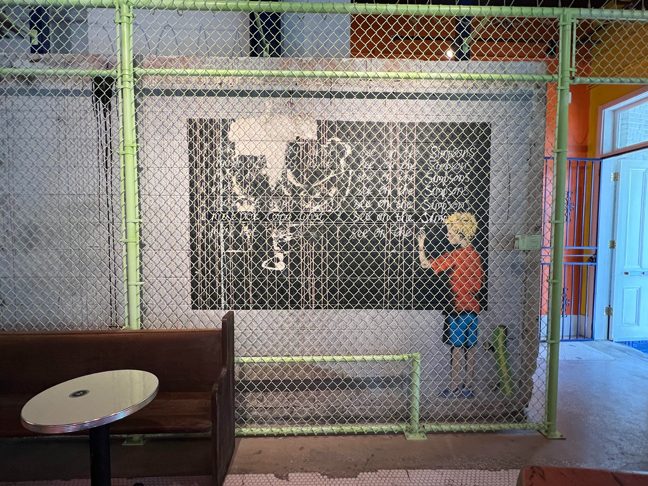
Unlike many of Banksy's New Orleans murals, I Must Not Copy What I See on The Simpsons survived. The work was protected behind plywood at its original location on St. Bernard Avenue and remained concealed for several years before the section of cinder-block wall containing the mural was eventually removed. It later resurfaced in New Orleans and is now displayed at Habana Outpost, where the work has been preserved and returned to public view. Its survival is particularly significant within the 2008 campaign, many of whose murals were subsequently painted over, demolished or otherwise lost.
STAY INFORMED
Receive the latest news, exhibitions, artworks and market updates on Banksy.