JEAN-MICHEL BASQUIAT
From the Streets of New York to the History of Art
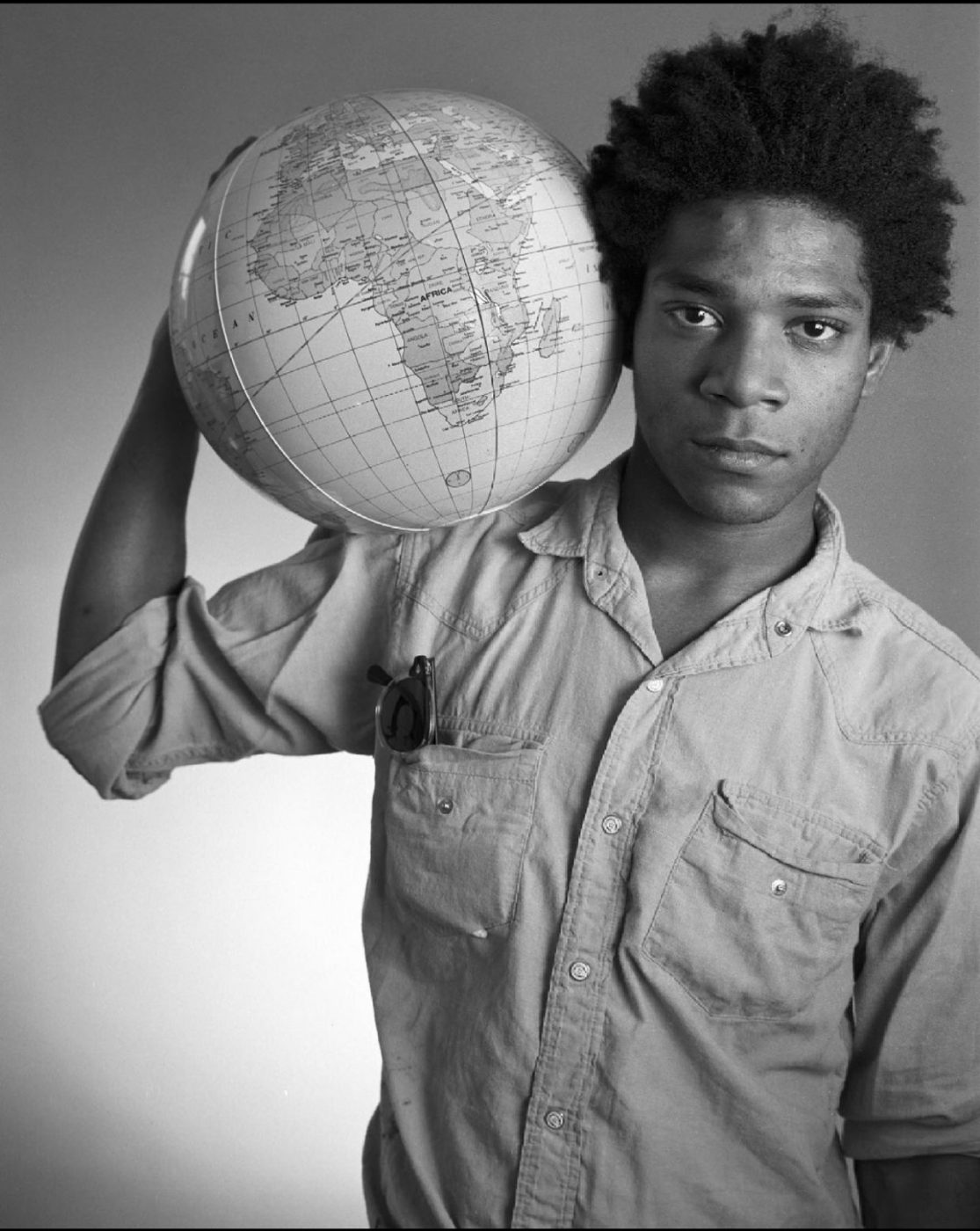
Jean-Michel Basquiat (1960–1988) emerged from the extraordinary creative environment of downtown New York at the end of the 1970s and became one of the defining artists of his generation. Born in Brooklyn to a Haitian father and Puerto Rican mother, Basquiat developed an intensely personal visual language combining painting, drawing, writing, symbols, anatomical references, fragments of history, popular culture, jazz, boxing and the experience of Black identity in America.
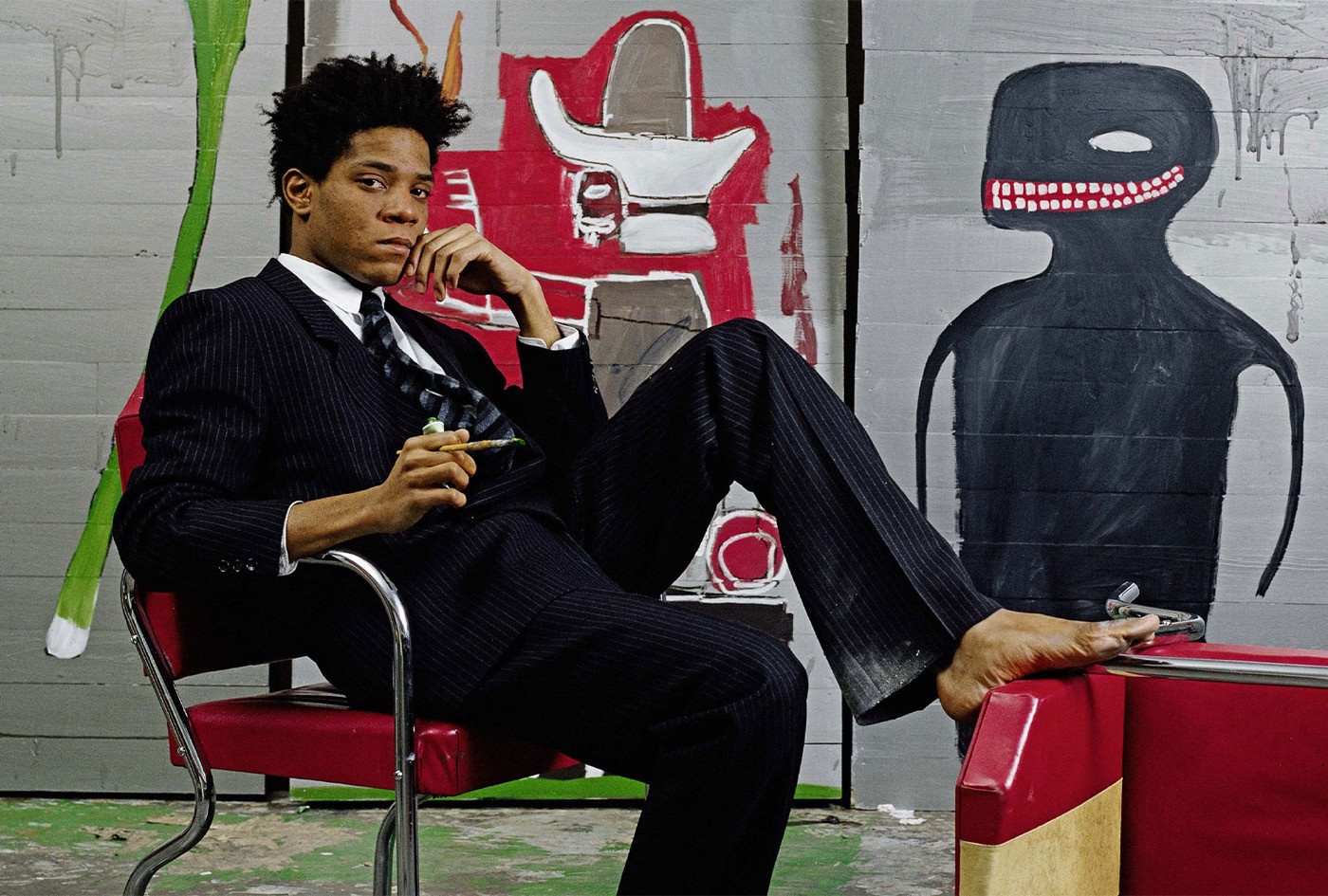
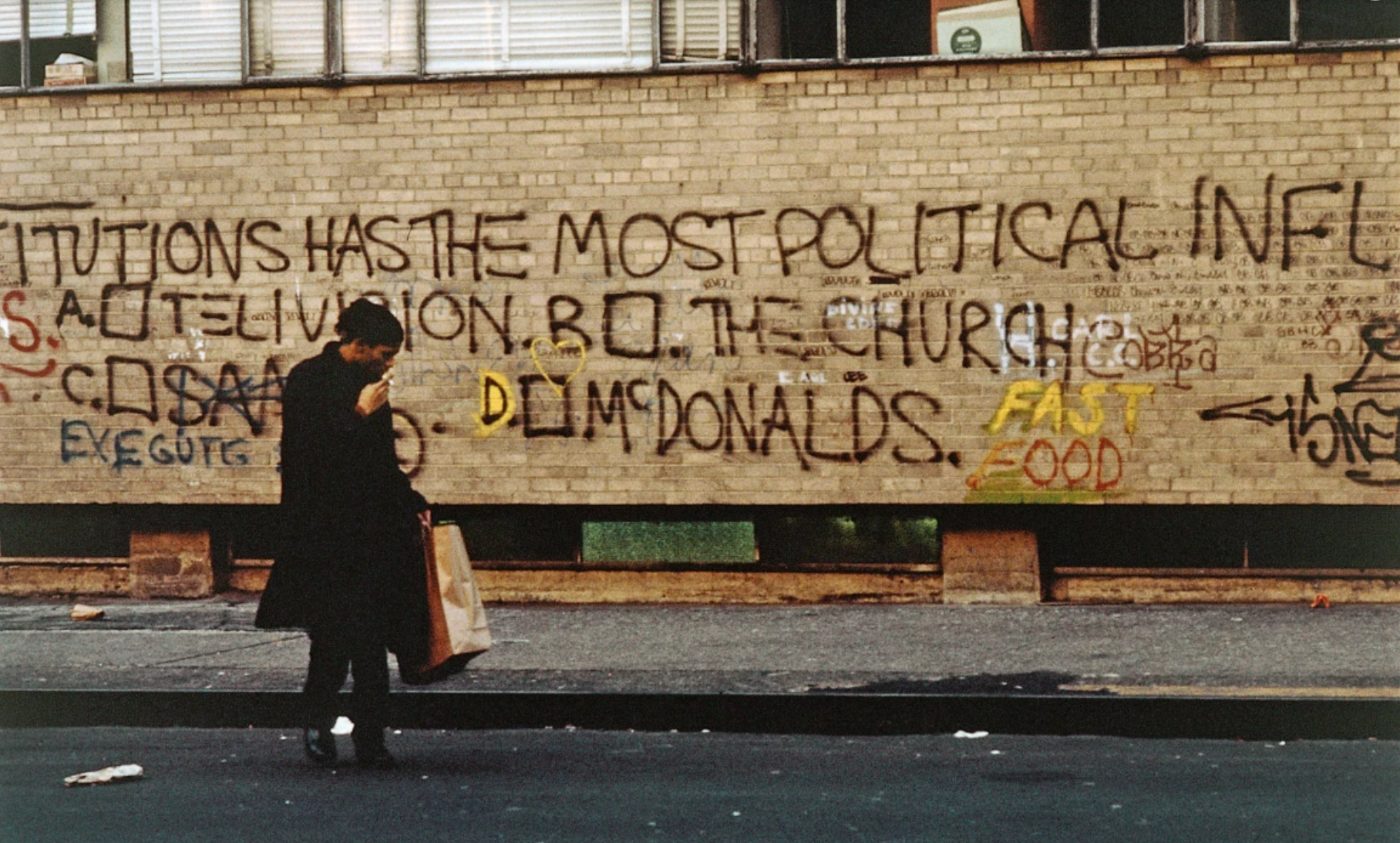
His earliest public recognition came through SAMO, the enigmatic phrases that Basquiat and Al Diaz began writing across Lower Manhattan in the late 1970s. Yet Basquiat's subsequent paintings cannot simply be understood as graffiti transferred onto canvas. He absorbed an enormous range of cultural and art-historical references, from Leonardo da Vinci and Picasso to African art, jazz musicians, Black athletes, medical illustrations and television, combining them within densely layered compositions in which words and images continually compete for attention.
By the early 1980s, Basquiat had moved rapidly from the downtown art scene into major galleries and international exhibitions. He collaborated with Andy Warhol, associated with artists and musicians including Keith Haring and Debbie Harry, and developed a body of work that addressed race, power, history, celebrity and cultural ownership. His career lasted barely a decade before his death in 1988 at the age of twenty-seven, yet his influence on subsequent generations of artists has been immense.
Heads, Heroes and Crowns
Basquiat's paintings are immediately recognizable through a vocabulary of recurring images: skeletal figures, heads, anatomical diagrams, fragments of text and, most famously, the three-pointed crown.
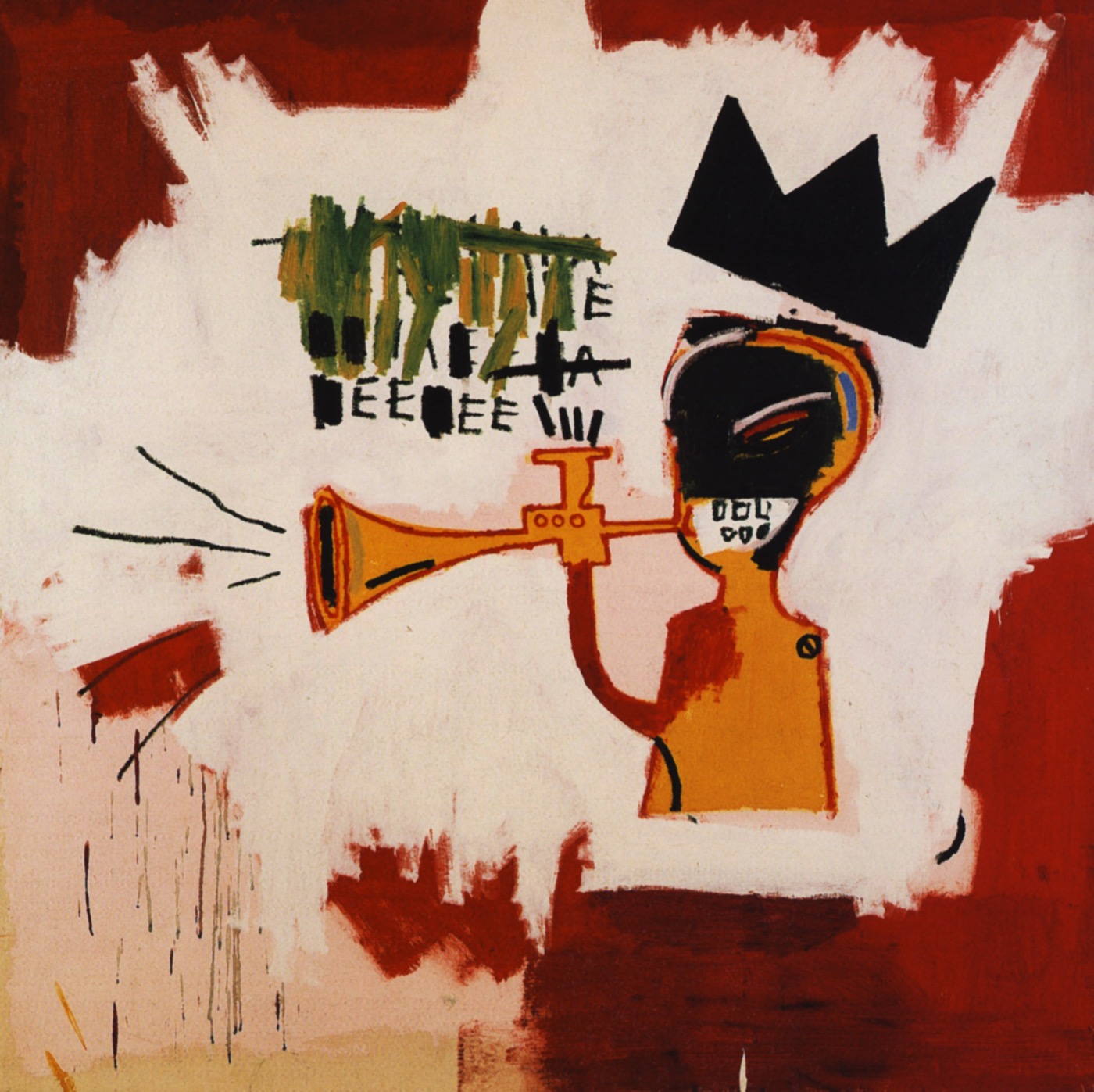
The crown appears throughout his work above figures ranging from jazz musicians and boxers to historical personalities and anonymous Black protagonists. Its meaning changes according to context, but it frequently operates as a symbol of authority, achievement and recognition. Basquiat repeatedly elevated figures from Black history and popular culture within a Western artistic tradition in which they had often been marginalized or excluded.
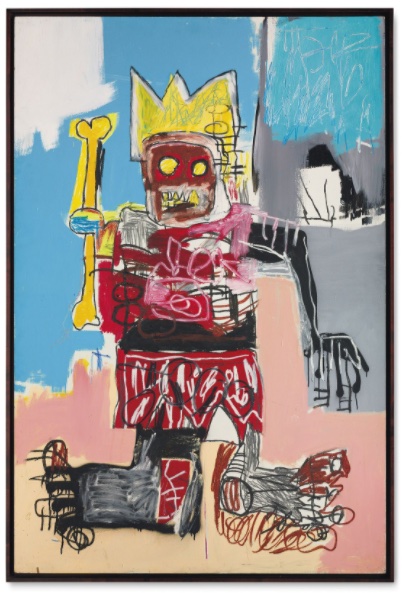
The crown consequently became inseparable from Basquiat himself. Like Warhol's Marilyn or Haring's Radiant Baby and Barking Dog, it developed into an immediately identifiable visual signature, although its ubiquity today can obscure the complexity of the paintings in which it originally appeared.
A $110.5 Million Basquiat
Among the defining works of Basquiat's breakthrough year is the monumental Untitled of 1982, dominated by an enormous skull-like head constructed from layers of blue, red, yellow, white and black paint. The image combines the appearance of a skull, mask and living face, its exposed teeth and fragmented anatomy characteristic of Basquiat's fascination with the human body and the unstable boundary between interior and exterior.
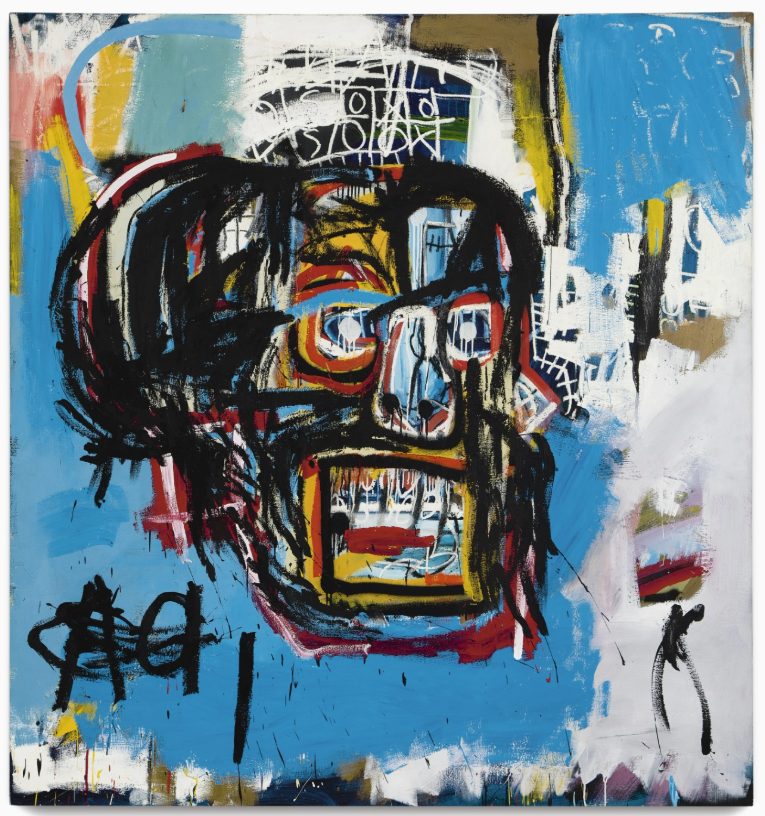
In May 2017, the painting sold at Sotheby's New York for $110.5 million, establishing a new auction record for Basquiat and, at the time, the highest auction price for an American artist. The result placed an artist who had begun writing anonymously on the streets of Lower Manhattan among the most valuable figures in the history of the international art market.
Discover Head, 1982 at Sotheby's
That transformation—from unauthorized markings in public space to one of the most valuable artists of the twentieth century—is central to Banksy's subsequent engagement with Basquiat. It raises questions familiar throughout Banksy's own career about who is permitted to make art, who determines its cultural value, and how institutions eventually absorb artistic practices they once regarded as vandalism.
Boy and Dog in a Johnnypump
One of Basquiat's most celebrated paintings, Boy and Dog in a Johnnypump, was also created in 1982. Across a vast canvas, a human figure and dog emerge from an explosive field of red, yellow, green, blue, black and white. The bodies appear simultaneously anatomical and energetic, constructed from bones, gestures, lines and rapidly applied layers of paint.
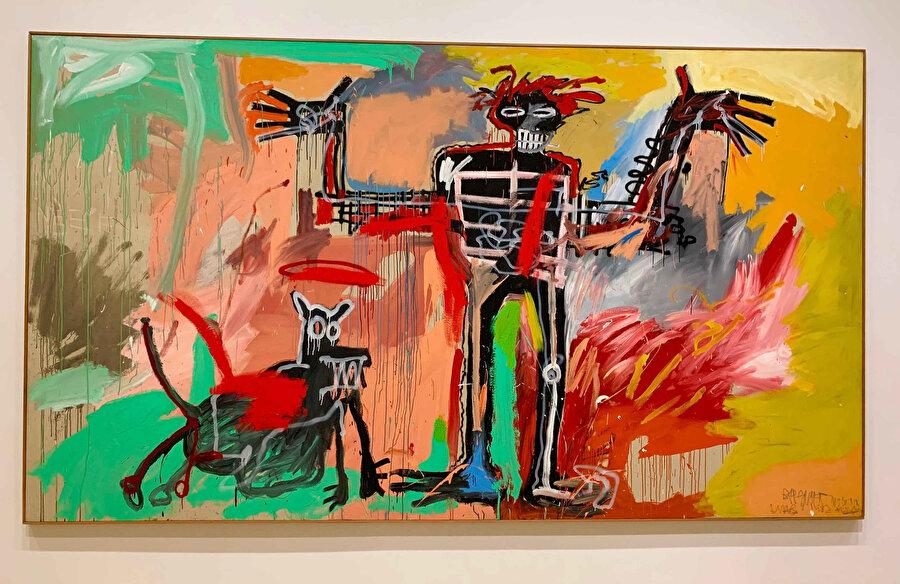
The title refers to a johnnypump, New York slang for a fire hydrant opened during the summer so that neighborhood children can play in the escaping water. The subject therefore originates in the everyday life of New York's streets, although Basquiat transforms the scene through a visual language in which bodies, color and environment seem to dissolve into one another.
The painting would become particularly important to Banksy. More than thirty years after Basquiat created it, Banksy removed its boy and dog from their brilliant field of color and placed them within an entirely different urban encounter.
Banksy Visits the Barbican
In September 2017, London's Barbican Centre was preparing to open Basquiat: Boom for Real, the first large-scale exhibition of Basquiat's work in the United Kingdom. The exhibition brought together more than one hundred works and extensive archival material documenting the artist's extraordinary emergence from the downtown New York scene.
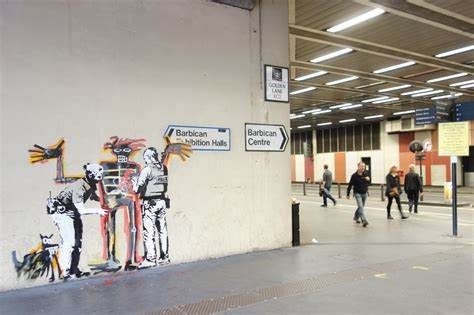
Four days before the exhibition opened, Banksy created two unauthorized murals on the exterior of the Barbican. He announced them with a characteristically pointed observation: the institution was preparing a major exhibition devoted to Basquiat while ordinarily being considerably less enthusiastic about graffiti appearing on its own walls.
The intervention exposed a genuine tension within the institutional history of street art. Basquiat's origins in the urban environment had become part of the mythology celebrated inside the museum, while unauthorized painting on the exterior of cultural institutions continued to be treated very differently.
Banksy's intervention was therefore both an homage to Basquiat and a commentary on the process through which rebellious visual cultures become institutionalized.
The Crown Becomes an Attraction
In the first mural, Banksy transformed Basquiat's famous three-pointed crown into the passenger cabins of a Ferris wheel. Visitors queue behind barriers beneath the structure while an attendant appears to manage the attraction.
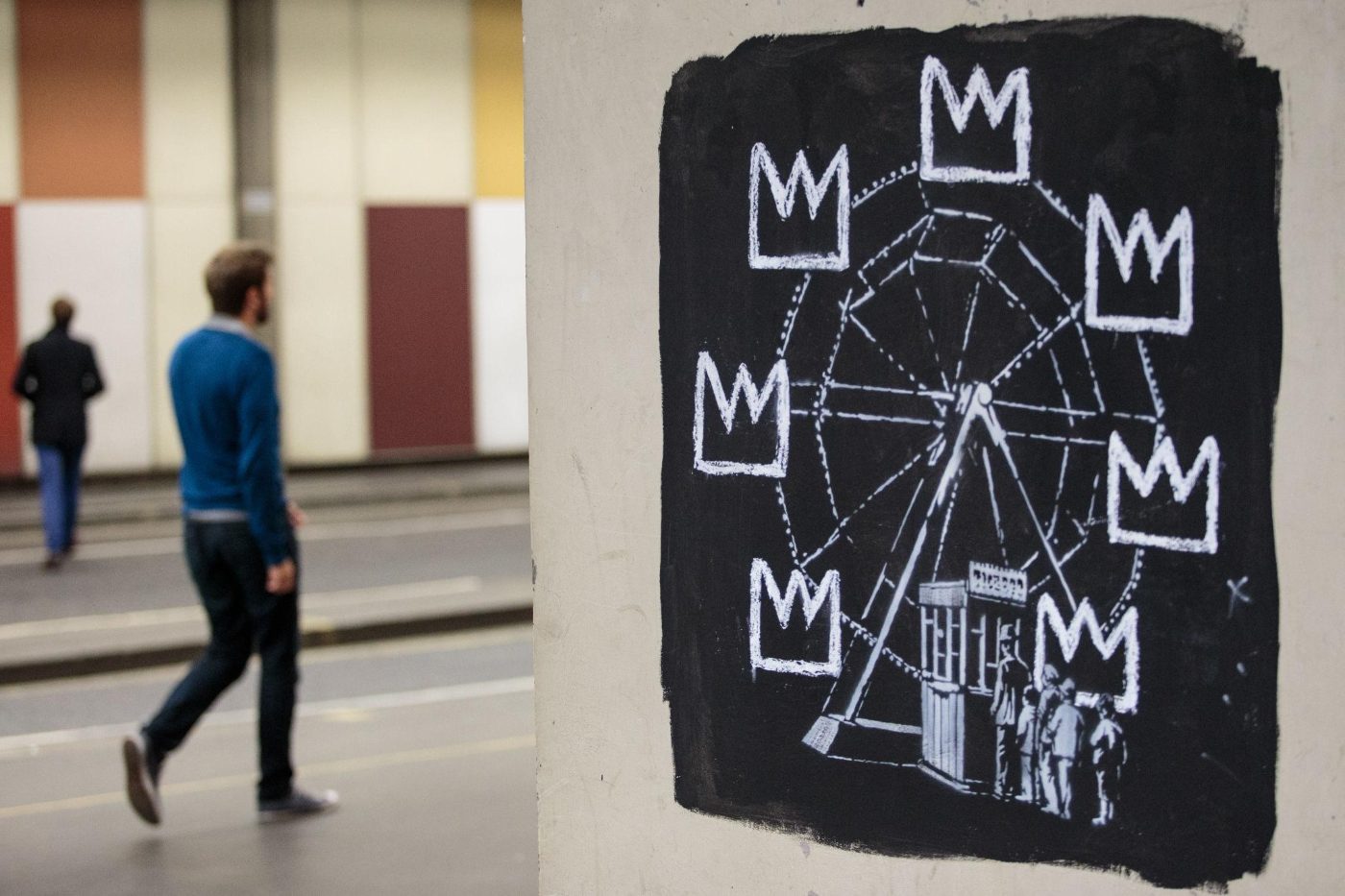
The transformation is subtle but significant. Basquiat's crown, originally associated with identity, authority and recognition, has become entertainment. Banksy suggests the way in which an artist's complex visual language can gradually be reduced to a recognizable symbol, reproduced and consumed long after the circumstances that produced it have disappeared.
Placed immediately outside a major Basquiat retrospective, the Ferris wheel also comments on the museum exhibition itself. Basquiat has become a cultural attraction, and the crown functions almost as a logo through which audiences recognize and consume his legacy.
Basquiat Welcomed by the Metropolitan Police
Banksy's second Barbican mural was considerably more confrontational. He appropriated the central figures from Boy and Dog in a Johnnypump and placed them between two Metropolitan Police officers conducting a stop-and-search.
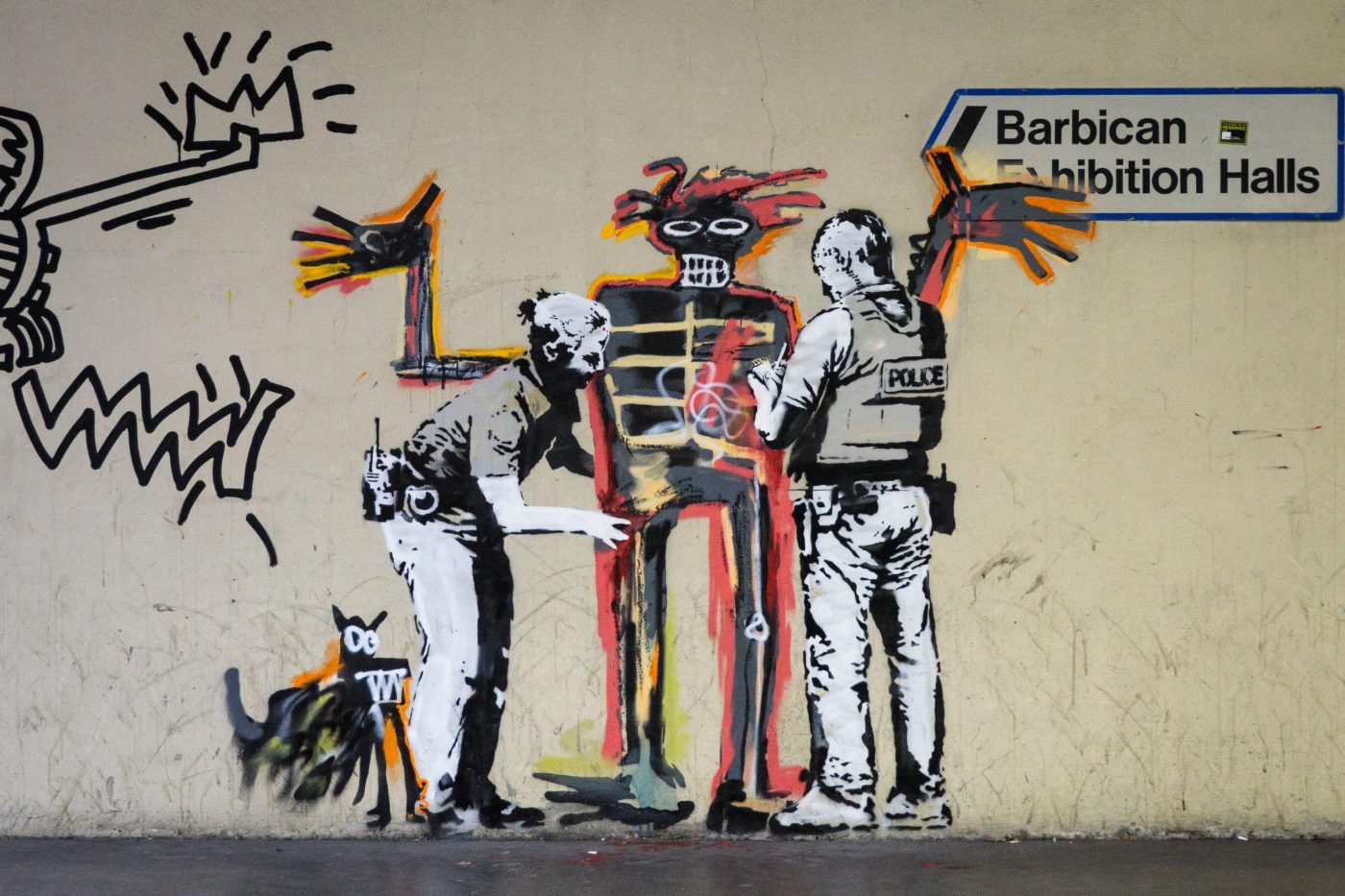
Basquiat's original figure raises his arms within an energetic field of color. Banksy removes most of that environment, leaving the boy and dog exposed against the pale institutional wall. In the presence of the police officers, the raised arms acquire an entirely different meaning, shifting from movement and exuberance toward compliance and vulnerability.
Banksy titled the intervention Portrait of Basquiat Being Welcomed by the Metropolitan Police. The irony is deliberately uncomfortable. Inside the Barbican, Basquiat was being celebrated as one of the most important artists of the twentieth century; outside, Banksy imagined the reception that a young Black graffiti writer might receive from authority in contemporary London.
The work consequently extends beyond a general comment about graffiti and museums. Basquiat's race is integral to the intervention. Banksy contrasts the cultural reverence afforded to the deceased, internationally celebrated artist with the forms of suspicion and policing that can confront young Black men in public space.
Banksquiat: Boy and Dog in Stop and Search
Banksy returned to the image the following year in the monumental Banksquiat. Boy and Dog in Stop and Search, 2018. Executed in acrylic and wax marker across three birchwood panels measuring approximately 2.4 by 3.4 metres, the work transforms the temporary Barbican intervention into a major autonomous painting.
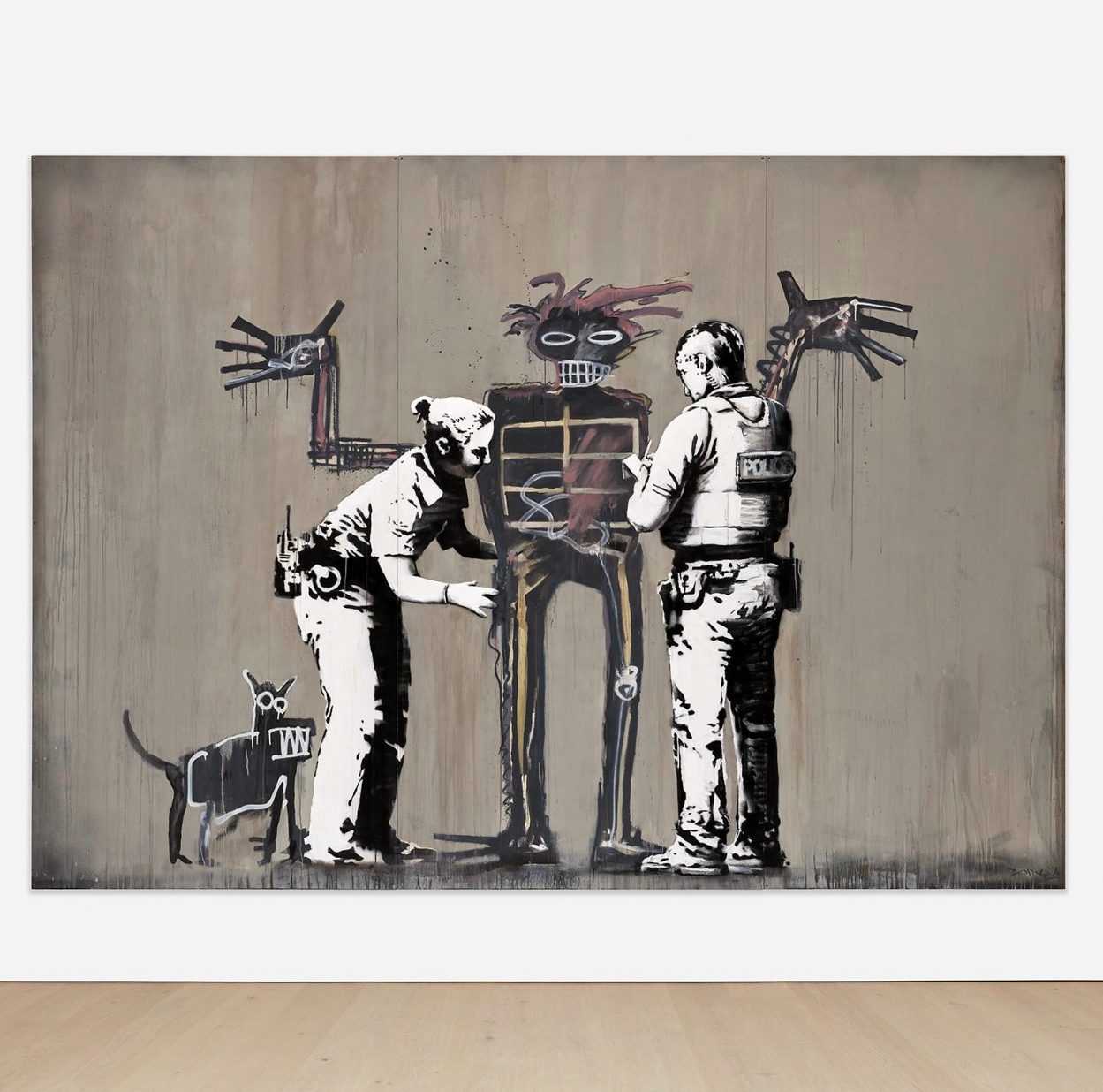
The composition retains the fundamental encounter established in the 2017 mural. Basquiat's boy and dog occupy the centre of the work while Banksy's Metropolitan Police officers search the figure on either side. Yet the scale, materials and treatment of the surface bring the dialogue much closer to painting. Banksy combines his controlled stencil vocabulary with an expressive treatment derived from Basquiat, allowing two radically different artistic languages to occupy the same physical space.
The title Banksquiat makes that hybridization explicit. Rather than simply reproducing Basquiat's imagery, Banksy creates a deliberately unstable collaboration between two artists separated by generation, geography and technique. Basquiat's expressive line encounters Banksy's stencil; 1980s New York encounters contemporary London; and a scene of street life becomes a scene of surveillance and authority.
The work also became one of Banksy's most important paintings on the market. At Phillips New York on 17 May 2023, Banksquiat. Boy and Dog in Stop and Search sold for $9,724,500, making it the highest-priced Banksy original sold at auction that year.
Basquiat × Banksy
The dialogue acquired an extraordinary institutional conclusion when the Hirshhorn Museum and Sculpture Garden in Washington, D.C. brought the two works together. From September 2024 to September 2026, the museum presented Basquiat × Banksy, placing Basquiat's original Boy and Dog in a Johnnypump alongside Banksy's Banksquiat. Boy and Dog in Stop and Search.
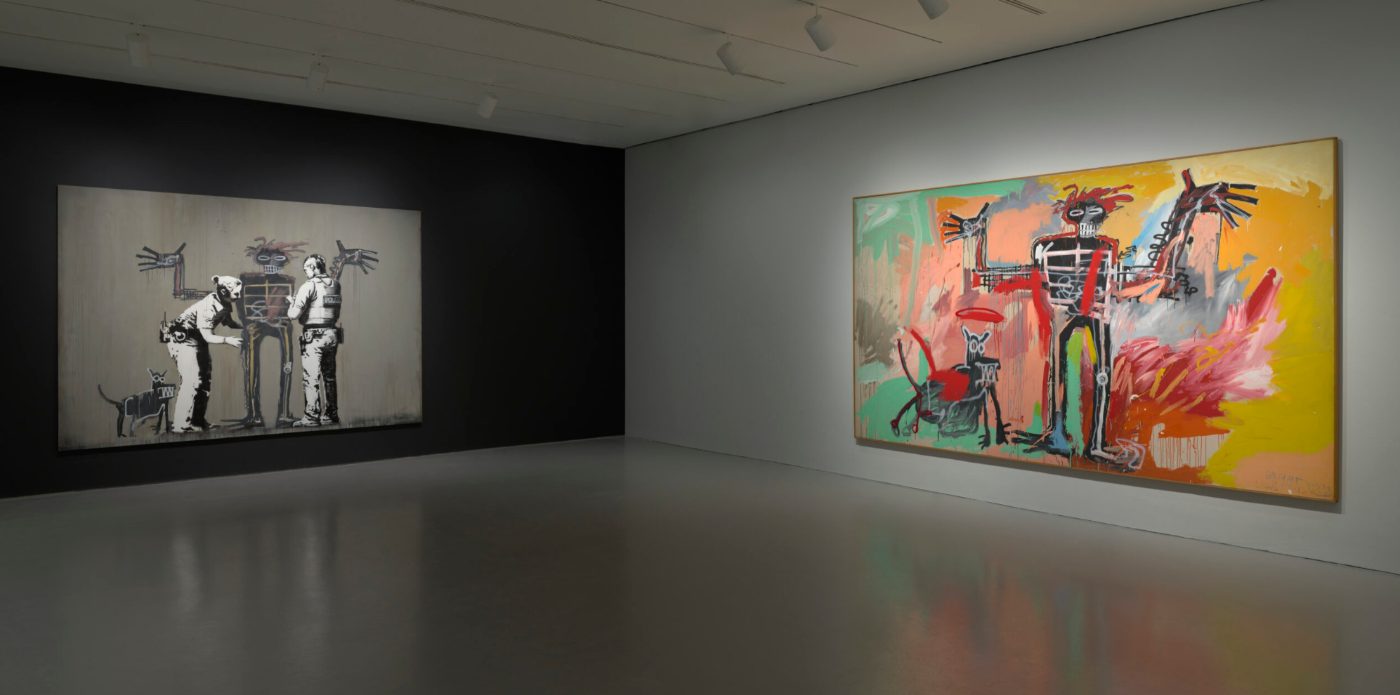
The pairing allowed viewers to examine directly what Banksy had retained and what he had transformed. Basquiat's original is expansive, chromatically intense and physically exuberant; Banksy's response isolates its central figures and subjects them to the rigid presence of authority. What begins in 1982 as a scene rooted in the energy of New York street life is reinterpreted thirty-six years later through questions of policing, race and institutional power.
Discover Basquiat x Banksy at The Hirshhorn in Washington
There is an additional historical irony in the museum encounter. Basquiat and Banksy both developed artistic identities through unauthorized interventions in public space, although their careers and circumstances are profoundly different. By 2024, their works were being deliberately paired inside one of America's principal museums of modern and contemporary art. The Hirshhorn described the exhibition as revealing connections between street art, contemporary art and the popular imagination, and it marked the first presentation of work by either artist at the institution.
Basquiat and Banksy
Banksy's engagement with Basquiat is unusually rich because it involves admiration and criticism simultaneously. He clearly acknowledges Basquiat as a crucial predecessor: an artist whose visual language emerged from the streets and ultimately entered the highest levels of museums, art history and the international market. Yet Banksy is equally interested in what happens during that transformation.
The crown turned into a Ferris wheel addresses the commodification of artistic identity. The stop-and-search works address race, policing and the contradictions involved in celebrating the legacy of a Black artist whose early activities existed outside established cultural institutions. The Barbican itself becomes part of the argument, because the museum's walls separate the officially sanctioned Basquiat exhibition from Banksy's unauthorized response outside.
Banksquiat. Boy and Dog in Stop and Search develops these questions further by transforming a temporary street intervention into a major painting and bringing Basquiat's and Banksy's visual languages into direct contact. Its subsequent exhibition beside Boy and Dog in a Johnnypump at the Hirshhorn completed an unusual art-historical trajectory: an image created by Basquiat in New York in 1982 was appropriated by Banksy on a London wall in 2017, reworked as a monumental painting in 2018, and ultimately returned to the museum beside the Basquiat that inspired it.
The relationship therefore encompasses far more than stylistic influence. Through Basquiat, Banksy examines the complicated passage from street to museum, from unauthorized image to cultural icon, and from artistic rebellion to institutional recognition.
STAY INFORMED
Receive the latest news, exhibitions, artworks and market updates on Banksy.