Provenance
- 33 1/3 Gallery, Los Angeles
- Private Collection, United Kingdom
- Acquired from the above by the present owner
Exhibited
- Los Angeles, 33 1/3 Gallery, Existencilism, 19 July - 18 August 2002
- Rome, Palazzo Cipolla, Banksy: War, Capitalism & Liberty, 24 May – 4 September 2016
Auction History
Prices are inclusive of buyer’s premium unless stated otherwise, as reported by the auction houses.
The Monkey as a Prophet
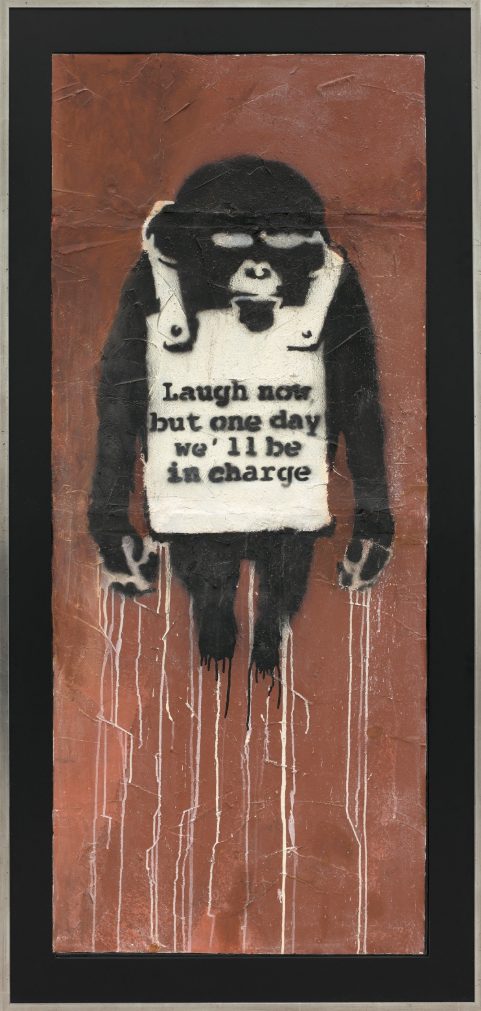
Created in 2002, Laugh Now Panel A presents one of the most enduring characters in Banksy's visual vocabulary: a solitary chimpanzee standing upright, shoulders slumped, arms hanging heavily beside its body and a sandwich board suspended from its neck. Upon it appears the warning that would become inseparable from the motif: “Laugh now, but one day we'll be in charge.”
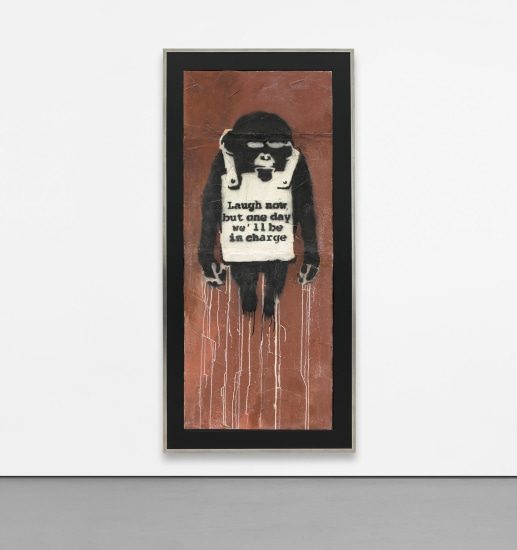
The economy of the composition is characteristic of Banksy's strongest early work. Almost everything has been removed except the figure and its message. Against the pale drywall, the monochrome chimpanzee appears simultaneously comic, vulnerable and strangely monumental. Its posture suggests exhaustion or submission; its words announce precisely the opposite. What initially resembles a downtrodden creature becomes a prophet of impending reversal.
Banksy leaves the identity of the collective “we” deliberately unresolved. The monkey can speak for animals against humans, outsiders against institutions, the socially marginalized against established authority, or graffiti itself against the cultural structures that dismissed it as vandalism. The ambiguity allows a deceptively simple image to operate simultaneously as joke, threat and political parable.
There is another possibility embedded in the work. The monkey may also be speaking for Banksy himself. Phillips has perceptively described Banksy's recurring figures as his “interactive surrogates”: for an artist who deliberately withholds his physical identity, rats, monkeys, policemen and children become alternative protagonists through which he addresses the public. Seen this way, Laugh Now acquires an almost autobiographical dimension. The anonymous street artist and the supposedly inferior primate occupy comparable positions outside established hierarchies. Both are underestimated; both observe the institutions above them; and both suggest that the existing order may prove less permanent than it assumes.
The Monkey in Art: A Mirror Held Up to Man
Banksy's chimpanzee belongs to a remarkably long tradition. For centuries, Western artists have used monkeys not simply as exotic animals but as distorted reflections of human behavior. Their fascination lies precisely in resemblance: close enough to humanity to imitate us, but sufficiently removed from us to make that imitation comic, uncomfortable or accusatory.
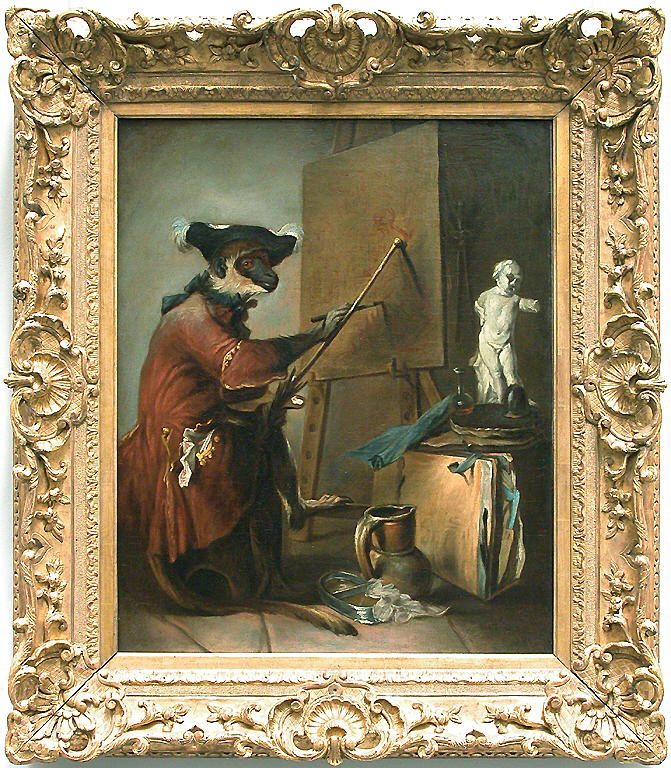
See Le Singe Peintre at Musee du Louvre, Paris
During the Renaissance and early modern period, apes and monkeys frequently carried moral associations with imitation, appetite, vanity and man's supposedly baser instincts. The very idea of artistic imitation became entangled with the animal: the Latin expression ars simia naturae—art as the “ape of nature”—used the monkey's mimetic ability as a metaphor for the artist's imitation of the visible world.
By the seventeenth and eighteenth centuries this developed into the decorative and satirical tradition known as singerie, from the French singe, or monkey. Artists depicted monkeys dressed as humans, attending fashionable gatherings, drinking, painting, playing music or participating in other supposedly civilized activities. The joke was never entirely about animals. The monkey behaved absurdly because it behaved like us.
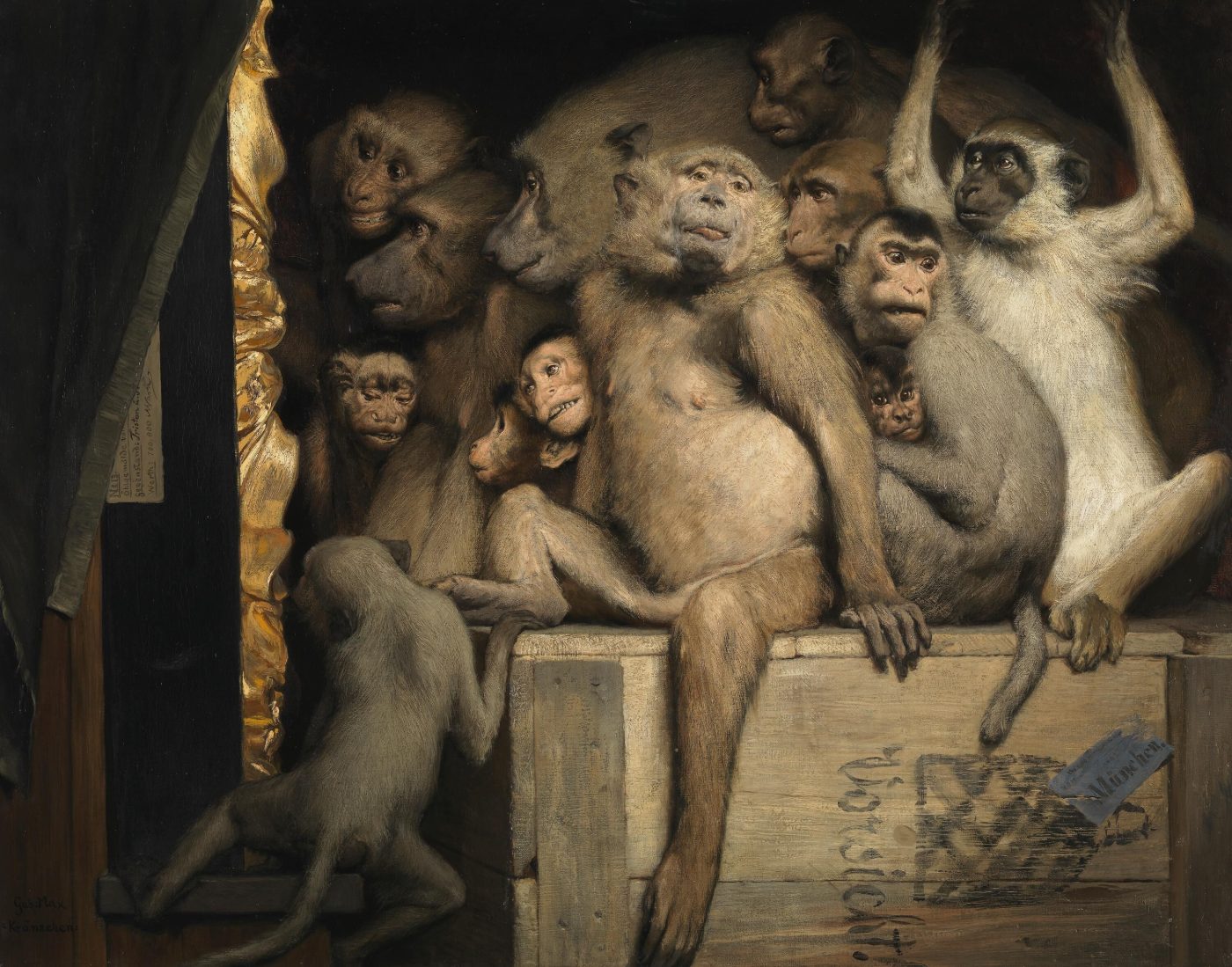
See Monkeys as Judges of Art at Saamlung
Artists such as David Teniers the Younger developed elaborate monkey satires, while Jean-Baptiste-Siméon Chardin's celebrated The Monkey Painter turned the animal into a parody of artistic pretension itself. By the nineteenth century the device could become explicitly institutional. Gabriel von Max's Monkeys as Judges of Art (1889) presents a group of apes solemnly inspecting a painting—an exquisitely cruel satire on critics, connoisseurship and the supposedly cultivated mechanisms by which art is judged.
Banksy's monkey belongs naturally within this history, but he reverses its hierarchy. Traditionally, humans looked at monkeys behaving like humans and laughed at them. In Laugh Now, the monkey knows that it is being laughed at—and answers back.
The sandwich board converts centuries of visual satire into a direct exchange with the spectator. The object of ridicule has acquired language, consciousness and historical agency. Instead of merely reflecting human foolishness, Banksy's chimpanzee predicts the collapse of the distinction between observer and observed, superior and inferior, ruler and ruled.
Darwin, Evolution and the Anxiety of Hierarchy
The image inevitably acquires another layer after Darwin. Following the nineteenth-century debates surrounding evolution, the ape became an especially potent instrument for questioning humanity's belief in its own exceptional status. Victorian caricaturists repeatedly exploited the uncomfortable implications of evolutionary theory, transforming the monkey into a visual shorthand for the destabilization of established hierarchies.
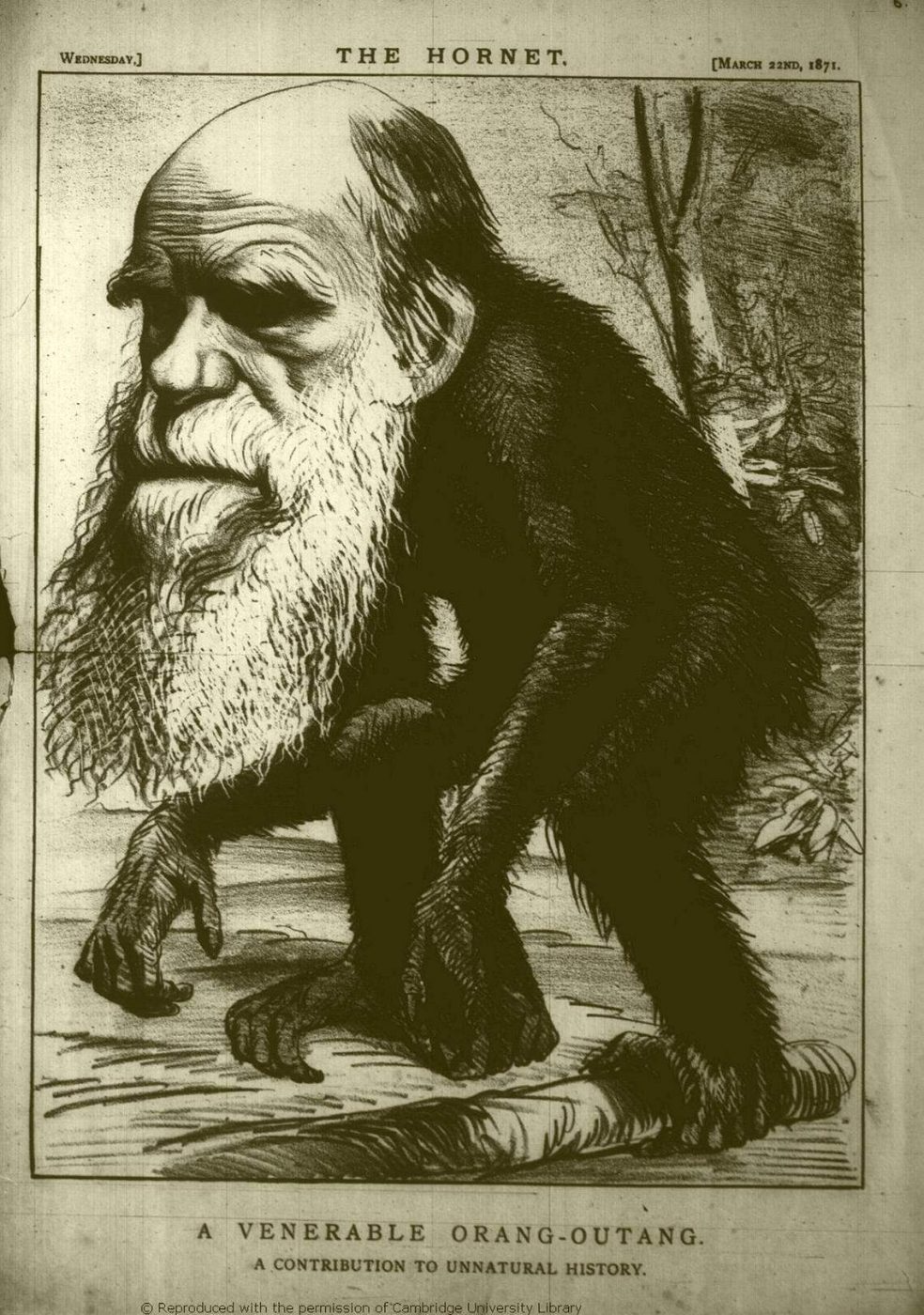
Banksy's use of chimpanzees belongs to this cultural inheritance, although his satire is directed less toward evolutionary science than toward human claims of superiority. Phillips has similarly connected the artist's recurrent chimps with Darwin and his mockery of politicians and other authority figures. The joke in Laugh Now therefore works in both directions. Humans have historically placed themselves at the summit of an evolutionary and social hierarchy; Banksy's monkey calmly announces that hierarchy's possible reversal.
This idea would become increasingly explicit elsewhere in his work. Monkeys recur throughout Banksy's practice as drinkers, consumers, cultural spectators and representatives of authority. Most spectacularly, Devolved Parliament replaces the members of Britain's House of Commons with chimpanzees. The relationship should not be reduced to a literal narrative, but the conceptual progression is irresistible. In Laugh Now, the monkey promises that one day its kind will be in charge. In Devolved Parliament, Banksy gives them the legislature. The humor conceals a darker question: if the monkeys finally occupy our institutions, would anyone notice the difference?
Existencilism, Los Angeles, 2002
Laugh Now Panel A also belongs to a crucial moment in Banksy's development beyond Britain. In the summer of 2002, Banksy staged Existencilism at 33⅓ Gallery in Los Angeles, his first Los Angeles exhibition. The title—also used for his second self-published book that year—collapsed “existentialism” and “stencil” into a characteristically Banksian joke, simultaneously mocking intellectual pretension and proposing stencil art as something approaching a philosophy of its own. The exhibition ran during July and August 2002 and introduced an American audience to imagery that was rapidly becoming central to Banksy's practice.
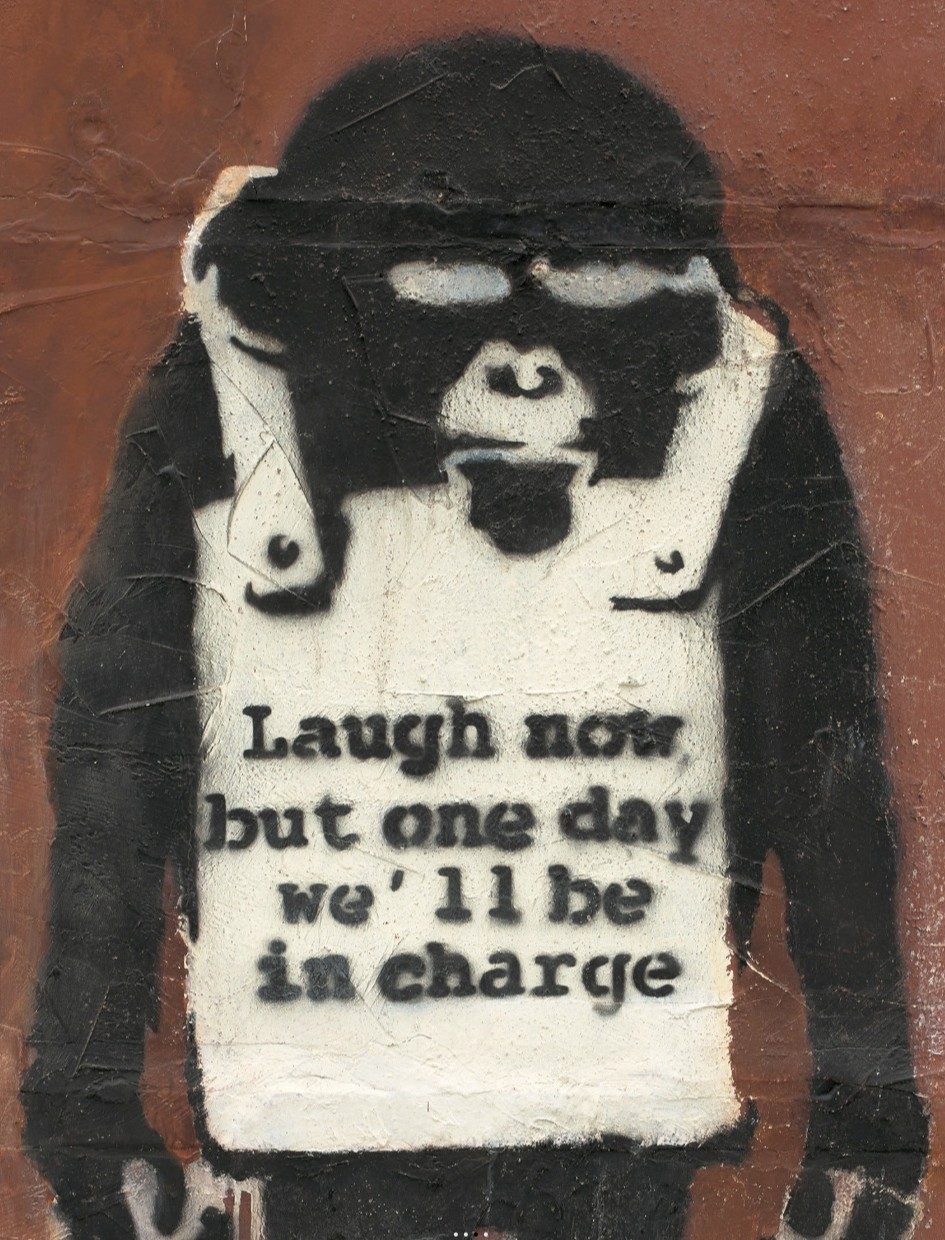
The material construction of Panel A is particularly significant in this context. It is not simply an image transferred onto conventional canvas. Banksy executed the work in spray paint and emulsion on drywall and placed it within his own frame. The combination creates a fascinating tension between street and gallery. Drywall belongs to architecture; the frame belongs to the traditional presentation of fine art. Banksy effectively places a piece of “wall” inside a frame.
That gesture encapsulates a fundamental transformation occurring within his practice at the time. The visual language developed through unauthorized interventions in public space was beginning to enter exhibitions and private collections, but Banksy did not entirely abandon its material origins. Here, the support retains the physical vocabulary of the built environment even as the artist's frame declares the resulting object to be art. The frame therefore does more than protect the work. It stages the contradiction between graffiti and painting, wall and object, vandalism and collectible artwork.
One Monkey and An Army
The solitary figure of Panel A becomes still more compelling when considered alongside the monumental Laugh Now created for the Ocean Rooms in Brighton during the same period. At Ocean Rooms, Banksy multiplied the chimpanzee into a procession stretching more than six meters. Phillips has described the repeated figures as acquiring something approaching the character of an army: individual weakness is transformed through repetition into collective force.
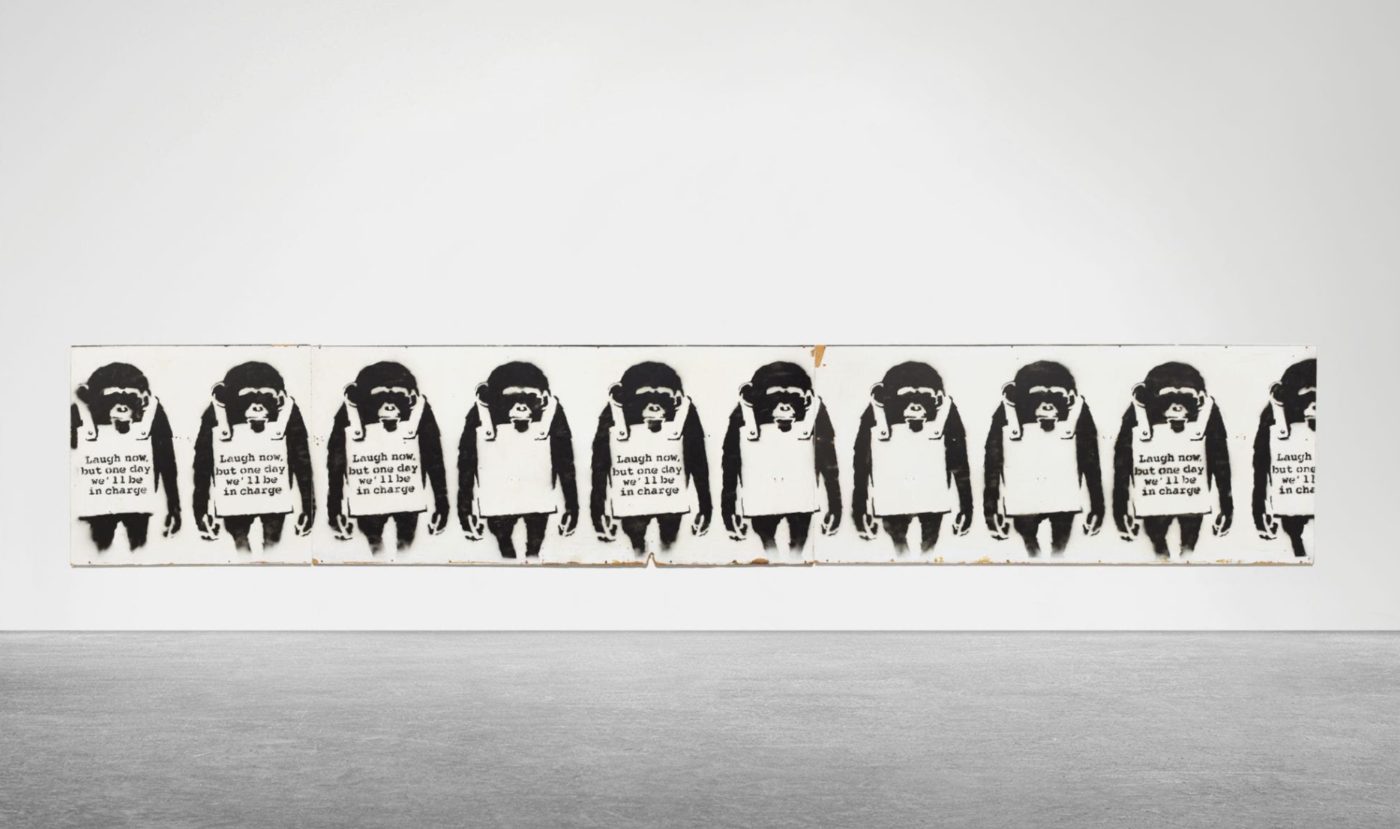
Panel A achieves the opposite effect. There is no crowd here. The chimpanzee stands alone, and the narrow vertical format intensifies its isolation. At 178.5 centimeters high, the work approaches human scale, creating a direct physical encounter between viewer and figure. The monkey is no longer one component within a procession but an individual presence occupying roughly the same vertical space as the person standing before it.
The comparison reveals how sophisticated Banksy's manipulation of the motif had already become. At Ocean Rooms, repetition turns the monkey into a movement; in Panel A, isolation turns it into a protagonist. Both lead to the same warning, but by different routes. One derives authority from numbers. The other derives it from the unsettling confidence of a solitary outsider who appears to know something the viewer does not.
From Outsider to Establishment
The subsequent history of Laugh Now Panel A adds an almost absurdly appropriate epilogue to its original message. When Phillips offered the work in Hong Kong on 8 June 2021, it carried an estimate of HK$22–32 million and sold for HK$24.45 million. Phillips More unusually, Phillips announced that it would accept cryptocurrency as payment for the lot—the first time the auction house had done so for a physical artwork in Asia. Phillips The historical irony is difficult to miss.
A figure conceived within the visual language of graffiti, representing an outsider who warns the establishment that the hierarchy may eventually be overturned, had become a multimillion-dollar object offered by one of the world's major auction houses, with payment accepted through a financial technology itself associated with challenges to conventional institutions.
None of this was contained literally in Banksy's 2002 composition, and it would be wrong to read subsequent events backwards into the artist's original intention. Yet the work's later trajectory demonstrates why Laugh Now has proved unusually durable. Its message is sufficiently simple to be immediately understood and sufficiently open to acquire new meanings as circumstances change.
The monkey's prediction also acquired an unexpected art-historical dimension. Street art entered museums. Banksy entered the international auction market. The anonymous graffiti artist became one of the most recognizable artists of his generation. The figure that promised an eventual reversal of cultural authority accompanied Banksy through precisely such a reversal.
Laugh Now Panel A consequently occupies an important place within the development of Banksy's early practice. It brings together the monkey as a centuries-old instrument of human satire, the material vocabulary of the street, the transition into the gallery, and one of the artist's most enduring meditations on power. The monkey is funny because it resembles us. It is threatening because it knows it. And perhaps the most Banksian aspect of the work is that, more than two decades later, we are no longer entirely sure who is laughing at whom.
STAY INFORMED
Receive the latest news, exhibitions, artworks and market updates on Banksy.