LIBERTY GIRL
LIBERTY WITHOUT THE MONUMENT
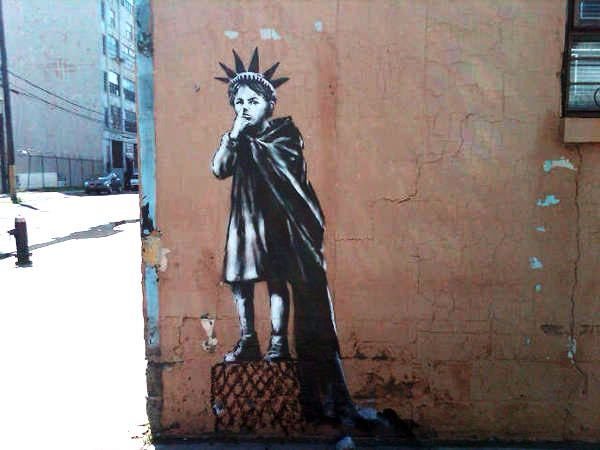
Painted in Long Island City, Queens, in May 2010, Liberty Girl, also known as Statue of Liberty, transforms one of the most solemn symbols of the United States into an irreverent portrait of childhood. Banksy depicts a young girl wearing the Statue of Liberty's unmistakable spiked crown and an oversized classical robe. Yet instead of raising the torch of enlightenment above New York Harbor, she stands awkwardly on a makeshift pedestal with one hand raised to her face, casually picking her nose. The substitution is immediate and deliberately absurd: the monumental allegory of Liberty has become an ordinary, slightly mischievous child.
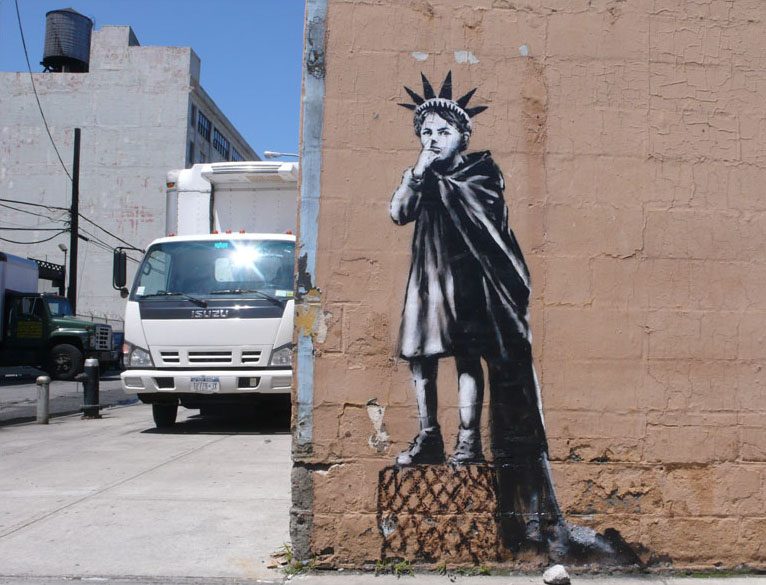
The image depends upon the enormous cultural weight of its model. Dedicated in 1886, the Statue of Liberty was conceived as a personification of freedom and subsequently became inseparable from the history of immigration to the United States, particularly through its position overlooking the entrance to New York Harbor and neighboring Ellis Island. Banksy retains just enough of its visual vocabulary—the crown, robe, frontal pose and pedestal—to make the reference unmistakable, while stripping away its grandeur. Liberty is brought down from her monumental plinth and returned, quite literally, to street level.
THE CHILD BEHIND THE SYMBOL
Children recur throughout Banksy's work as figures capable of puncturing the language of authority. Their gestures are instinctive, playful and frequently indifferent to the systems constructed around them. Here the girl's nose-picking is not merely a juvenile joke. It performs a kind of visual deflation, replacing the ceremonial dignity of a national monument with an intimate gesture so ordinary that it would normally never be represented in public sculpture.
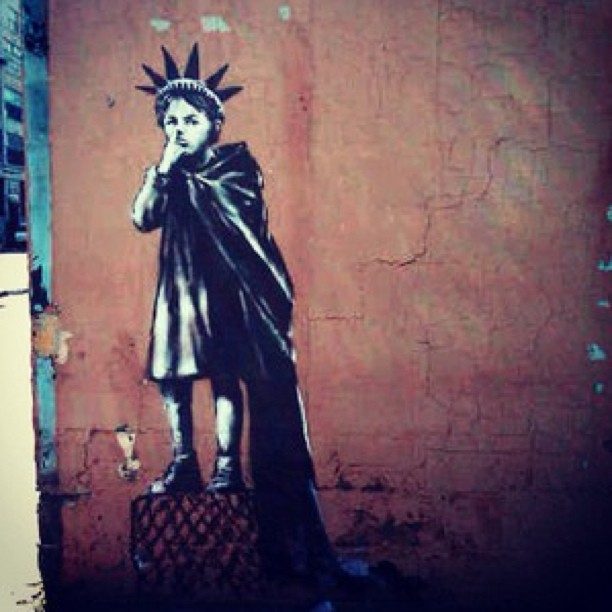
Banksy's humor therefore works through demystification rather than destruction. He does not attack or mutilate the Statue of Liberty; he makes her human. The ideals represented by the monument remain recognizable, but their monumental presentation is subjected to the irreverence of the street. The contrast is characteristic of Banksy's practice: an image invested with institutional seriousness is confronted with an action that refuses to behave appropriately in its presence.
The work also permits a more political reading. Liberty is one of America's most powerful expressions of its own national ideals—freedom, opportunity and refuge—yet those ideals have always existed alongside the more complicated realities of American social and political life. By turning Liberty into a vulnerable child standing on an improvised pedestal, Banksy introduces a distance between the ideal represented by the monument and the society expected to uphold it. The image never resolves that contradiction. Its humor is precisely what allows the question to remain open.
NEW YORK, 2010
Liberty Girl appeared during Banksy's 2010 North American campaign, undertaken around the theatrical release of his film Exit Through the Gift Shop. During the spring of that year, new works appeared across cities including Los Angeles, San Francisco, Toronto and New York, temporarily returning Banksy's practice to the kind of rapid, geographically dispersed street interventions that had helped establish his reputation.

New York provided an especially appropriate setting for this particular image. Rather than painting the actual monument or positioning the work within a conventional tourist landscape, Banksy placed his miniature Liberty on a weathered wall in the industrial surroundings of Long Island City. Contemporary photographs show trucks, loading areas, deteriorating masonry and rooftop water tanks around the figure. The contrast matters: one of America's grandest public monuments has been transplanted from its island in New York Harbor to an anonymous urban wall across the city.
The location also reinforces the work's relationship with New York itself. The real Statue of Liberty is designed to be seen from a distance, rising dramatically above the harbor; Banksy's version can only properly be encountered from the street. One is monumental, permanent and protected. The other is small, unauthorized and vulnerable to whatever happens next.
A SHORT-LIVED LIBERTY
That vulnerability proved decisive. Liberty Girl disappeared very shortly after its appearance, with later accounts claiming that the mural survived for only around twelve hours before being defaced or destroyed. The precise duration is difficult to establish from surviving contemporary documentation, but the work was unquestionably short-lived, and today it survives primarily through photographs.
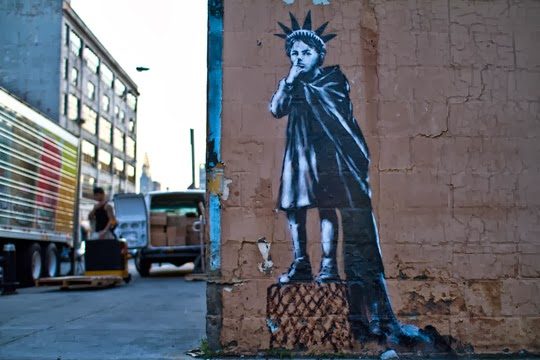
Its disappearance is particularly fitting, if accidental, for an image constructed around the reversal of monumentality. The original Statue of Liberty was engineered to endure as a permanent national symbol; Banksy's Liberty existed temporarily on a deteriorating wall and could vanish almost as quickly as it appeared. What survives is not a monument but the record of an intervention—a brief moment when Banksy reduced one of the world's most recognizable symbols to the scale of a child, placed her on a New York street, and allowed her to behave with complete disregard for the dignity history had assigned her.
STAY INFORMED
Receive the latest news, exhibitions, artworks and market updates on Banksy.