RAT WITH 3D GLASSES
A Rat Goes to the Movies
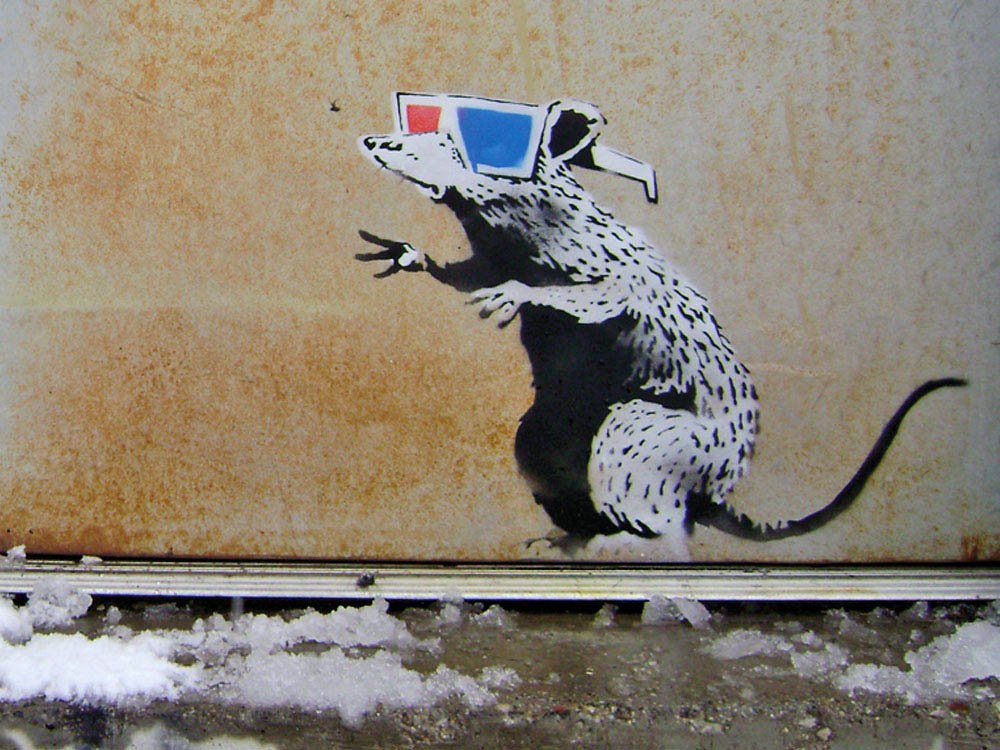
In January 2010, as Park City filled with filmmakers, journalists and audiences for the Sundance Film Festival, Banksy placed one of his signature rats on the lower portion of a stage door at the historic Egyptian Theatre. Standing upright and wearing a pair of unmistakable red-and-blue 3D glasses, the small animal appeared almost as another festival-goer: an anonymous spectator preparing to watch the show.
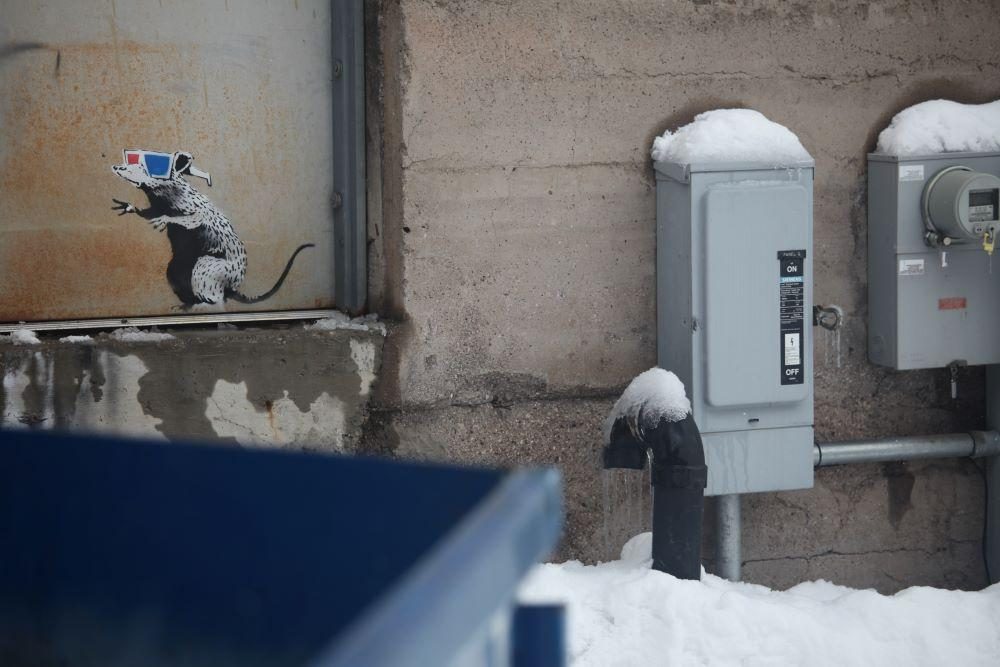
The location was anything but incidental. Banksy had come to Sundance for the world premiere of Exit Through the Gift Shop, screened on 24 January 2010, and left several works around Park City during his visit. Alongside Cameraman and Flower, the 3D Rat effectively extended the film beyond the cinema. Before audiences encountered Banksy's exploration of street art, authorship and authenticity on screen, they encountered Banksy on the streets outside.
The Egyptian Theatre made the intervention particularly precise. The rat was not merely somewhere in Park City during a film festival; it was painted directly onto the stage door of a cinema and performance venue. Its 3D glasses therefore become less an arbitrary accessory than a site-specific prop. Banksy's habitual urban outsider had become a moviegoer.
Seeing in Three Dimensions
The glasses also place the mural firmly within its cultural moment. By 2010, stereoscopic cinema was experiencing a spectacular revival, most visibly following the release of Avatar in December 2009. The flimsy red-and-blue glasses offered an instantly recognizable shorthand for technologically enhanced vision: put them on and an apparently flat image acquires depth.
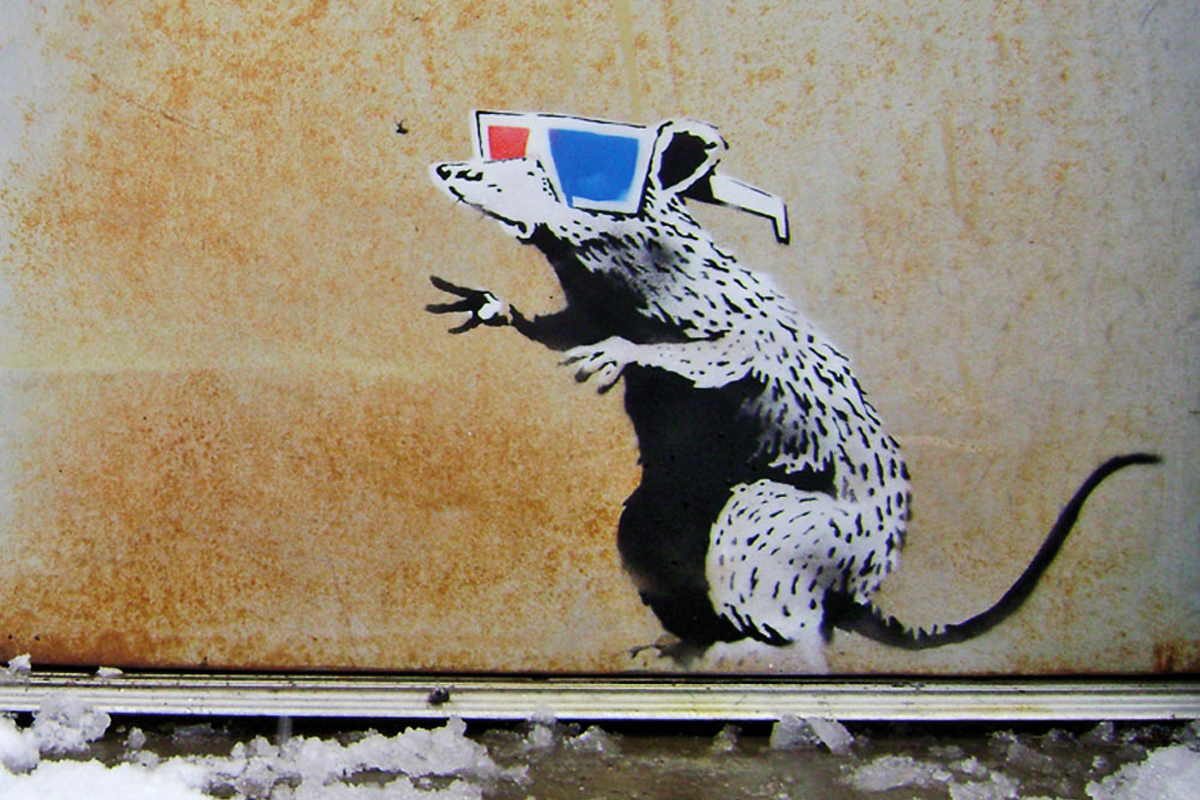
Banksy's rat complicates that promise. Three-dimensional cinema does not reveal another reality; it manufactures the illusion of one. The glasses supposedly allow the animal to see more, while simultaneously reminding us that what it sees is being technologically mediated.
That tension resonates particularly strongly with Exit Through the Gift Shop. Presented as a documentary assembled from Thierry Guetta's obsessive filming of the street-art world, the film continually destabilizes the relationship between documentation and performance, authenticity and fabrication. Viewers are encouraged to look closely while never being entirely certain how much of what they are seeing should be believed.
The 3D glasses therefore make a wonderfully economical companion to the film. They promise greater visual depth while openly announcing the mechanism through which the illusion is created.
The Rat as Spectator
Banksy's rats had traditionally been actors. They carried placards, drilled through walls, painted slogans, photographed themselves, wielded tools and occupied spaces from which human society had excluded them. Here the rat assumes a subtly different role: it becomes the audience.
That shift matters. The creature remains an outsider—small, unwanted and close to the ground—but it is now looking at the spectacle rather than creating it. Banksy's recurring alter ego becomes a proxy for everyone arriving in Park City to watch his film.
The image consequently turns the relationship between artist and audience back upon itself. Inside the Egyptian Theatre, spectators watch Banksy's film about a man who watches and films street artists. Outside, Banksy leaves a rat wearing cinema glasses to watch them.
The street, cinema and audience become parts of the same work.
From Street Motif to Studio Works
Banksy evidently considered the image worth developing beyond Park City. During 2010 he produced several related works using the 3D Rat motif on board and found metal, including variations in which the rat confronts a swarm or burst of black forms. One board version measures 48 × 38 cm and was reportedly gifted to the family of a producer of Exit Through the Gift Shop, creating a particularly direct connection between the motif and the film.
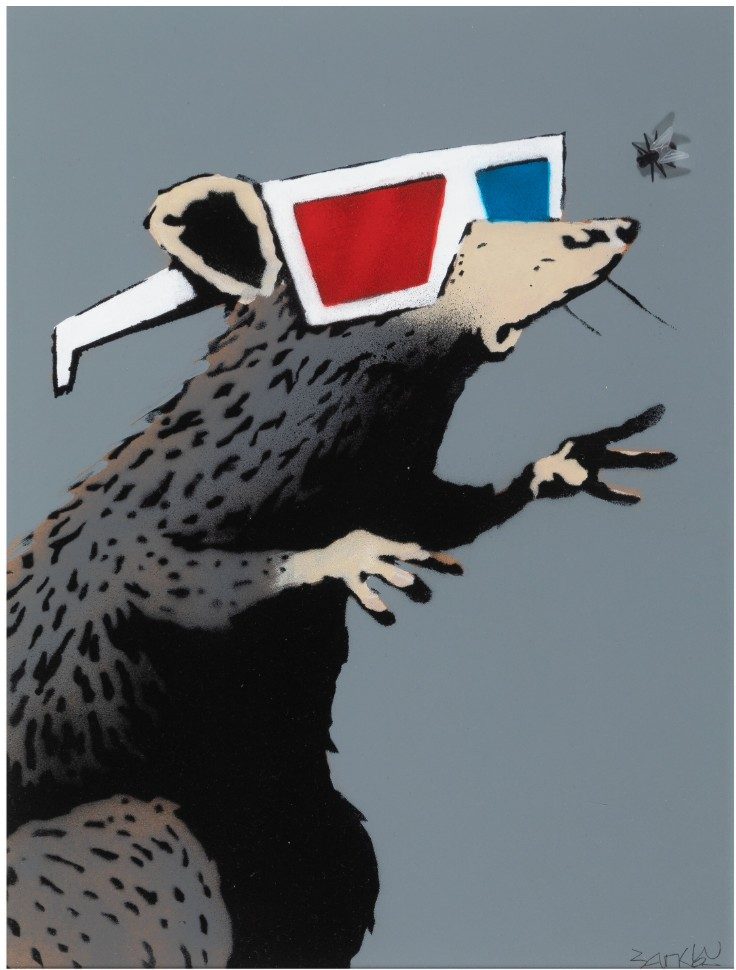
Another version was associated with Marks & Stencils, the Pictures on Walls event in London in November 2010. These subsequent objects are worth linking from the mural entry rather than treating the street image as an isolated design.
Saved by the Theatre
The survival story is unusually good. According to Sundance's retrospective account, Egyptian Theatre executive director Randy Barton was alerted to the rat shortly after it appeared. Because Banksy had fortuitously painted it on a removable door, Barton and another theatre employee removed the entire door that night and replaced it with temporary material, specifically to prevent the artwork from being vandalized.
The door then remained out of public view for approximately nine years while the nonprofit theatre raised funds to conserve and display it. Rather than cutting Banksy's image away from its support, the theatre preserved the object on which he had actually painted it—an important distinction when considering the increasingly complicated histories of detached Banksy street works.
The result is one of the more fortunate outcomes among Banksy's American interventions. The mural was removed almost immediately, but not to monetize it. It was removed so that it could survive.
Exit Through the Stage Door
Rat with 3D Glasses is ultimately a small work with an unusually precise relationship to place and moment. A rat wearing cinema glasses appeared on the stage door of a theatre during the festival at which Banksy was introducing his first film. The image takes one of the artist's oldest street motifs and temporarily transforms it into something new: a spectator.
Together with Cameraman and Flower, it makes Banksy's 2010 Park City intervention particularly coherent. One work shows the person behind the camera becoming so preoccupied with recording an image that he damages his subject; the other places a viewer behind a pair of glasses designed to manufacture visual depth. One concerns making images, the other looking at them.
Both appeared while Banksy was presenting a film that asks us to question precisely those two activities.
STAY INFORMED
Receive the latest news, exhibitions, artworks and market updates on Banksy.