SKULL AND CROSSBONES RAT
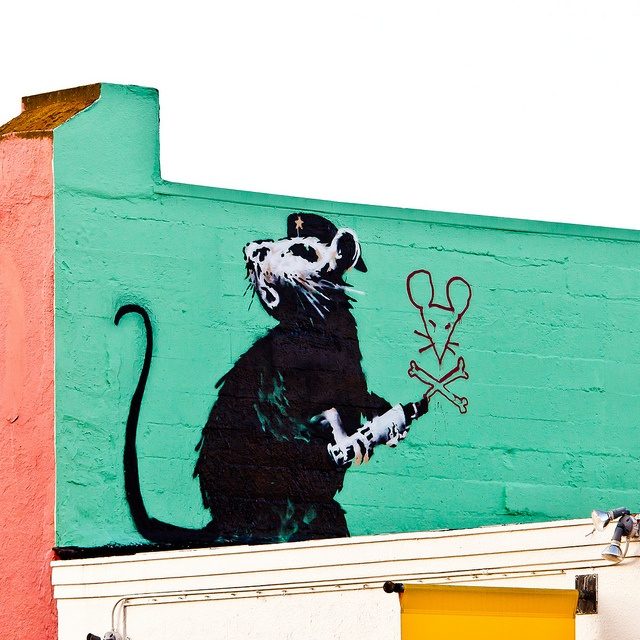
A PIRATE RAT IN SAN FRANCISCO
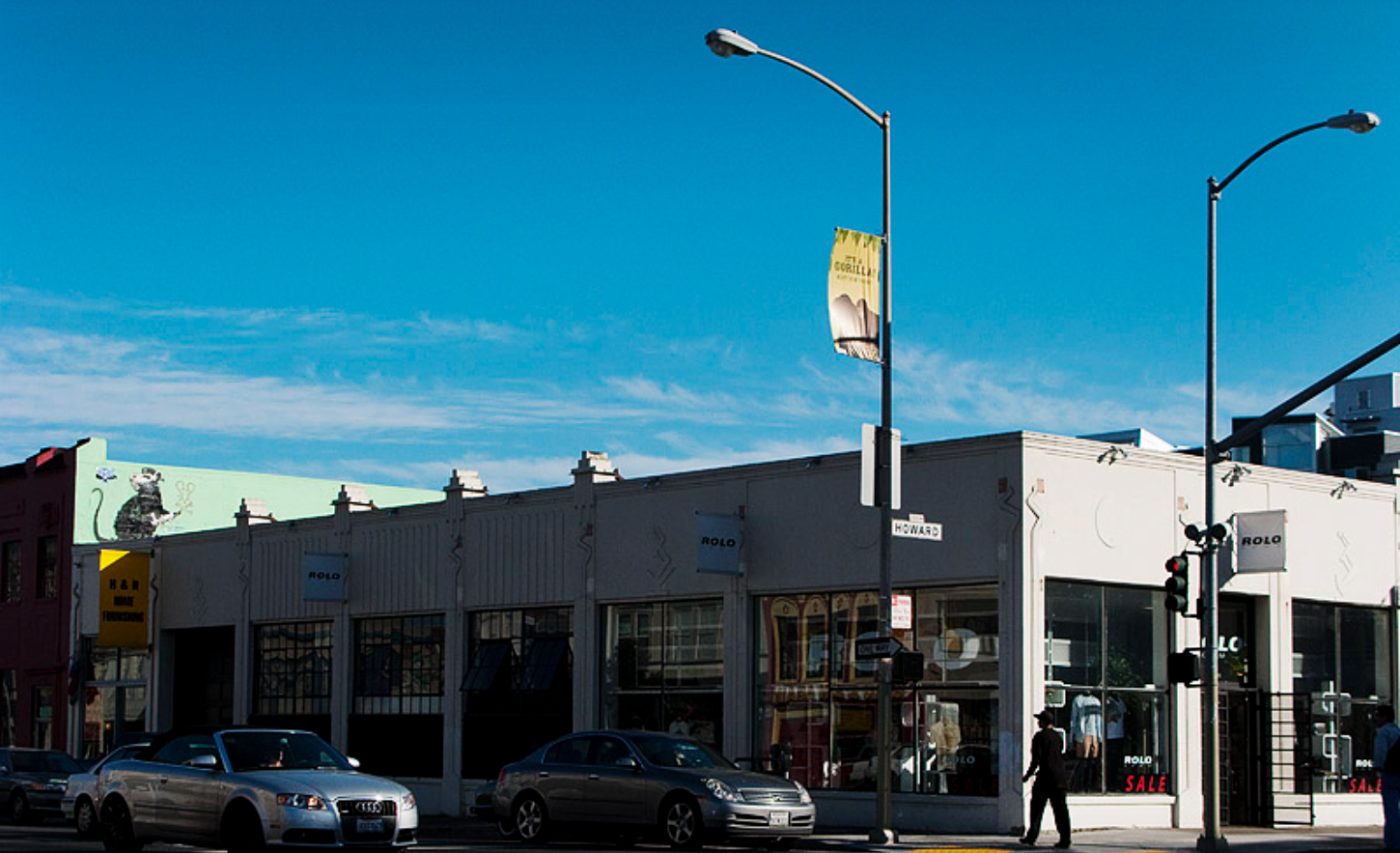
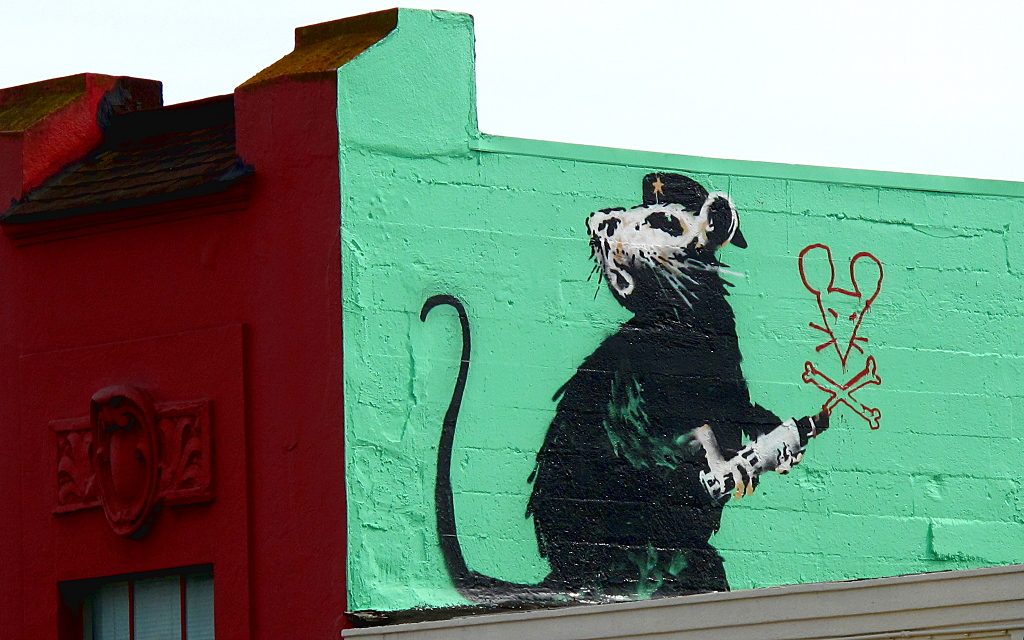
During his visit to San Francisco in the spring of 2010, Banksy painted a large rat high on the wall of a building at 1309 Howard Street, near 9th Street in the South of Market district. The work formed part of the group of interventions that appeared around the city as Exit Through the Gift Shop was beginning its American theatrical release. By 1 May, KQED had documented six large Banksy works across the Mission, Chinatown, SOMA and Haight-Ashbury, turning Banksy's brief presence in San Francisco into an unofficial citywide exhibition.
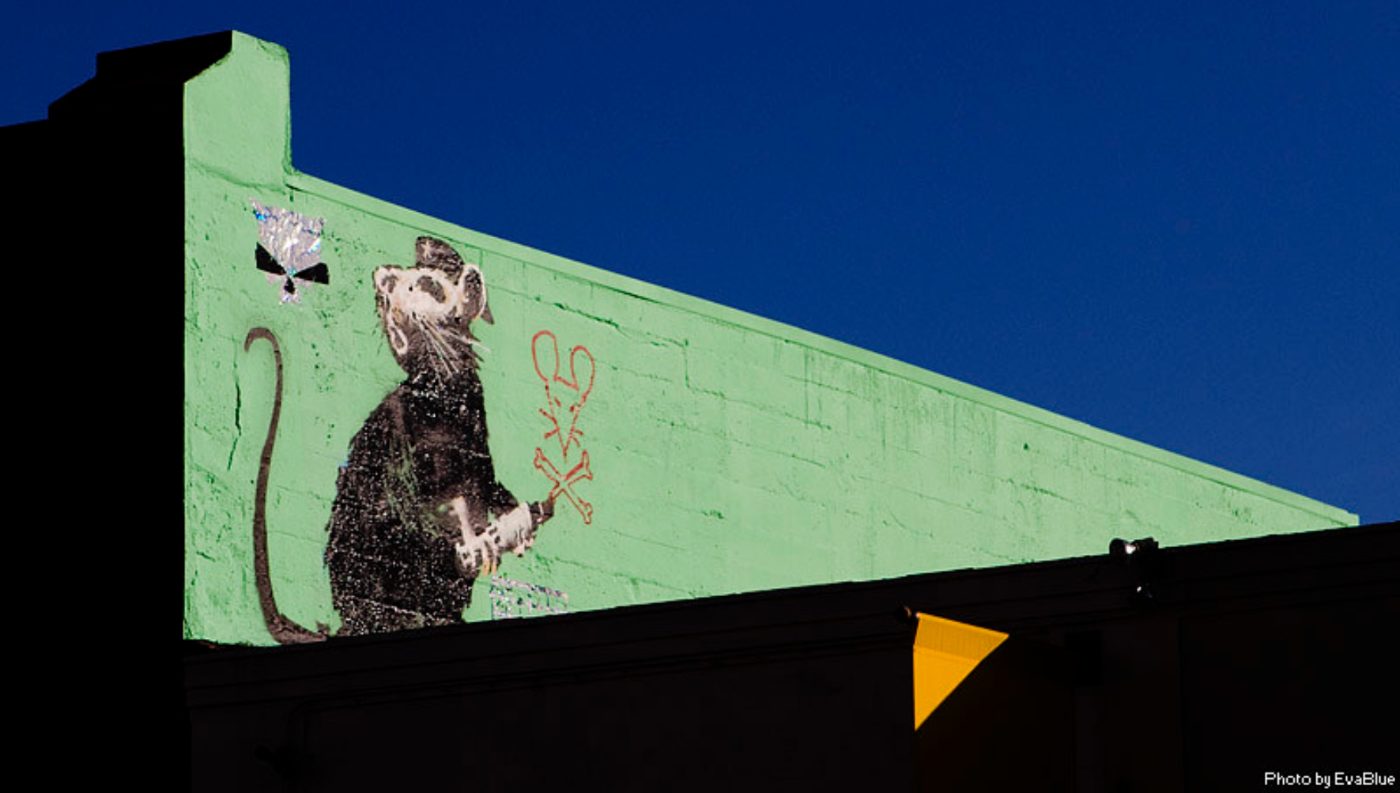
The mural depicts an unusually large rat dressed in dark clothing and wearing what appears to be a cap or head covering. In one hand it holds a paintbrush with which it has apparently drawn a red skull and crossbones on the wall. The rat is therefore both the subject of the mural and, fictionally, its author: Banksy paints a graffiti-writing rat caught in the act of making its own piece of graffiti.
BANKSY'S RATS
Rats had occupied a central position in Banksy's visual vocabulary since his earliest work in Bristol and London. Small, fast, difficult to control and capable of occupying the neglected spaces of the modern city, they offered an obvious surrogate for the graffiti artist. They live largely outside accepted social structures, emerge when they are not wanted and survive despite repeated attempts to eradicate them. Banksy repeatedly exploited this association, depicting rats painting slogans, carrying tools, making music, protesting or engaging in acts of minor insurrection.
Skull and Crossbones Rat develops this familiar character on an unusually monumental scale. The rat is no longer a discreet creature occupying the bottom of a wall but a dominant figure towering above the street. Its paintbrush makes the analogy between rodent and graffiti artist explicit, while the red skull and crossbones introduces a traditional symbol of piracy, danger and rebellion. The combination is playful rather than simply threatening: an unwanted urban animal has appropriated both the wall and the visual language of the outlaw.
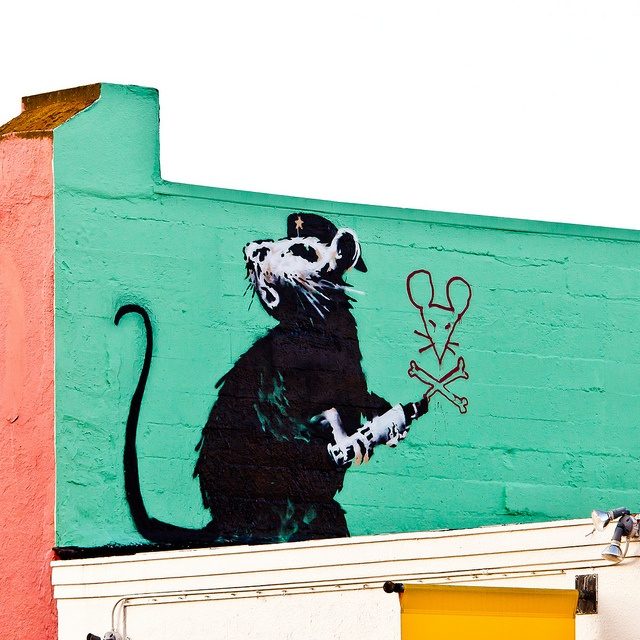
The mural also contains a characteristic visual hierarchy. Banksy's rat is rendered principally in black and white, while the graffiti it produces is drawn in vivid red. The distinction allows the viewer to read two simultaneous acts of mark-making: Banksy has painted the rat, while the rat appears to have painted the skull. Authorship is folded back upon itself, transforming a simple stencil into a small fiction about the act of making unauthorized art.
SAN FRANCISCO, 2010
The Howard Street rat should be understood within Banksy's wider San Francisco campaign rather than as an isolated intervention. During the same period, works appeared at Valencia Street, Mission Street, Haight Street, Grant Avenue and Erie Street. They included This'll Look Nice When It's Framed, No Trespassing, Marker Rat / This Is Where I Draw the Line, Peaceful Hearts Doctor and Bird Singing in Tree. Contemporary reporting documented the works almost immediately, while photographers began recording them in anticipation that they might quickly be altered, removed or painted over.
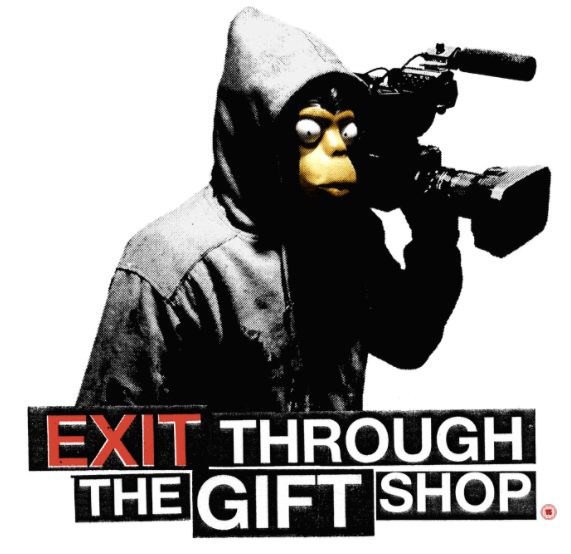
Their appearance coincided closely with the American release of Exit Through the Gift Shop, which had premiered at Sundance in January 2010. The connection is particularly appropriate for Skull and Crossbones Rat. The film examines the transformation of unauthorized street art into a recognized cultural and commercial phenomenon, while the San Francisco interventions placed Banksy back in the environment from which his reputation had originally emerged: anonymously altering walls without permission and leaving the city to decide whether the resulting images constituted vandalism or art.
THE RAT AS STREET ARTIST
Among the San Francisco works, Skull and Crossbones Rat is particularly closely connected to Banksy's established iconography. Rather than introducing an entirely new character, Banksy returned to one of the central protagonists of his early career and enlarged it dramatically for the American city. The rat's paintbrush makes explicit a comparison that had underpinned the motif from the beginning: like the graffiti artist, the rat inhabits the margins of the urban environment while leaving evidence of its presence in places where it is not supposed to be.
The work consequently operates both as an individual mural and as part of Banksy's broader mythology of the rat. Its scale, prominent placement and red pirate emblem transform an animal conventionally associated with infestation into a confident urban author. Within the wider San Francisco series, it provides a particularly direct connection between the internationally famous Banksy of 2010 and the clandestine stencil practice from which his career had developed.
STAY INFORMED
Receive the latest news, exhibitions, artworks and market updates on Banksy.