THE CAVEMAN, 2008
Literature
- This work is reproduced in the book ‘Banksy. You Are an Acceptable Level of Threat and If You Were Not You Would Know about It’ Gary Shove (Editor), Patrick Potter, published in 2014
Auction History
Prices are inclusive of buyer’s premium unless stated otherwise, as reported by the auction houses.
From Caveman to Consumer
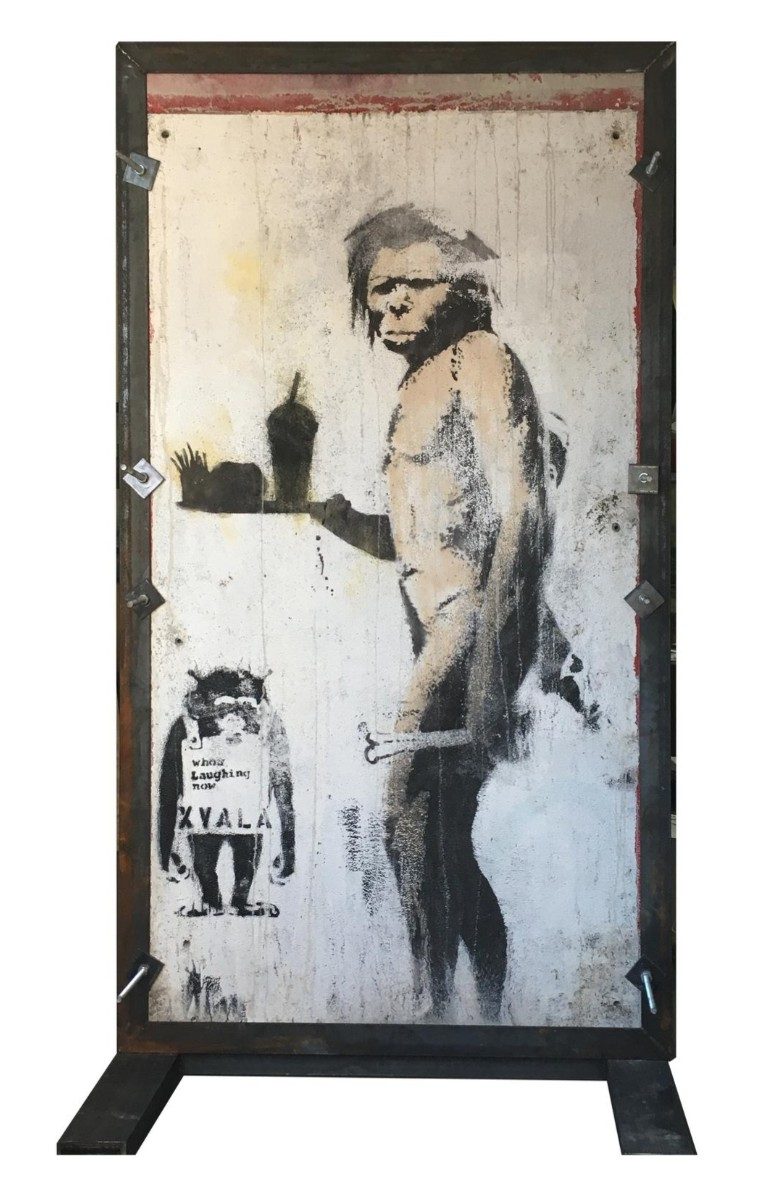
The Caveman belongs to that particularly effective category of Banksy images in which an apparently simple joke opens onto a much larger criticism of contemporary society. A prehistoric man stands before what appears to be the counter of a modern fast-food restaurant. He carries a primitive bone in one hand while holding what looks like a disposable drink in the other. Behind the counter are the unmistakable silhouettes of a cup and French fries. Thousands of years of civilization have apparently taken us from hunting with bones to ordering fries. Banksy's verdict on human progress is not especially flattering.
The humor depends upon a collision of incompatible historical periods. The caveman should belong to prehistory; the disposable cup, fries and service counter belong to the contemporary consumer economy. By placing them together, Banksy compresses the supposed evolution of civilization into a single image and quietly asks how far humanity has really travelled.
Who's Laughing Now?
At the lower left appears one of Banksy's monkeys wearing a sandwich board bearing the words “Who's Laughing Now?” This small secondary figure radically changes the composition. Without it, The Caveman could be read primarily as a joke about consumerism. With the monkey present, the work connects directly to one of the central themes running through Banksy's oeuvre: humanity's rather inflated opinion of itself.
Banksy's monkeys repeatedly function as distorted mirrors of human society. They protest, work, rebel, govern and occasionally seem considerably more perceptive than the people surrounding them. From Laugh Now and Monkey Queen to his numerous placard-bearing chimpanzees, Banksy repeatedly reverses the conventional hierarchy between supposedly civilized humans and supposedly primitive animals.
Here that evolutionary ladder becomes wonderfully confused. At the top of the composition stands a caveman consuming fast food. At the bottom stands a monkey apparently laughing at him. The question becomes unavoidable: who exactly has evolved?
Progress, Banksy Style
The work therefore operates as a compact satire of the mythology of progress.
Modern societies tend to understand history as a forward movement: primitive becomes civilized, scarcity becomes abundance, ignorance becomes knowledge. Banksy replaces this heroic trajectory with something considerably less impressive. Humanity has certainly developed extraordinary technology, global commerce and industrial food production—but perhaps only to become a more efficient consumer.
The Caveman's bone is especially important. It identifies him immediately as “primitive,” yet the disposable drink in his other hand belongs to an economic system of industrial production, packaging, transportation, consumption and waste of almost unimaginable complexity. Banksy's joke is that both objects ultimately serve rather basic appetites. Civilization has changed the packaging.
A Wall, Not a Canvas
The physical character of The Caveman is equally important. This was not conceived as a conventional studio painting. The stencil was executed directly onto a concrete wall, whose irregularities, staining and accumulated surface history remain visible throughout the work. The pale, distressed concrete is not merely a neutral background; it is part of the image.
The contrast is particularly effective. Banksy's predominantly black stencil appears almost archaeological against the battered wall, as though the caveman himself were an image excavated from some strange contemporary ruin.
The later removal of the concrete section and its mounting within a substantial metal structure transformed an architectural fragment into a transportable object. Like many detached Banksy murals, it consequently occupies an ambiguous territory between street work, archaeological fragment and collectible artwork.
Its considerable depth—approximately 30.5 cm—makes that history physically apparent. This is not simply an image transferred from a wall. The wall itself has become the object.
The Street Work Paradox
That transformation also introduces the familiar paradox surrounding Banksy's detached murals.
Street art derives much of its meaning from location, surprise and accessibility. Nobody buys a ticket to encounter it; the city supplies the exhibition space. Once a section of wall is removed, reinforced, transported and eventually offered at auction, its status fundamentally changes.
Yet the alternative is frequently destruction.
Detached street works therefore occupy a peculiar category within Banksy's oeuvre. Their removal can simultaneously be understood as preservation and displacement. What survives is unquestionably a physical fragment of the original intervention, but it survives under completely different circumstances.
In The Caveman, this contradiction seems particularly appropriate. A work satirizing consumption eventually became a highly valuable commodity itself. Banksy would probably appreciate the joke.
A Quintessential Banksy
Despite its relative obscurity compared with Banksy's most famous motifs, The Caveman contains many of the elements that define his visual language: an immediately readable stencil, an absurd collision of references, monkeys, humour, social criticism and an idea that becomes progressively less amusing the longer one considers it.
There is no elaborate symbolism to decode. The image functions almost instantly. Caveman. Fast food. Monkey. Three elements are enough to construct an entire argument about evolution, consumption and civilization.
And perhaps that economy is the work's greatest strength. Banksy's best street images often resemble exceptionally good jokes: they require very little explanation, yet somehow leave behind an uncomfortable question.
Here the question is particularly simple. After several million years of evolution, is this really where we were trying to get?
STAY INFORMED
Receive the latest news, exhibitions, artworks and market updates on Banksy.