THIS'LL LOOK NICE WHEN IT'S FRAMED
ART OUTSIDE THE FRAME
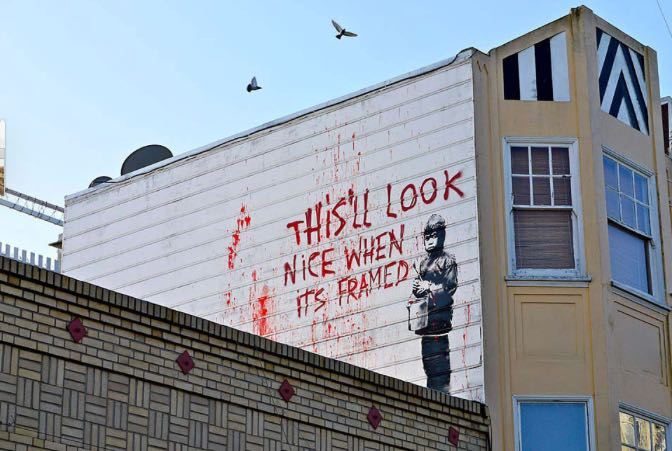
In April 2010, during a concentrated series of interventions across San Francisco, Banksy painted This’ll Look Nice When It’s Framed high on the exterior wall of 853 Valencia Street, between 20th Street and Cunningham Place in the Mission District. Contemporary photographs document the work there in late April, while local reporting identified it as one of at least six Banksy interventions that appeared around the city during this period.
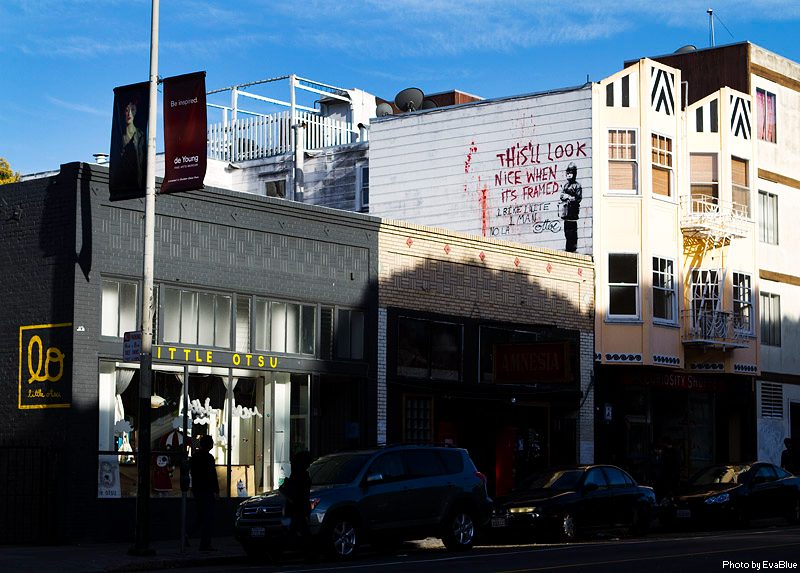
The composition depicts a young boy standing beside a paint bucket, accompanied by the roughly painted inscription “THIS’LL LOOK NICE WHEN IT’S FRAMED.” Red paint has been thrown and allowed to run freely across the wall behind him, visually contrasting with the carefully controlled black-and-white stencil of the child. The boy appears simultaneously to be the author of the unruly marks and an observer of them, turning an apparently vandalized wall into a self-conscious commentary on the status of street art.
FROM VANDALISM TO ART
The phrase addresses one of the central paradoxes surrounding Banksy’s career. On the street, an unauthorized image can be classified as graffiti, criminal damage or visual pollution; once removed from that environment, framed and presented within a gallery or auction house, the same image may be treated as a valuable work of contemporary art. Banksy compresses that transformation into a deliberately casual prediction: what appears to be vandalism now will eventually “look nice” when someone places a frame around it.
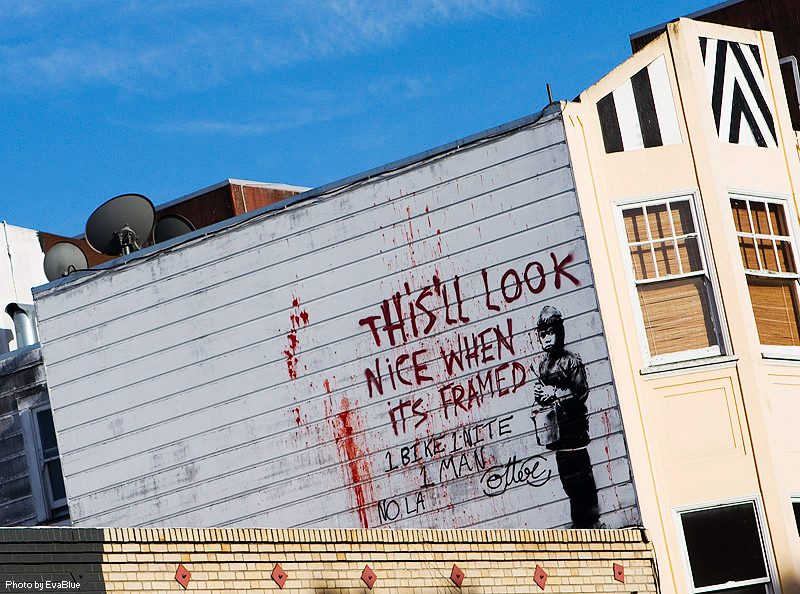
The joke was particularly pertinent by 2010. Banksy had long since moved beyond the relatively small Bristol and London graffiti communities from which he emerged, and his works were commanding substantial prices on the international secondary market. The physical removal and commercialization of his street works had itself become increasingly common. The mural consequently addresses not only the conventional distinction between graffiti and art, but also the market’s ability to change the perceived status of an object simply by changing its context.
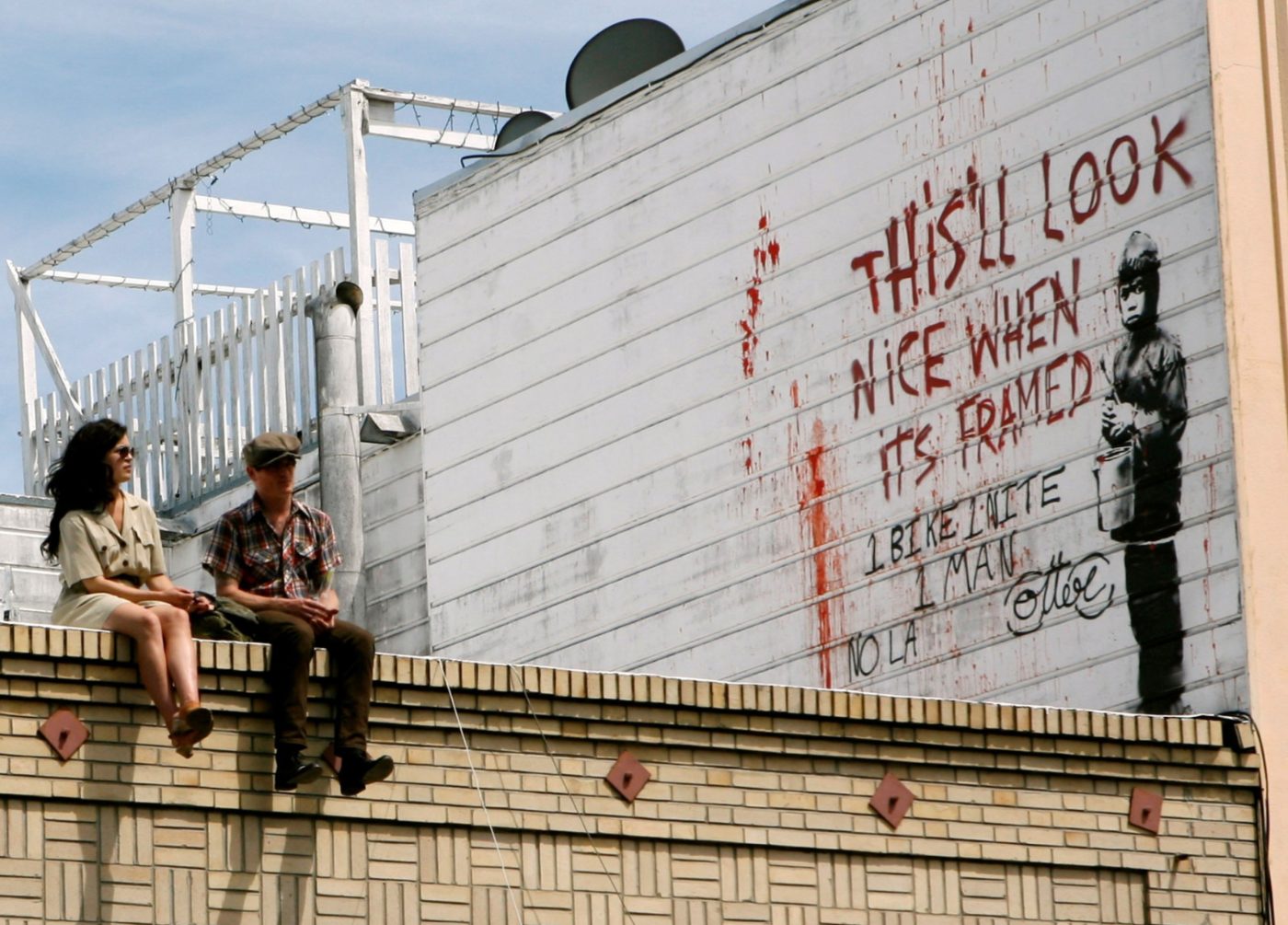
There is an additional irony in the fact that the work is itself fundamentally dependent upon the wall. The streaks and splashes of red extend across the building rather than remaining within a conventional pictorial boundary, while the horizontal cladding becomes the surface upon which the entire composition is constructed. To place the image neatly inside a frame would therefore eliminate part of what makes the intervention effective. Banksy is simultaneously anticipating the institutionalization of street art and pointing toward the difficulty of separating such work from the architecture for which it was conceived.
BANKSY IN SAN FRANCISCO
This’ll Look Nice When It’s Framed formed part of Banksy’s highly visible San Francisco activity in April 2010. Other interventions appeared at 2140 Mission Street, 1672 Haight Street, 1309 Howard Street, 720 Grant Avenue, and near Erie and Mission Streets, including No Trespassing, This Is Where I Draw the Line, Skull and Crossbones Rat, Peaceful Hearts Doctor and Bird Singing in Tree. Contemporary observers were already attempting to document the works before they could be altered or removed.
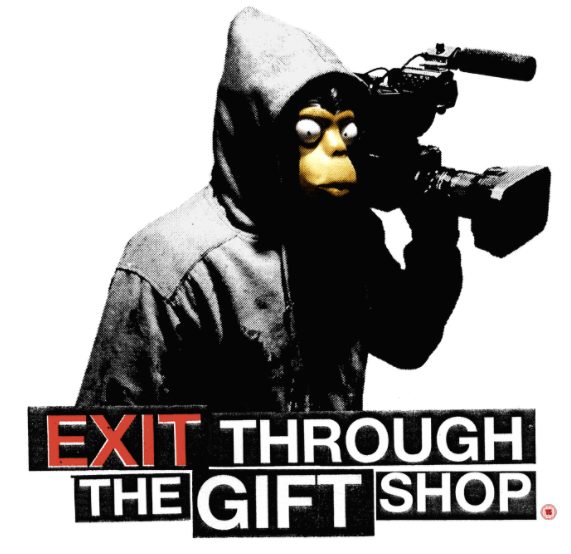
The interventions coincided with the American release of Banksy’s film Exit Through the Gift Shop, which had premiered at the Sundance Film Festival earlier that year and was playing in San Francisco at the time. The relationship is significant: both the film and the street works engage with questions of authorship, authenticity, reputation and the mechanisms through which underground visual culture becomes absorbed by the established art world.
A SELF-FULFILLING PROPHECY
The Valencia Street mural is particularly effective because its humor depends upon Banksy’s own increasingly ambiguous position between the street and the art market. The child with his bucket still belongs to the visual language of illicit graffiti, yet the accompanying sentence anticipates the processes of preservation, removal, exhibition and commodification that had already begun to surround Banksy’s work.
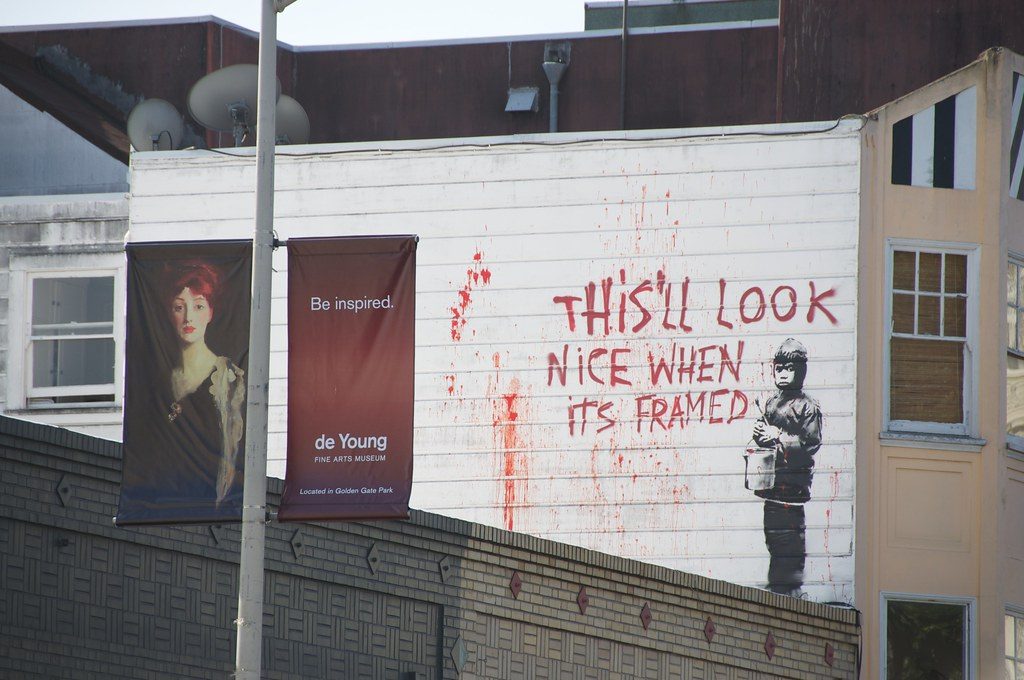
The result is a concise meditation on the power of context. Nothing intrinsic to an image necessarily changes when it moves from a wall to a gallery, but almost everything surrounding it does: ownership, legality, monetary value and cultural authority. In "This’ll Look Nice When It’s Framed", Banksy turns that contradiction into the subject of the mural itself, using the unframed architecture of the street to question precisely what happens when street art is transformed into an art object.
STAY INFORMED
Receive the latest news, exhibitions, artworks and market updates on Banksy.