VENICE IN OIL, BANKSY AT THE VENICE BIENNALE, MAY 2019

Setting Out His Stall
In May 2019, while the international art world descended upon Venice for the 58th Venice Biennale, Banksy staged his own unofficial contribution. Rather than entering one of the exhibition halls, he set up an unlicensed street stall near St Mark’s Square, positioning himself among the painters and souvenir sellers who offer romantic views of Venice to tourists.
The intervention actually took place on 9 May, two days before the Biennale opened to the public, although Banksy did not reveal it until 22 May, when he released a short film entitled Street Artist in Venice. The figure operating the stall was deliberately concealed, and the municipal officers who eventually approached him neither established his identity nor issued a fine.
Banksy introduced the film with characteristic understatement:
“Setting out my stall at the Venice Biennale. Despite being the largest and most prestigious art event in the world, for some reason I’ve never been invited.”
He had solved the problem by inviting himself.
Venice in Oil
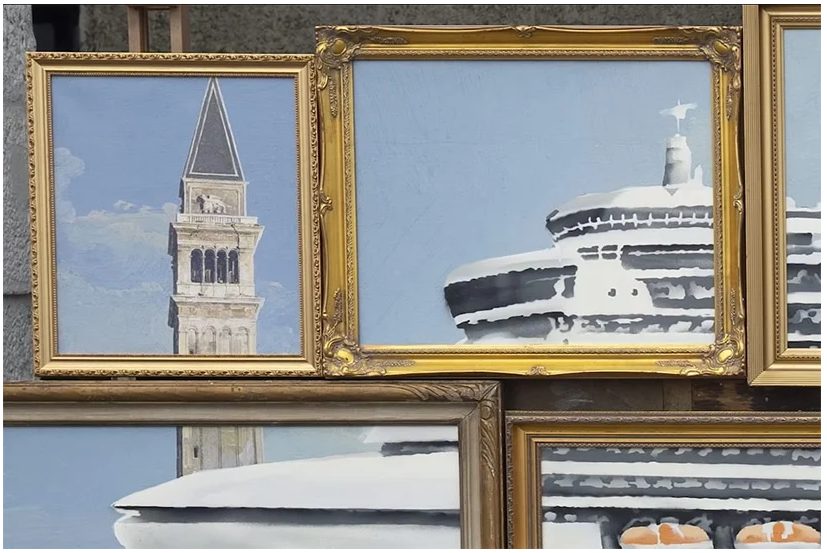
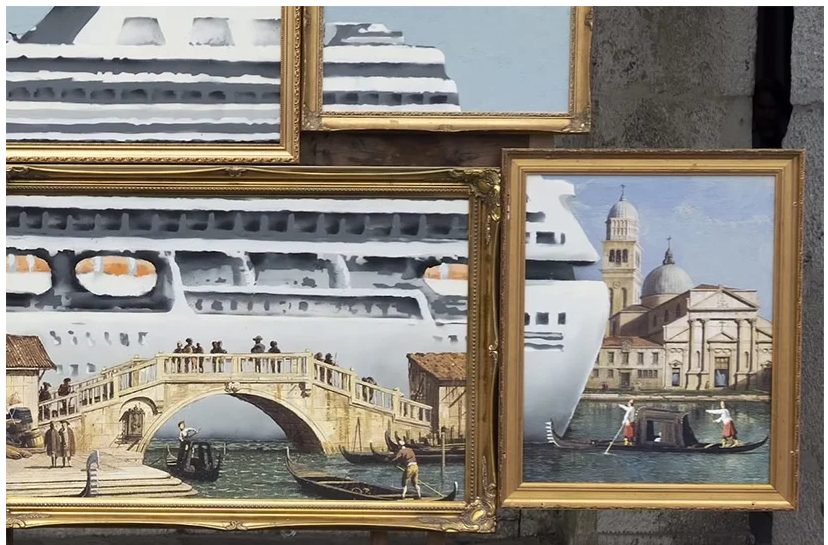
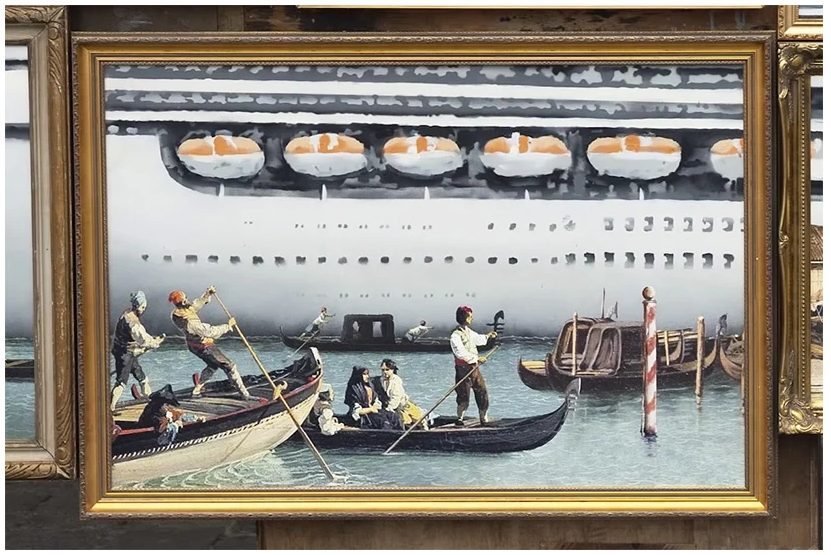
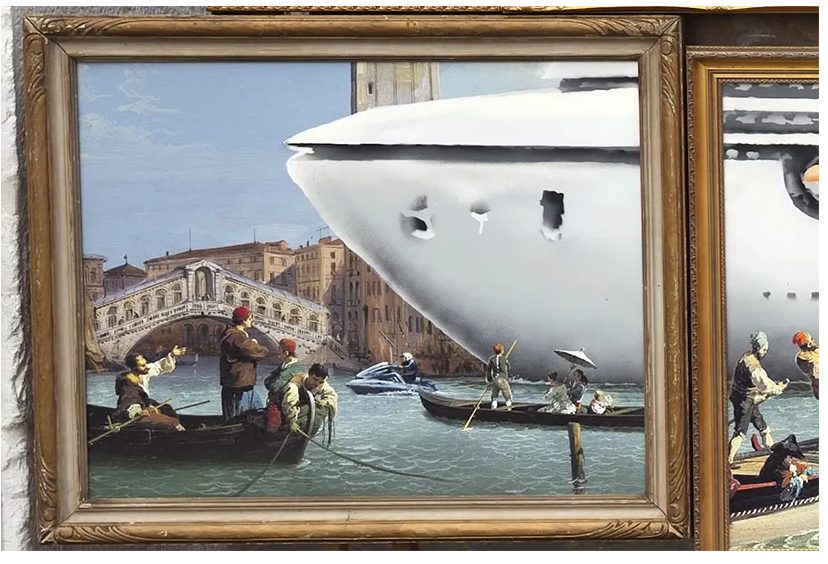
At first glance, the stall appeared entirely conventional. Nine individually framed oil paintings depicted fragments of an idealized Venetian panorama: blue water, historic architecture and gondolas rendered in the picturesque language of paintings sold throughout the city.
Only when the nine pictures were assembled did the complete image become visible. A colossal modern cruise liner occupies the centre of the composition, dwarfing the surrounding buildings and overwhelming the tiny gondolas beneath it. The romantic image of Venice has not disappeared; it has simply been pushed to the margins by the machinery of mass tourism.
The handwritten sign beside the paintings provided the title: VENICE IN OIL.
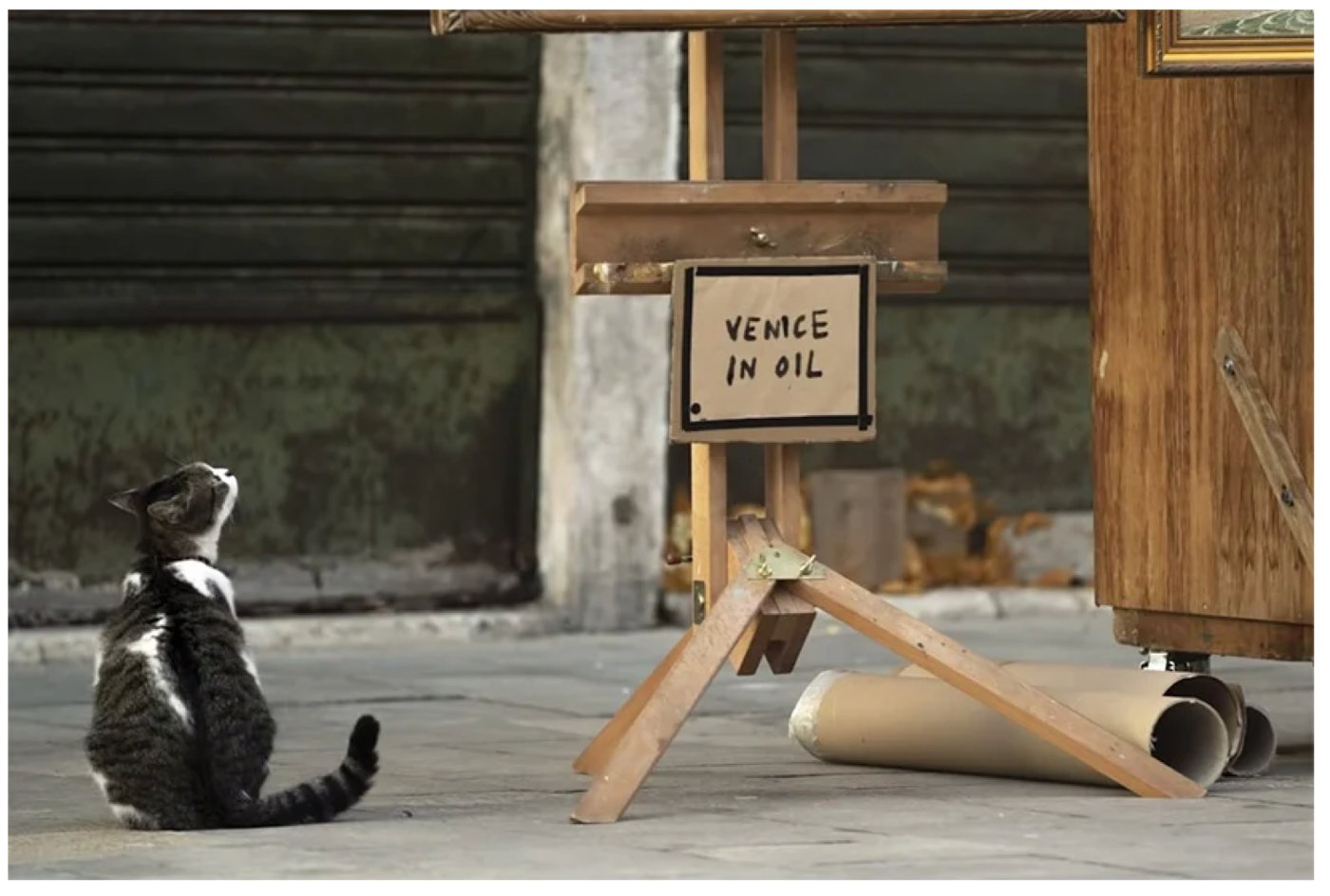
The phrase operates as a typically economical Banksy pun. These are literally views of Venice painted in oils, but “oil” also evokes the fuel, pollution and industrial infrastructure represented by the enormous ship. A traditional medium associated with picturesque Venetian painting becomes the language through which Banksy depicts a city threatened by the modern tourist economy.
The Beautiful View and the Machine Behind It
The choice of Venice makes the intervention considerably richer than a straightforward environmental protest. For centuries, the city has been converted into images for visitors: painted by Canaletto and generations of vedutisti, photographed by millions of tourists and reproduced endlessly as an ideal of architectural beauty and romantic escape.
Banksy adopts precisely this tradition and contaminates it from within.
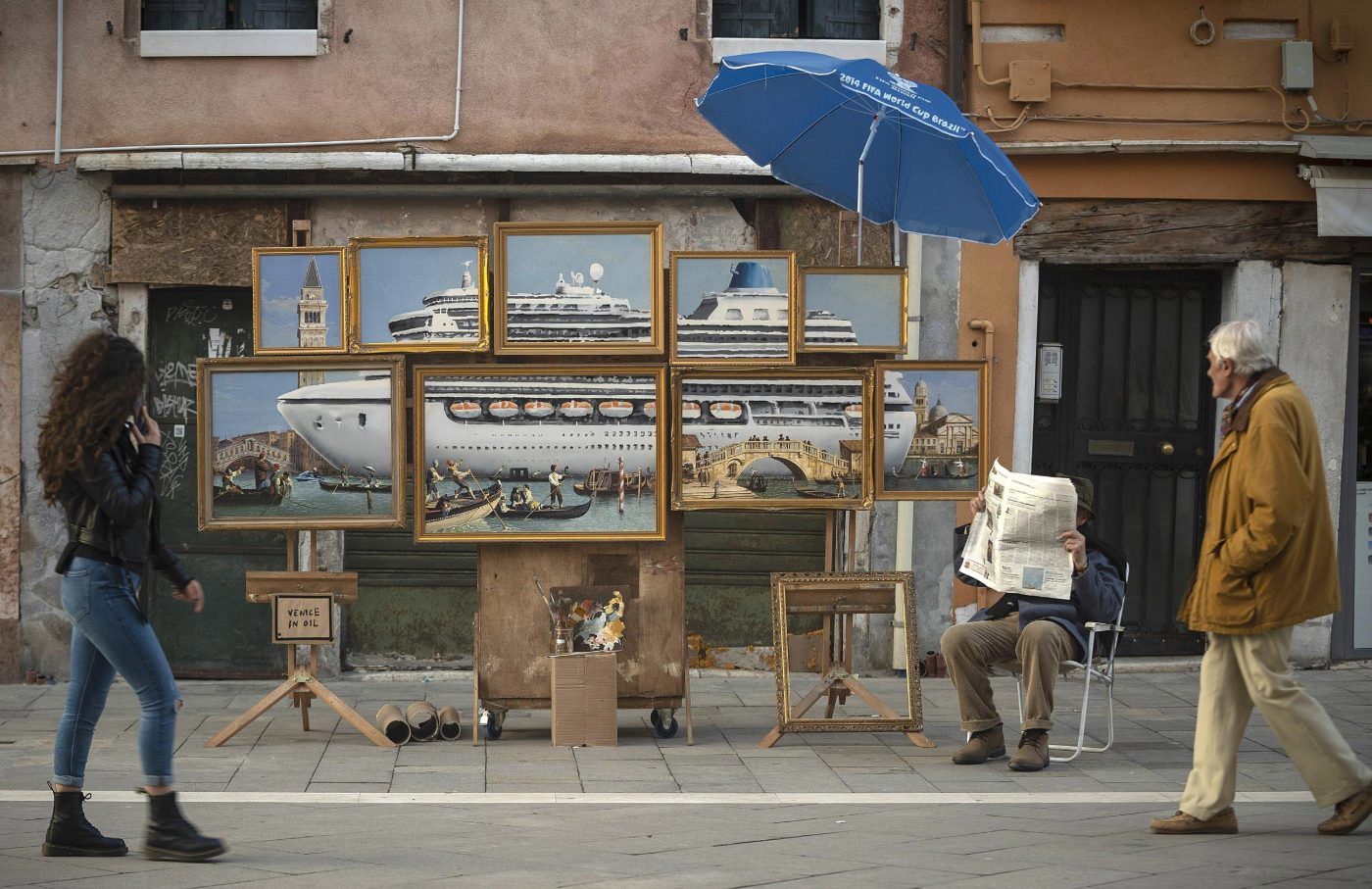
Each individual painting can initially pass for the kind of nostalgic Venetian view a tourist might buy. Only the complete arrangement reveals what has invaded the picture. The cruise ship is so large that it becomes almost absurd, yet its disproportion is grounded in reality: during these years enormous passenger vessels routinely passed through the Venetian lagoon, creating an extraordinary visual collision between the scale of contemporary tourism and the fragile historic city. Contemporary reporting on Banksy’s intervention explicitly connected the work to the environmental and cultural controversy surrounding these ships.
The work is therefore also about consumption. Tourists come to Venice seeking an image of Venice, while the infrastructure required to deliver millions of visitors increasingly threatens the very qualities they have travelled to experience. Banksy turns that contradiction into a picture: the machine bringing people to see Venice becomes so large that they can no longer see Venice.
An Exhibition Outside the Exhibition
The Biennale provided a second target.
Banksy was already one of the world's most famous living artists, yet his relationship with the institutional art world had always been deliberately antagonistic. Earlier interventions had involved clandestinely installing his own works inside major museums. In Venice, he used a different strategy. He placed himself physically outside one of the world's most prestigious art events and transformed that exclusion into the subject of the performance.
The street stall is essential. Had the nine paintings simply been installed inside a pavilion, Venice in Oil would have remained a clever image about cruise ships. Presented by an apparently anonymous street vendor outside the official exhibition, the work became simultaneously a critique of mass tourism, a parody of the art market and an intervention into the Biennale itself.
The distinction between the internationally celebrated artist and the unlicensed pavement seller depended entirely upon knowing that the man behind the stall represented Banksy. Without the name, municipal regulations prevailed.
No Permit
The performance reached its conclusion when officers from Venice’s municipal police approached the stall and asked whether the vendor had authorization. He did not.
They instructed him to leave.
The sequence was almost too perfect. An artist who had not been invited to participate in the Biennale created an exhibition outside it, only to be removed because he lacked permission to occupy the public space. Venice could accommodate an enormous international art festival and vast cruise ships carrying thousands of tourists, but Banksy’s tiny unauthorized art stall could not remain.
Even the police commander later wondered whether the timing had been orchestrated. As the vendor packed up and wheeled his paintings away, an actual cruise liner moved through the Bacino di San Marco behind him—the real object suddenly reproducing the painted image.
That final coincidence, staged or otherwise, completes the work. The paintings cease to be exaggeration. Reality enters the frame.
Inside and Outside
Venice in Oil belongs to a long sequence of Banksy interventions built around permission: who is authorized to make art, where it may be displayed, and who decides when an object becomes culturally valuable. Yet in Venice these questions were unusually concentrated. The Biennale represented institutional legitimacy at its most prestigious; the pavement represented its opposite.
Banksy chose the pavement.
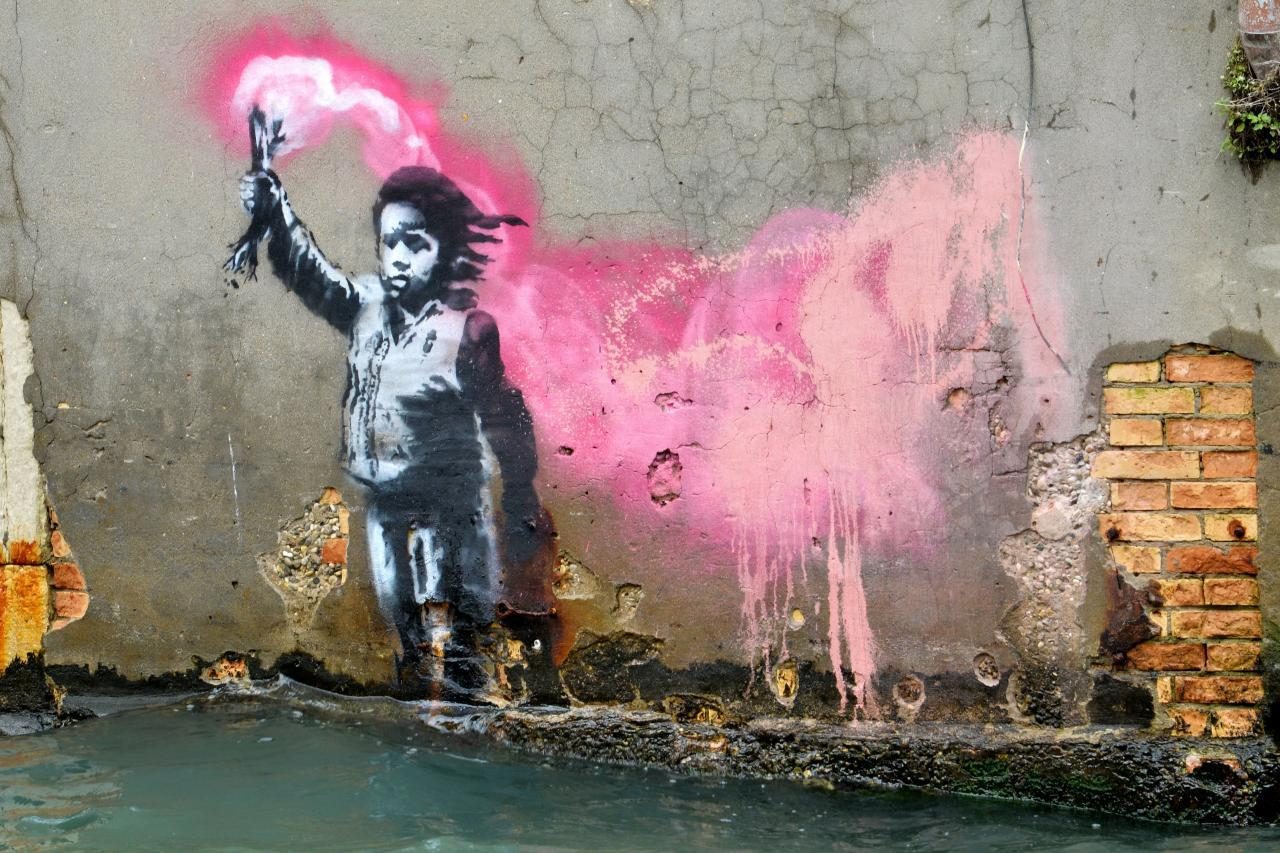
The episode also coincided with another intervention in Venice, the Migrant Child, painted on the wall of a building overlooking a canal and subsequently confirmed through Banksy’s own documentation. Together, the works confronted two uncomfortable realities behind the postcard image of the city: mass tourism arriving aboard enormous ships and human migration arriving under radically different circumstances.
The humor of Venice in Oil should not obscure how carefully constructed the prank was. The paintings, the tourist stall, the absence of authorization, the Biennale, the police intervention and finally the real cruise ship all became components of a single performance.
Banksy was never invited to exhibit at the Venice Biennale. He exhibited there anyway—and being thrown out became part of the exhibition.
STAY INFORMED
Receive the latest news, exhibitions, artworks and market updates on Banksy.