EDWARD HOPPER
Breaking the Silence of Nighthawks
Few twentieth-century paintings have become as deeply embedded in popular culture as Edward Hopper's Nighthawks. Painted in 1942, its late-night diner has become shorthand for the loneliness of the modern city: four people gathered within the same brightly illuminated space yet somehow remaining profoundly alone.
More than sixty years later, Banksy returned to Hopper's diner for one of the most ambitious paintings in his 2005 exhibition Crude Oils. In Are You Using That Chair?, he painstakingly reconstructs Hopper's nocturnal world, then introduces something the original seems almost constitutionally incapable of accommodating: a drunken, half-naked British hooligan. The joke is immediate. The art-historical intervention is considerably more sophisticated.
Edward Hopper: Painting The Modern City
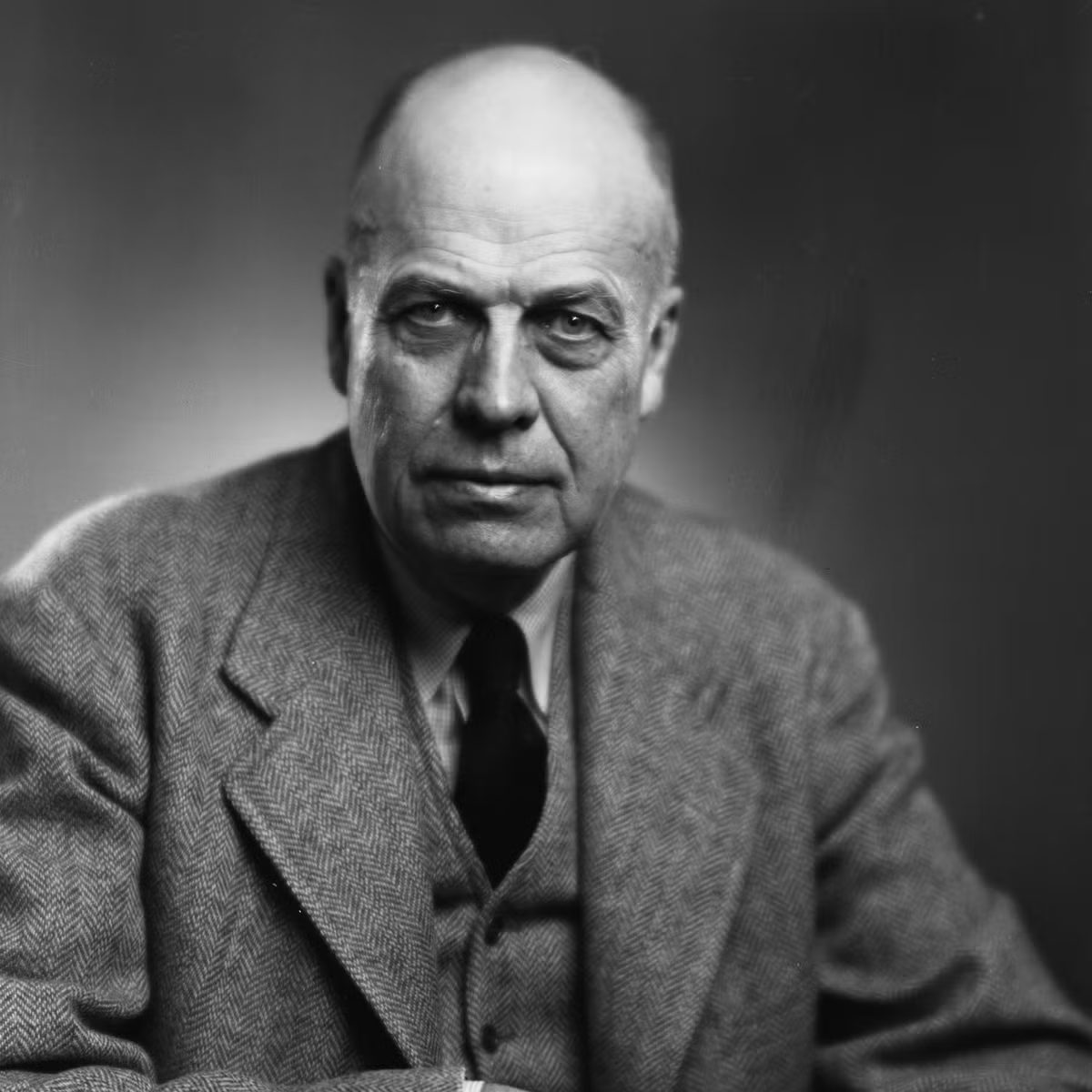
Born in Nyack, New York, in 1882, Edward Hopper spent most of his mature life in New York City, living from 1913 until his death in 1967 at 3 Washington Square North in Greenwich Village. The city became one of the defining subjects of his career, although Hopper largely avoided its monumental architecture and spectacular crowds. Instead, he concentrated on restaurants, theatres, apartments, storefronts, hotel rooms, railway tracks and anonymous streets: the ordinary spaces through which modern urban life was experienced. The Whitney Museum has emphasized the importance of New York to Hopper’s imagination and the way his work repeatedly explored the relationship between public and private space.
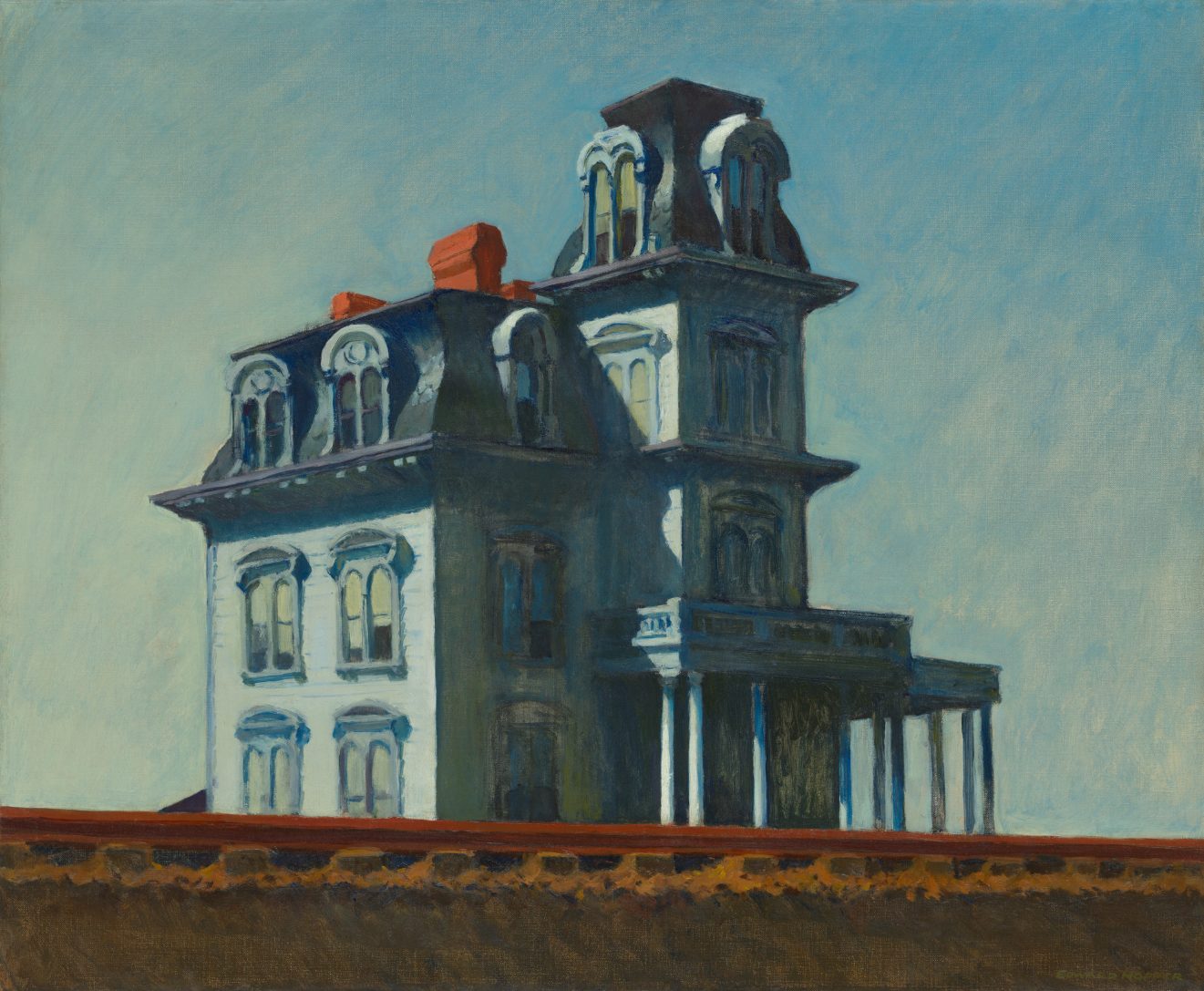
See Edward Hopper's House by the Railroad at the Museum of Modern Art, New-York
His figures frequently inhabit these spaces without fully belonging to them. Couples sit together without obvious communication; solitary men and women stare through windows; hotel rooms and theatres become psychological environments as much as physical ones. Hopper’s paintings are often described in terms of loneliness and alienation, but their emotional register is more elusive. His characters appear absorbed within private worlds whose narratives remain inaccessible to the spectator. Architecture reinforces this condition: walls, windows, counters and pools of artificial light establish boundaries between people who may be physically close but remain psychologically separate.
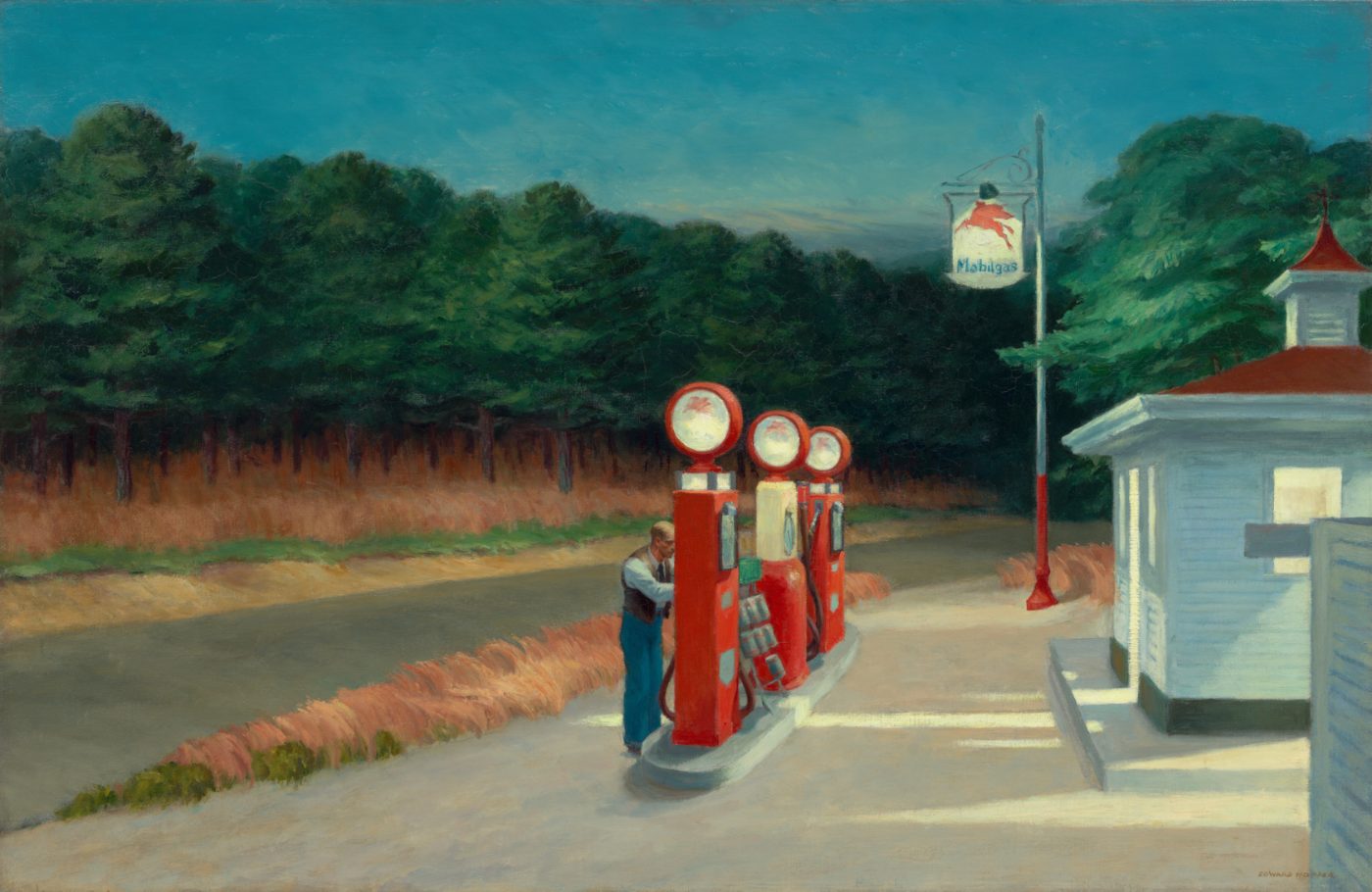
See Edward Hopper's Gas at The Museum of Modern Art, New-York
Hopper’s achievement lies partly in his ability to suggest narrative without resolving it. His paintings resemble scenes extracted from stories whose beginnings and endings remain unknown. The spectator is invited to imagine what has happened or what might happen next, but Hopper withholds sufficient information to prevent any definitive answer. This combination of familiarity and uncertainty gives his urban scenes their distinctive psychological intensity.
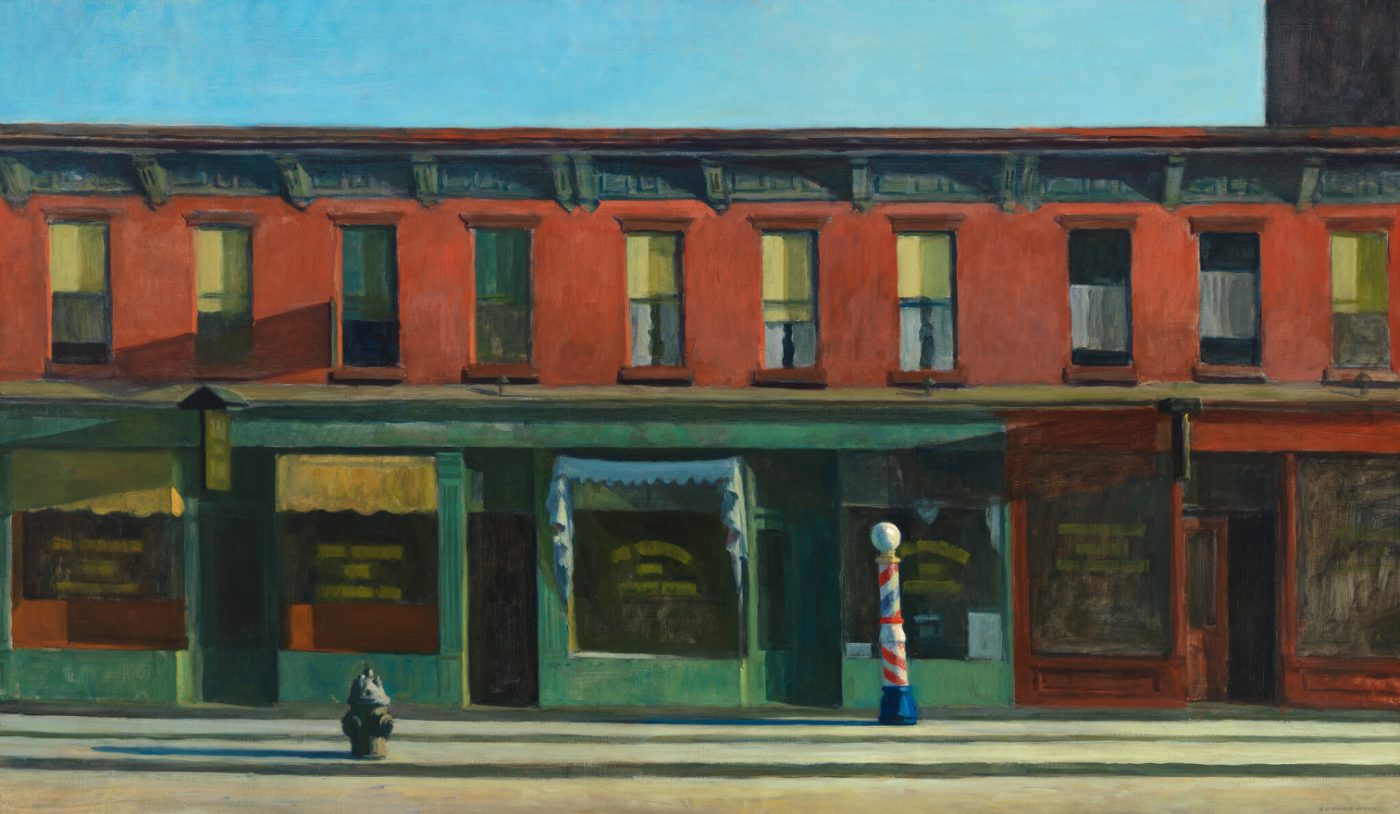
See Early Sunday Morning at the Whitney Museum of American Art
Hopper began Nighthawks shortly after the attack on Pearl Harbor in December 1941 and completed it in January 1942. He explained that the setting had been suggested by a restaurant on Greenwich Avenue where two streets met, although the final diner was an imaginative synthesis rather than the representation of a specific establishment. The Art Institute of Chicago acquired the painting in the year of its completion.
Four figures occupy the brightly illuminated interior. A solitary man sits with his back towards the viewer, while a man and woman sit nearby at the counter. Behind it, an attendant appears to be working or conversing with them. The scene contains almost no explicit action, yet Hopper carefully constructs relationships between the figures through posture, distance and orientation. They share a physical environment without forming a coherent social group.
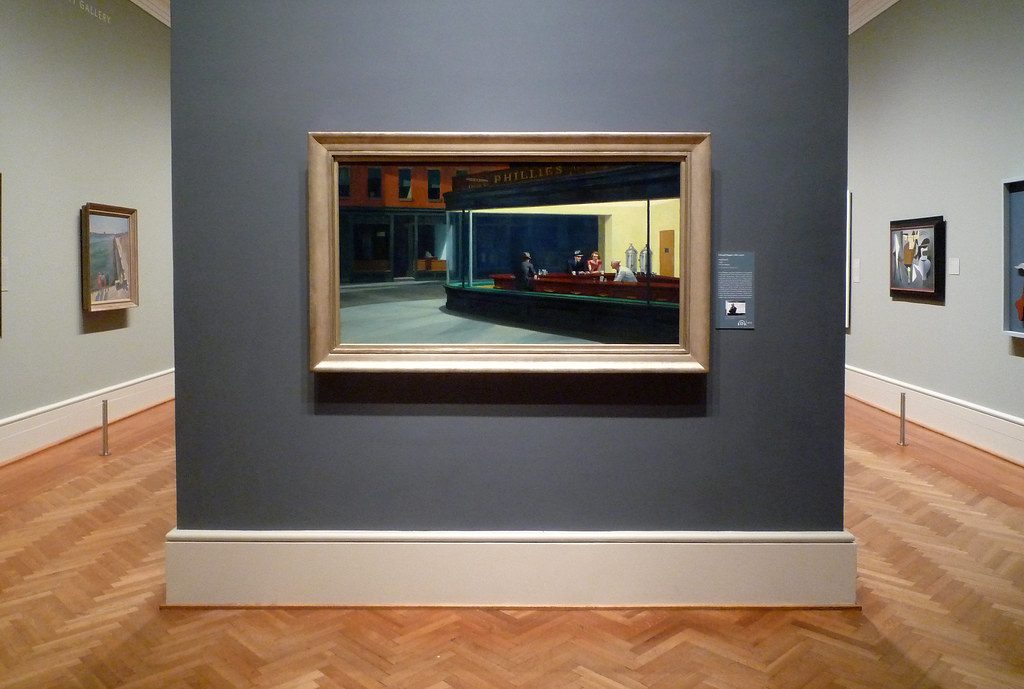
See Nighthawks at The Art Institute of Chicago
Hopper later acknowledged that, although he had not consciously intended to paint loneliness, he was probably expressing what he described as the loneliness of a large city. Artificial illumination is central to that effect. The diner glows against the surrounding darkness, transforming an ordinary commercial interior into something approaching a theatrical stage. Its occupants are exposed to our gaze while the streets surrounding them appear almost completely deserted.
The painting has often been associated with cinema and film noir, although its power does not depend upon any specific cinematic source. Hopper and his wife Jo were enthusiastic moviegoers, and his compositions frequently employ the kinds of framing, illumination and suspended narrative that would later make his paintings particularly attractive to filmmakers. Nighthawks resembles a film still removed from an unidentified sequence: we encounter a situation already underway but are given no reliable means of reconstructing what preceded it or anticipating what will follow.
The Window: Seeing without Entering
One of the most remarkable features of Nighthawks is the enormous curved pane of glass separating the diner from the street. The window allows the spectator almost unrestricted visual access to the interior, yet Hopper provides no obvious entrance. We can observe the customers but cannot join them. The Whitney has described this recurrent relationship between windows, spectatorship and private life as fundamental to Hopper’s treatment of New York, where public and private worlds exist in close proximity without necessarily communicating.
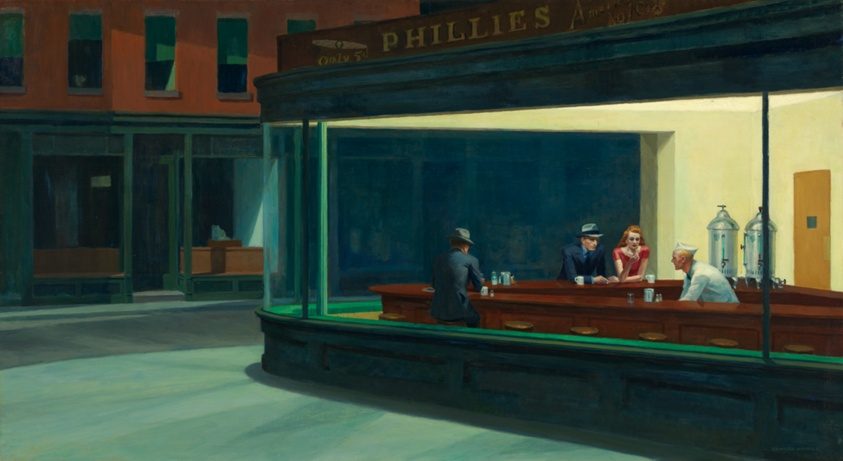
The window therefore performs more than an architectural function. It establishes the spectator as an observer situated outside the social and psychological space of the painting. Hopper repeatedly exploited this tension in works depicting apartments, offices and restaurants viewed through windows: the modern city allows unprecedented access to the lives of strangers while simultaneously preserving their anonymity and distance.
This distinction between interior and exterior is essential to understanding Banksy’s subsequent intervention. The plate glass in Nighthawks preserves Hopper’s carefully controlled separation between the silent world of the diner and the dark city surrounding it. Banksy does not merely add another character to the composition; he places that character precisely on the other side of this boundary and makes the boundary itself vulnerable.
Banksy Enters Hopper's Diner
Banksy preserves the essential architecture and principal characters of Hopper’s composition while radically expanding the action outside it. A bare-chested, skinheaded man wearing Union Jack boxer shorts stands on the pavement, apparently shouting or gesticulating towards the people inside. Plastic chairs have been displaced and the previously immaculate glass of the diner has been cracked. The intruder has generally been understood as an exaggerated caricature of the British football hooligan, importing into Hopper’s restrained American scene a familiar stereotype of drunken British behavior abroad.
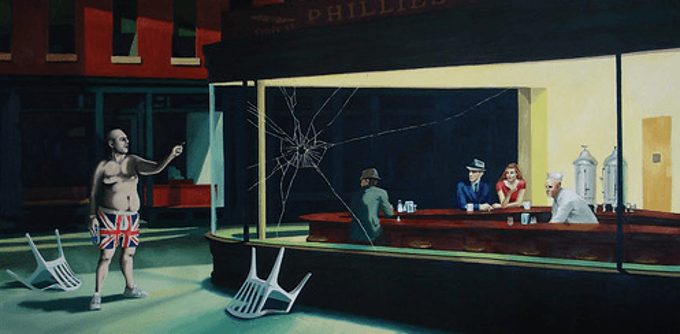
The contrast is deliberately excessive but carefully constructed. Hopper’s figures are static and introspective, while Banksy’s outsider is animated and confrontational. Their environment is controlled and illuminated; his is disorderly and exposed. The customers communicate little, whereas the intruder appears determined to make himself heard. Banksy consequently does not need to alter Hopper’s protagonists substantially. Their original stillness becomes newly conspicuous when confronted with a character governed by an entirely different social and visual language.
National stereotypes also contribute to the humor. Nighthawks has become an almost mythological representation of urban America, celebrated for its restraint, melancholy and cinematic sophistication. Banksy introduces an aggressively stereotyped Brit whose Union Jack underwear announces his nationality with none of Hopper’s subtlety. The juxtaposition produces a deliberately crude collision between two cultural identities, but it also allows Banksy to explore questions of belonging and exclusion. The customers occupy the warm, illuminated interior while the disruptive outsider remains on the pavement, physically and socially separated from them.
Breaking The Glass
The cracked window is therefore one of Banksy’s most significant alterations to the original composition. Hopper’s glass separates spectator from subject and exterior from interior while permitting visual communication between them. Banksy converts this psychological boundary into the apparent target of physical aggression. The hooligan has not entered the diner, but the integrity of the barrier protecting it has been compromised.
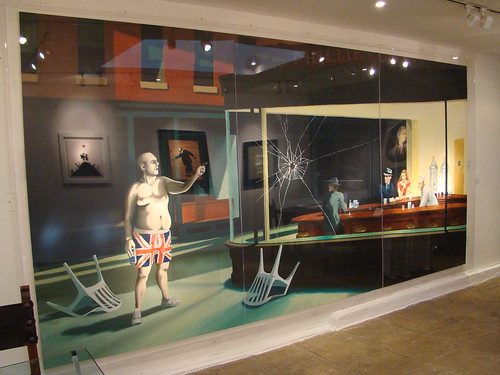
This intervention changes the emotional structure of the scene. Hopper’s tension derives partly from the possibility that nothing will happen: the painting suspends its inhabitants within an apparently endless nocturnal moment. Banksy introduces the possibility of an event. The outside world can no longer be regarded as merely empty space surrounding the diner; it has acquired a disruptive human presence capable of intruding upon its carefully maintained order.
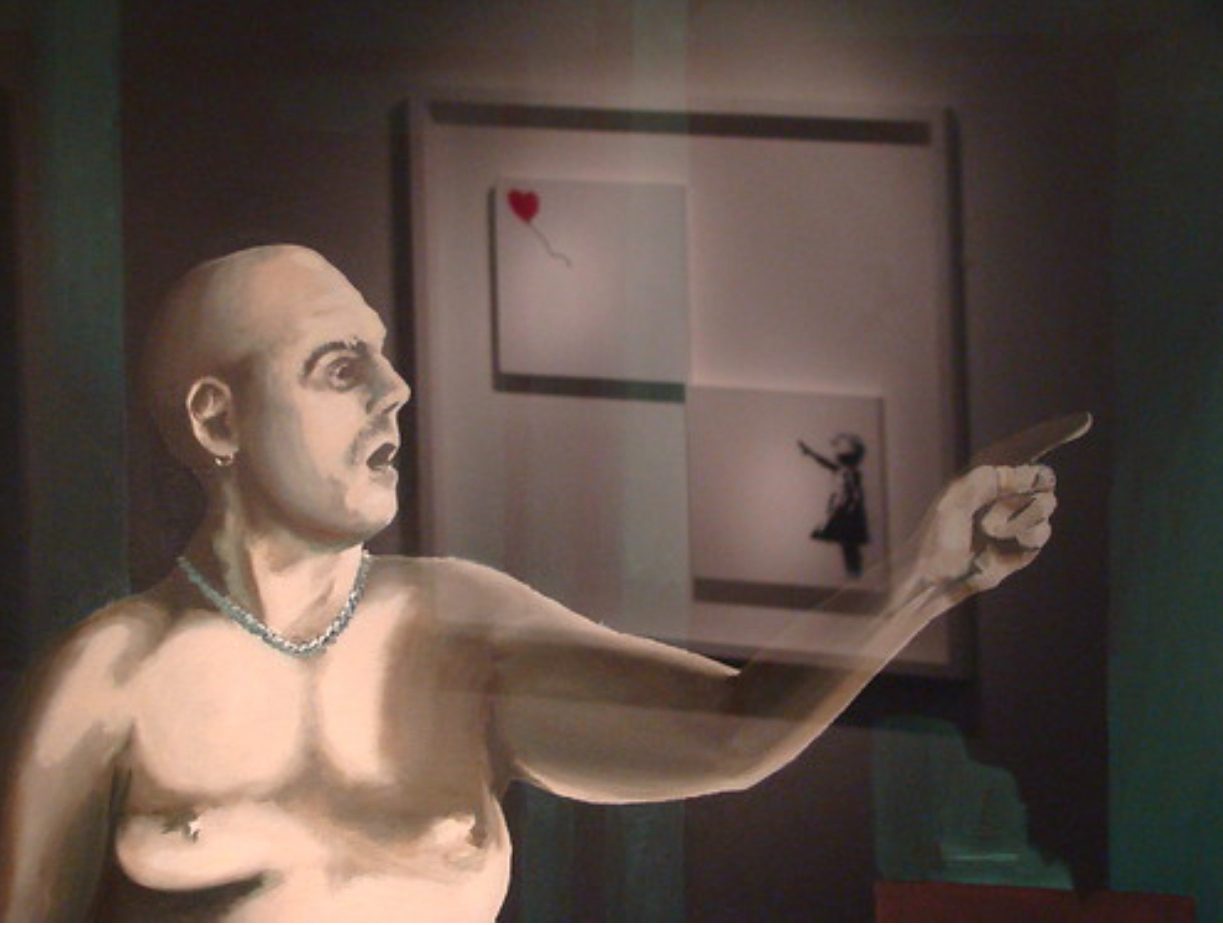
The humor therefore depends upon a sophisticated understanding of Hopper rather than upon simple visual parody. Banksy identifies one of the principal mechanisms through which Nighthawks produces its psychological effect—the separation of interior and exterior—and attacks precisely that mechanism. The act of vandalism is conceptual as much as physical: what has been damaged is Hopper’s carefully constructed atmosphere of distance and containment.
Are You Using That Char?
The title adds another layer to the intervention. “Are you using that chair?” ordinarily belongs to the minor rituals of public politeness, a courteous question asked before taking an apparently unoccupied seat. Banksy retains the language of civility while presenting a scene in which the chairs appear to have become objects of disorder, perhaps even projectiles.
This contradiction between polite language and aggressive behavior is characteristic of Banksy’s humor. A conventional social formula becomes absurd when detached from the circumstances in which it normally operates. The title also introduces an ambiguity that the painting deliberately refuses to resolve: is the outsider attempting to participate in the social space from which he is excluded, mocking its conventions, or simply attacking it?
That uncertainty prevents the work from becoming a straightforward caricature of hooliganism. Banksy’s intruder is grotesque, but the people inside remain conspicuously indifferent and inaccessible. The distinction between respectable interior and disorderly exterior can consequently be read not only in terms of behavior but also through class, social exclusion and the regulation of public space. As elsewhere in Banksy’s work, humor provides an immediate point of entry while leaving the underlying hierarchy less comfortably resolved.
Hopper, Cinema and The Interrupted Narrative
Banksy’s intervention also exploits the cinematic character frequently associated with Hopper’s work. Hopper and Jo were regular visitors to cinemas and theatres, and paintings such as New York Movie demonstrate his sustained interest in artificial illumination, spectatorship and the psychological separation between individuals sharing the same public environment. The Whitney has documented the importance of both theatre and cinema within Hopper’s experience of New York.
Nighthawks is particularly receptive to narrative projection because Hopper gives the spectator so little explicit information. The diner seems to contain a story, yet the painting never identifies it. Banksy effectively exploits this narrative vacuum by imagining an event occurring immediately outside Hopper’s original frame. Rather than replacing the existing scene, he extends it and introduces an incident capable of disturbing its equilibrium.
This distinguishes Are You Using That Chair? from a simple visual quotation. Banksy treats Hopper’s painting almost as an existing piece of narrative material whose latent possibilities can be developed. Recognition of Nighthawks remains essential, but the intervention asks the viewer to reconsider the original composition by imagining what its carefully controlled world would look like if the silence were interrupted.
Crude Oils: Remixing The Canon
Are You Using That Chair? was presented at Banksy’s 2005 exhibition Crude Oils: A Gallery of Re-mixed Masterpieces, Vandalism and Vermin, alongside a substantial group of works in which familiar images from art history were reconstructed, altered or deliberately corrupted. Monet’s idyllic water garden became contaminated by discarded shopping trolleys in Show Me the Monet; Van Gogh’s sunflowers were subjected to the visual language of contemporary petroleum culture; other landscapes and portraits acquired military hardware, environmental damage or unexpected intruders.
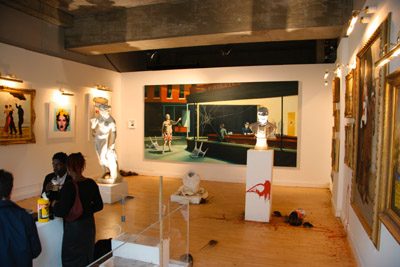
The exhibition established an intentionally unstable relationship between admiration and vandalism. Banksy could only successfully disrupt these paintings because he understood their visual language and because the originals were sufficiently familiar for the alteration to remain legible. His interventions therefore depend upon the cultural authority of the very canon they appear to mock. Rather than simply rejecting art history, Crude Oils treats it as a living visual vocabulary capable of being appropriated and redirected toward contemporary concerns.
The medium reinforces this dialogue. Are You Using That Chair? is an oil painting on a monumental scale, produced by an artist principally associated with stencil and aerosol. Banksy reconstructs a canonical painting through the traditional language of painting before introducing the kind of disruptive gesture associated with his street practice. Painter and vandal consequently coexist within the same object: the first creates the conditions necessary for the second to intervene.
Two Visions of the Modern City
Hopper and Banksy are separated by generation, geography, technique and temperament, yet both are profoundly concerned with the social experience of the modern city. Hopper observes urban life through interiors, illuminated windows, empty streets and individuals caught between public visibility and private consciousness. Banksy approaches the city more confrontationally, treating walls and public spaces as territories in which political, economic and social relationships can be exposed and contested.
Are You Using That Chair? brings those two visions into direct contact. Hopper’s city allows people to occupy the same space while remaining psychologically isolated; Banksy’s city is more unstable, subject to interruption, conflict and the unpredictable behavior of those who occupy its margins. By introducing his outsider into Nighthawks, Banksy does not invalidate Hopper’s vision but tests its boundaries against a different conception of urban experience.
The success of the work ultimately depends upon this balance between recognition and disruption. Enough of Hopper’s painting survives for its atmosphere to remain perceptible, while Banksy’s intervention makes that atmosphere newly visible by violating it. The silence, isolation, artificial light and separation between interior and exterior that define Nighthawks become clearer precisely because Banksy introduces their opposites. What initially appears to be a comic act of art-historical vandalism therefore becomes a surprisingly attentive dialogue with Hopper: an artist of contemporary urban disorder confronting one of the twentieth century’s great painters of urban solitude.
STAY INFORMED
Receive the latest news, exhibitions, artworks and market updates on Banksy.