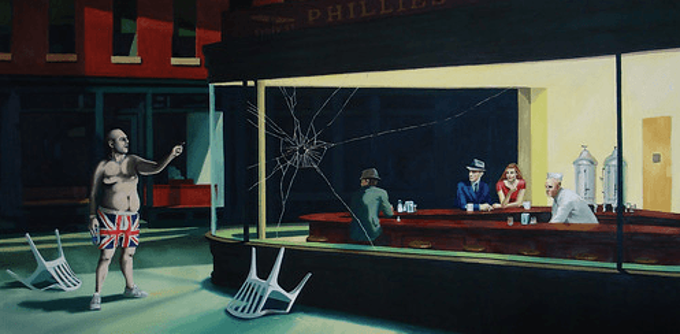
Nighthawks, Interrupted
Created for Banksy's landmark Crude Oils exhibition in 2005, Are You Using That Chair? is a monumental reworking of Edward Hopper's Nighthawks (1942), one of the most recognizable paintings in twentieth-century American art. Banksy reconstructs Hopper's nocturnal diner and its famously introspective inhabitants, only to introduce an aggressively incongruous figure outside the window: a bare-chested, skinheaded man wearing Union Jack boxer shorts, gesticulating towards the customers inside. Two plastic chairs lie scattered on the pavement and the diner's immaculate plate-glass window has been cracked.
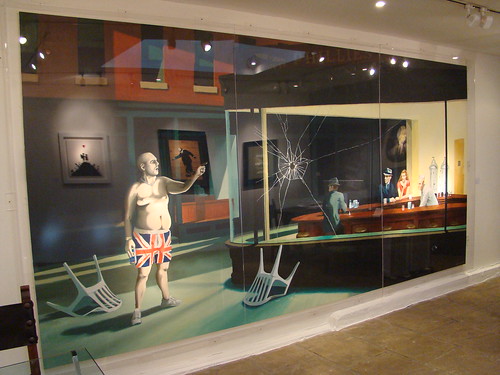
The intervention is both comic and violent. Hopper's original derives much of its extraordinary atmosphere from stillness: four figures occupy a brightly illuminated diner surrounded by the emptiness of the sleeping city. They share a physical space while remaining psychologically isolated from one another and from the spectator, who observes them through the enormous curved window. Banksy preserves that carefully constructed world only to allow contemporary disorder to erupt immediately outside it.
The British Invasion
Banksy's intruder has generally been interpreted as a caricature of the British football hooligan. His shaved head, Union Jack underwear and overturned plastic chairs evoke a familiar tabloid image of British tourists and football supporters behaving badly abroad. Research into Crude Oils identifies Harvey Haddock as the model for the figure and connects the imagery to press photographs of British football hooliganism.
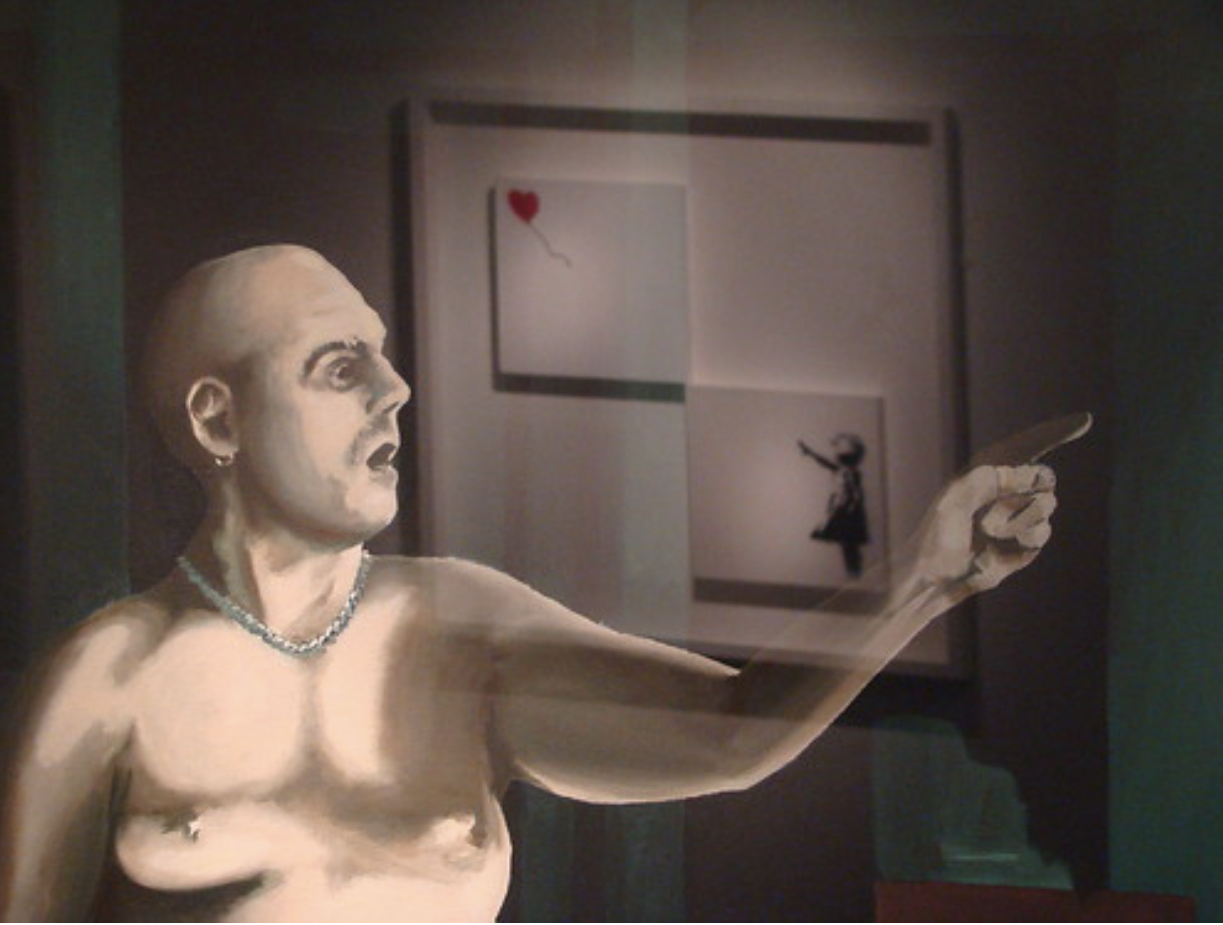
The national contrast is deliberately exaggerated. Hopper's diner has become an almost mythological image of urban America: restrained, cinematic and psychologically sophisticated. Into this exquisitely controlled environment Banksy inserts an aggressively stereotyped Brit who appears incapable of respecting either the window, the furniture or the atmosphere.
The title supplies the final joke. Are You Using That Chair? transforms the polite question one might ask before borrowing an empty seat into something considerably less civilized. The chairs are no longer being requested; they appear to have become projectiles.
Yet the comedy also introduces questions of class, nationalism and exclusion. The hooligan remains outside while Hopper's customers sit within the illuminated interior, separated from him by glass. Whether he is trying to join them, confront them or simply destroy their tranquility remains unresolved. Banksy turns Hopper's psychological barrier into a literal one—and then cracks it.
Banksy as a Painter
The medium is particularly significant. At approximately 4.26 metres wide, Are You Using That Chair? is an enormous oil painting, executed by an artist principally associated with stencil and aerosol. Contemporary research identifies it as one of the major fully painted “remixes” created for Crude Oils, alongside Banksy's transformations of Monet, Van Gogh and Jack Vettriano.
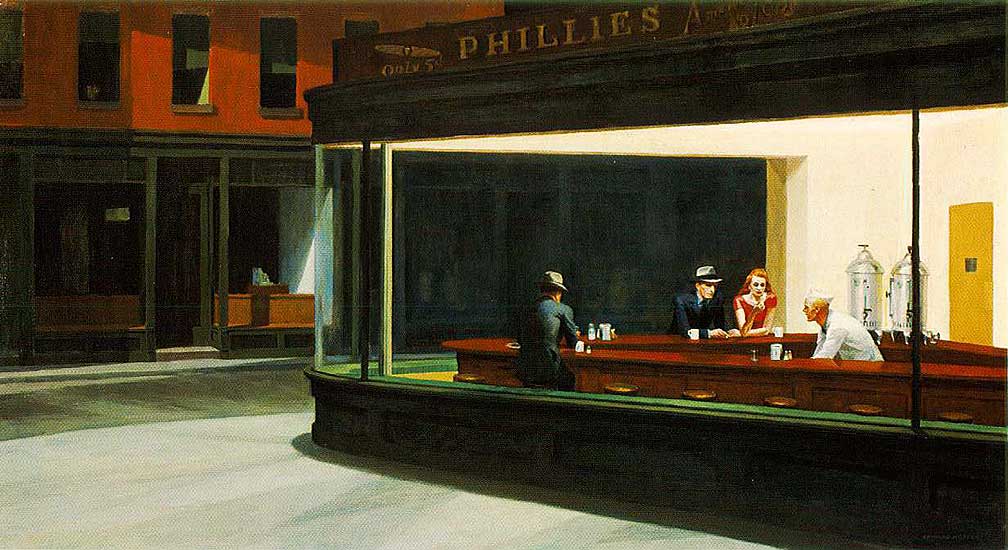
Rather than simply stenciling an intervention onto an existing reproduction, Banksy recreates Hopper's pictorial world in paint before vandalizing his own reconstruction. The distinction is important. The act of appropriation requires considerable labor: Banksy must first become the painter before he can become the vandal.
This tension lies at the heart of Crude Oils. The exhibition simultaneously demonstrated Banksy's knowledge of the canon and his refusal to treat it reverentially. Masterpieces became raw material—images sufficiently embedded in collective memory that a single disruptive addition could fundamentally alter their meaning.
Crude Oils, 2005
Within Crude Oils, Are You Using That Chair? belonged to a remarkable group of reimagined paintings. Monet's idyllic water garden became choked with abandoned shopping trolleys in Show Me the Monet; Van Gogh's sunflowers wilted beneath the sign of a petrol station in Sunflowers from Petrol Station; and Jack Vettriano's romantic beach scene was invaded by environmental catastrophe.
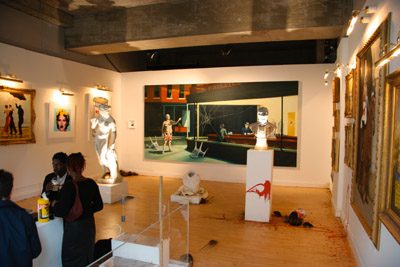
Banksy's treatment of Hopper is different. He does not introduce pollution, consumer waste or an overt political symbol. Instead, he introduces another human being. The vandalism comes from the collision between two social and visual worlds: Hopper's carefully orchestrated American solitude and Banksy's grotesquely exuberant British outsider.
The result remains one of the most ambitious paintings of the Crude Oils period. Banksy does not destroy Nighthawks. He understands precisely what makes Hopper's painting work—and then introduces the one thing its immaculate silence cannot possibly accommodate: someone making a scene.
STAY INFORMED
Receive the latest news, exhibitions, artworks and market updates on Banksy.