BANKSY IN PALESTINE: BEYOND THE WALL, AUGUST 2005
Painting the Impossible
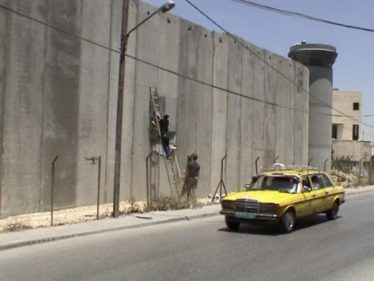
In August 2005, Banksy travelled to the West Bank and created nine interventions on the Palestinian side of the barrier. The works appeared around Bethlehem, Abu Dis and Ramallah, with individual images also documented around the Qalandiya area. Banksy subsequently published photographs from the trip on his website under the deliberately casual description of “holiday snaps.”
Palestine is now the world's largest open-air prison and the ultimate activity holiday destination for graffiti artists.
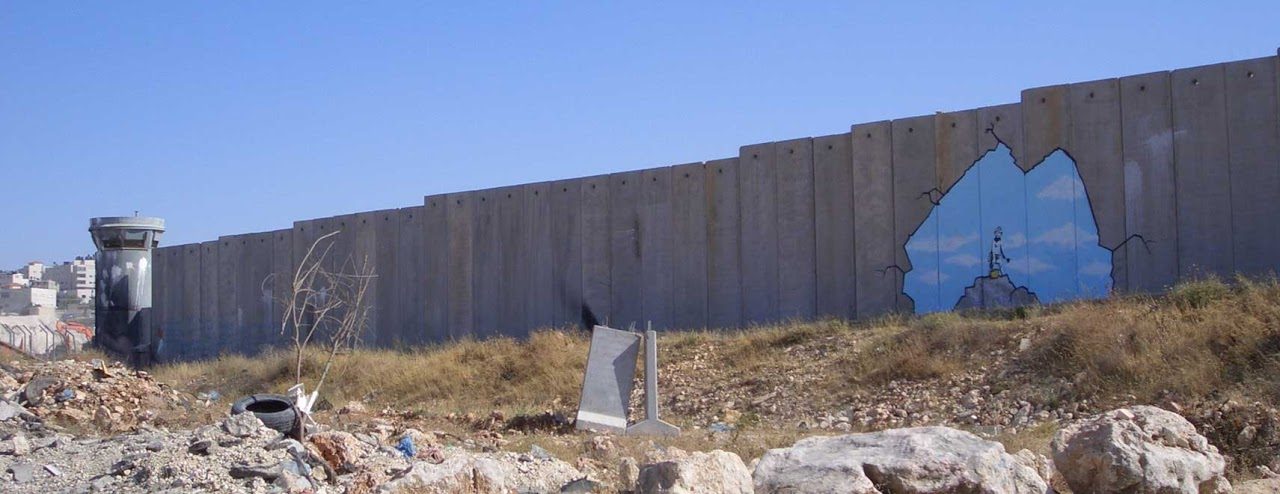
The intervention would become one of the defining episodes of Banksy's career. Rather than covering the barrier with conventional political slogans, Banksy repeatedly attacked its most fundamental characteristic: its apparent solidity. Windows appear in the concrete. Painted openings reveal mountains, beaches and blue skies. Children stand before imaginary passages through it. A ladder climbs toward its summit. A girl simply floats above it with balloons.
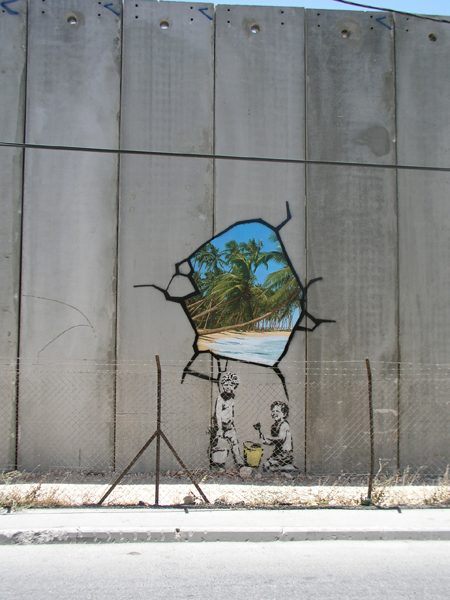
Banksy was not attempting to disguise the wall. He was imagining what the world might look like without it.
The Wall
Construction of the West Bank barrier had begun in 2002 during the Second Intifada. Israel argued that the barrier was necessary to prevent terrorist attacks and protect Israeli civilians. Palestinians opposed its route through the West Bank, the restrictions it imposed on movement and access, and the separation it created between communities, agricultural land, workplaces and Jerusalem.
In July 2004, the International Court of Justice issued an advisory opinion concluding that the construction of the barrier within the occupied Palestinian territory, together with its associated regime, was contrary to international law.
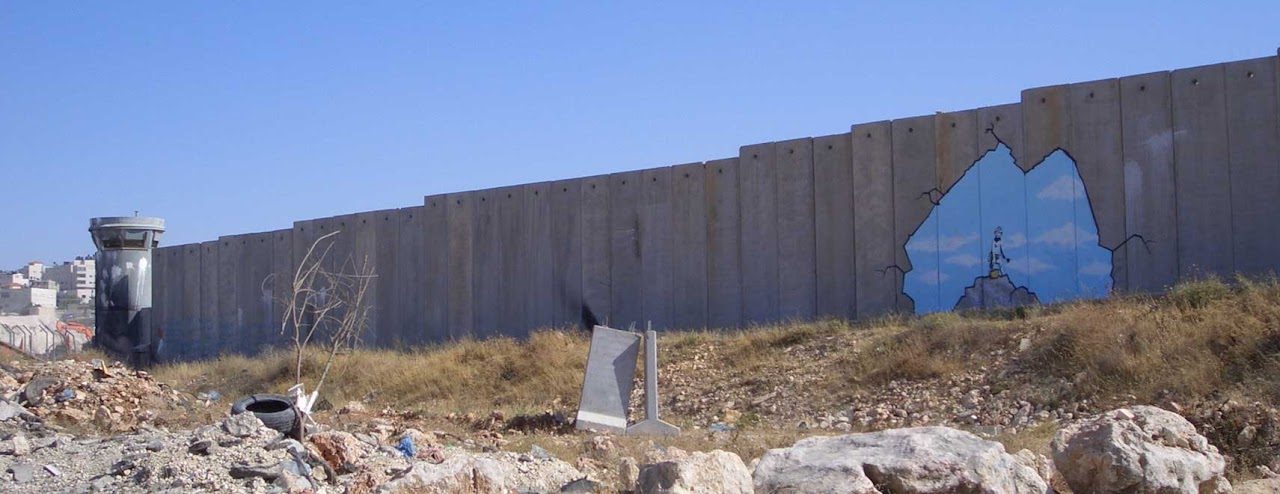
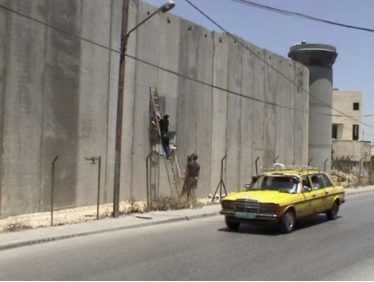
By the time Banksy arrived in 2005, enormous sections of concrete had become an unavoidable feature of the landscape. In densely populated areas, the barrier rose to approximately eight metres, its blank surfaces presenting Banksy with both a political symbol and an extraordinary physical canvas.
Banksy described Palestine provocatively as “the world's largest open-air prison” and joked that the barrier had transformed it into “the ultimate activity holiday destination for graffiti writers.” His black humor did not diminish the seriousness of the subject. Instead, it established the method he would use throughout the intervention: confronting an overwhelming political reality with images of deliberately improbable simplicity.
Escaping Through Concrete
The nine works repeatedly return to a remarkably small vocabulary: windows, holes, ladders, balloons, landscapes and children. Almost all concern movement.
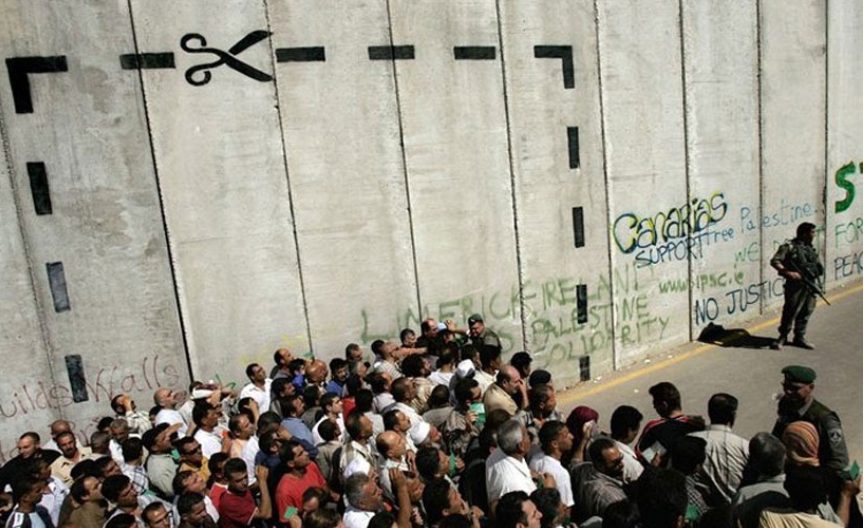
Banksy rarely depicts the political leaders responsible for the conflict, nor does he attempt to explain its history through lengthy slogans. Instead, he concentrates on one of the most immediate consequences of the barrier itself: the regulation of physical space and the restriction of passage.
The concrete therefore becomes part of every composition. Its height gives meaning to the ladder. Its solidity gives meaning to the imaginary openings. Its grey surface intensifies the blue skies and landscapes painted beyond it. Its function gives meaning to the child floating overhead.
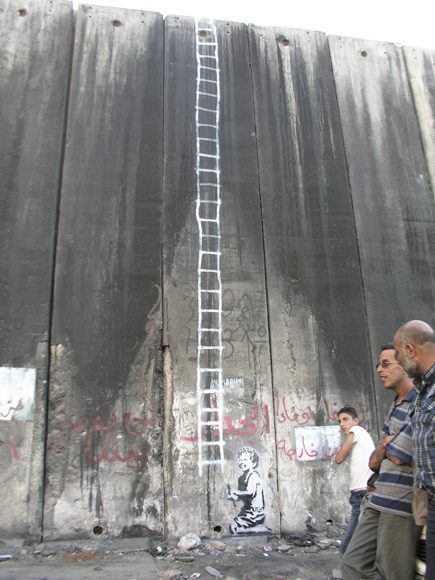
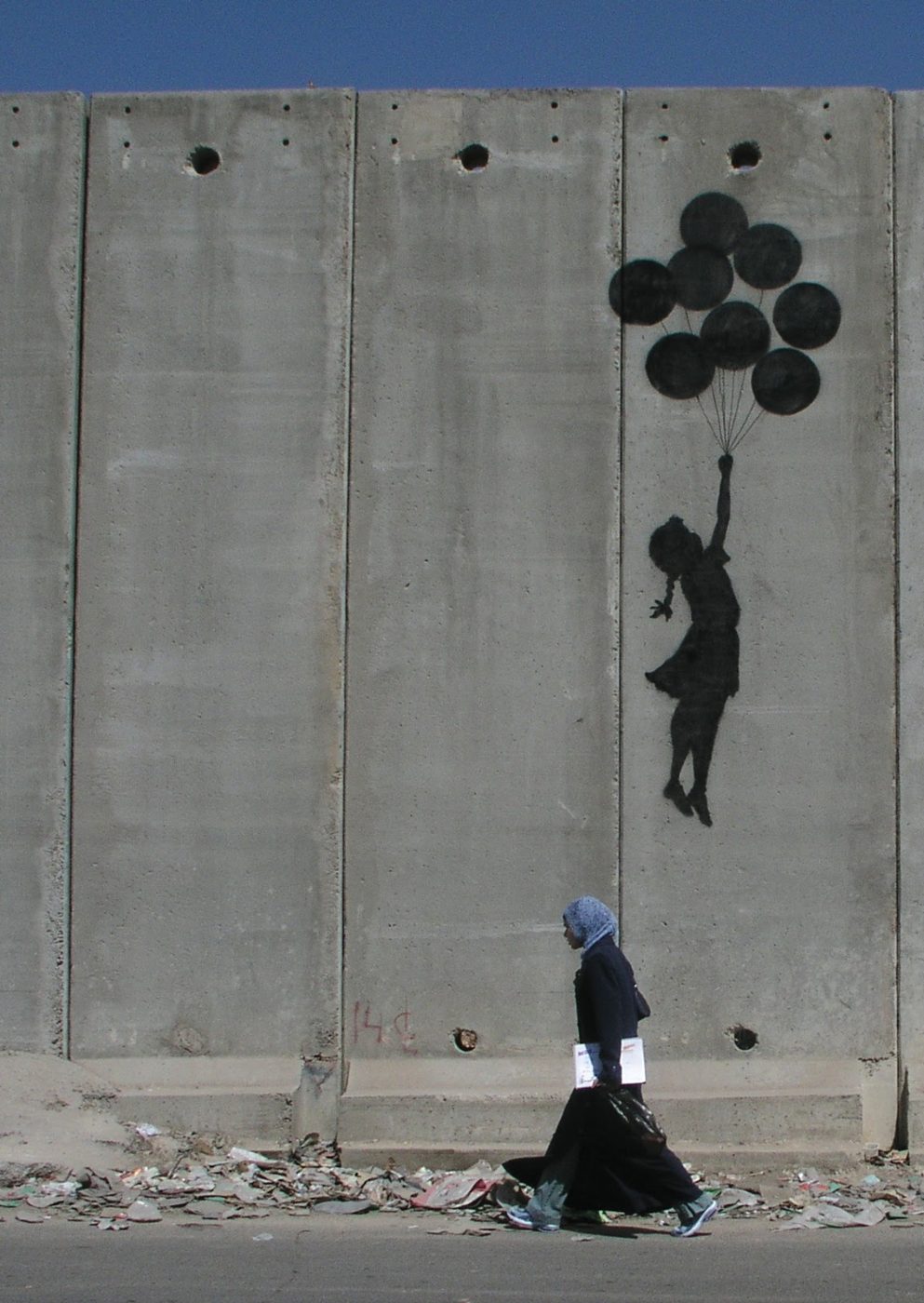
The works offer escape repeatedly, but never actually provide it. A painted window cannot be opened. An imaginary hole cannot be crossed. A painted ladder cannot be climbed. Balloons cannot carry a child over an eight-metre concrete barrier.
The fantasy remains compelling precisely because the obstacle is real.
Nine Images, One Proposition
Although the interventions differ considerably in appearance, together they form an unusually coherent body of work. Again and again, Banksy imagines the barrier becoming permeable.
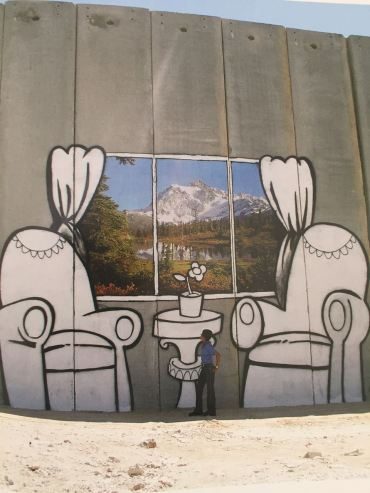
Sometimes the transformation is architectural: a window, a hole, an opening. Elsewhere the solution belongs to childhood fantasy: balloons or an impossible ladder. Cut It Out abandons the illusion altogether and proposes the removal of the structure itself.
Children appear repeatedly throughout the campaign. Their presence removes the works from the language of military or diplomatic confrontation and returns the consequences of the barrier to an ordinary human scale. Against vast expanses of concrete, their bodies appear extraordinarily small. Yet within Banksy's imaginary world, they are often the figures capable of overcoming it.
The contrast between their vulnerability and the scale of the architecture is central to the intervention. Banksy confronts an enormous structure not with heroic figures or grand political gestures, but with children playing, looking, climbing and dreaming of somewhere beyond the concrete.
A Palestinian Response
Banksy's own account of the trip contains one of the most revealing episodes in the history of the project.
According to the story published on his website, an elderly Palestinian man watched Banksy working and told him that his painting made the wall beautiful. Banksy thanked him.
The man replied:
“We don't want it to be beautiful, we hate this wall. Go home.”
The exchange complicates any comfortable interpretation of the intervention.
For an international artist and his audience, transforming the barrier into art could be understood as an act of resistance. For someone forced to live beside it, beautifying the structure could equally be perceived as making an intolerable reality more visually acceptable.
Banksy chose to publish the criticism himself. Rather than presenting his intervention as unquestionably virtuous, he allowed the limitations—and perhaps the contradictions—of his own position to become part of its history.
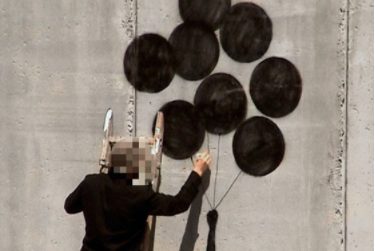
Art can draw attention to a wall. It can ridicule it, photograph it and circulate images of it around the world. It cannot make the wall disappear.
The Wall as Medium
The 2005 intervention marked an important development in Banksy's street practice because architecture became more than a surface carrying an image. The physical structure itself became part of the work.
Remove Window on the West Bank from the barrier and it becomes a surreal domestic scene. Remove Beach Boys and its tropical landscape from the concrete and much of the contradiction disappears. Separate Balloon Debate from the enormous height of the wall and the girl's ascent loses its urgency.
Banksy was not simply painting pictures on the barrier. He was painting pictures of a world in which the barrier did not exist.
The works therefore depend upon the specific physical and political properties of their location. Banksy's imaginary openings are meaningful because the real barrier cannot be opened. His escape routes matter because movement is restricted. The idyllic landscapes become powerful because they appear precisely where the viewer cannot simply walk toward them.
After 2005
The intervention established a relationship between Banksy and Palestine that would continue for more than a decade.
He returned to Bethlehem in 2007 for Santa's Ghetto, producing another group of politically charged works including Donkey Documents, Girl Frisking Soldier and Armoured Dove of Peace. In 2015, he travelled to Gaza, where new works appeared among buildings devastated by conflict. Two years later, in 2017, he opened The Walled Off Hotel in Bethlehem, directly overlooking the barrier.
The 2005 intervention therefore represents the beginning of a sustained engagement rather than an isolated excursion. It also established a method Banksy would return to elsewhere: responding not merely to a political situation but to its physical environment, allowing walls, ruins, architecture and existing objects to become active elements within the work.
The survival of the original interventions has been uneven. Exposure, repainting, alteration, subsequent graffiti and changes to the barrier have transformed or eliminated several of them. Contemporary photographs have consequently become essential records of works whose meaning depended upon a particular place at a particular moment.
Twenty years later, the conceptual simplicity of the intervention remains striking. Banksy confronted one of the most politically charged structures in the world with remarkably modest propositions: a window, a beach, a child, some balloons, a ladder and a pair of scissors.
None of them can overcome the concrete in reality. Within the images, they repeatedly do.
That tension between physical restriction and imaginative freedom gives the 2005 intervention its enduring power. Banksy does not pretend that art can remove a wall. He asks us, nine times, to imagine what the world might look like without it.
The Nine Interventions
1. Window on the West Bank
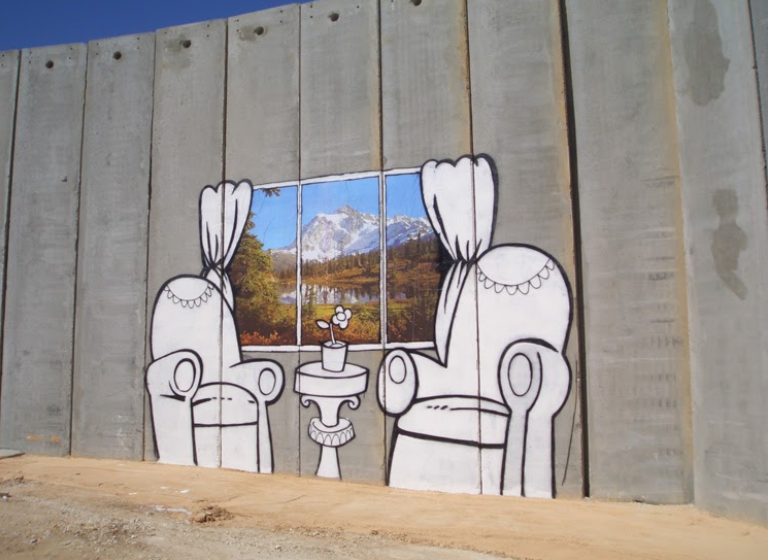
Banksy transforms the concrete barrier into the wall of an imaginary sitting room. Monumental armchairs flank a curtained window opening onto mountains, trees and brilliant blue sky. The architecture of separation momentarily becomes the architecture of a home, while the greatest luxury in the room is simply the possibility of a view.
2. Unwelcome Intervention (Beach Boys)
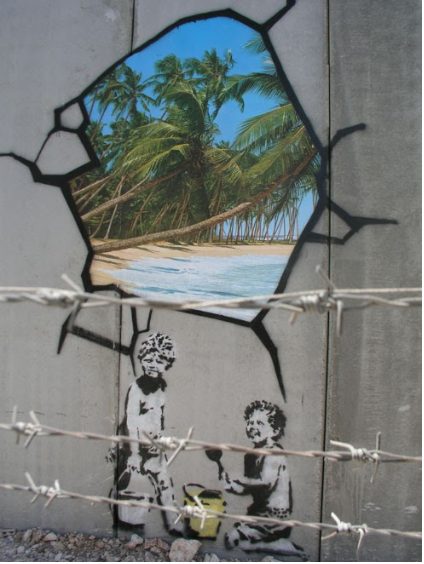
Two children carrying a bucket and spade stand beneath an apparent rupture in the concrete. Through the opening lies a tropical beach of white sand, turquoise water and palm trees. Paradise appears tantalizingly close, yet exists only as paint on the surface of the barrier.
3. Art Attack (Child Through The Wall)
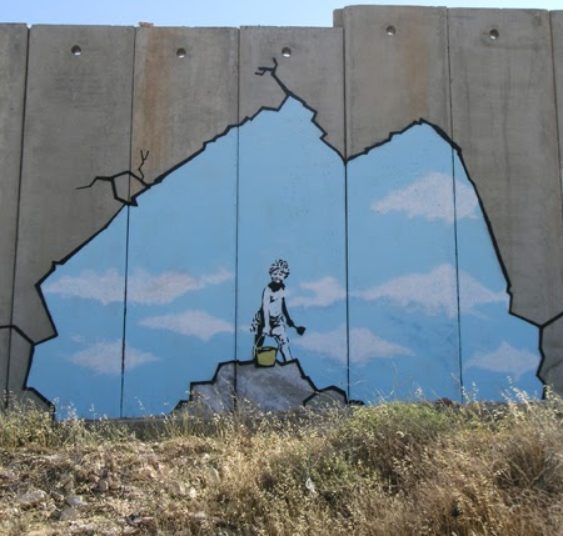
A small child stands at the centre of an enormous imaginary breach in the concrete, holding a bucket and spade while brilliant blue sky appears beyond. Rather than offering an exotic destination, Banksy reduces the idea of freedom to something elemental: open space itself.
4. Balloon Debate (Girl with Balloons)
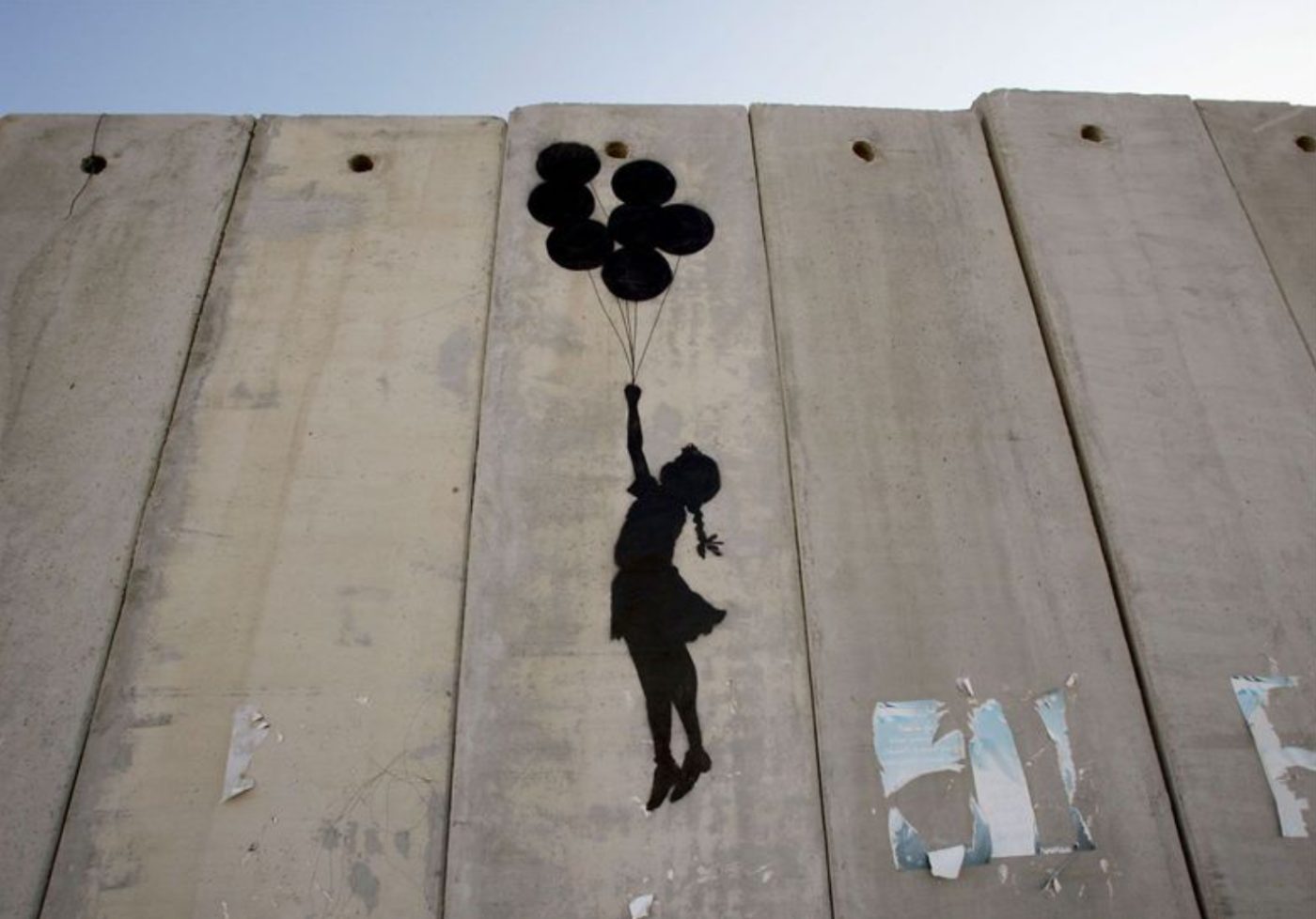
A young girl rises toward the top of the barrier, carried by a cluster of balloons. The title refers to the traditional British “balloon debate,” in which participants must argue who deserves to remain aboard a failing hot-air balloon and who must be sacrificed—adding questions of survival, exclusion and belonging to an apparently innocent image of escape.
5. Escapism (The Ladder)
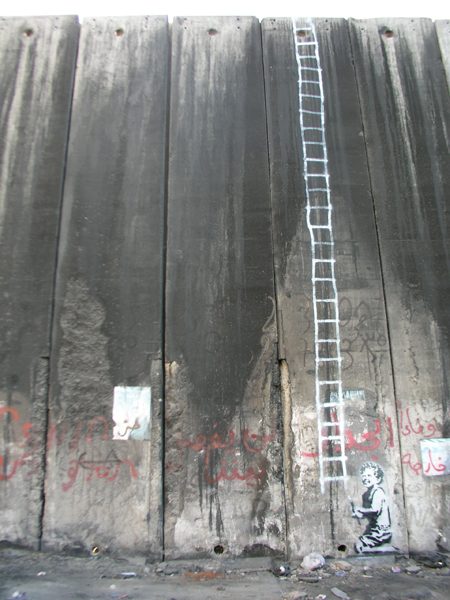
A small boy crouches beneath an enormous white ladder painted vertically up the concrete. The solution appears almost comically straightforward, yet the ladder is as unusable as the wall is real. An escape route has been provided visually while remaining physically impossible.
6. Cut it Out
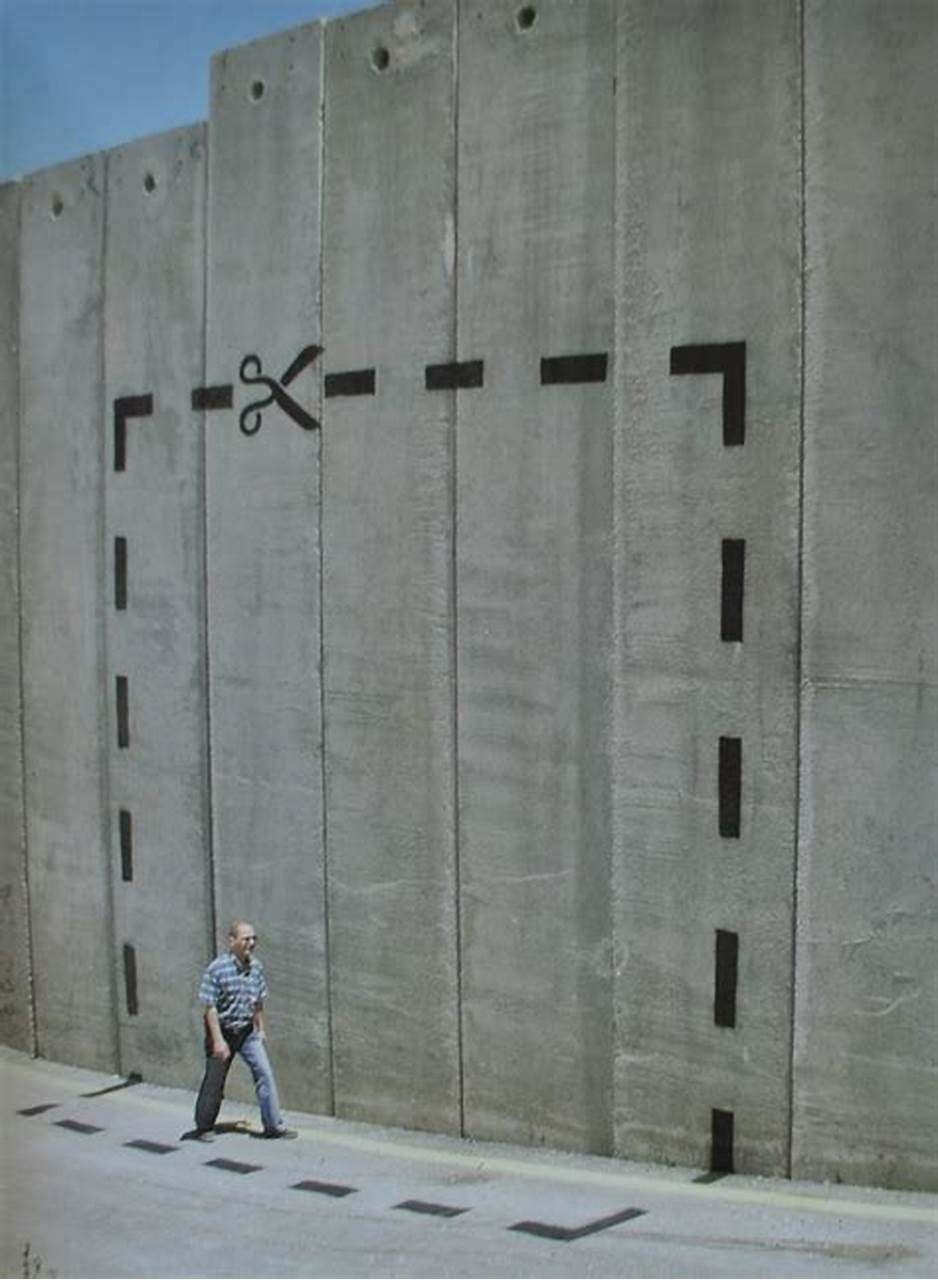
Banksy treats the barrier as an enormous sheet of paper. A dotted cutting line stretches across the concrete while an oversized pair of scissors indicates where to begin. The language of a children's craft project is applied to monumental infrastructure, reducing an extraordinarily complex political reality to an absurdly simple instruction: cut here.
7. Stable Conditions (Horse)
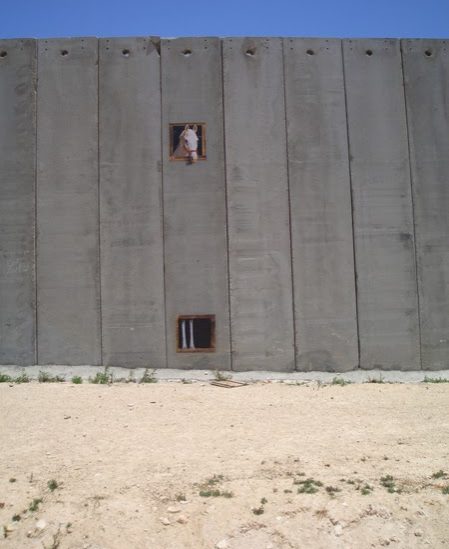
A white horse appears to push its head through a small opening in the concrete barrier, as though another world existed immediately behind it. The title adds a characteristically Banksy-like play on words, connecting the horse’s stable with the idea of political “stability.”
8. Pulling Back The Curtain
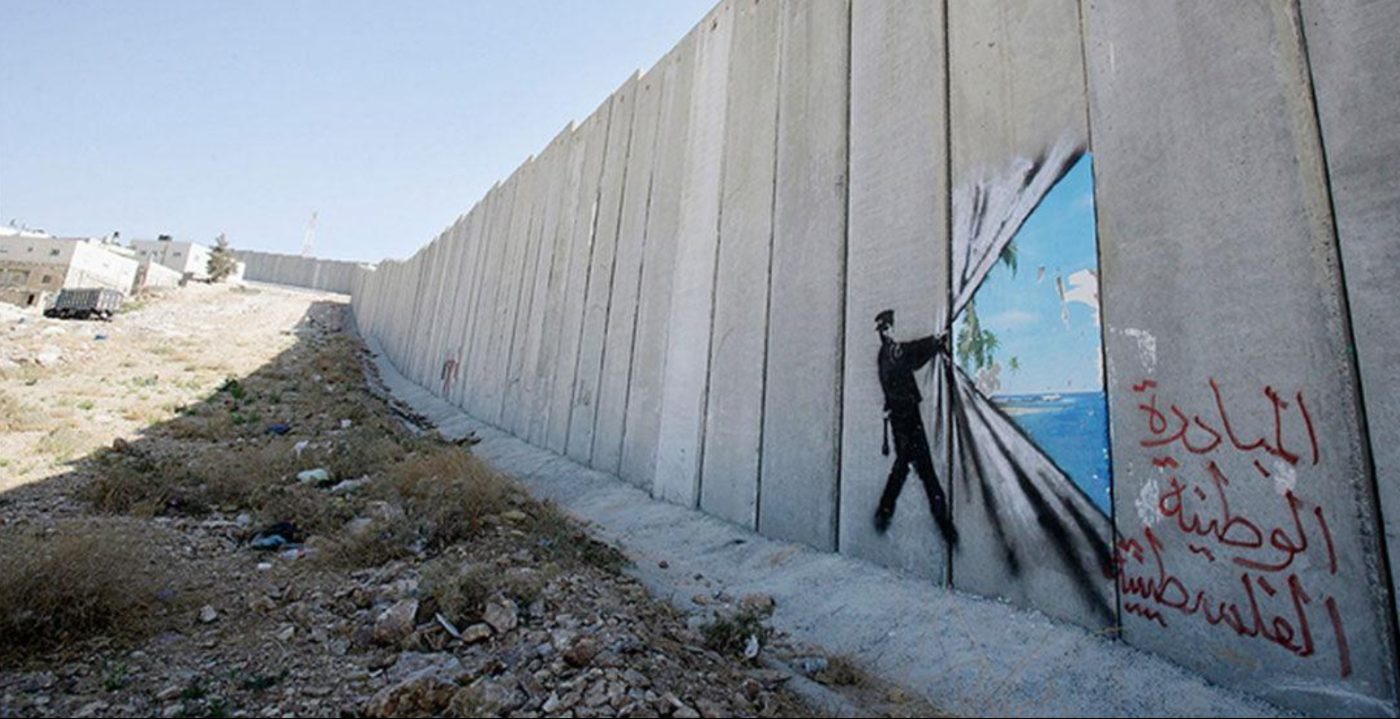
A uniformed figure pulls the surface of the barrier aside like a curtain, revealing a brilliant blue sea and tropical landscape beyond. The massive concrete structure is momentarily transformed into theatrical scenery, concealing an imagined world of freedom behind it.
9. Peel Back (Forest)
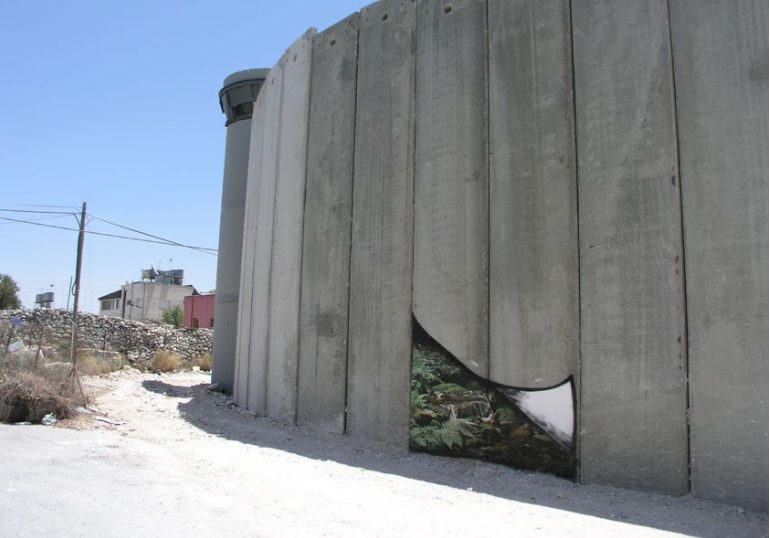
The surface of the concrete barrier appears to peel upward, revealing a lush forest and flowing stream beneath it. Banksy transforms the wall into a thin, artificial skin, suggesting an idyllic natural landscape concealed immediately beyond the concrete.
STAY INFORMED
Receive the latest news, exhibitions, artworks and market updates on Banksy.