BARELY LEGAL, LOS ANGELES, 2006
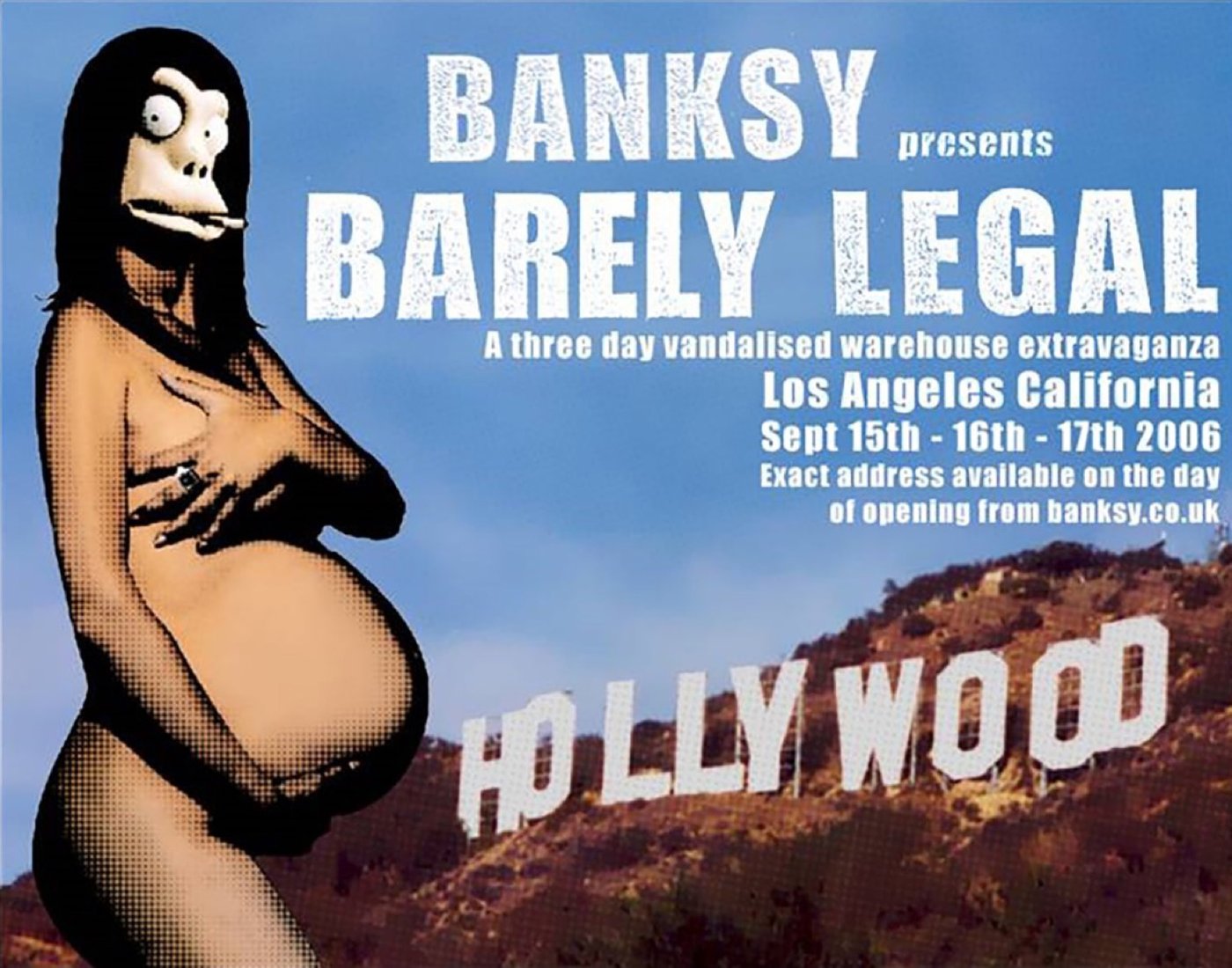
A Three Day Vandalized Warehouse Extravaganza
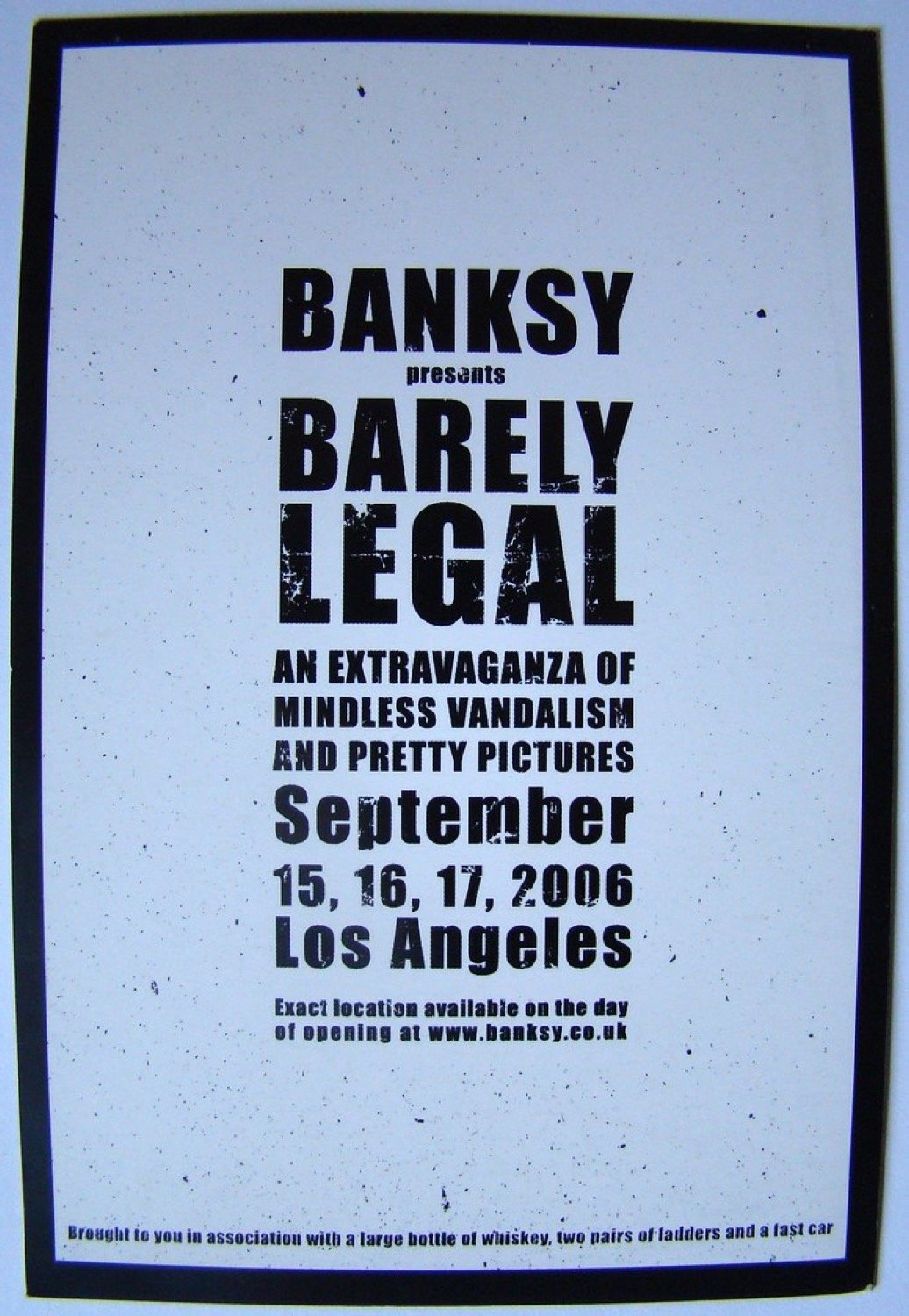
In September 2006, Banksy staged Barely Legal, an unauthorized-feeling but meticulously orchestrated three-day exhibition in an industrial warehouse in Los Angeles. It was his first major exhibition in the United States and one of the decisive events of his career: an ambitious combination of painting, sculpture, installation, printmaking and spectacle that transplanted the strategies developed through Turf War and Crude Oils into the heart of American celebrity and consumer culture.
The location was kept secret until immediately before the exhibition, continuing the sense of temporary occupation that had characterized Turf War. Yet the scale of the audience was changing dramatically. Collectors, artists, journalists and celebrities converged on the warehouse; Brad Pitt and Angelina Jolie were among the visitors reported by the contemporary Los Angeles press. Banksy had arrived in a city whose culture of wealth, entertainment, advertising and manufactured celebrity offered an unusually fertile setting for his work.
Barely Legal was therefore more than Banksy's latest exhibition. It represented a transition. The anonymous Bristol graffiti artist who had built his reputation through illegal interventions, self-organized exhibitions and inexpensive prints was becoming an international contemporary artist, even while continuing to present himself as an antagonist of precisely the cultural and commercial machinery now gathering around him.
AN ELEPHANT IN THE ROOM
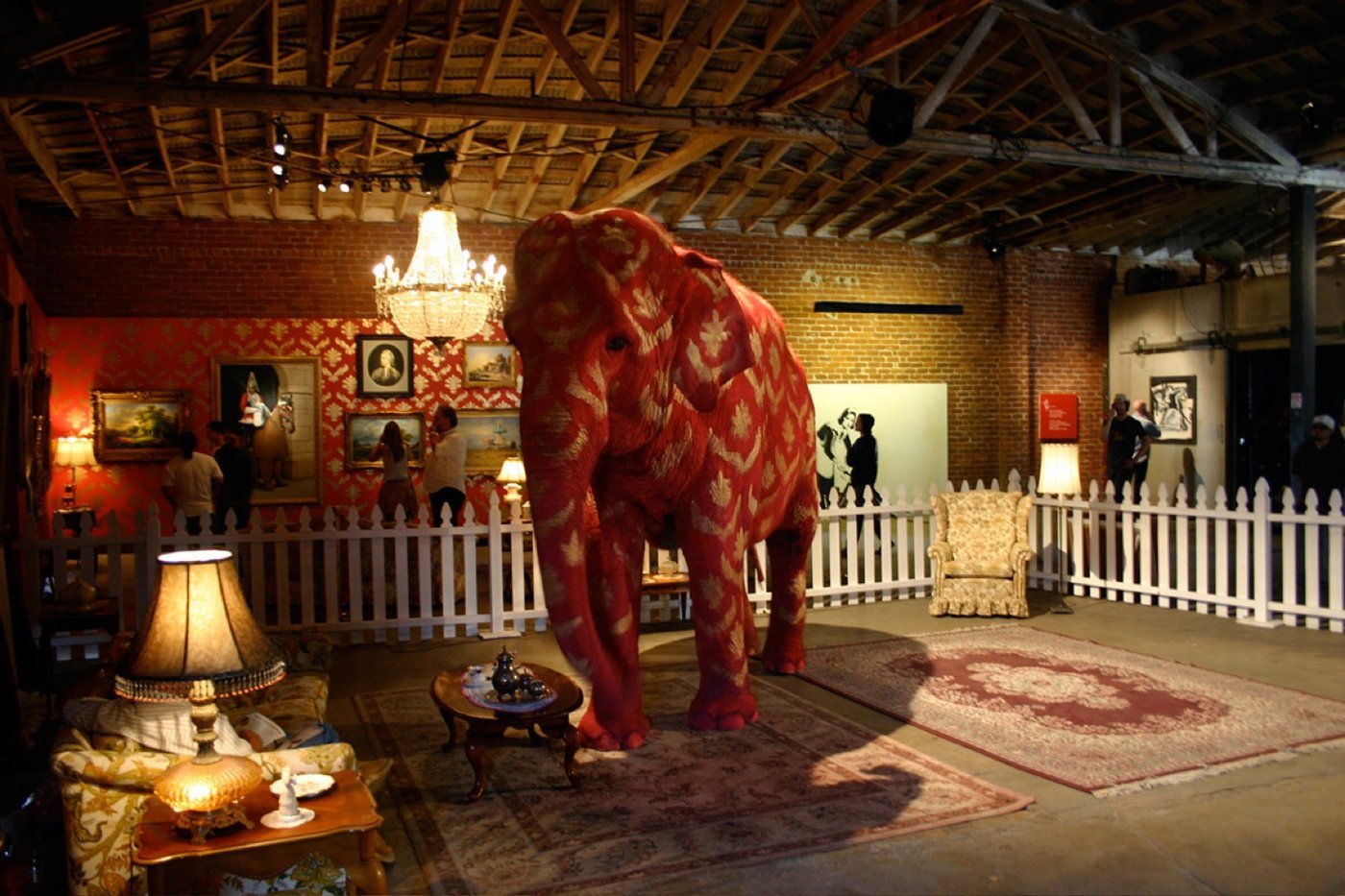
At the centre of the exhibition stood its most famous—and most controversial—installation: a live Indian elephant named Tai, painted in an elaborate red-and-gold floral pattern and placed inside a mock bourgeois living room decorated with matching wallpaper. The animal was physically enormous yet visually camouflaged by its surroundings: Banksy had transformed the familiar expression “the elephant in the room” into literal spectacle.
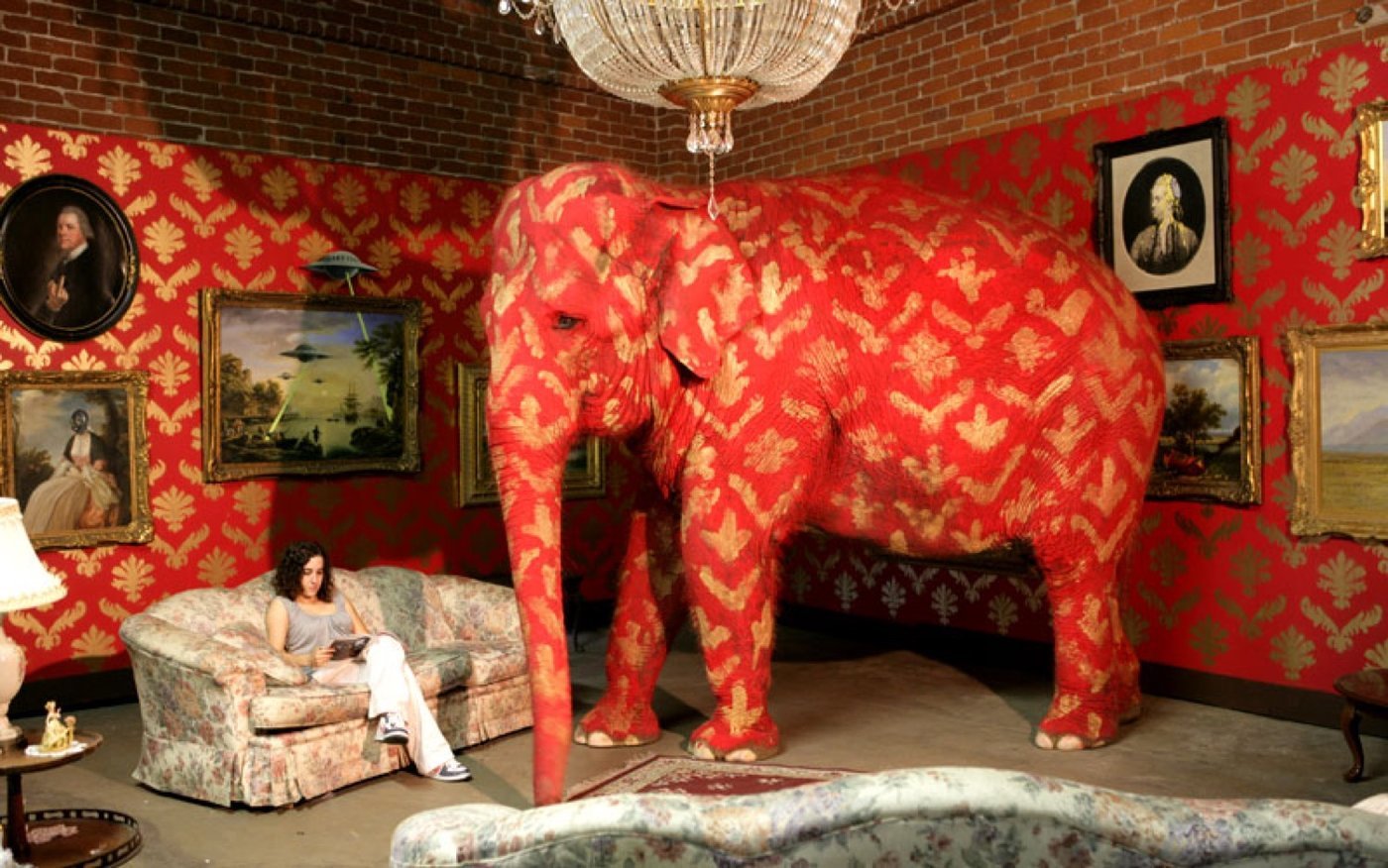
The accompanying text made the intended subject explicit. Visitors were told that there was “an elephant in the room” and “a problem we never talk about”: the persistence of global poverty and inequality. The installation was therefore constructed around a contradiction characteristic of Banksy. Something overwhelmingly visible could nevertheless remain socially unseen. The elephant was impossible to ignore physically while representing problems that prosperous societies had become remarkably accomplished at ignoring intellectually.
Manifesto
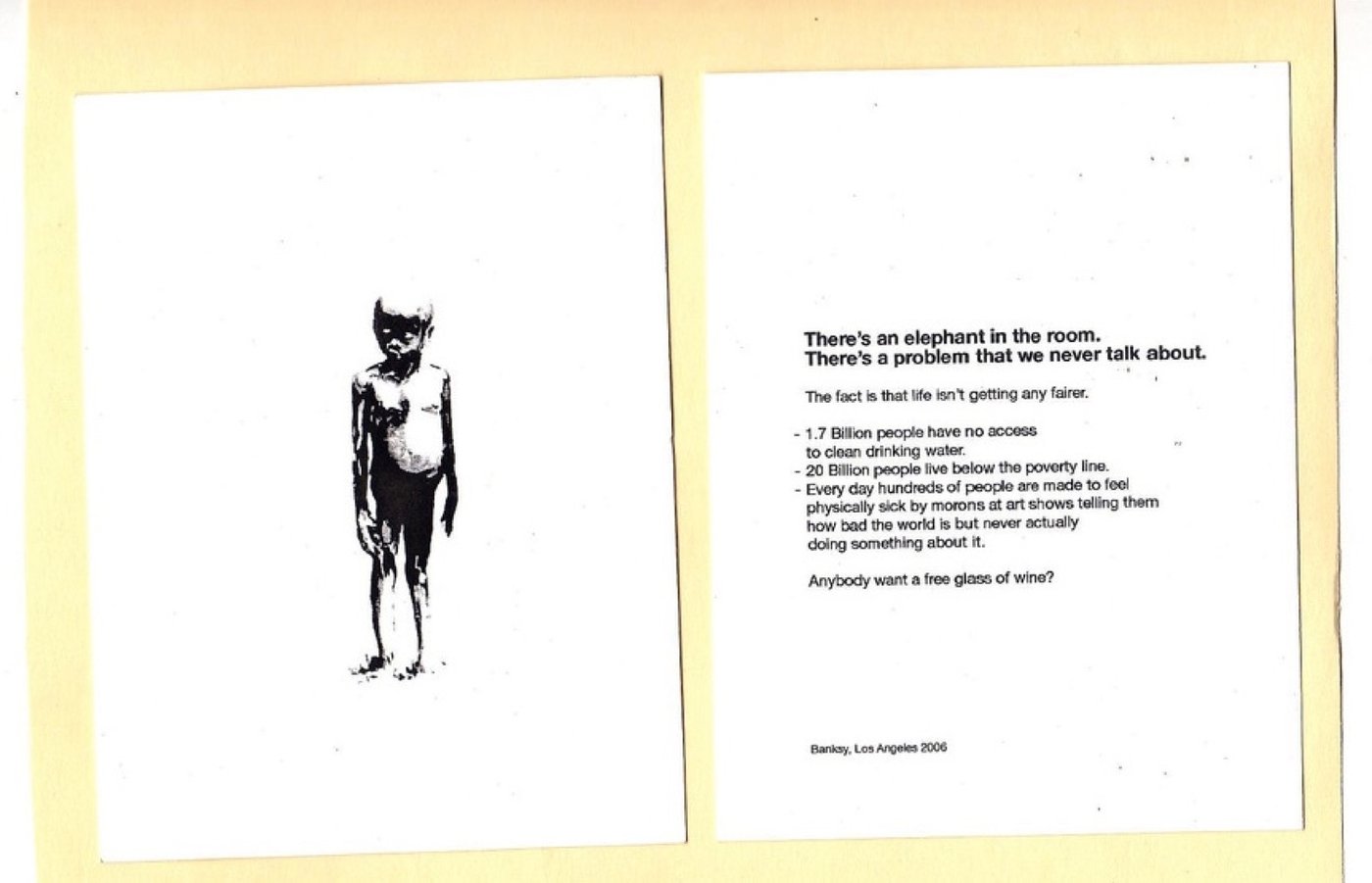
Banksy immediately undercut his own moralizing position. After presenting statistics concerning poverty and access to clean water, the exhibition text mocked the familiar experience of being lectured about global suffering at an art event before concluding with the offer of a free glass of wine. The joke implicated artist and audience alike. Barely Legal was not positioned outside the contradictions it criticized; the exhibition deliberately became part of them.
- There’s an elephant in the room.
- There’s a problem we never talk about.
- The fact is that life is not getting any fairer.
- 1.7 Billion people have no access to clean drinking water.
- 20 Billion people live below the poverty line.
- Every day hundreds of people are made to feel physically sick by morons at art shows telling them how bad the world is but never actually doing something about it.
- Anybody want a free glass of wine?
The installation generated enormous press attention but also controversy. Los Angeles animal-welfare officials had permitted the elephant to appear, but objections were subsequently raised to the painting of the animal. On the final day, city authorities required Tai to be washed, leaving visitors confronted with an unpainted elephant standing within the patterned room.
The episode became inseparable from the mythology of Barely Legal. Banksy had constructed an artwork about society's ability to ignore an obvious problem, only for the treatment of the elephant itself to become another obvious problem around which the exhibition was forced to negotiate.
LOS ANGELES AS SUBJECT
The choice of Los Angeles was particularly apt. Barely Legal arrived in a city synonymous with Hollywood, advertising, celebrity, extraordinary wealth and equally visible social inequality. Banksy did not merely bring an exhibition from Britain to America; he adapted his established language to an environment in which spectacle and commercial imagery were already forms of public architecture.
The exhibition poster made this explicit. Banksy's Original Concept for Barely Legal Poster (After Demi Moore) appropriated Annie Leibovitz's celebrated 1991 Vanity Fair portrait of the pregnant Demi Moore, transforming one of the defining images of modern celebrity culture into an advertisement for his own show. The Hollywood sign appeared behind the figure, binding Banksy's intervention directly to the mythology of Los Angeles.
The irony was difficult to miss. Banksy had built his reputation by attacking advertising, commodification and cultural authority, yet Barely Legal itself became a highly desirable cultural event populated by celebrities and collectors. Rather than concealing this contradiction, the exhibition appeared to feed upon it.
THE VANDALISED PAINTING CONTINUES
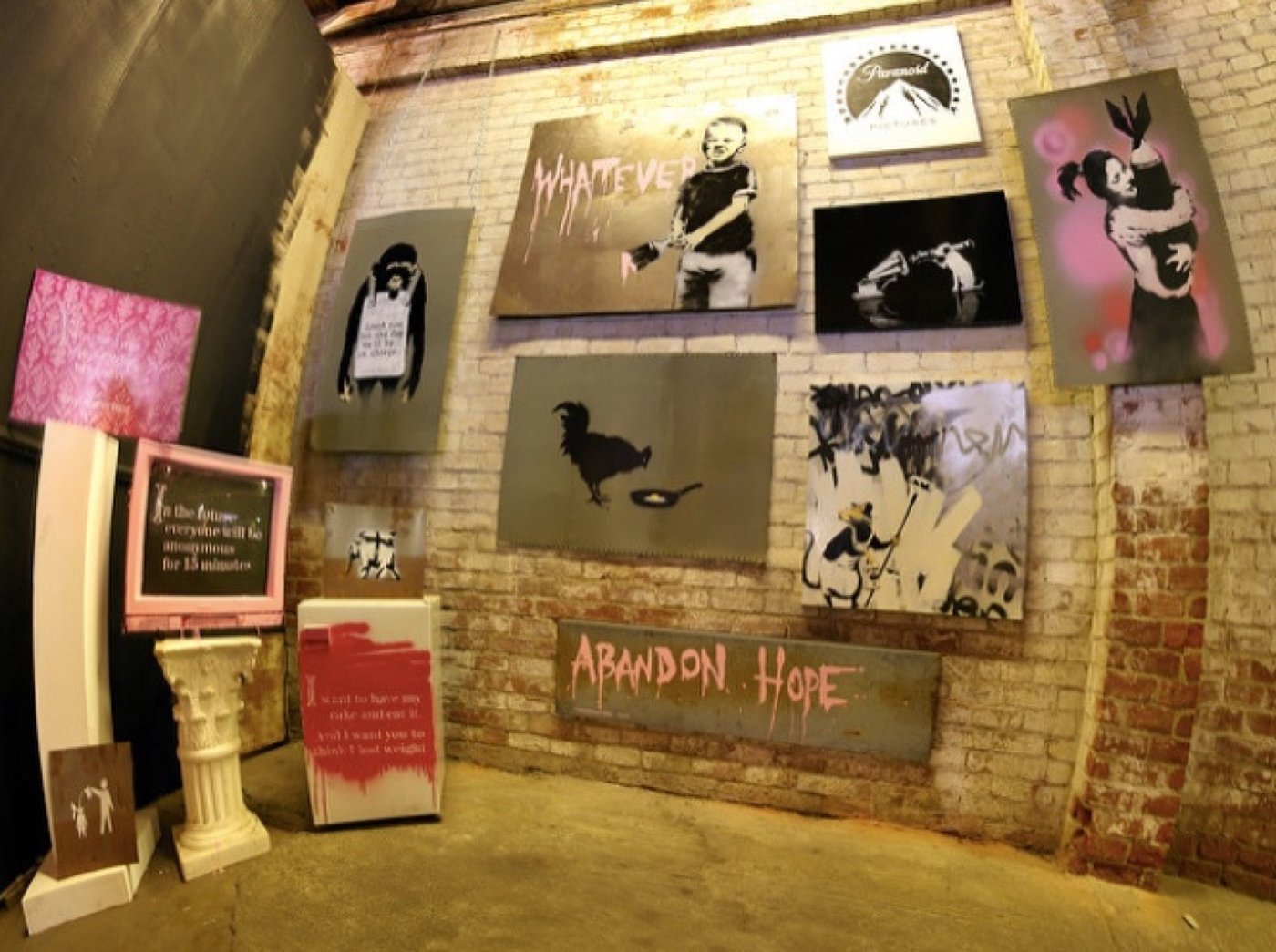
Barely Legal also represented an important continuation of the project developed most explicitly in Crude Oils the previous year. Banksy again presented found and appropriated paintings altered through small contemporary intrusions, bringing the language of traditional art into collision with consumer culture, technology, policing and modern social anxieties.
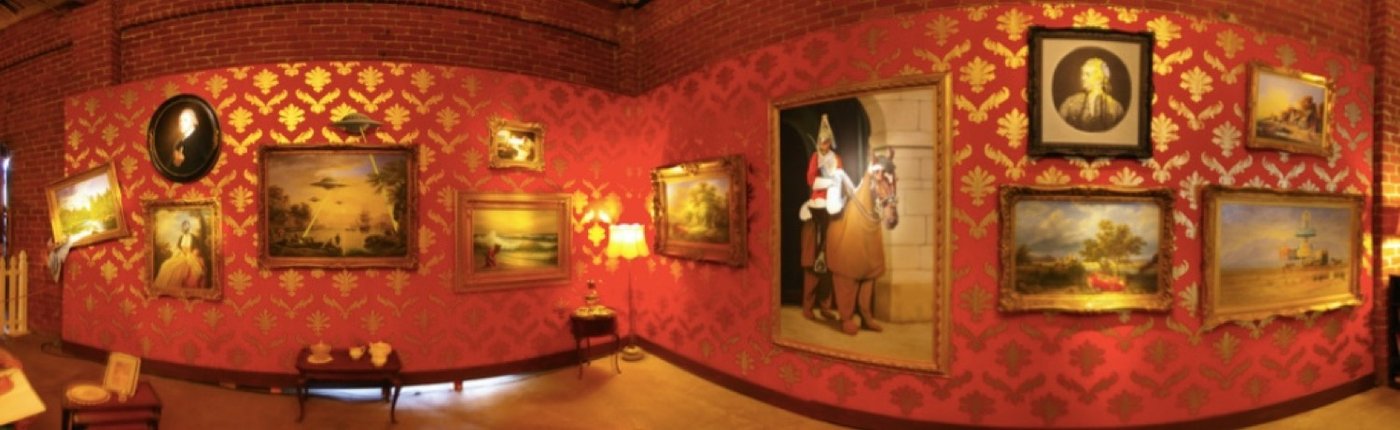
Among the works exhibited was System Error, in which an apparently conventional period painting is interrupted by a computer dialogue box announcing that “A system error has occurred.” The intervention operates not within the fictional world of the original painting but across its surface, as though the artwork itself had malfunctioned.
Other altered paintings extended the same strategy in different directions. Venus reworked Velázquez's Rokeby Venus, transforming one of Western art's canonical images of beauty through the intrusion of contemporary visual culture. The work is documented as having been signed and dated September 2006, firmly associating its creation with the Los Angeles exhibition.
Works including Waterfall, Toxic Lady and Hen with Fried Egg further demonstrated that the vandalised oil was no longer merely an exhibition concept associated with Crude Oils. By 2006 it had become a sustained strand of Banksy's studio practice: existing images functioned as cultural raw material upon which a minimal intervention could overturn the meaning of the entire composition. Your existing exhibition archive documents these works alongside numerous other originals shown in Los Angeles.
PAINTINGS, OBJECTS AND SCULPTURE
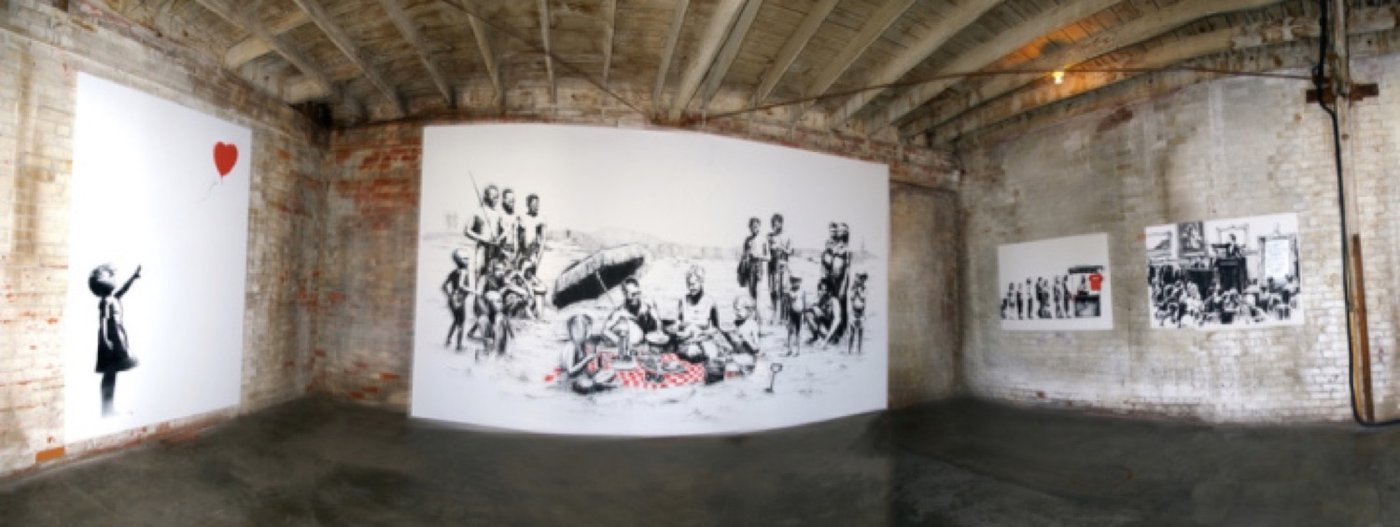
The exhibition extended considerably beyond altered paintings. Banksy presented unique stencil works and objects on a variety of supports, further dissolving the boundary between the language he had developed on the street and the conventions of gallery art.
Among the most striking was Bullet Hole Bust, a classical-style sculptural bust interrupted by a gunshot wound to the forehead and a thin trail of painted blood. Another variant from the edition was acquired in connection with the exhibition by Angelina Jolie and Brad Pitt. The work condensed a strategy Banksy had already explored through his clandestine museum interventions: the authority of classical culture could be destabilized by a single contemporary gesture.
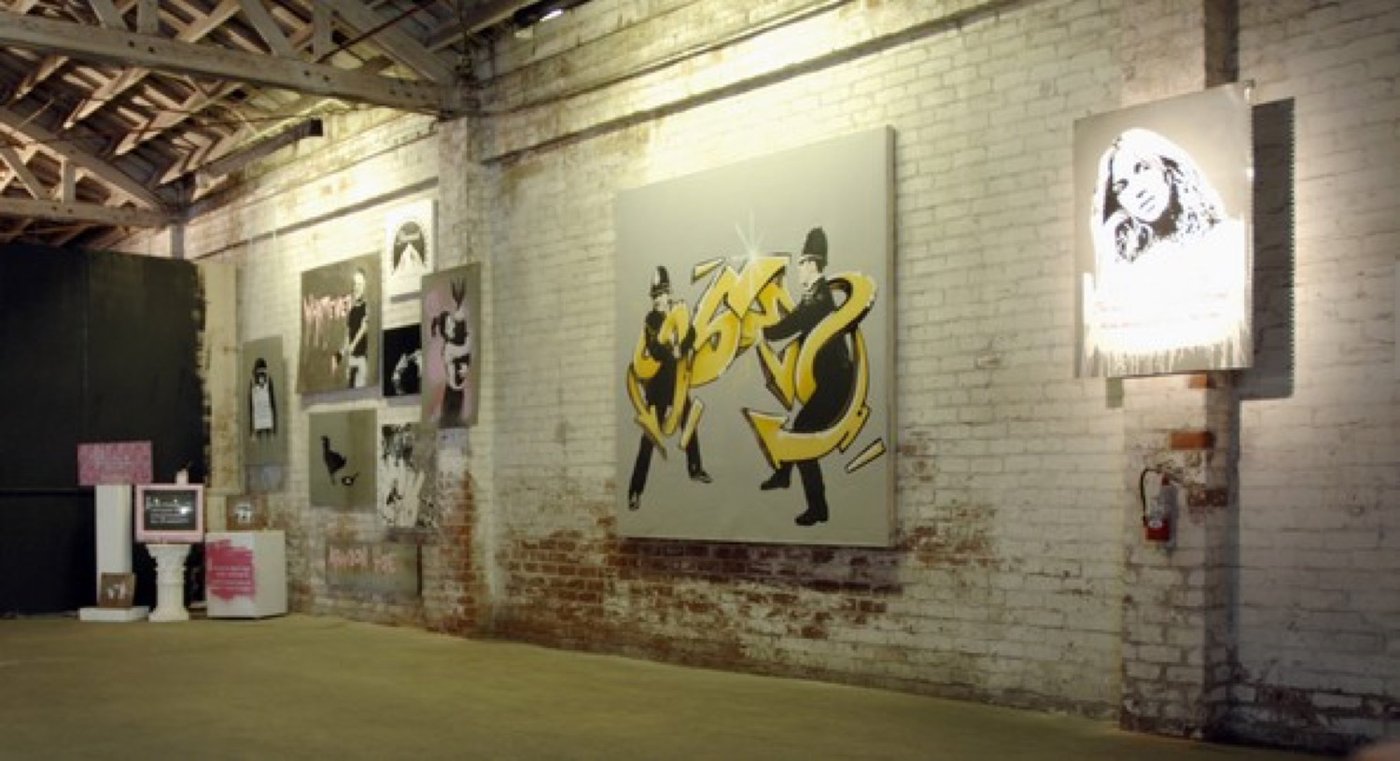
Other works moved imagery familiar from Banksy's street practice onto found or unconventional supports. Keep It Real, for example, appeared on reclaimed steel, allowing the physical history of an industrial surface to remain part of the work rather than disguising it beneath the neutrality of canvas.
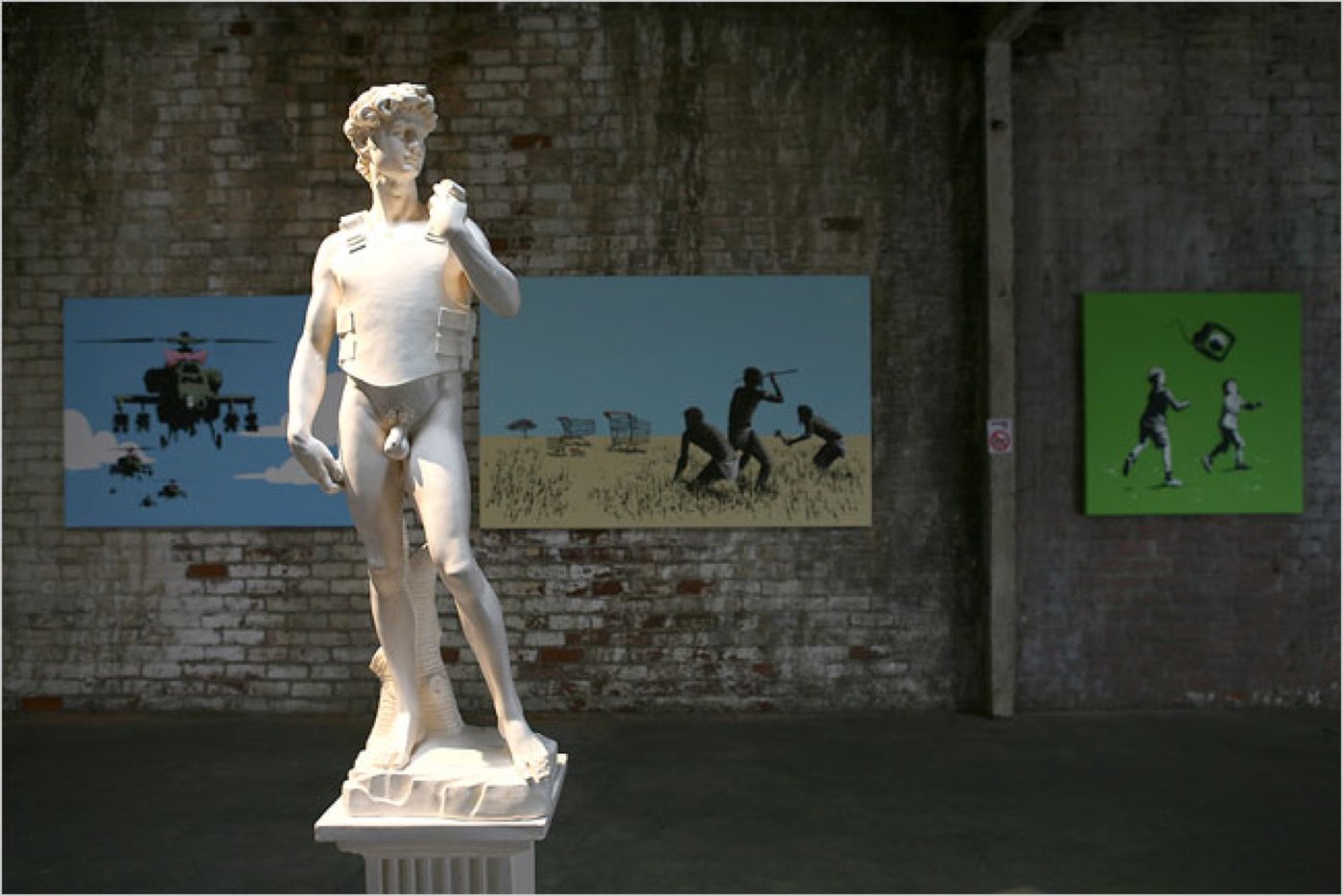
The exhibition therefore presented Banksy's practice as considerably broader than graffiti. Stencil painting remained its visual foundation, but painting, found objects, sculpture, installation, film and printmaking increasingly operated as parts of the same artistic vocabulary.
THE BARELY LEGAL SET
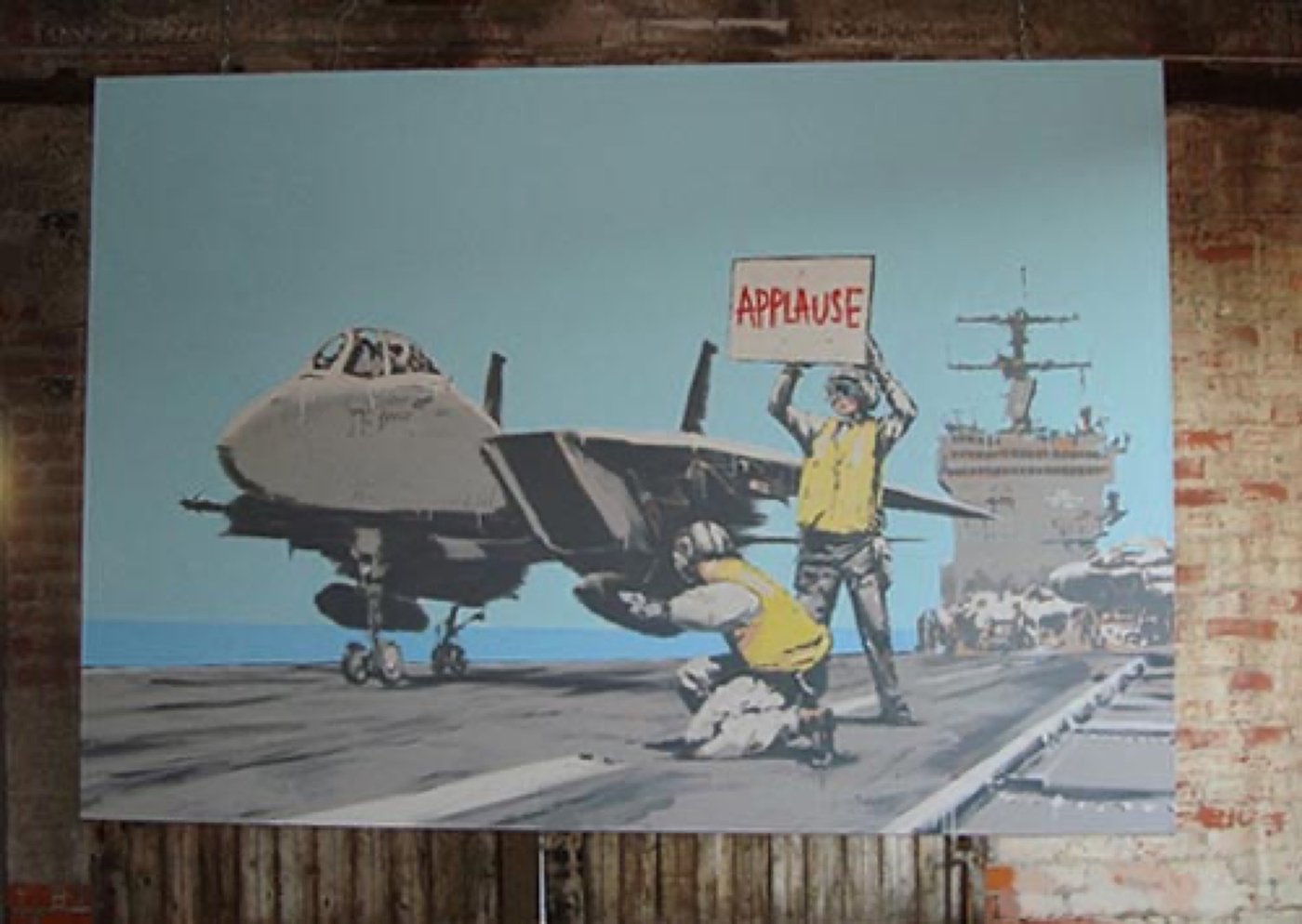
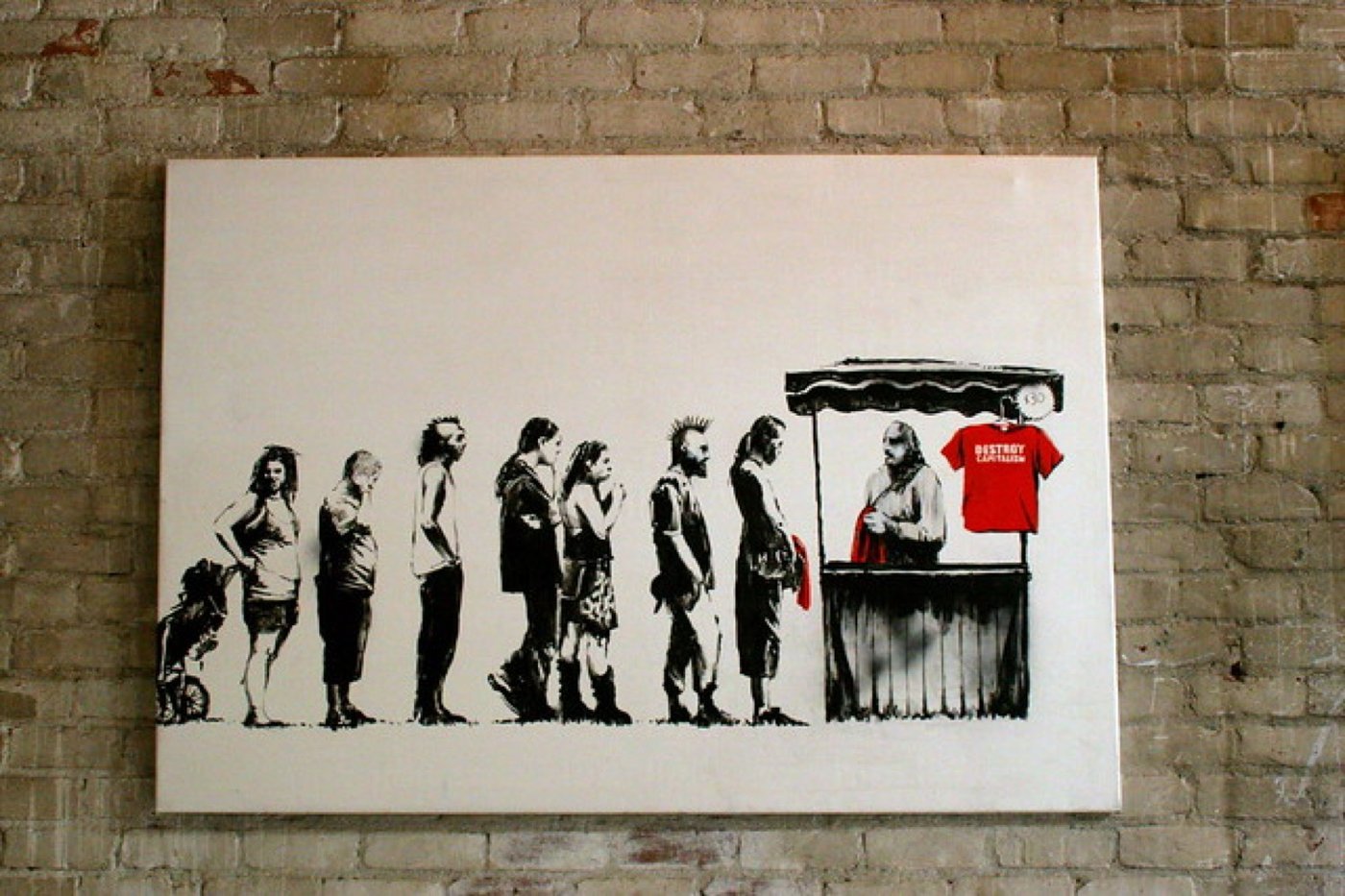
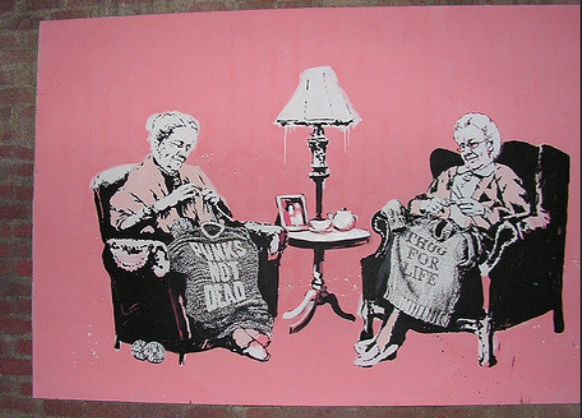
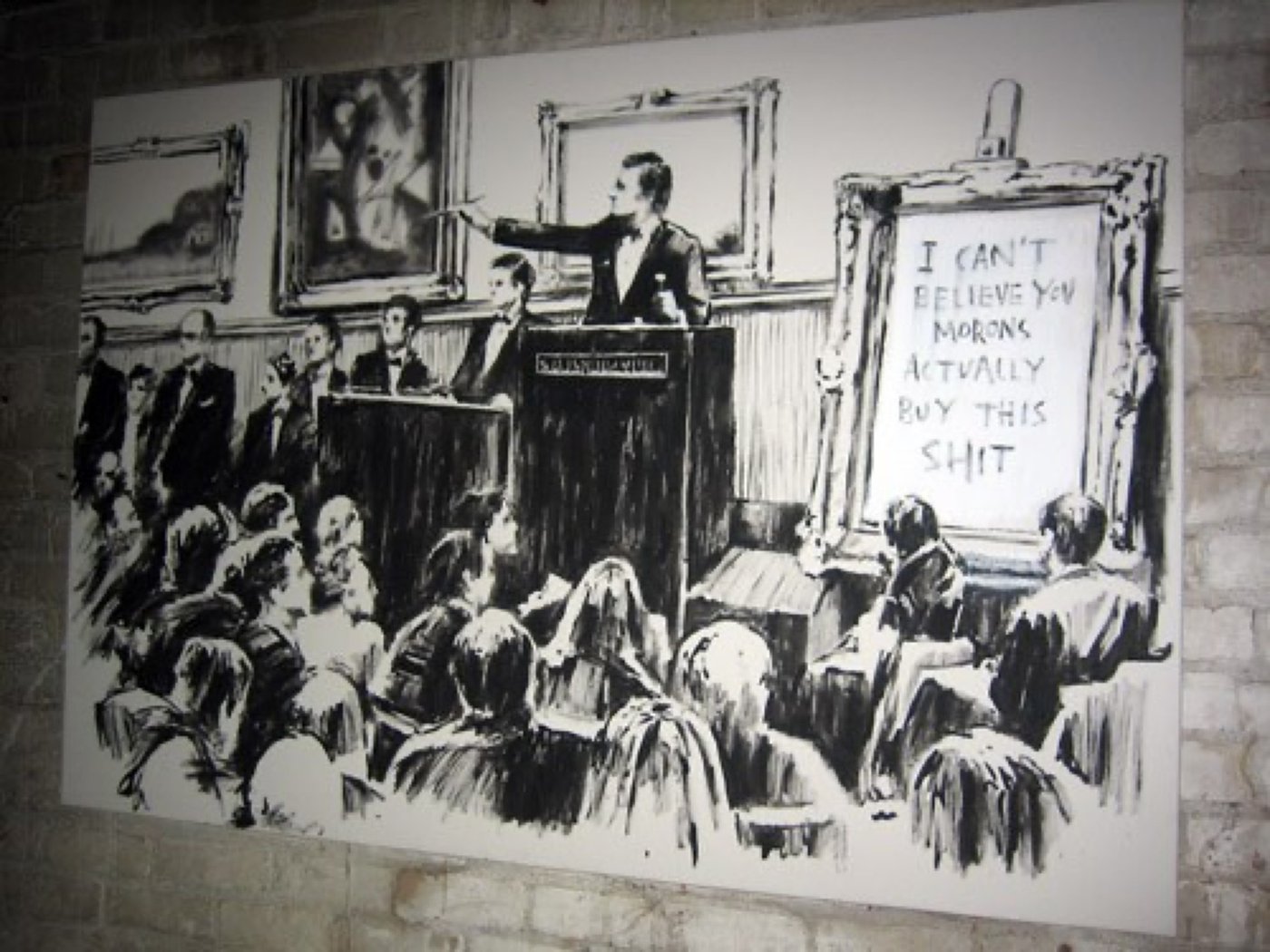
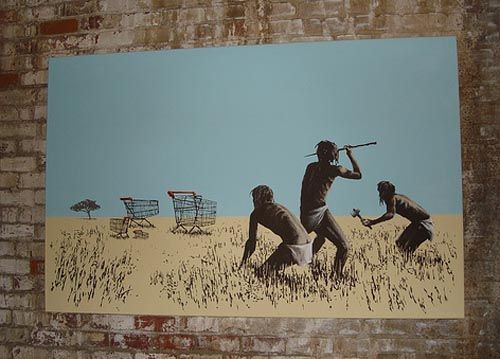
One of the exhibition's most enduring legacies was the group of six images now known collectively as The Barely Legal Set: Applause, Festival (Destroy Capitalism), Grannies, Morons, Trolley Hunters and Sale Ends.
Production began when Banksy approached Los Angeles master printer Richard Duardo of Modern Multiples, reportedly following a recommendation from Shepard Fairey. The works were produced in Los Angeles immediately before the exhibition in association with Pictures on Walls. The LA editions were stated as editions of 500, although only 100 of each were actually printed, together with six signed printer's proofs per image.
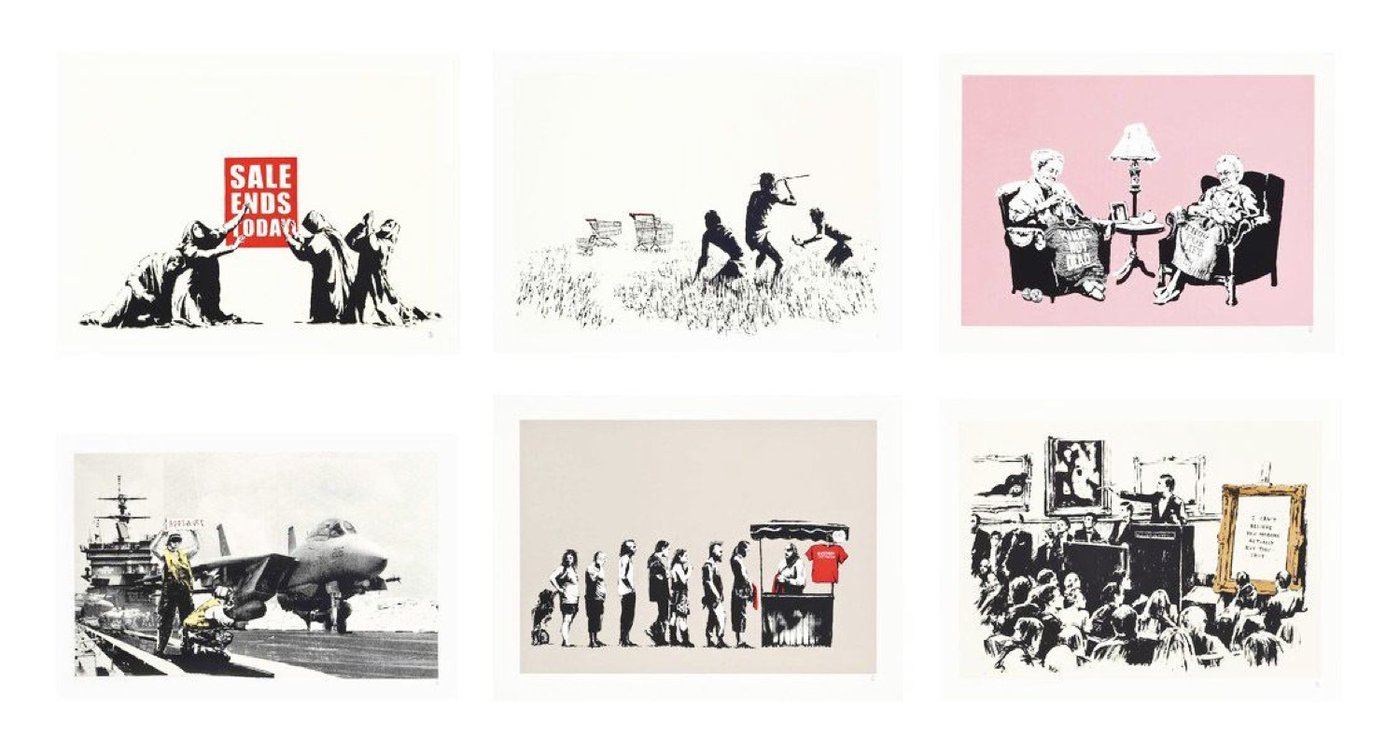
The six compositions form something close to a manifesto for Banksy's concerns at this stage of his career. Consumerism becomes religious devotion in Sale Ends; an apparently anti-capitalist gathering queues to purchase identical merchandise in Festival; prehistoric hunters pursue supermarket trolleys in Trolley Hunters; elderly women embroider punk slogans in Grannies; and an auction room applauds the sale of a canvas declaring “I CAN'T BELIEVE YOU MORONS ACTUALLY BUY THIS SHIT” in Morons.
The irony would prove remarkably durable. Images conceived partly as attacks upon consumerism and the commodification of art subsequently became some of Banksy's most desirable editions. Morons, in particular, would become almost prophetic as Banksy's own market expanded exponentially during the years that followed.
Banksy exhibited the originals for each print at Barely Legal.
ART, MARKET AND CONTRADICTION
That contradiction sits at the heart of Barely Legal. Banksy arrived in Los Angeles with a practice fundamentally shaped by illegality, temporary interventions and hostility toward the traditional art establishment. He left having demonstrated that the same imagery could function successfully as painting, sculpture, print, installation and highly collectible object.
This was not necessarily a retreat from his earlier position. Banksy's work had long depended upon contradictions between rebellion and visibility, vandalism and preservation, anti-commercial rhetoric and the production of desirable objects. What changed in Los Angeles was the scale upon which those contradictions operated.
The exhibition attracted precisely the wealthy collectors and celebrities whose culture some of its works appeared to mock. The paintings and prints entered private collections. The live elephant became international news. Banksy's critique of spectacle itself became a spectacle. Rather than weakening Barely Legal, this tension arguably became its central subject.
FROM STREET ARTIST TO INTERNATIONAL PHENOMENON
Barely Legal now occupies a pivotal position in Banksy's chronology. Turf War in 2003 had established the model for the independently staged Banksy exhibition; Crude Oils in 2005 demonstrated the conceptual ambition of his engagement with art history; Barely Legal translated those strategies into an international context and dramatically enlarged their audience.
It also coincided with one of Banksy's most audacious interventions in the United States. Days before the exhibition, he secretly installed a life-size figure dressed as a Guantanamo Bay detainee inside Disneyland's Big Thunder Mountain Railroad attraction in Anaheim. The figure reportedly remained in place for approximately ninety minutes before being removed, and footage of the intervention was subsequently shown at Barely Legal. The relationship was revealing: Banksy could still infiltrate one of America's most tightly controlled entertainment environments illegally while simultaneously preparing a major exhibition destined to attract collectors and Hollywood celebrities.
In retrospect, September 2006 represents one of the clearest turning points in Banksy's career. The artist did not abandon the street for the gallery so much as demonstrate that the mechanisms developed on the street—appropriation, surprise, anonymity, unauthorized intervention and the manipulation of public attention—could operate on a much larger cultural stage.
Barely Legal was ostensibly a three-day warehouse show. Its consequences were considerably more permanent. Within a remarkably short period, Banksy had moved from an underground British phenomenon to an artist whose actions could command international headlines, attract major collectors and generate an increasingly sophisticated global market.
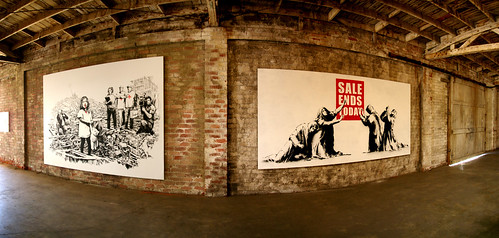
The irony, of course, was already hanging on the wall: “I CAN'T BELIEVE YOU MORONS ACTUALLY BUY THIS SHIT.”
ORIGINALS EXHIBITED
STAY INFORMED
Receive the latest news, exhibitions, artworks and market updates on Banksy.