Auction History
Prices are inclusive of buyer’s premium unless stated otherwise, as reported by the auction houses.
NEEDLEWORK AND SUBVERSION
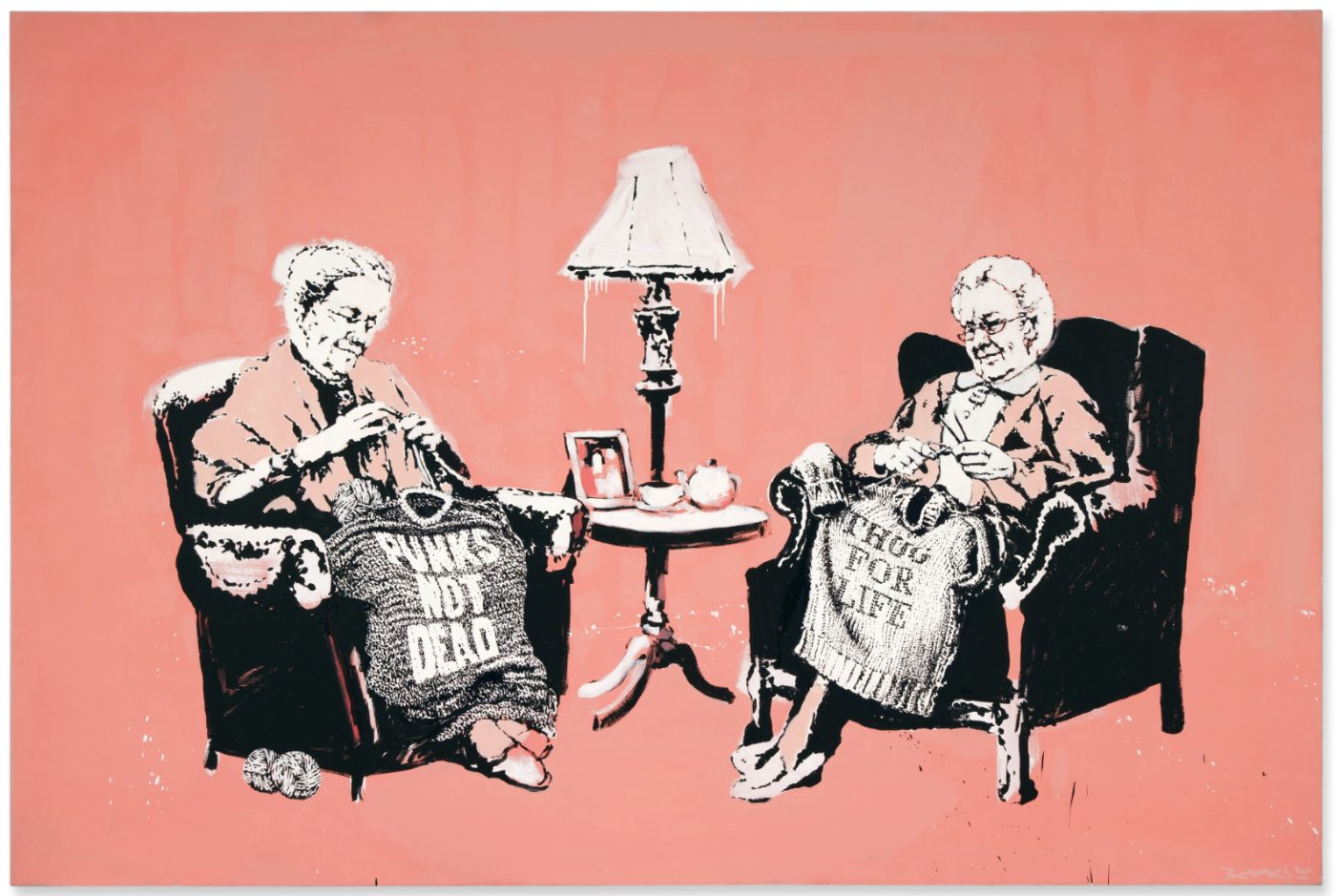
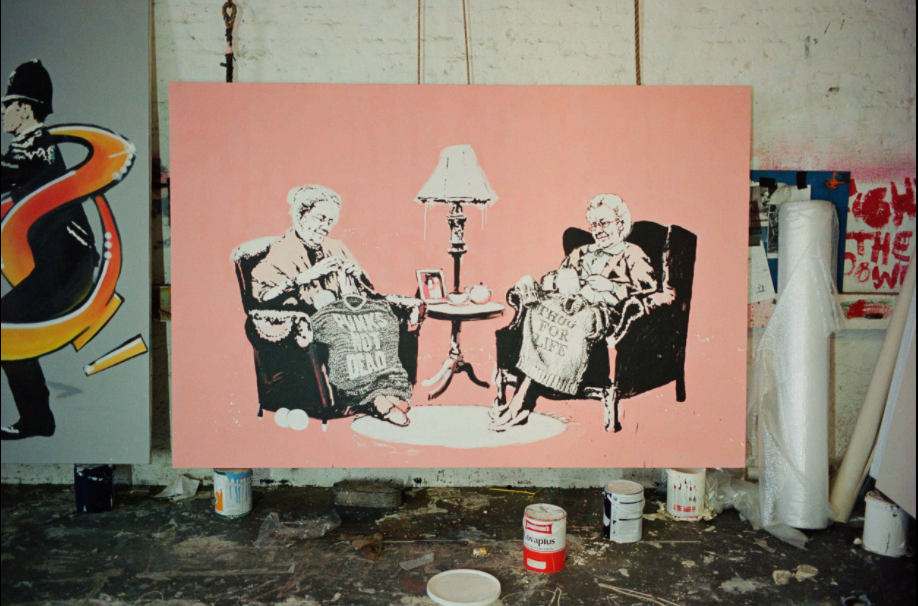
At almost three meters wide, Grannies transforms an apparently innocuous domestic scene into one of Banksy's most memorable meditations on rebellion and conformity. Two elderly women sit comfortably in armchairs beneath the warm light of a domestic lamp, knitting and sharing tea. Everything initially suggests familiarity, security and tradition. Only the products of their patient labour disturb the scene: the jumpers taking shape in their hands bear the slogans “PUNKS NOT DEAD” and “THUG FOR LIFE.”
Banksy constructs the image around a collision of stereotypes. The elderly women embody precisely the generation and domestic respectability against which youth countercultures traditionally define themselves, yet here they have become the manufacturers of rebellion. Knitting—the archetype of slow, traditional handicraft—is repurposed to produce the language of punk and street culture. Subversion is no longer sprayed hurriedly onto a wall; it is patiently assembled, one stitch at a time.
The humor is affectionate rather than aggressive. Banksy does not ridicule the women. Their concentration and evident satisfaction give them an unexpected agency. They appear perfectly comfortable with the slogans they are producing, as though rebellion has always belonged in the sitting room.
PUNK'S NOT DEAD — OR HAS IT BECOME DECORATION?
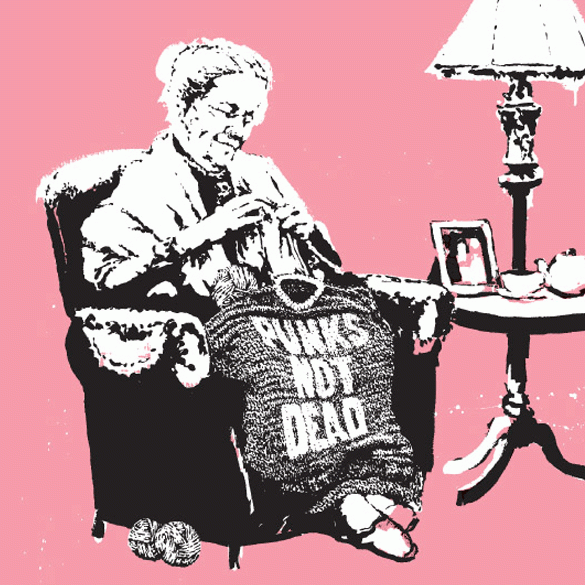
Behind the immediate joke lies a more complicated question about the fate of counterculture. Punk emerged in Britain during the 1970s as an aggressively anti-establishment movement, yet by 2006 its slogans, typography and visual codes had long since been absorbed into fashion, advertising and popular culture. Banksy's “PUNKS NOT DEAD” is therefore deliberately ambiguous. Perhaps the grandmothers are preserving rebellion, transmitting its language across generations. But the opposite reading is equally persuasive. Punk has become sufficiently safe to be knitted into a jumper over tea. What once signified social rupture has become domestic decoration.
This tension between rebellion and assimilation runs throughout Banksy's practice. His own career in 2006 was confronting precisely the same paradox. An artist whose reputation had been built through unauthorized interventions was becoming an international cultural phenomenon, while works conceived through the visual language of graffiti were rapidly entering major private collections.
Grannies consequently turns a simple generational joke into something more self-reflexive. Counterculture can survive, Banksy suggests, but survival may come at a price: eventually even rebellion risks becoming comfortable.
BARELY LEGAL: LOS ANGELES, 2006
The canvas was created during one of the decisive years of Banksy's career and was shown at Barely Legal, his landmark three-day Los Angeles exhibition of September 2006. The exhibition brought together an extraordinary concentration of major originals, including Sale Ends Today, Festival, Morons, Trolley Hunters, Angel, CCTV Angel and numerous vandalised paintings and sculptures. Its notorious live elephant transformed the event into an international media spectacle.
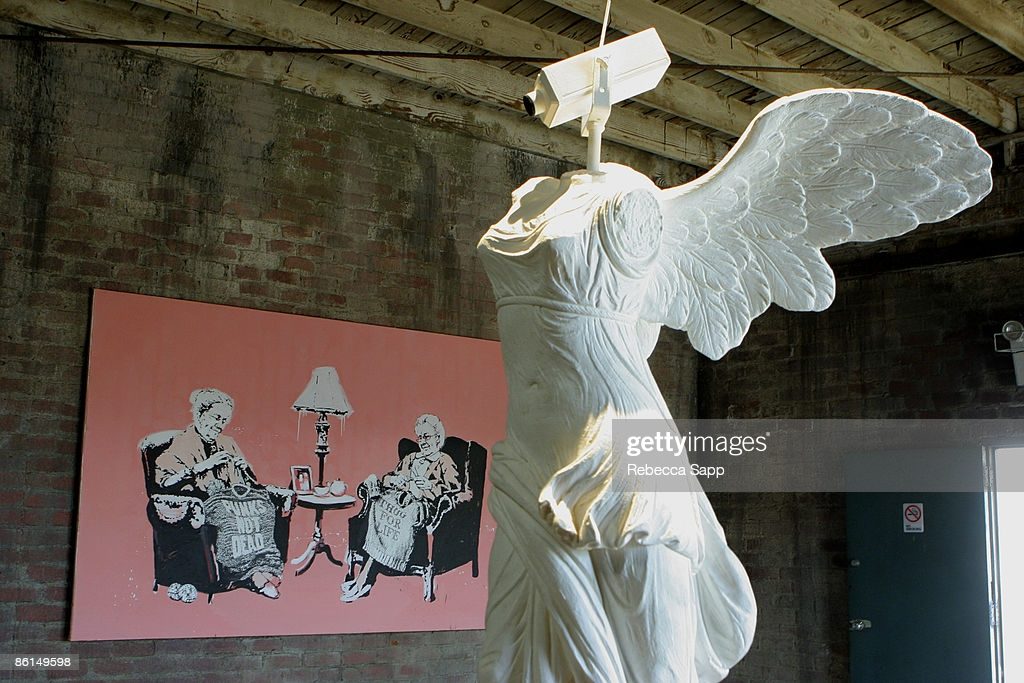
Within this group, Grannies belongs to a particularly coherent examination of contemporary culture. Festival transforms anti-capitalist protest into consumer merchandise; Morons attacks the absurdities of the art market; Trolley Hunters imagines primitive hunters pursuing supermarket carts; and Sale Ends Today converts the gestures of religious devotion into worship of a retail sign. Grannies addresses the commodification of dissent from the opposite direction: rather than showing consumer culture invading rebellion, it shows rebellion quietly entering the domestic interior.
The scale of the original is crucial. At 274.3 centimeters wide, this is not the intimate image familiar from the later screenprints but a monumental painting whose two seated figures approach human scale. The expanses of pink surrounding them and the physical separation of the armchairs give the composition an almost theatrical quality. Banksy's stencil language, developed partly for the practical necessities of working rapidly on the street, has been expanded into the dimensions of a substantial contemporary painting.
FROM UNIQUE CANVAS TO BANKSY ICON
The subsequent history of the image demonstrates its importance within Banksy's visual vocabulary. Grannies became one of the six compositions associated with the Barely Legal Set, alongside Applause, Festival (Destroy Capitalism), Morons, Trolley Hunters and Sale Ends. The Los Angeles editions were produced with Modern Multiples and Pictures on Walls around the exhibition; the image was subsequently issued through Pictures on Walls in signed and unsigned editions.
That chronology matters. The monumental canvas should not be understood as an enlarged version of the familiar print. The direction runs from painting to edition. The unique work belongs to the concentrated group of major studio paintings Banksy produced for Barely Legal, while the screenprints subsequently disseminated the composition internationally.
Seen twenty years later, Grannies captures one of the central contradictions of Banksy's career with unusual economy. Punk, street culture and anti-establishment rhetoric have entered the comfortable sitting room; at the same time, Banksy's own street-derived imagery has entered the monumental canvas, the private collection and eventually the evening auction. The two grandmothers remain serenely unconcerned by any of this. They simply continue knitting. Punk may not be dead. But Banksy understood remarkably early that its afterlife could be complicated.
STAY INFORMED
Receive the latest news, exhibitions, artworks and market updates on Banksy.