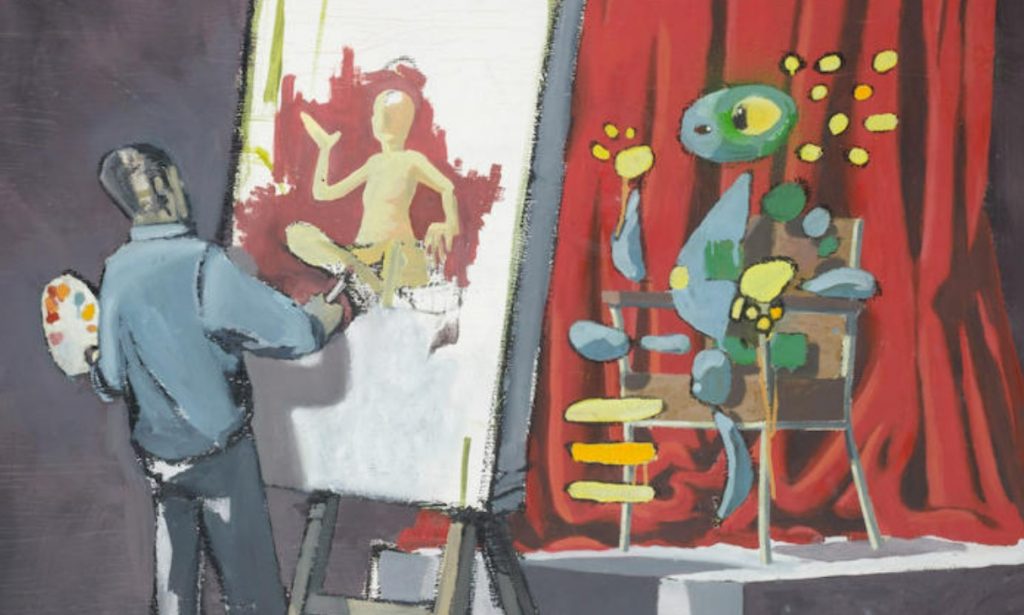

BANKSY
Portrait of An Artist, 1998
Oil on Canvas
100×141 cm (39 3/8 x 55 1/2 inches)
Stenciled signed, lower left
Exhibited
Easton, Bristol, 1999
Auction History
| Bonhams London Est.: GBP 50,000 – 70,000 11 January 2011 | Price Realized GBP 60,000 / USD 80,835 Bonhams ‘Portrait of an Artist’, circa 1998 |
Catalogue Note
Believed to be the first painting Banksy created specifically for sale, Portrait of an Artist already contains many of the themes that would come to define his career: the questioning of artistic authority, the subversion of art historical conventions, and a sharp sense of visual irony.

The composition appears deceptively traditional. An artist stands before his easel, carefully painting a nude model posed in a studio framed by rich crimson curtains. Yet the scene quickly unravels. The model is not a human figure at all, but a whimsical, alien-like creature with exaggerated features and an almost childlike appearance. More remarkably, the painter seems either unable—or unwilling—to acknowledge what stands before him. Instead of depicting the fantastical creature, he dutifully paints the idealized human form expected by centuries of academic tradition.
Banksy thus transforms a simple studio scene into a meditation on artistic perception. The painting asks a deceptively simple question: does an artist record reality, or merely reproduce what convention tells him he ought to see? The traditional painter becomes a symbol of inherited artistic dogma, while the bizarre model embodies originality, imagination and the unexpected. Rather than embracing the unfamiliar, the artist instinctively translates it into something comfortably classical.

The work also offers a sly reflection on the evolution of modern art itself. For generations, avant-garde artists have been dismissed as producing childish, absurd or incomprehensible images. Here Banksy reverses the joke. The “monster” waiting patiently on the pedestal may in fact represent creativity itself, while the conventional painter is revealed as the truly unimaginative figure, incapable of seeing beyond established ideals.

Art history provides another layer to the composition. The motif of the artist painting within the painting inevitably recalls masterpieces such as Diego Velázquez’s Las Meninas, where the act of representation becomes the true subject of the work. Banksy adopts this classical device only to undermine it with characteristic humour. Instead of exploring who is looking at whom, he questions whether the artist is looking at all.
Executed in a hybrid style that combines stencil techniques with expressive brushwork, Portrait of an Artist occupies an important place within Banksy’s early oeuvre. Even before his celebrated interventions into Old Master paintings, Crude Oils, and later museum infiltrations, Banksy was already engaging directly with the history of art. Rather than rejecting tradition, he appropriates its visual language in order to expose its assumptions, demonstrating that the most enduring artistic revolutions often begin not by destroying the canon, but by painting over it with a smile.