BANKSY
Queen Victoria, 2002
Oil on canvas in original artist’s frame
Canvas: 91.5 x 91.5 cm (36×36 inches)
Overall: 113.5 x 112 cm (44 3/4 x 44 inches)
Stencil signature, lower right
Provenance
Lazarides Gallery, London
Acquired directly from the above by the present owner
Exhibited
London, Shoreditch Dragon Bar, Santa’s Ghetto, 2002
Auction History
| Sotheby’s London 17 October 2008 Est.: GBP 250,000 – 350,000 | Price realized |
Catalogue Note
“Show your friends and colleagues your admiration for Britain’s greatest ever living monarch with this deluxe lesbian watersports fetish tableaux.”
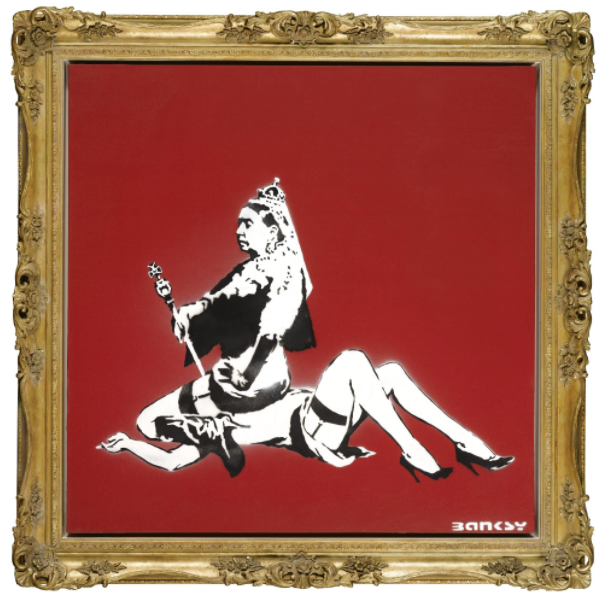
Executed in 2002, Queen Victoria is one of Banksy’s earliest and most provocative appropriations of British national iconography. Created during the formative years of his career and exhibited at Santa’s Ghetto, the work perfectly encapsulates the artist’s instinct for challenging established authority by confronting revered historical symbols with unexpected and deliberately unsettling imagery. Characteristically, Banksy achieves this not through violence or condemnation, but through satire, humor and irreverence.
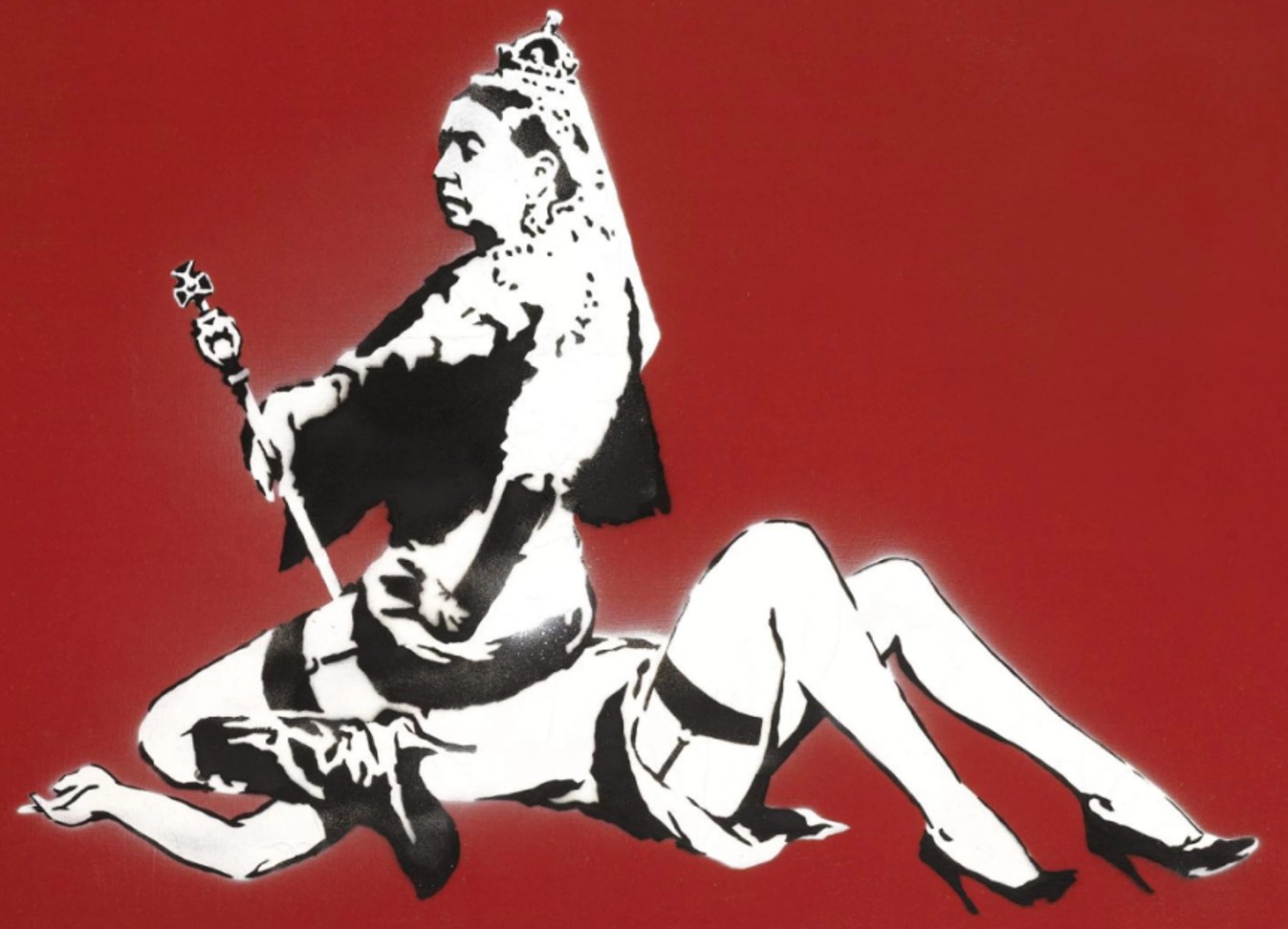
The composition depicts Queen Victoria, one of the most enduring symbols of the British Empire, seated dominantly upon the reclining body of another woman while holding her royal scepter. Instantly recognizable through her crown and formal attire, the monarch retains every visual attribute of sovereign authority, yet the context has been radically transformed. The collision between regal dignity and overt eroticism is intentionally disorienting, inviting the viewer to reconsider the values traditionally associated with monarchy, morality and power.
The work derives much of its force from the extraordinary contrast between subject and setting. Queen Victoria has long embodied ideas of imperial grandeur, discipline and moral respectability. Indeed, the entire Victorian era became synonymous with restraint, propriety and rigid social conventions. By portraying the monarch in a sexually dominant role, Banksy overturns one of Britain’s most deeply rooted historical myths. The image is not simply provocative for its own sake; it exposes the fragile nature of symbols whose authority depends upon unquestioned reverence.
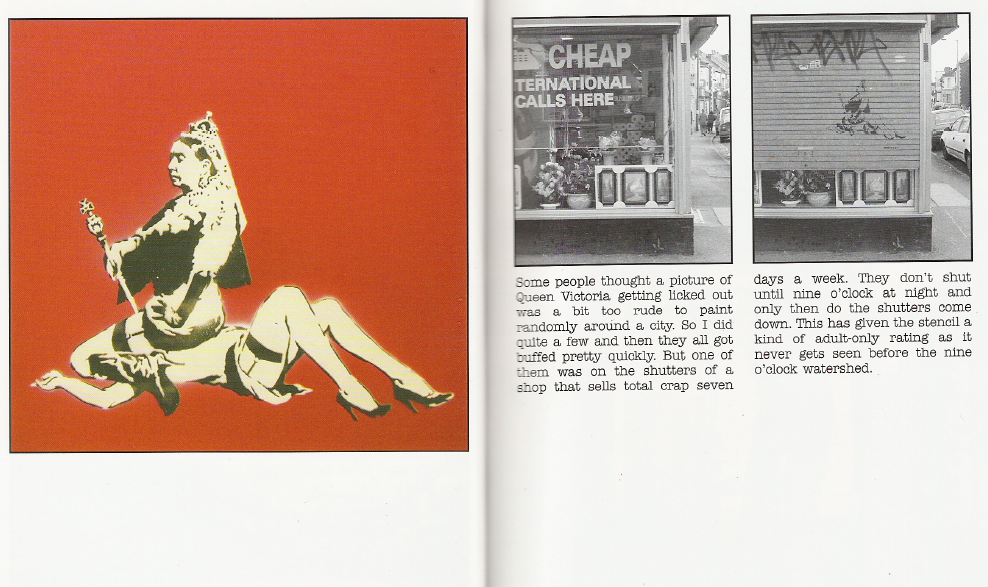
Like much of Banksy’s early work, Queen Victoria operates through inversion. Rather than attacking the institution directly, he transforms one of its most revered representatives into an unlikely participant in an image of desire and transgression. The humour lies precisely in the impossibility of the scene. Yet beneath the absurdity lies a broader reflection on the relationship between power and representation. History, Banksy suggests, is not immutable. Its heroes, monarchs and institutions remain open to reinterpretation by each successive generation.
Executed against a rich crimson background, the composition achieves a striking graphic clarity. The monochrome stencil appears almost luminous against the saturated field of red, a color that simultaneously evokes royalty, authority, passion and political revolution. The simplicity of the palette reinforces the theatrical quality of the scene, stripping away unnecessary detail and allowing the extraordinary tension between image and idea to dominate the composition.
The original artist’s ornate gilt frame further enriches the work’s conceptual framework. Traditionally associated with aristocratic portraiture and official state commissions, the frame deliberately reinforces the conventions that Banksy is simultaneously dismantling. Rather than functioning as a decorative accessory, it becomes part of the satire itself, transforming what might initially appear to be a formal royal portrait into a mischievous act of institutional subversion.

Exhibited at Santa’s Ghetto, one of Banksy’s earliest and most influential exhibitions, Queen Victoria belongs to the remarkable period during which the artist established many of the visual strategies that would define his career. Throughout his oeuvre, figures of political, religious and cultural authority are repeatedly removed from their traditional contexts and reimagined through humour rather than hostility. In doing so, Banksy reminds us that the greatest challenge to power is often not direct confrontation but the ability to laugh at it.
More than twenty years after its creation, Queen Victoria remains one of the defining images of Banksy’s early period. Simultaneously irreverent, witty and intellectually sophisticated, it demonstrates the artist’s remarkable gift for transforming a single visual contradiction into a broader meditation on authority, identity and the myths through which societies choose to define themselves.