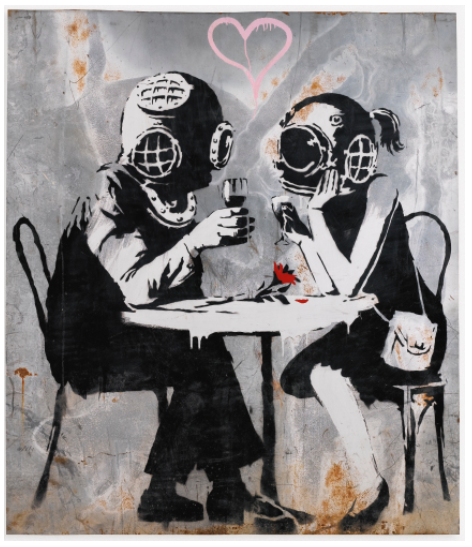
In 2003, Banksy stepped outside his usual anti-establishment lane to design the cover for Think Tank, the seventh studio album by British band Blur. It was a surprising move for an artist known for his fierce resistance to commodification and collaboration. But this wasn’t a simple case of selling out: it was a layered act of subversion, perfectly in sync with the album’s introspective tone and sociopolitical commentary. What emerged was more than a cover. Think Tank became one of Banksy’s most iconic commercial images: two figures seated at a table, sharing a glass of wine, their heads encased in vintage diving helmets. Above them floats a dripping pink heart—barely intact, slightly off-center, and hauntingly tender.
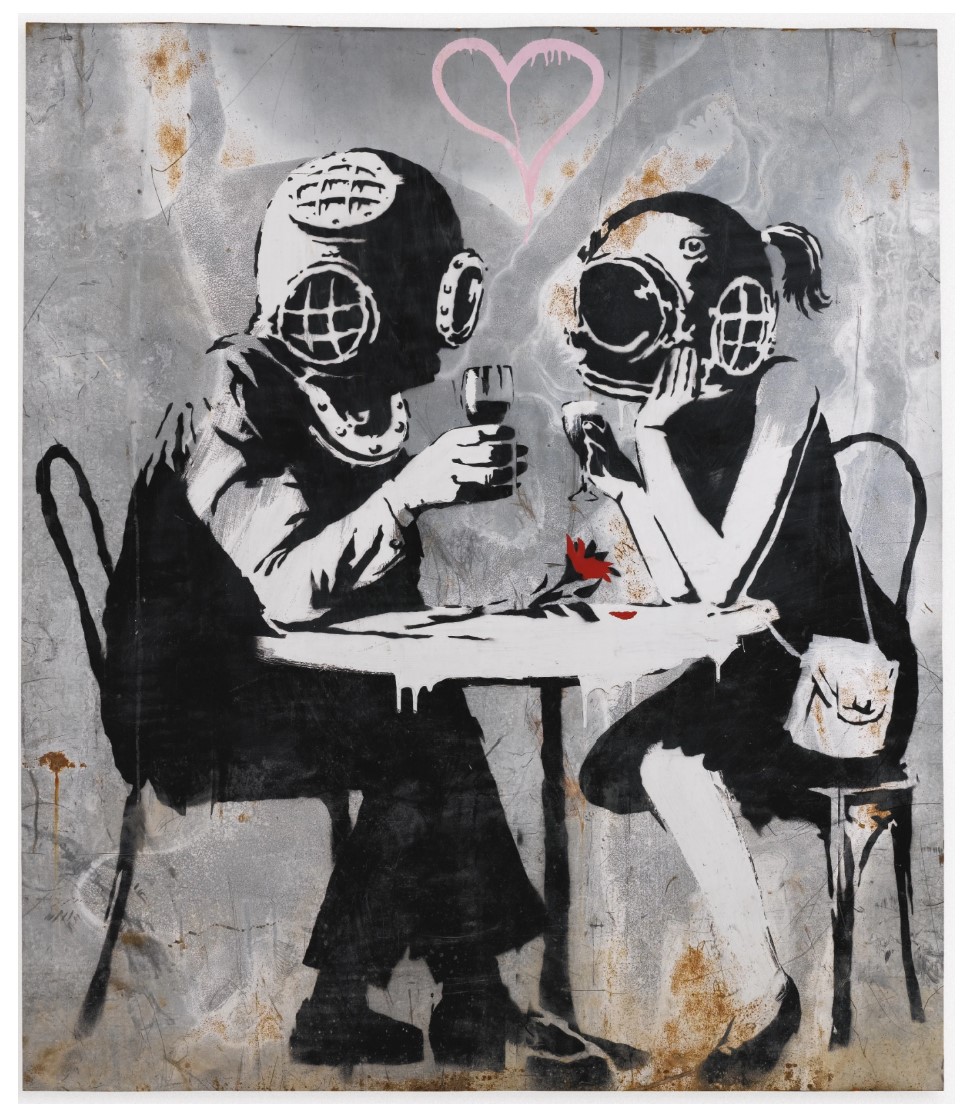
In Think Tank, Banksy invites us to eavesdrop on a romantic moment weighed down, quite literally, by the absurdities of modern life. The couple’s dinner, seemingly intimate, is rendered almost surreal by the clunky helmets they wear, more suited to deep-sea exploration than quiet conversation. These protective suits, designed for survival in extreme conditions, become metaphors for emotional armor. Despite their best efforts at connection, they remain sealed off from one another, encased in isolation.
The dripping pink heart above them offers a note of irony or perhaps hope—a fleeting sign of affection that feels both sincere and sarcastic. With characteristic wit, Banksy shows us love not as a grand flourish, but as something fragile, clumsy, and ultimately human. Think Tank is a meditation on connection in an age of disconnection, rendered in stencil and steel.

Blur’s Think Tank marked a departure for the band: sonically and thematically. The album grappled with post-9/11 anxieties, political disillusionment, and personal fragmentation. Banksy, whose work so often critiques war, consumerism, and emotional alienation, was a fitting collaborator.
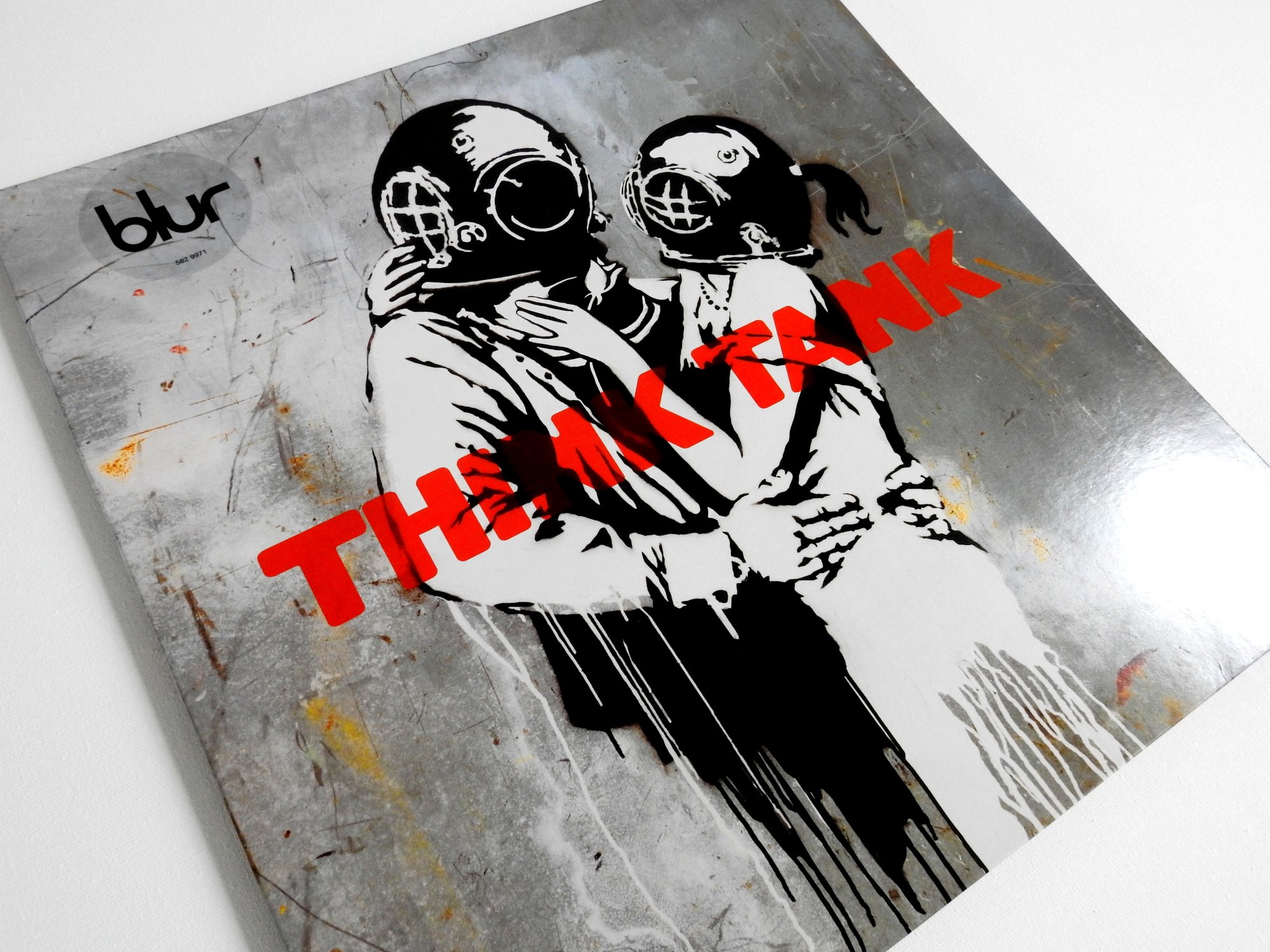
Though the artist usually shunned commercial commissions, Banksy took on the Blur project citing a mix of admiration and pragmatism:
“If it’s something you actually believe in, doing something commercial doesn’t turn it to shit just because it’s commercial.”
The result was a cover that stood in perfect harmony with the album’s tone—raw, uneasy, and quietly poetic. Over the years, the image has been reproduced widely—on posters, T-shirts, and prints. Yet despite its ubiquity, Think Tank retains its poignancy. Its charm lies in its contradictions: it is both commercial and critical, romantic and bleak, intimate and alien.
Banksy’s Think Tank is a visual poem about intimacy in a world that feels increasingly armored. It’s a love story told through stencils and symbols: a narrative of warmth trapped beneath layers of social, political, and emotional insulation. It may have started as an album cover, but it has since transcended that role to become one of the artist’s most affecting and quietly powerful statements. In the end, what Think Tank leaves us with is this: even when we’re sealed off, masked up, and drifting, we still reach out.
Auction Results
Think Tank, 2003
Sotheby’s London: 13 February 2013
Estimated: GBP 120,000 – 180,000
Price realized: GBP 397,250 / USD 617,305
BANKSY
Think Tank, 2003
Spray-paint on steel
182.1 x 157 cm (71 5/8 x 61 3/4 inches)
Provenance
Private Collection
Sale: Bonham’s, Knightsbridge, Vision 21, 25 April 2007, Lot 298
Acquired directly from the above by the present owner
Think Tank, 2003
Estimated: GBP 80,000 – 120,000
GBP 156,000
Stencil and spray paint on steel
192×179 cm (75 9/16 x 70 1/2 inches)
Drip Dinner, 2003
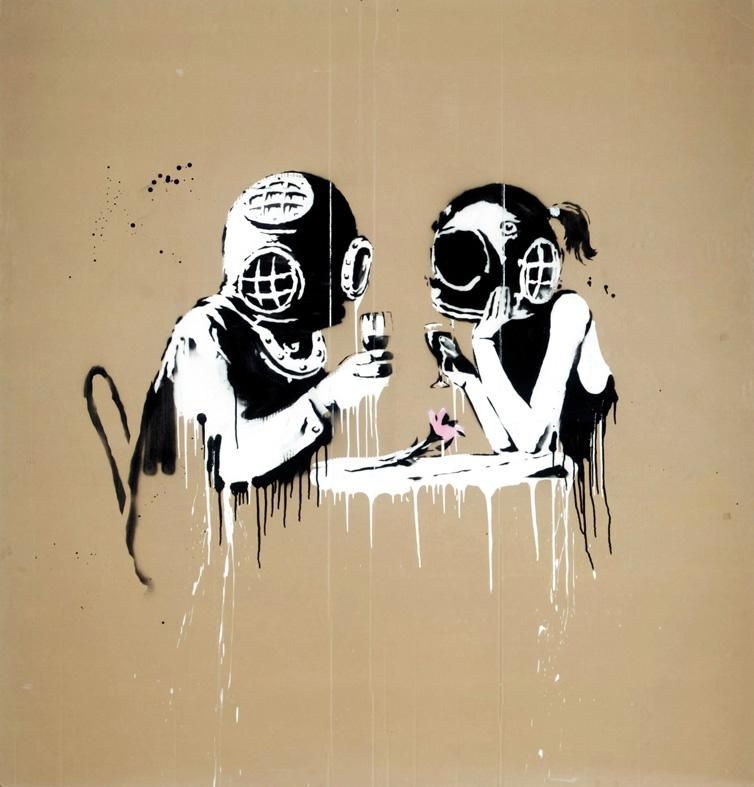
Drip Dinner, 2003
Spray and household emulsion on cardboard