Love Is In The Air
Banksy’s iconic symbol of peaceful protest
Introduction
In the realm of contemporary art, few images resonate as profoundly as Banksy’s Love Is in the Air. Also known as Flower Thrower, this artwork encapsulates the paradox of aggression and peace, revolution and love. Originating as a piece of guerrilla street art, it has since transcended its medium to become a global emblem of nonviolent resistance.
An archetypal example of Banksy’s perceptive and stimulating commentaries on contemporary political and social events, Love is in the Air is one of the most recognizable works by the brilliant graffiti artist and offers a simple message of hope. In the tradition of other historically iconic images that preceded it, such as Leonardo’s Mona Lisa, Warhol’s Marilyn or Alfred Leete’s Lord Kitchener Wants You poster, Love is in the Air has been imitated and replicated countless times in a testament to its visual strength and power. It is indisputable that this bold and powerful work helped to establish Banksy’s place in art history, cementing his reputation as a pivotal and universally heard artistic voice.
In its original guerrilla iteration in Beit Sahour near the West Bank Barrier, Love is in the Air testifies to Banksy’s unique ability to activate urban environments and public architecture in a way that supercharges his message, lending his images a searing immediacy which extends far beyond all those who live in or visit the region, juxtaposing the active gesture of protest with the reconciliatory symbol of a Flower Bouquet.
Genesis: From the Streets of Beit Sahour
In 2003, amidst the escalating tensions surrounding the construction of the West Bank Wall, Banksy unveiled Love Is in the Air on a wall in Beit Sahour, a town near Bethlehem. The imagery of Love is in the Air first appeared on the side of a garage in Beit Sahour, a Palestinian town east of Bethlehem, close to the Israeli West Bank Barrier. A 708 kilometre wall controlled by a series of checkpoints and observation towers, the Israeli West Bank Barrier separates Israel from the West Bank territories of Palestine.
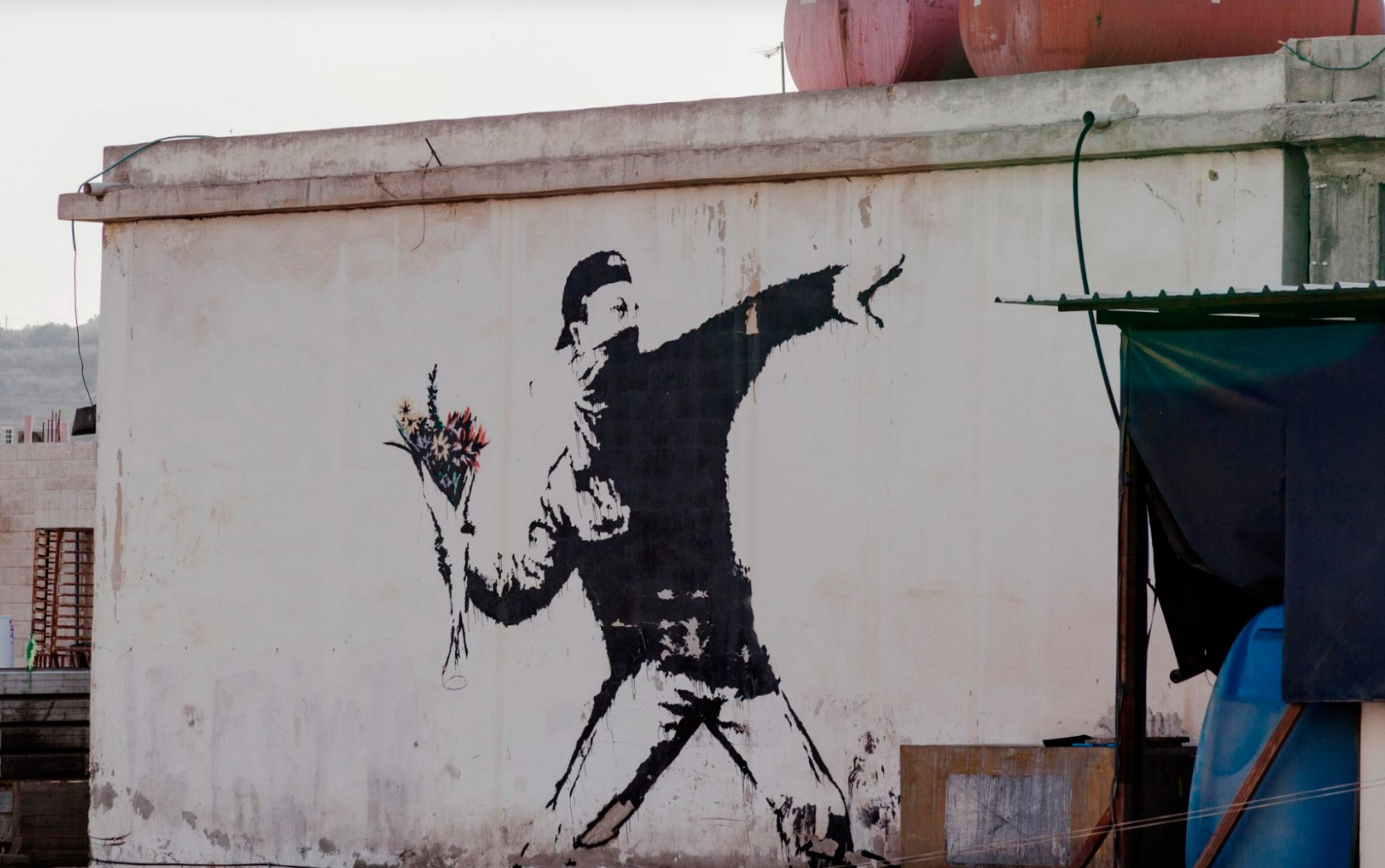
Photo: © PHOTOBYTE / Alamy Stock Photo. Artwork: © Banksy / Courtesy of Pest Control Office, Banksy.
The mural portrays a masked protester poised to hurl a bouquet of flowers, replacing the expected Molotov cocktail with a symbol of peace. This juxtaposition serves as a poignant commentary on the power of peaceful protest in the face of oppression.

Since Love is in the Air, the West Bank barrier wall has become a site of particular focus for Banksy. Over the years, multiple works have sprung up in the region: notably his 2005 take on his iconic Girl with Balloon, depicting a young girl being lifted over the wall by a bunch of balloons. In 2017, Banksy designed the Walled Off Hotel with a view of the barrier, in an attempt to boost tourism in the area while simultaneously highlighting the ongoing conflict.


BANKSY, WALLED OFF HOTEL, PALESTINE, 2017 © BANKSY
The location of Love is in the Air, however—a town called Beit Sahour, just east of Bethlehem—holds deeper significance still. In Christian tradition, it is said to be the site of the Annunciation to the shepherds, which told them of the birth of Jesus. Interestingly, the pose of Banksy’s protagonist is perhaps reminiscent of the angel statue outside the town’s Shepherds’ Fields Chapel, whose arm similarly reaches into the distance. In Love is in the Air, Banksy makes a case for ongoing hope in a region that once bore tales of miracles and salvation, his protagonist pointing eternally towards the future.
Flower Power

Left: Demonstrators march in support for the legalization of drugs, Hyde Park, London, 1967. (Photo by Stanley Sherman / Express / Hulton Archive / Getty Images)
Right: Flower Power photograph by Bernie Boston, taken during “March on The Pentagon”, 21 October 1967.
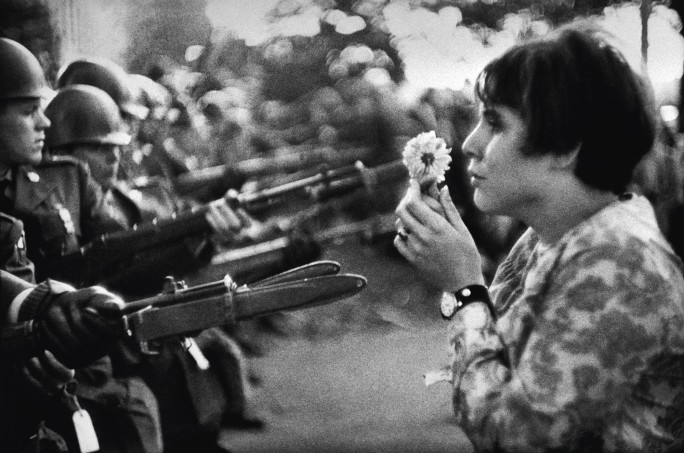
Anti-Vietnam peace protestor Jan Rose Kasmin confronting the American National Guard with a chrysanthemum flower outside the Pentagon, 1967. Photo: © Marc Riboud / Fonds Marc Riboud au MNAAG/Magnum Photos.
During the protests against the Vietnam War in the late 1960s and early 1970s in the United States, flowers became symbols of passive resistance and methods of non-violence, opposing the war and the atrocities it caused. With Love is in the Air, Banksy campaigns for peace rather than war, and evokes the notion of civil disobedience, highlighting the notion that weapons are not necessarily needed to achieve political or social change, and change can be achieved through non-violent means.
With this now-iconic image, Banksy offers us a universal message: that we must harness the virtues of peace in order to overcome the division and conflict that surround us and look ahead to a hopeful future.
Banksy: Anti-War Activist
An activist for peace, Banksy is known for his striking, tongue-in-cheek street art and compelling images that disseminate his anti-war sentiments. Militarism, war and the overall advocacy for peace are key themes that Banksy explores throughout his oeuvre, juxtaposing symbols of peace with images of violence to intrigue the viewer and startle them from passivity.

This can be seen in many of the artist’s most important graffiti works, particularly in those executed in the early 2000s, from the image of Mona Lisa holding a rocket launcher which appeared on a wall in Soho in 2001, to the little girl that cradles a missile in Banksy’s iconic Bomb Hugger and the banana-wielding protagonists of the artist’s Pulp Fiction. In Love is in the Air, Banksy’s masked subject adopts the pose of a violent protester, moments away from hurling his weapon into the air towards an unseen enemy.
The Art of Stenciling
In a few versions of Love Is In the Air, a radiant, hand-painted flowers are exquisite features. It is uncommon in Banksy’s oeuvre to see the use of hand-painted oil paint and stenciled spray paint coexist within the same image, and here, Banksy’s choice of medium enhances the message of the work and the juxtaposition of violence with peace. In Love is in the Air, the softness of the artist’s delicately painted flowers contrasts with the graphic sharpness of his signature stenciled spray-painted figure.

The bright, chromatic colors of the flower arrangement instantly command the viewer’s attention and engage them in the artist’s advocacy for peace. Banksy is well known for his distinctive use of stenciling, a technique he started using widely in the late 1990s in order to create complex graffiti works very rapidly in public spaces. The use of stenciling allowed the artist to reduce the window in which he risked being caught ‘vandalizing’ by the police, but without compromising the intricacy of the images. Banksy’s choice of stenciling as a technique has significance beyond pragmatic considerations: the practice has long been associated with underground political movements and punk culture, as it enables people to create visually striking images that can be reproduced quickly, cheaply and by anyone. These characteristics lend the technique to grassroots activism and speak to the DIY, anti-establishment, traditions of punk.

“As soon as I cut my first stencil I could feel the power there. I also like the political edge. All graffiti is low-level dissent, but stencils have an extra history. They’ve been used to start revolutions and to stop wars.”
Despite the site-specific context of its iteration on the West Bank Wall, Love Is In The Air represents protest without specifying its target, thereby embodying a hint of the punk ethos of non-conformity and perpetual resistance to authority that is typical of the artist’s early graffiti works. Like Keith Haring and Jean-Michel Basquiat, Banksy utilizes graffiti as a tool for activism—but for Banksy, the stencil is the driving force.
Artistic References
With works such as Love is in the Air, Banksy joins an important lineage of artists who have used their art to comment on pressing political and social issues, from Eugène Delacroix’s Liberty Leading the People, created after the July Revolution of 1830 as a symbol for liberty and democracy; to Andy Warhol’s use of stencils to subvert often highly political images from popular culture, as seen in Race Riot from 1964; and the many artists who have taken to the streets to disseminate their message for the world to see. The imagery of Love is in the Air has been frequently reproduced in popular culture, making this work an important, highly-sought after example from the illustrious street artist’s compelling, thought-provoking oeuvre. Today, the powerful message of Love is in the Air remains as pertinent as ever.

EUGENE DELACROIX, LIBERTY LEADING THE PEOPLE, 1830, LOUVRE MUSEUM, PARIS
Executed in 2006, Love is in the Air was created after Banksy’s foray into oils in his series of vandalized oil paintings, Crude Oils: A Gallery of Re-mixed Masterpieces, Vandalism and Vermin (2005), a departure from his signature street interventions and archetypal graffiti using spray paint and stencils.

The incorporation of these richly painted flowers also brings to mind the long tradition of floral still life paintings; yet in typical Banksy fashion, these vivid blooms are a far cry from the somber beauty of a 17th century Dutch floral arrangement, or indeed the symbolic incorporation of flowers by Medieval, Renaissance and Victorian artists, but rather appear as if they may have been snatched from a local gas station to be hurled at an unseen enemy.

Image: © Vanni Archive / Art Resource, NY
Singing Love is in the Air
The work shares its title with the 1978 hit song by John Paul Young. Emblematic of Banksy’s wit, satire and dark humor, the title is expressive of the positive message of the work, that being the call for peace.

Banksy’s iconic flower thrower has become synonymous with the artist’s thought-provoking oeuvre, a powerful image expressing the absurdity of war and the artist’s vocal advocacy for peace.
Love Is in the Air serves as an excellent educational tool, introducing students to themes of peaceful protest, symbolism in art, and the role of street art in societal commentary. Its striking imagery and underlying message encourage discussions about conflict resolution, the power of nonviolence, and the impact of art in public spaces
Auction Results
Across the various painted iterations of Love Is In The Air, Banksy varies the effect of the spray paint, showcasing different renderings of shadow, blur, and the figure’s bouquet.

Banksy’s London studio, 2004. Photo: James Pfaff
In the present work, the artist elongates the shadow between the figure’s legs and creates a prominent blurring effect to the image, at once evoking the speed of the protestor’s movement and the nature of memory. Creating a striking visual contrast with the rest of the composition, the touches of bright red allude the color’s dual significations of violence and love, encapsulating Banksy’s message for this iconic image—love as the ultimate weapon.
You will find below all versions sold at auction in decreasing order of price realized.
#1. Love is in the Air, 2005
Sotheby’s New-York: 12 May 2021
Estimated: USD 3,000,000 – 5,000,000
USD 12,903,000
Love is in the Air | Contemporary Art Evening Auction | 2021 | Sotheby’s (sothebys.com)

BANKSY
Love is in the Air, 2005
Oil and spray paint on canvas
90×90 cm (35.4 x 36.4 inches)
Provenance
Lazarides Gallery, London
Acquired by the present owner from the above in 2006
Love is in the Air is a quintessential Banksy painting: instantly recognizable, the image has become synonymous with the artist’s indelible graphic style, wry humor and galvanizing political commentary. Banksy’s subject adopts the archetypal pose of civic unrest, preparing to hurl a brick or bomb towards an unseen foe, however the artist replaces his projectile with a bunch of flowers, disarming this image of violent unrest to create a work that is both a call for change and advocation of peace.
XXXXXXXXXX
#2. Love Is In The Air (life size), 2011
Sotheby’s London: 25 June 2026
Estimated: GBP 3,500,000 – 5,500,000
GBP 6,434,000 / USD 8,619,290
Banksy | Love Is In The Air (life size) | Modern & Contemporary
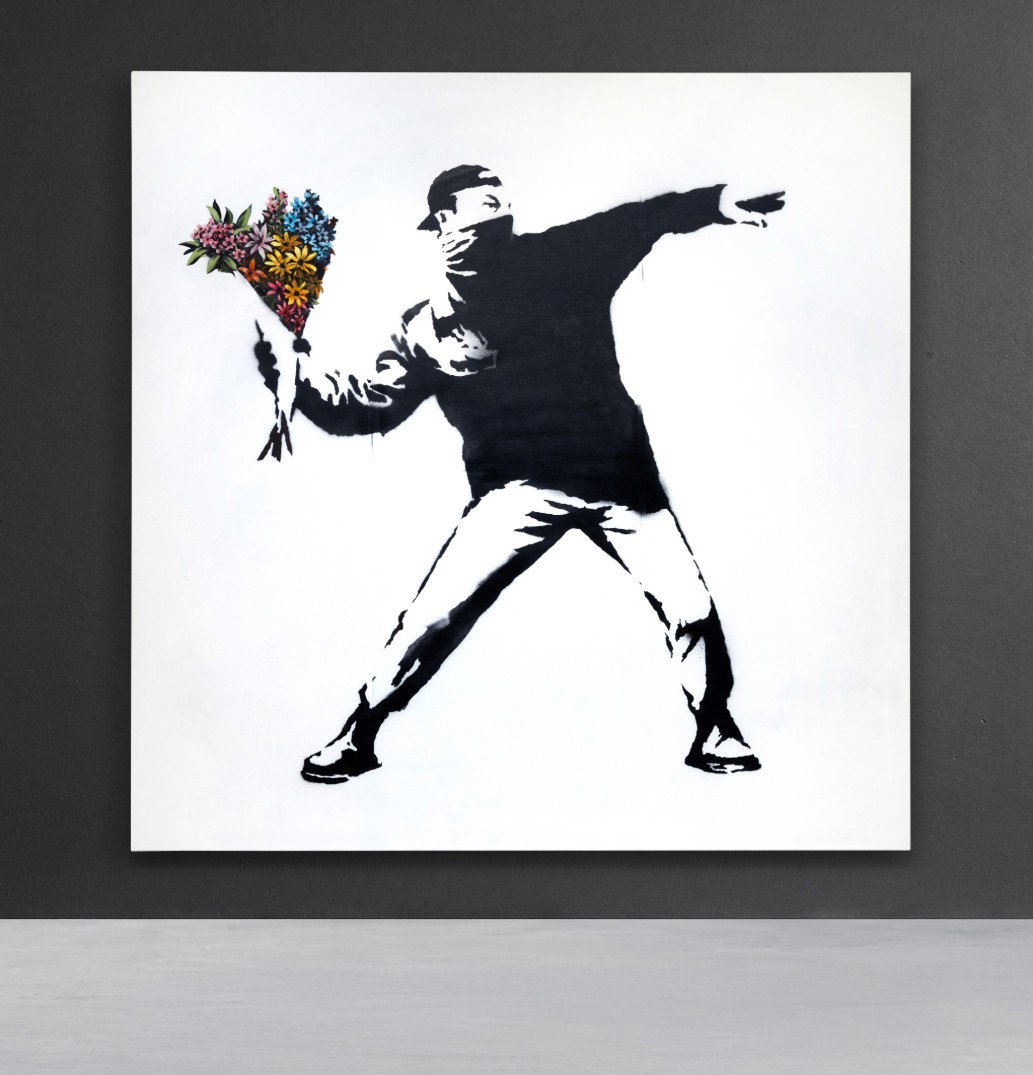
BANKSY (b. 1973)
Love Is In The Air (life size), 2011
Spray paint and oil on canvas
210×210 cm (82-5/8 x 82-5/8 inches)
Signed and dated 11 (on the overlap)
XXXXXXXXXX
#3. Love Is In The Air, 2006
Sotheby’s New-York: 18 November 2021
Estimated: USD 4,000,000 – 6,000,000
USD 8,077,200
Love is in the Air | The Now Evening Auction | 2021 | Sotheby’s (sothebys.com)

BANKSY
Love Is In The Air, 2006
Oil and spray paint on canvas
90×90 cm (35.4 x 35.4 inches)
XXXXXXXXXX
#4. Love is in the Air, 2006
Sotheby’s Hong-Kong: 27 April 2022
Estimated: HKD 40,000,000 – 60,000,000
HKD 51,273,000 / USD 6,508,768

BANKSY
Love is in the Air, 2006
Oil and spray paint on canvas
91.4 x 91.4 cm (36×36 inches)
XXXXXXXXXX
#5. Love Is In The Air, 2006
Sotheby’s London: 14 October 2022
Estimated: GBP 3,400,000 – 4,000,000
GBP 3,483,500 / USD 3,905,269
Love Is In The Air | The Now Evening Auction | 2022 | Sotheby’s (sothebys.com)

BANKSY (B. 1974)
Love Is In The Air, 2006
Spray paint and oil on linen
91.5 x 91.5 cm (36×36 inches)
Tagged (on the overturn edge)
Signed Banksy, dated May 2006 and numbered AP 02 (on the overlap)
XXXXXXXXXX
#6. Flower Thrower Triptych, 2017
Christie’s New-York: 21 February 2024
The Collection of Sir Elton John
Estimated: USD 1,000,000 – 1,500,000
USD 1,925,500
BANKSY, Flower Thrower Triptych | Christie’s (christies.com)

BANKSY
Flower Thrower Triptych, 2017
Spray paint on canvas in artist’s frame, in three parts
Left panel: 84.5 x 64.1 cm (33 1/4 x 25 1/4 inches)
Center panel: 106.7 x 76.2 cm (42×30 inches)
Right panel: 42.2 x 52.3 cm (16 5/8 x 20 5/8 inches
Overall: 106.7 x 203.2 cm (42×80 inches)
Signed and dated ‘Banksy 2017’ (on the reverse of the left panel)
XXXXXXXXXX
#7. Flower Chucker
Hessink’s: 26 May 2021
Estimated: EUR 300,000 – 400,000
EUR 1,000,000 (Hammer)
EUR 1,220,000 / USD 1,492,600
Hessink’s Fine Art Auctioneers | Home

BANKSY
Flower Chucker, 2003
Spray-paint on cardboard
56 x 54.5 cm (26 3/4 x 26 5/8 inches)
Unique from a varied series
XXXXXXXXXX
#8. Love is in the Air, 2002
Christie’s London: 1 March 2022
Estimated: GBP 600,000 – 800,000
GBP 978,000 / USD 1,303,670

BANKSY
Love is in the Air, 2002
Spray paint on canvas
17×17 inches (43.2 x 43.2 cm)
Executed in 2002, this work is a variant outside an edition of five
XXXXXXXXXX
#9. Love Is In The Air, 2002
Phillips New-York: 23 June 2021
Estimated: USD 1,000,000 – 2,000,000
USD 1,179,500
Banksy – 20th Century & Contemporary Ar… Lot 46 June 2021 | Phillips

BANKSY
Love Is In The Air, 2002
Spray-paint on canvas
20×17 inches (50.8 x 43.3 cm)
This work is number 4 from an edition of 5
XXXXXXXXXX
#10. Love Is In the Air (with stars), 2006
Sotheby’s New-York: 17 November 2022
Estimated: USD 1,000,000 – 1,500,000
USD 1,159,200
Love Is In the Air (with stars) | Contemporary Day Auction | 2022 | Sotheby’s (sothebys.com)

BANKSY (B. 1974)
Love Is In the Air (with stars), 2006
Acrylic and spray paint on canvas
42.5 x 43 cm (16 3/4 x 17 inches)
Tagged BANKSY (on the turning edge); signed BANKSY (on the reverse)
XXXXXXXXXX
#11. Love is in the Air, 2002
Christie’s London: 13 October 2022
Estimated: GBP 500,000 – 700,000
GBP 567,000 / USD 635,650
Estimated: GBP 40,000 – 60,000

BANKSY
Love is in the Air, 2002
Spray paint on canvas
21×18 inches (53.4 x 45.7 cm)
From a series, Tagged ‘Banksy’ (lower right)
XXXXXXXXXX
#12. Love is in the Air, 2003
Phillips London: 15 April 2021
Estimated: GBP 400,000 – 600,000
GBP 441,000 / USD 607,770
Banksy – 20th Century & Contemporary A… Lot 20 April 2021 | Phillips

BANKSY
Love is in the Air, 2003
Spray paint on cardboard
68 x 67.5 cm (26.7 x 26.6 inches)
XXXXXXXXXX
#13. Love is in the Air, 2006
Bonhams London: 27 June 2013
Estimated: GBP 70,000 – 100,000
GBP 163,250 / USD 249,380
Bonhams : Banksy (b. 1975) Love is in the Air

Stencil spray paint and oil on canvas
91×91 cm (35 13/16 x 35 13/16 inches)
Signed, dated 24/4/2006 and inscribed AP 16/15 on the reverse
Stencil signature to the overlap
XXXXXXXXXX
#14. Love is in the Air (AKA Flower Thrower), 2010
Phillips London: 30 June 2015
Estimated: GBP 150,000 – 200,000
GBP 134,500 / USD 211,545
Banksy – Contemporary Art Day Sale London Lot 123 June 2015 | Phillips

BANKSY
Love is in the Air (AKA Flower Thrower), 2010
Spray paint on canvas
Diamond: 84.5 x 84.5 cm (33 1/4 x 33 1/4 inches)
Square: 60×60 cm (23 5/8 x 23 5/8 inches)
Signed and dated ‘BANKSY 2010’ on the reverse
XXXXXXXXXX
#15. Love is in the Air 2002
Bonhams London: 29 March 2012
Estimated: GBP 40,000 – 60,000
GBP 87,650 / USD 139,180
Bonhams : Banksy (b. 1975) Love is in the Air

Stencil spray paint on canvas
51×43 cm (20 1/16 x 16 15/16 inches)
Stenciled BANKSY to the overlap
Signed, dated 2002, numbered 2/5 and inscribed LA to the reverse