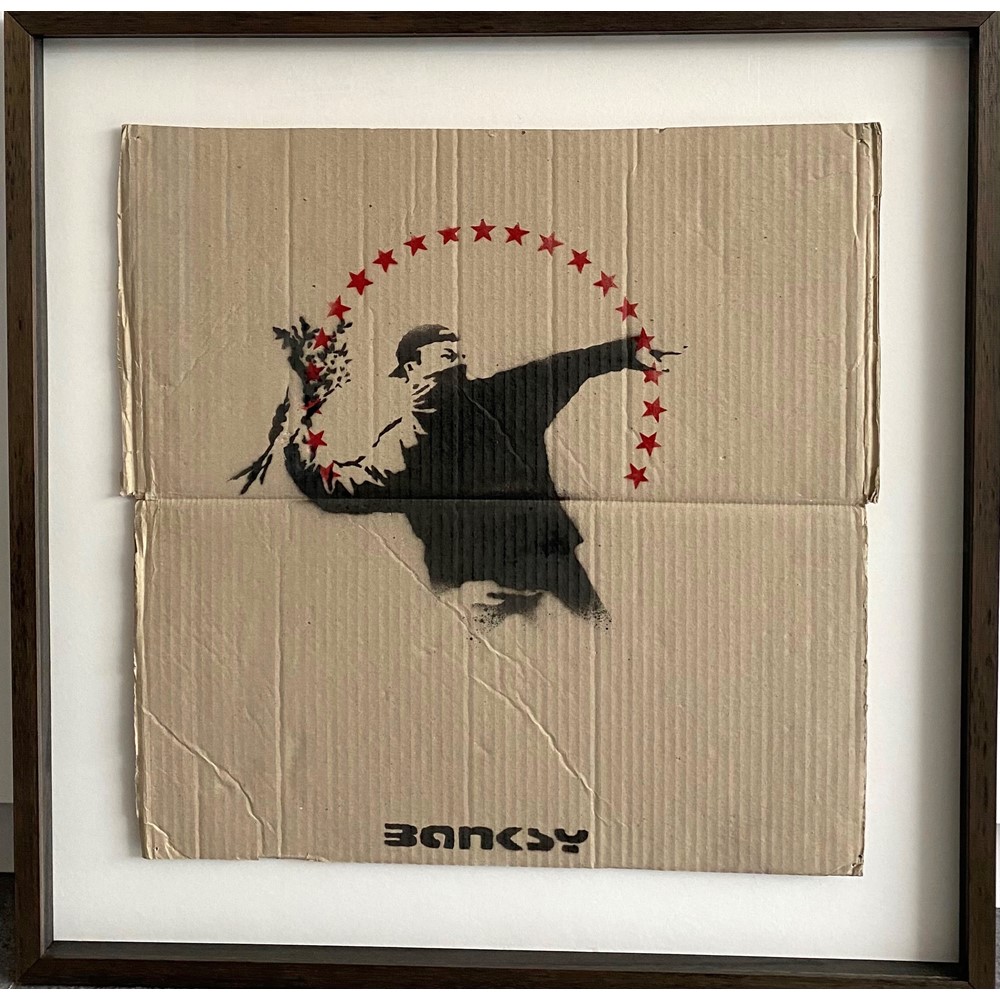

Flower Chucker, 2003
Auction History
| Hessink’s 26 May 2021 Est.: EUR 300,000 – 400,000 |
Price Realized EUR 1,000,000 (Hammer) EUR 1,220,000 / USD 1,492,600 Hessink’s Fine Art Auctioneers | Home |
Catalogue Note
Executed in 2003, this unique Flower Chucker exemplifies Banksy’s remarkable ability to transform the humblest of materials into an image of extraordinary symbolic power. Spray-painted directly onto a discarded sheet of corrugated cardboard, the work strips one of the artist’s most celebrated compositions back to its essentials, preserving the raw immediacy and spontaneity of its street origins.
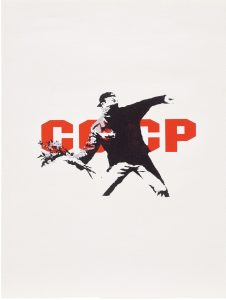
Originally created as a mural in Jerusalem, Flower Chucker has become one of Banksy’s defining images, replacing the violence of a thrown projectile with a bouquet of flowers. The gesture has often been interpreted as a call for peace, but its enduring appeal lies in its deliberate ambiguity. The figure remains poised for confrontation, its body charged with the energy of conflict, yet the object it hurls offers beauty rather than destruction. Banksy does not erase violence; instead, he redirects it, suggesting that acts of defiance need not always be expressed through aggression.

This particular version introduces an additional visual element absent from many later interpretations: a halo of red stars surrounding the protester. The circular arrangement recalls both a target and a halo, simultaneously evoking political symbolism, revolutionary iconography and even traditional religious imagery. As so often in Banksy’s work, the motif resists any definitive reading, enriching the composition without diminishing its striking visual simplicity.
The choice of corrugated cardboard is fundamental to the work’s meaning. Far from serving as a convenient support, the material preserves the authentic language of the street. Cardboard is temporary, inexpensive and readily discarded—qualities shared by many of the urban surfaces upon which Banksy first established his reputation. Its visible folds, creases and imperfections remain fully exposed, emphasizing the object’s previous life while rejecting the polished refinement traditionally associated with painting. The support becomes part of the artwork itself, reinforcing Banksy’s longstanding fascination with overlooked materials and his refusal to separate art from everyday life.
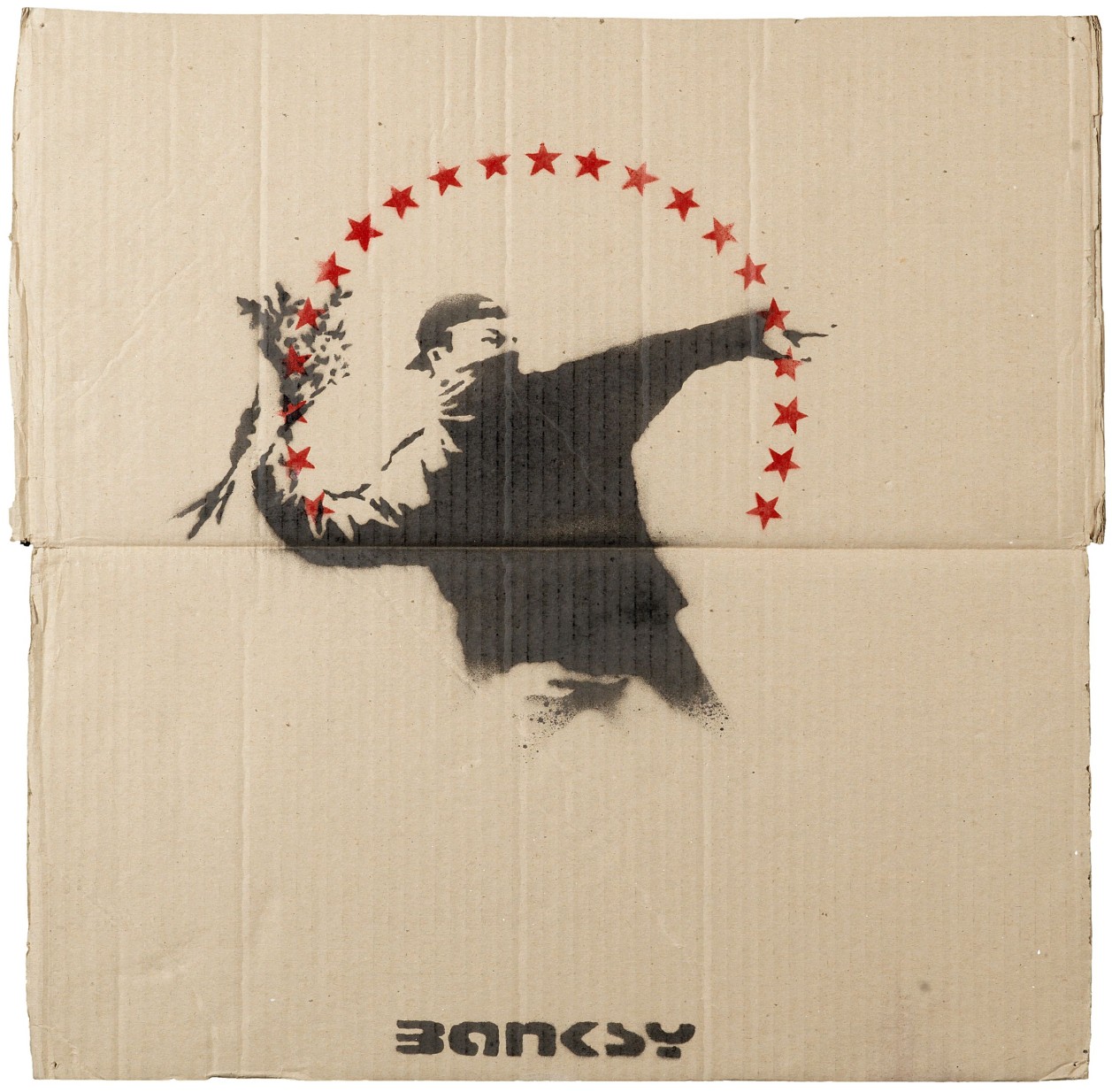
The stark contrast between the monochrome stencil and the warm, natural tones of the cardboard further heightens the image’s graphic clarity. The vivid red bouquet and surrounding stars provide the composition’s only color, immediately drawing the viewer’s attention to the symbolic transformation at the heart of the work. Through this restrained palette, Banksy demonstrates once again that visual economy can produce extraordinary emotional impact.
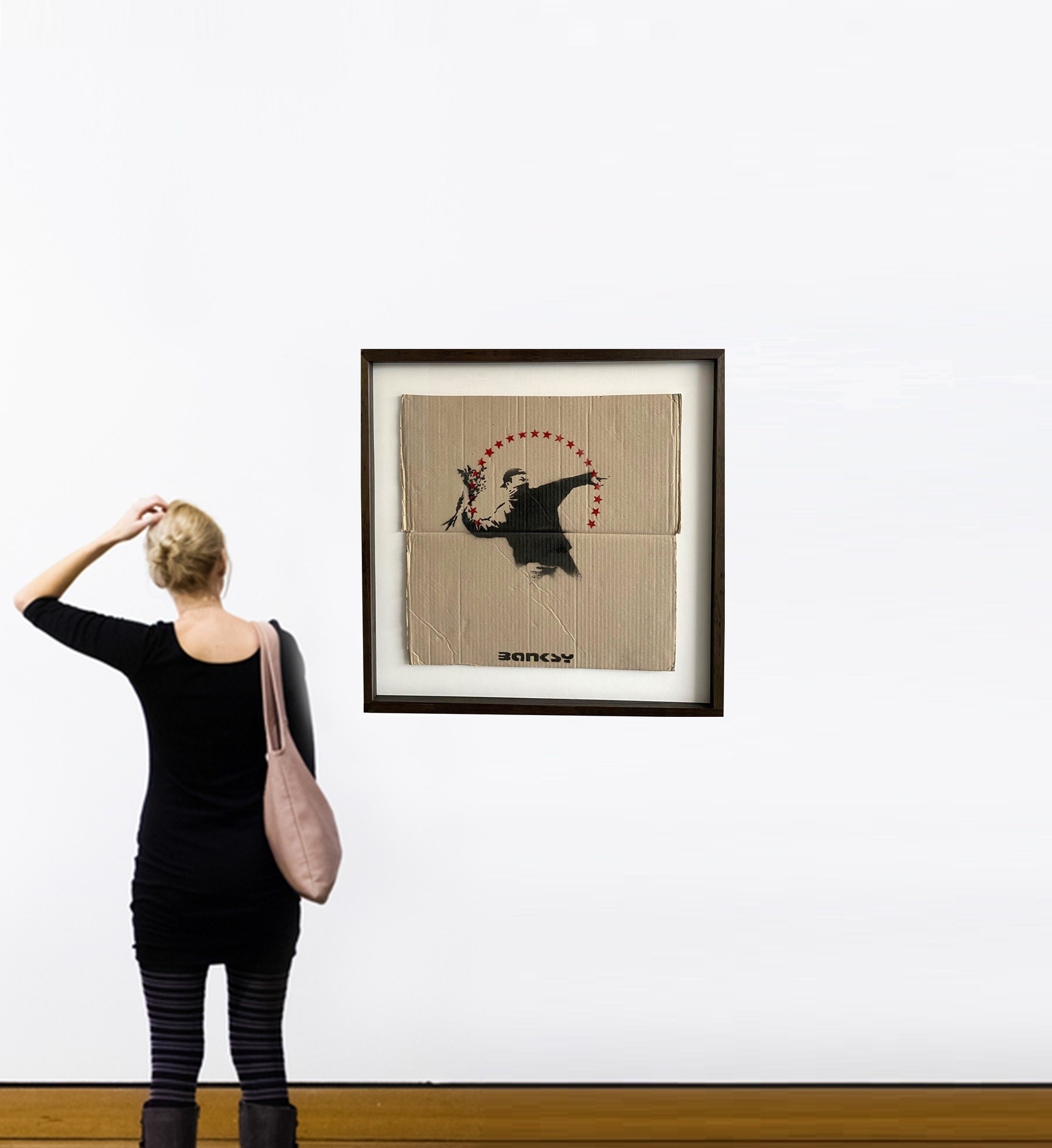
More than a painted object, this unique Flower Chucker represents the successful translation of one of Banksy’s most iconic murals into an intimate studio work without sacrificing its authenticity. It retains the immediacy of graffiti while embracing the permanence of the original artwork, demonstrating how the artist could elevate the most ordinary materials into enduring contemporary icons. In doing so, it reminds us that the true power of Banksy’s art lies not in technical complexity, but in his extraordinary ability to communicate universal ideas through images of remarkable simplicity.