BANKSY
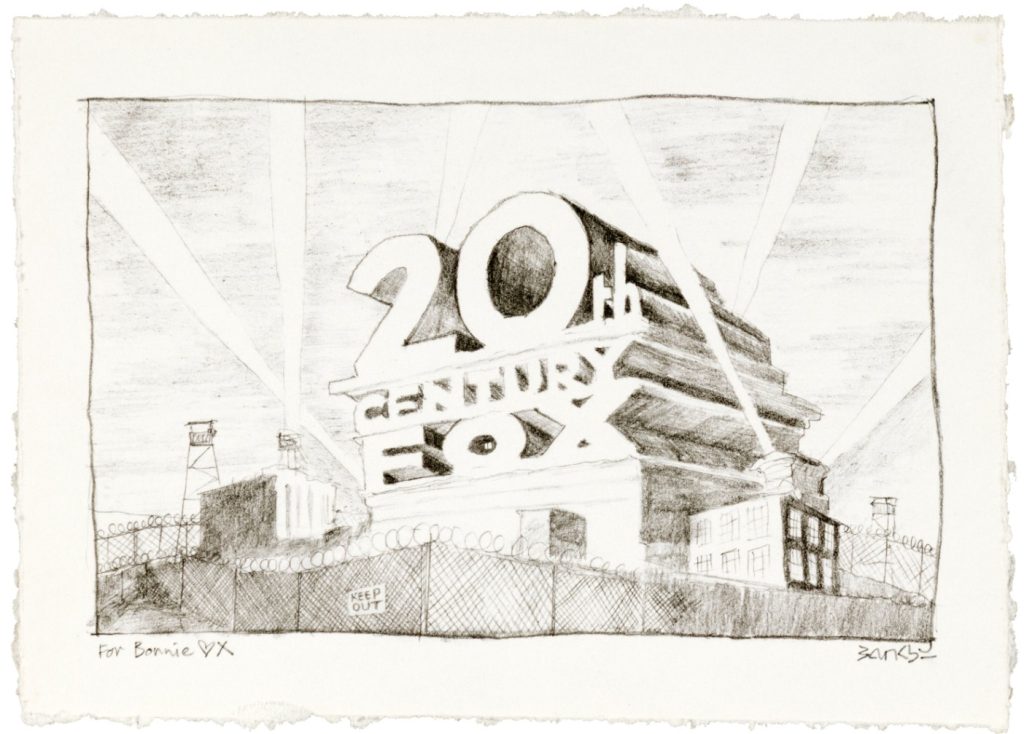
The Simpsons Original Drawing, 2010
From “MoneyBART” (Fox, 2010)
Graphite on paper mounted on board
Image: 17.8 x 11.4 cm (7 x 4 1/2 inches)
Sheet: 8 1/2 x 6 inches
Signed BANKSY in pencil lower right
Inscribed “For Bonnie (heart) X” in pencil lower left
Provenance
Gift from the Artist
Personal Archive of The Simpsons Producer Bonita Pietila
Auction History
| Heritage Auctions 21 October 2025 No Estimates Provided | Price Realized USD 168,000 The Simpsons BANKSY | Heritage Auctions |
Catalogue Note
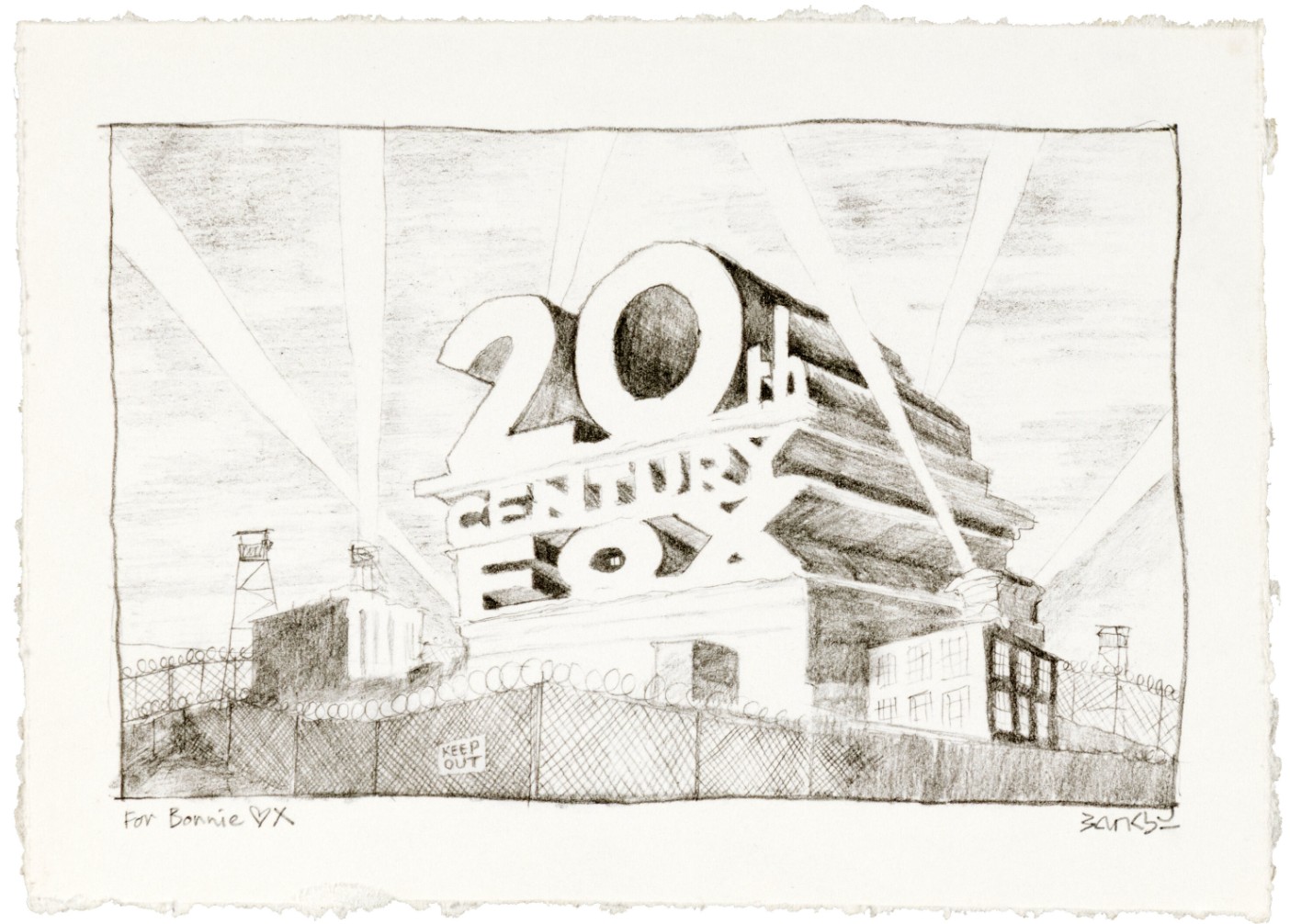
Created in 2010, The Simpsons Original Drawing is intimately connected to one of Banksy’s most audacious interventions into popular culture: his notorious opening sequence for The Simpsons episode MoneyBART. Small, monochromatic and executed simply in graphite, the drawing depicts the monumental 20th Century Fox studio sign transformed into something altogether more sinister. Searchlights sweep across the sky, watchtowers rise around the buildings and coils of razor wire run along a perimeter fence marked KEEP OUT. The dream factory has become a prison.
The drawing reproduces the final image of the extraordinary opening sequence Banksy conceived for The Simpsons, broadcast on 10 October 2010. What initially appears to be a conventional opening to America’s longest-running animated sitcom gradually descends beneath the fictional Springfield into a nightmarish factory where exhausted workers and children manufacture animation cells and Simpsons merchandise under brutal conditions. Kittens are used to stuff Bart Simpson dolls, a chained unicorn punches holes into DVDs, and an emaciated panda is forced to haul merchandise. The sequence eventually pulls back to reveal the entire dystopian operation taking place beneath the heavily fortified Fox complex depicted in the present drawing.
The joke was particularly sharp because it appeared inside the very commercial machine it attacked. Banksy was not parodying The Simpsons from the safety of a gallery wall or the side of a building; his criticism of industrialized entertainment, merchandising and outsourced production was broadcast by Fox as part of The Simpsons itself. The corporation effectively became the distributor of its own caricature. It was institutional critique smuggled directly into the institution.
There was also an irresistible symmetry to the collaboration. The Simpsons had spent decades satirizing American politics, corporations, consumer culture and television itself. Banksy’s practice had evolved around many of the same targets, albeit through an entirely different medium. Bringing the two together therefore felt strangely inevitable: the world’s most famous anonymous street artist briefly entered one of the world’s most recognizable animated universes and was apparently given sufficient freedom to make the encounter genuinely uncomfortable.
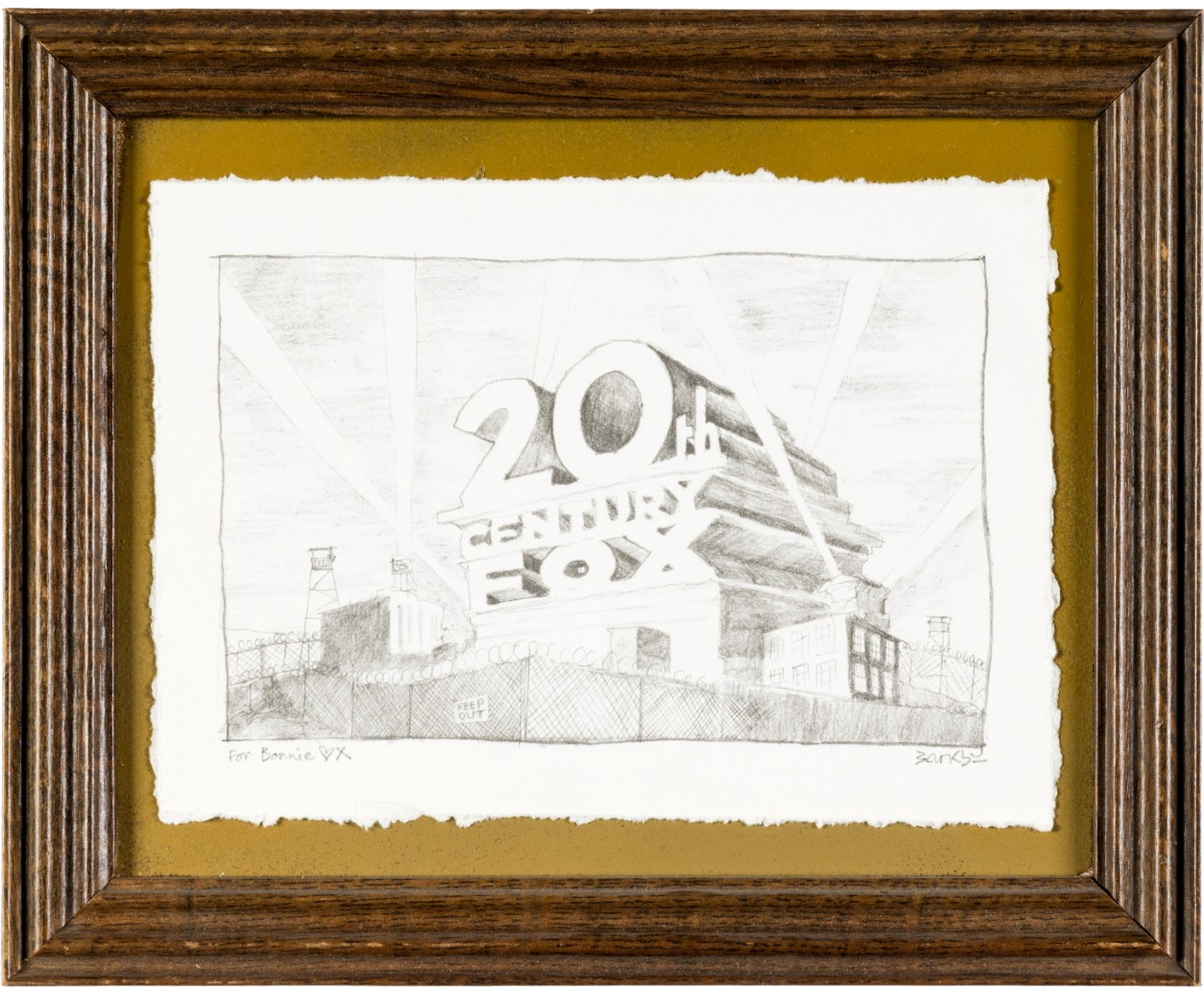
The provenance of the present work gives it particular significance. Rather than being a later interpretation of the imagery, the drawing was gifted directly by Banksy to Bonita Pietila, a longtime producer of The Simpsons, and remained in her personal archive. Banksy inscribed the sheet “For Bonnie ♥ X” and signed it at lower right. According to the accompanying provenance, another message appears on the reverse of its frame: “Thanks, Bonnie. You do a fine job – B.” The dedication transforms the drawing into something unusually personal: both an artwork and a tangible document of Banksy’s direct involvement with the production.
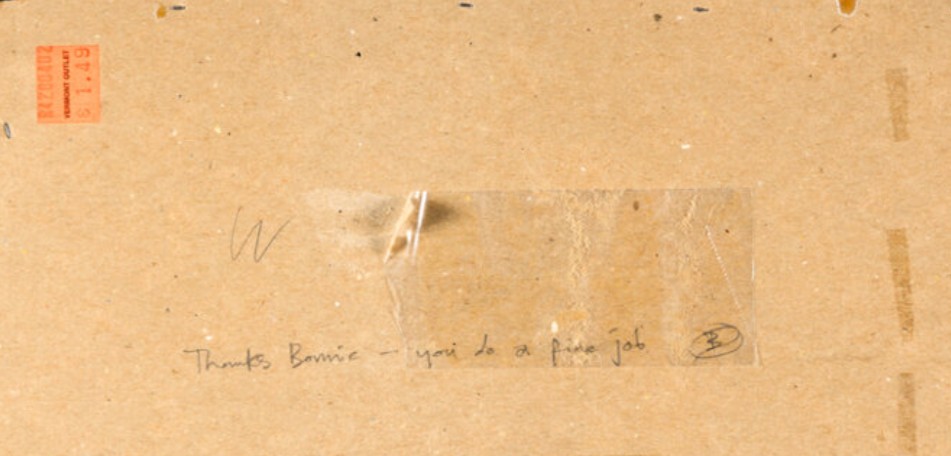
Even the frame contributes a wonderfully Banksy-esque footnote. According to its auction history, the simple frame chosen for the drawing retained a $1.49 Vermont Outlet price tag on its reverse. It is difficult to imagine a more appropriate container for an original Banksy connected to one of the most commercially successful television franchises in history: a valuable artwork attacking mass consumerism, presented in a frame costing less than two dollars.
The final image is deceptively important. After the grotesque machinery of production revealed throughout the sequence, Banksy does not conclude with another exploited worker or endangered animal. Instead, he turns his attention toward the corporation itself. The familiar Fox monument—normally an emblem of Hollywood spectacle—is enclosed behind fencing, razor wire and surveillance architecture. Entertainment and imprisonment become visually indistinguishable. The image asks an uncomfortable question that runs throughout Banksy’s work: what lies behind the polished objects and images we consume so effortlessly?
Despite its modest dimensions and deliberately informal execution, The Simpsons Original Drawing therefore records an extraordinary cultural encounter. Banksy temporarily crossed from the street into mainstream American television without surrendering the antagonism that had made his work famous in the first place. If anything, he used the scale of the platform against itself.