Banksy and Simon Munnery:
The Commandments, 2005
A Series of Stencilled Aphorisms on Repurposed Wood
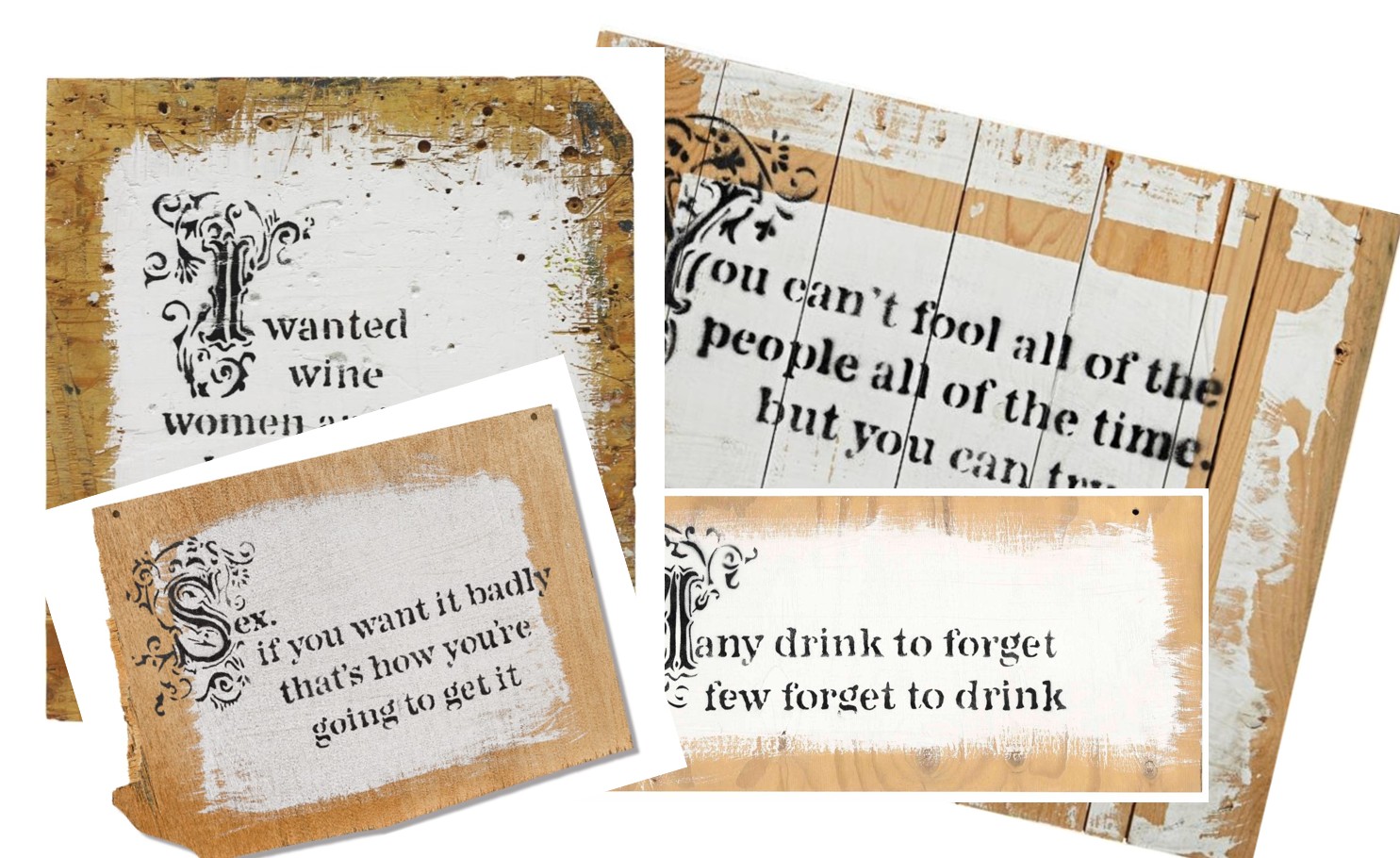
Created in 2005, Banksy’s collaboration with the English comedian and writer Simon Munnery occupies a distinctive position within the artist’s oeuvre. The group consists of unique text-based works painted in spray paint and emulsion on pieces of reclaimed wood, plywood and other roughly finished supports. Each carries a short aphorism written by Munnery and visually interpreted by Banksy through stenciled lettering, ornamental initials and compositions recalling traditional book design. Even though Banksy has never titled this group of works as a series, we would use The Commandments as the principal title because it captures the mock-authoritative tone of the works: each panel resembles a moral instruction, proverb or fragment of inherited wisdom, yet every statement collapses into irony. Each is unique, and several were exhibited at Santa’s Ghetto in London in December 2005. Rather than forming a conventional edition, they constitute a family of individual works united by language, materials, humour and presentation.
The Commandments
The series represents a rare meeting between two closely compatible artistic sensibilities. Munnery’s writing depends upon linguistic compression, misdirection and the sudden reversal of expectation. Banksy’s visual practice similarly relies upon economy: an image or statement appears immediately legible before revealing an internal contradiction. In these works, the mechanics of the joke and the mechanics of the stencil become almost indistinguishable.
The panels present themselves as repositories of wisdom. Their decorated initials and old-fashioned typography evoke fables, sermons, commandments, Victorian moral instruction and the opening pages of antique books. Yet the lessons they contain are profoundly unreliable. They address sex, punishment, alcohol, advertising, ambition and disappointment, but offer no path toward moral improvement. Instead, they expose the absurdity of human behavior and the inadequacy of the formulas through which people attempt to explain it.
They are commandments for a world that no longer believes in commandments.
The Origins of the Collaboration
Munnery later described an encounter with a graffiti artist who approached him after a performance and admitted to spraying fragments of his material on walls. According to Munnery’s account, a similar encounter occurred approximately a year later, when the man identified himself as Banksy. Munnery subsequently contributed writing and ideas to Banksy-related projects, although he characteristically resisted providing a definitive or neatly packaged history of their relationship.
The collaboration is especially natural because both artists work through the controlled disruption of expectation. A comedian constructs a sentence so that its final words force the audience to reinterpret its beginning. Banksy frequently constructs images in precisely the same way: what initially appears sentimental becomes political, what seems violent becomes tender, and what looks familiar suddenly turns absurd.
In the Munnery panels, language performs the visual reversal normally supplied by Banksy’s imagery. The viewer does not merely read the joke; the viewer is caught inside it. The opening phrase establishes a familiar moral, proverbial or conversational structure, while the conclusion overturns the apparent meaning.
Banksy’s contribution is nevertheless far more than decorative. By transferring Munnery’s lines from the stage onto salvaged wood, he changes their cultural status. A sentence that might have existed for a few seconds during a comedy performance becomes a unique, physical object. The joke acquires a surface, a scale, an exhibition history and an afterlife.
Santa’s Ghetto, 2005
Several works from the series were shown at the 2005 edition of Santa’s Ghetto, Banksy’s alternative seasonal exhibition and retail project in London. Santa’s Ghetto brought together original works, prints and objects by Banksy and artists associated with the Pictures on Walls circle, presenting art within an environment that simultaneously resembled and mocked a commercial Christmas shop.
The series was particularly suited to this context. Santa’s Ghetto borrowed the appearance of retail while questioning consumption; the Munnery panels borrowed the appearance of moral instruction while questioning wisdom. Both employed recognizable cultural forms only to undermine them from within.
The year 2005 was also one of extraordinary experimentation for Banksy. His work moved fluidly between street interventions, altered paintings, museum infiltrations, politically charged murals and unique studio objects. The Munnery collaboration belongs to this wider investigation of authority: the authority of museums, historical painting, political borders and, in the present series, language itself.
Rather than altering an existing masterpiece, Banksy here interferes with the structure of the proverb. The cultural object being vandalized is not a painting but a sentence.
The Appearance of Authority
The visual language of the panels is central to their meaning. Their compositions frequently feature large ornamental initials, traditional serif lettering and decorative flourishes suggestive of illuminated manuscripts, early printed books or collections of moral tales.
Historically, such visual devices conferred importance upon written language. Ornament suggested that a text deserved attention, labor and preservation. Banksy borrows these conventions but reproduces them with spray paint and stencils—the materials of speed, repetition and unauthorized urban communication.
The result is a collision between two seemingly incompatible traditions. The elegance of the antique page encounters the roughness of the street. Formal typography is placed upon plywood, crate timber or damaged boards. Decorative letters resembling the work of a patient scribe are produced through a process associated with rapid execution.
This visual contradiction exposes the way authority is constructed. A banal sentence may appear profound when rendered in formal typography. A joke can begin to resemble a proverb when isolated on a panel. The appearance of wisdom may depend as much upon presentation as upon meaning.
Banksy simultaneously exploits and ridicules this mechanism. He gives the statements the dignity of historical inscription while ensuring that their content remains stubbornly undignified.
Repurposed Wood and the Material Language of the Street
The wooden supports are not neutral surfaces. They bear stains, scratches, nail holes, uneven paint, visible grain and evidence of earlier use. Some resemble parts of packing cases; others suggest temporary hoarding, discarded signs or fragments removed from construction sites.
This material roughness prevents the works from becoming polished exercises in graphic design. Their surfaces preserve a connection with the urban environment and with the improvised nature of street art. Rather than placing stencil painting upon pristine canvas, Banksy allows the pre-existing history of each board to remain visible.
The materials also intensify the central contradiction of the series. The statements mimic eternal truths, yet they are recorded on objects associated with temporary use and eventual disposal. They resemble commandments, but their tablets are pieces of plywood.
This tension between permanence and impermanence would become increasingly significant within Banksy’s career. An inexpensive piece of reclaimed timber, once painted and authenticated, is transformed into a unique and valuable work of art. Yet it continues to resemble something that might have been discarded. The object therefore retains two identities simultaneously: cultural artefact and construction debris.
Interpretation
Comedy as an Artistic Method
Humor in Banksy’s work is sometimes described merely as a means of making political ideas accessible. In the Munnery series, however, comedy is not an introduction to the serious content. It is the content’s principal form. A joke reveals instability within language. It demonstrates that a word may carry contradictory meanings, that a familiar phrase may conceal an unexpected conclusion, and that authority can collapse through a slight change of emphasis.
The series repeatedly uses this structure. The viewer encounters an apparently familiar statement and predicts its conclusion. The sentence then denies that expectation. Meaning occurs twice: first as assumption and then as correction.
This delayed understanding closely parallels Banksy’s visual method. Many of his best-known images communicate instantaneously but contain a second moment of recognition. A protester appears to throw a weapon, but the weapon is a bouquet. A girl reaches toward a balloon, but the image can be read as either loss or liberation. In the Munnery works, grammar takes the place of pictorial reversal. The joke is therefore not an ornament placed upon the work. It is a machine for producing thought.
Anti-Proverbs and Secular Commandments
Traditional proverbs promise that experience can be reduced to a stable formula. They offer reassurance that virtue will be rewarded, excess punished and patience vindicated. Their authority depends upon repetition: a sentence appears true because generations have continued to repeat it.
The Banksy–Munnery panels retain the cadence of proverbs but remove their certainty. They offer what might be called anti-proverbs: statements that begin like wisdom and end in disappointment, cynicism or absurdity.
The world described by these panels is governed neither by divine justice nor by dependable moral consequence. Desire leads to inadequate fulfilment. Attempts to forget become habits. Advertising is institutionalized deception. Ambition ends in bathos. The pursuit of freedom may produce catastrophe.
Yet the series is not entirely nihilistic. Its humor creates a form of recognition. The viewer laughs because the statements exaggerate familiar failures: self-deception, excess, frustration and the gap between imagined life and lived experience. Their wisdom lies precisely in their refusal to sound wise.
Desire, Consumption and Disappointment
Although the works address different subjects, many revolve around a common structure: the distance between what human beings want and what they receive.
This concern places the series firmly within Banksy’s broader critique of consumer culture. Advertising repeatedly promises that desire can be satisfied through acquisition. Products, experiences and identities are presented as solutions to dissatisfaction. Yet wanting something intensely does not guarantee that obtaining it will produce pleasure, meaning or fulfilment.
The panels transpose this critique into intimate language. They address sex, alcohol, entertainment and ambition rather than explicitly depicting corporations or shoppers. Nevertheless, the underlying problem remains similar: the modern subject is trained to desire yet poorly equipped to recognize when desire has become self-defeating.
Munnery’s lines are funny because they compress this predicament into sentences simple enough to remember. Banksy’s presentation then returns them to the viewer as mock advertisements for disappointment.
Authorship and Collaboration
Banksy is usually discussed through the mythology of an isolated anonymous artist, yet his practice has frequently involved printers, performers, musicians, filmmakers, technicians, activists and other artists. The Munnery series makes this collaborative dimension unusually visible.
Munnery supplies the verbal architecture: the rhythm, ambiguity and reversal. Banksy determines the graphic appearance, material form and visual setting. Neither element is entirely subordinate to the other.
The works should therefore not be described merely as Banksy paintings containing quotations by Munnery. Their meaning is produced through the encounter between writing and presentation. The sentence operates as comedy; the panel transforms it into visual art.
This distinction is particularly important in a catalogue context. The collaboration does not diminish Banksy’s authorship. Instead, it reveals his practice as one capable of recognising, appropriating and materially reframing another artist’s language.
Banksy’s role resembles that of a director as much as that of a painter. He controls the stage upon which the words perform.
The Individual Works
Sex, If You Want It Badly
The sentence depends upon the double meaning of the word badly. In its first appearance, it describes intensity: to want something badly is to desire it desperately. By the end of the phrase, however, badly has become an assessment of quality. The promised fulfilment arrives, but it arrives badly.
The reader is forced to reinterpret the beginning only after reaching the conclusion. Desire becomes the cause of its own disappointment. The work does not condemn sexuality; rather, it questions the assumption that intensity of longing guarantees value or satisfaction.
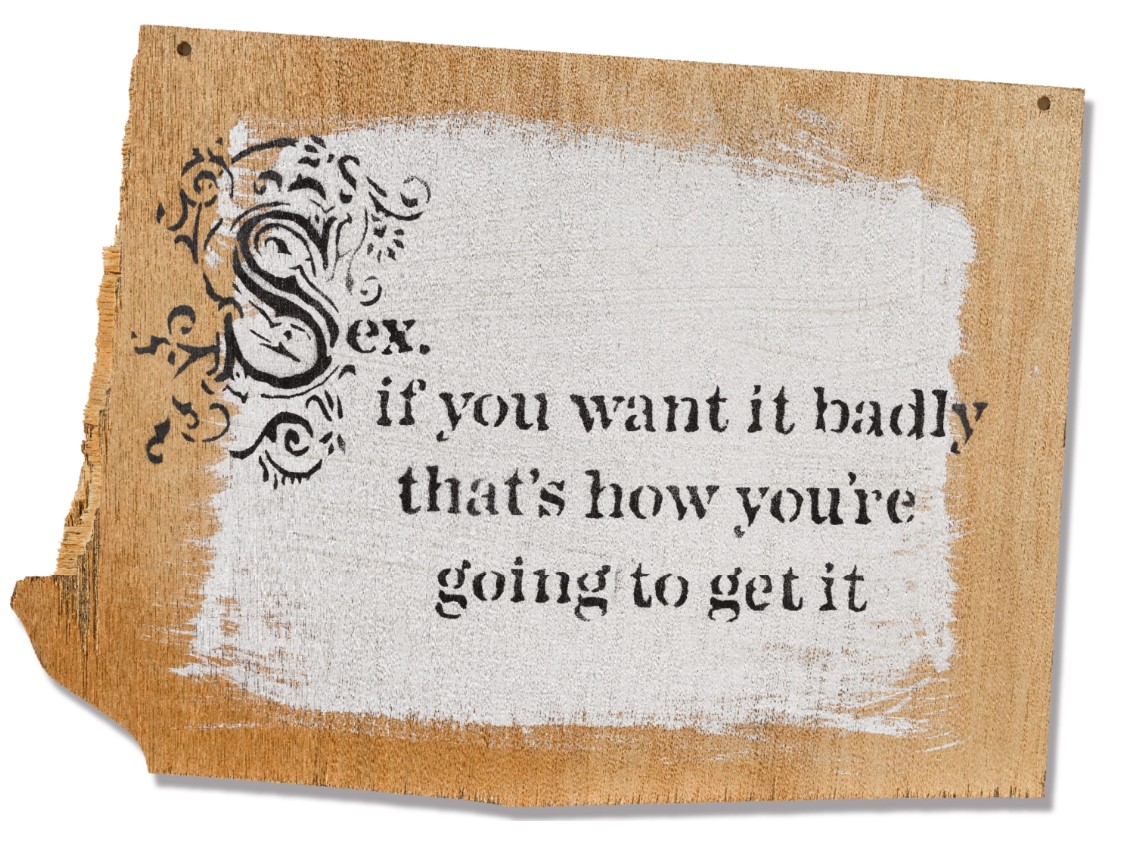
The statement can also be extended beyond its immediate subject. It applies to ambition, consumption and romantic idealization. Wanting something obsessively may distort judgement, encourage compromise and render fulfilment almost impossible.
Rendered with an ornamental initial and formal typography upon scarred plywood, the sentence resembles ancient romantic wisdom. Instead, it delivers a warning worthy of a disappointed comedian: obtaining what one wants and obtaining it well are entirely different achievements.
Do Not Punish Yourself
The opening sentence appears compassionate. It resembles therapeutic advice, encouraging forgiveness and relief from guilt. The second sentence immediately withdraws that comfort. The individual should refrain from self-punishment not because punishment is unnecessary, but because the wider world remains perfectly willing to administer it.
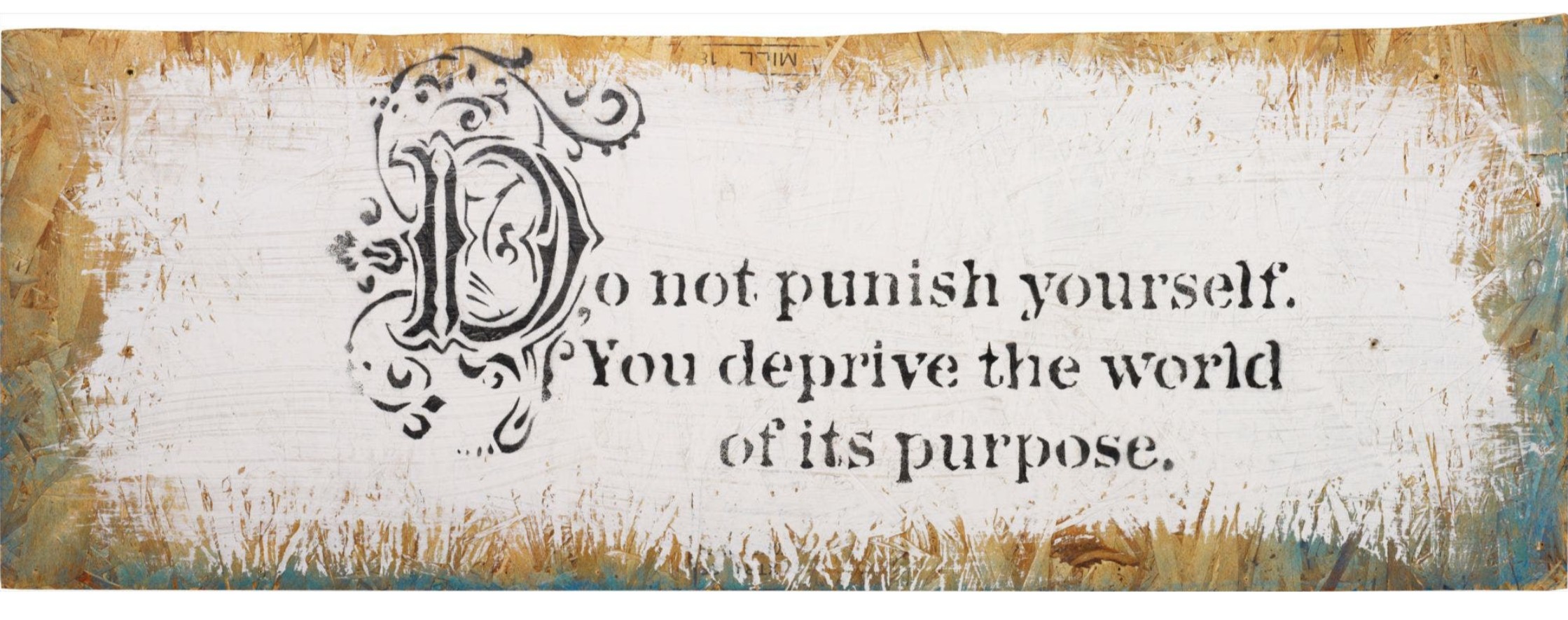
The joke turns reassurance into fatalism. Society appears not as a source of support but as an impersonal machinery of criticism, humiliation and consequence. The statement suggests that self-reproach is redundant: external forces will inevitably complete the task.
Its humor is dark because the reversal touches upon a recognizable truth. Individuals frequently internalize social judgement, punishing themselves before anyone else has the opportunity. Munnery’s line externalizes the process, while Banksy’s formal presentation gives the cynical observation the appearance of benevolent instruction.
Many Drink to Forget
The first sentence reproduces a familiar explanation of alcohol as escape. Drinking appears as a temporary strategy for suppressing painful memories, anxiety or disappointment. The second sentence reverses cause and effect. What begins as a means of forgetting becomes a habit that cannot itself be forgotten.
The work compresses the cycle of dependency into eight words. The drinker seeks relief from memory but develops a ritual more persistent than the memories being avoided. Alcohol ceases to serve the individual; the individual begins to serve the act of drinking.
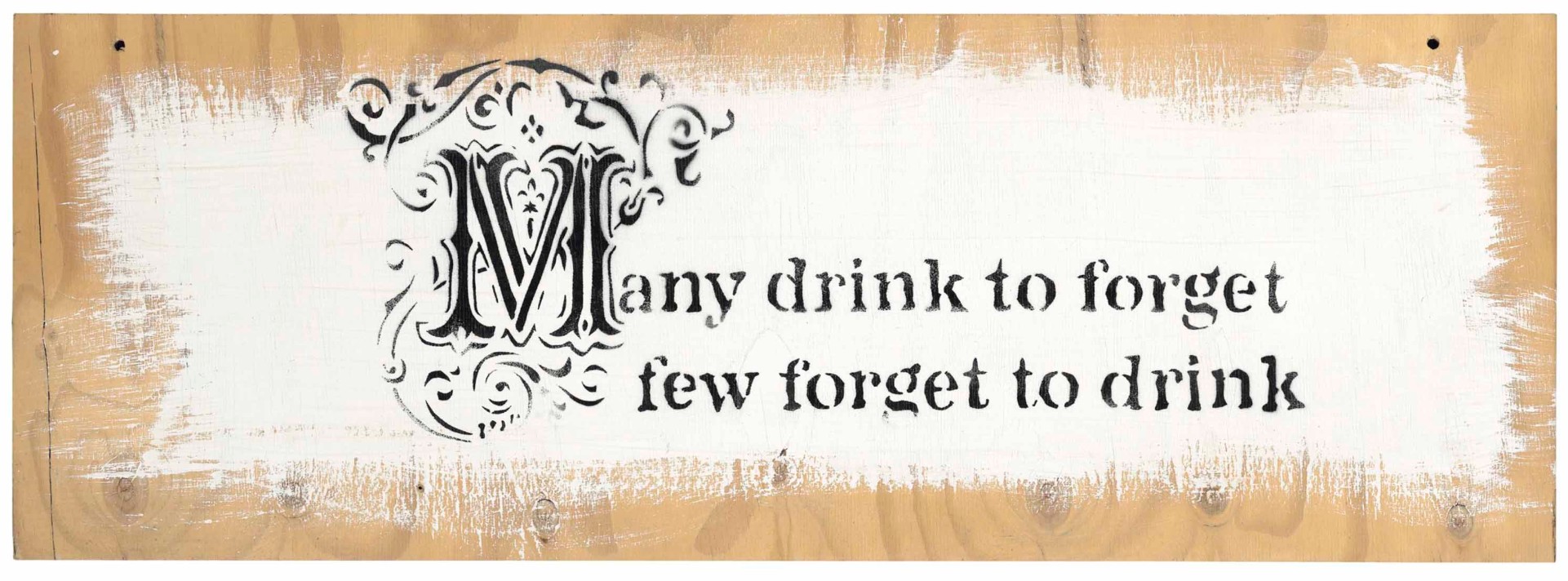
Many drink to forget…, 2005
43.5 x 121.8 cm (17-1/8 x 48 inches)
Yet the statement avoids the tone of moral instruction. It neither condemns nor sentimentalizes. Its symmetry makes the observation memorable, while its humor protects it from becoming a public-health slogan.
The sentence also speaks more broadly to consumption. Activities initially pursued for comfort or pleasure can become automatic, detached from their original purpose. The desire to escape one obligation produces another.
You Can’t Fool All the People
The statement begins by adapting the familiar maxim commonly associated with Abraham Lincoln: although some people may be deceived temporarily, universal and permanent deception remains impossible.
Munnery’s addition replaces moral reassurance with commercial pragmatism. Advertising does not need to deceive everyone forever. It needs only to influence enough people for long enough to generate attention, desire and sales.
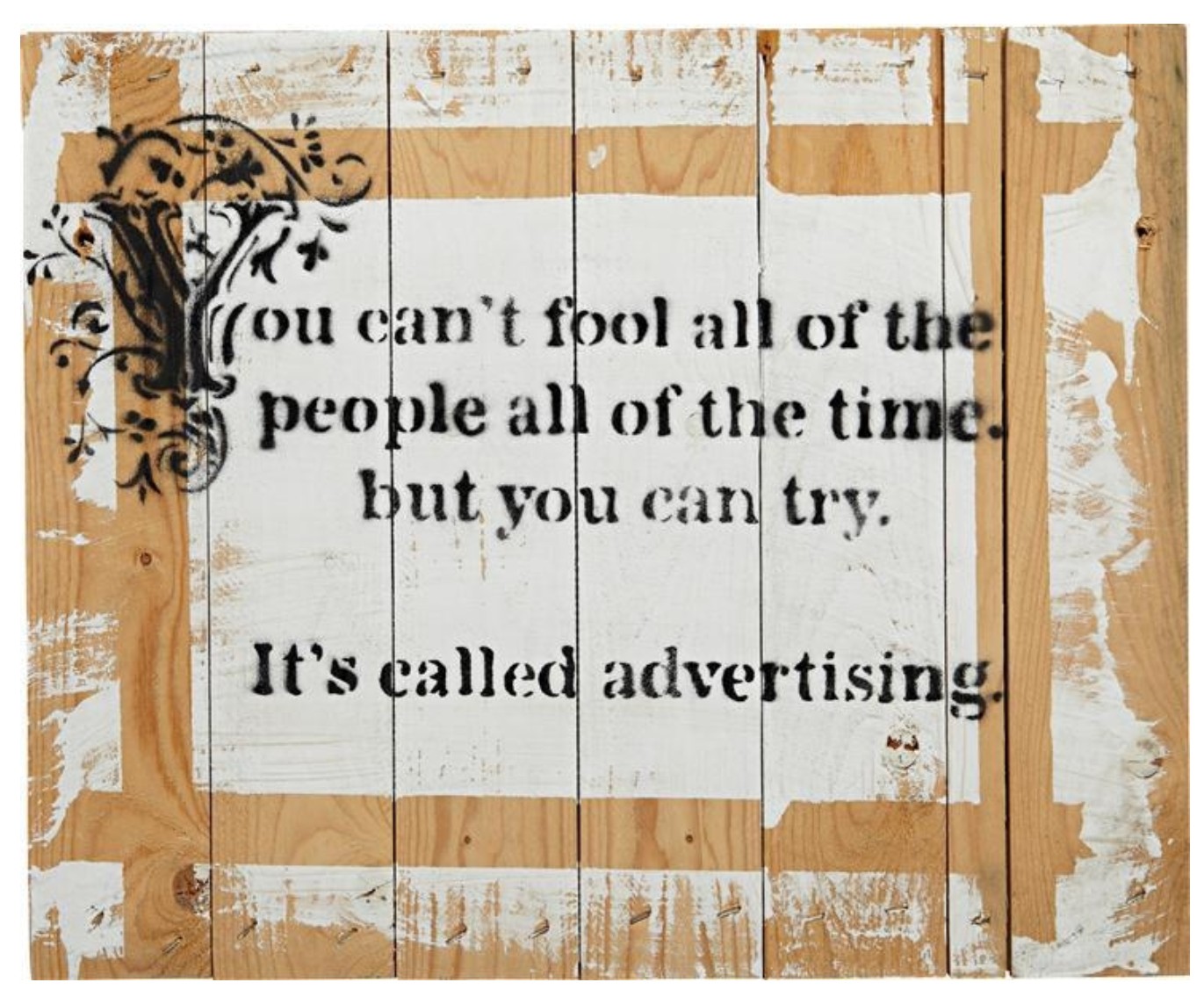
The joke is particularly compatible with Banksy’s sustained critique of branding and consumer culture. Advertising frequently presents itself as information while functioning through aspiration, anxiety and manufactured inadequacy. Its claims need not be literally false to distort reality; they need only arrange reality in the service of consumption.
By presenting this observation in the visual language of a venerable maxim, the work turns advertising into a modern moral system. Traditional proverbs communicated inherited social wisdom; contemporary slogans teach audiences what to want.
I Wanted Wine, Women and Song
The phrase begins with an established formula for pleasure and excess. “Wine, women and song” evokes a life devoted to sensuality, celebration and freedom from restraint. The conclusion delivers the same constituent elements, but in a collapsed and disappointing form.
Nothing is technically absent. There is alcohol, a woman and a song. Yet the glamorous ideal has contracted into a single mundane scene: a drunken woman singing.
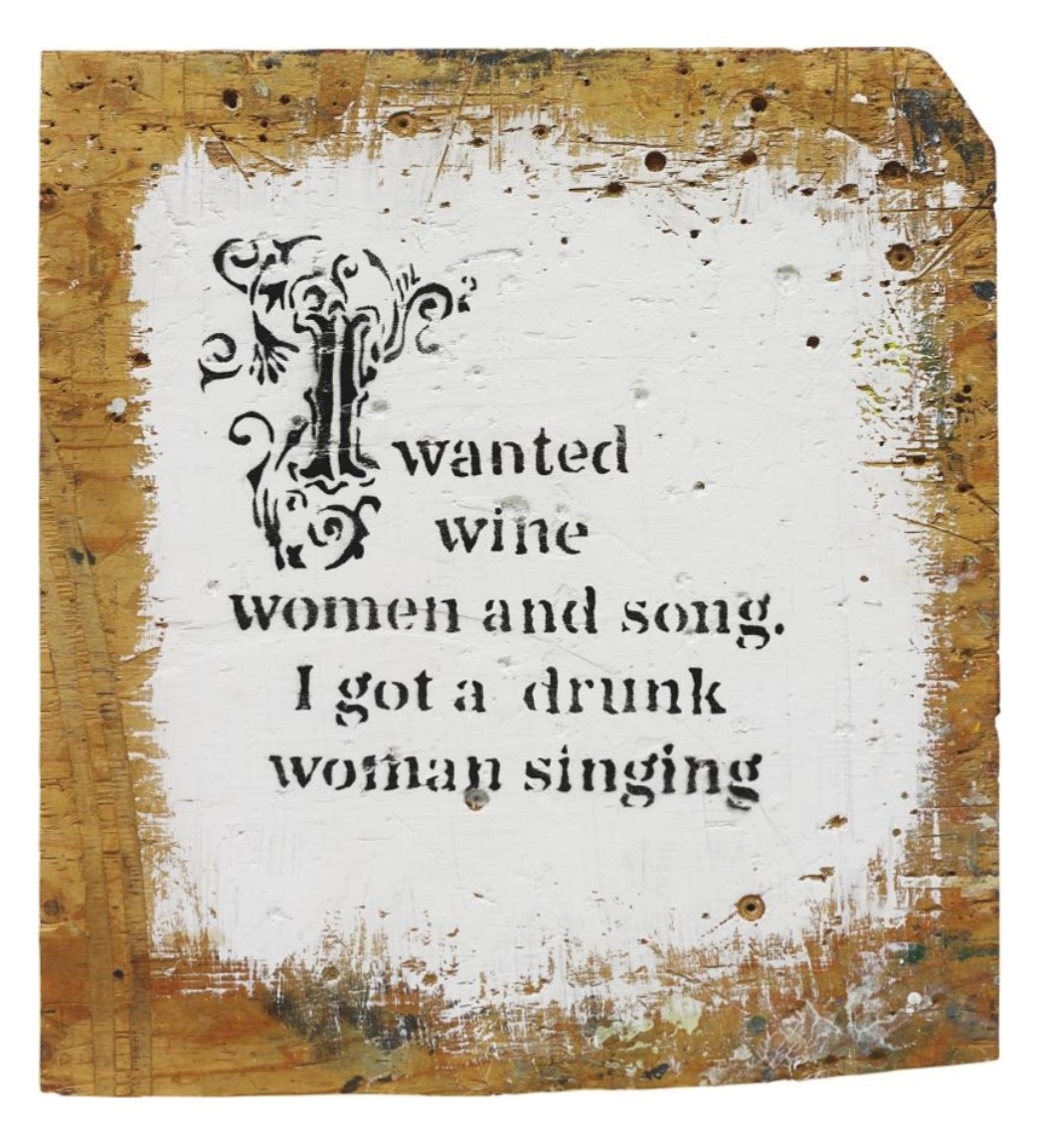
I Wanted Wine Women and Song, 2005
60×56 cm (23 5/8 x 22 inches)
The humor lies in the distance between the fantasy and its literal fulfilment. Ambition is defeated not through total failure but through inadequate success. The protagonist receives what was requested, only stripped of all the romance projected upon it.
The work may therefore be read as a concise meditation on aspiration. Human beings rarely desire objects or experiences in isolation; they desire the idealized narratives attached to them. Reality may fulfil the terms of the fantasy while failing entirely to reproduce its atmosphere.
The Rolling Stone May Gather No Moss
The traditional proverb presents movement as a form of freedom. A person who continually changes direction avoids stagnation, attachment and the burdens of permanence. Munnery’s extension transforms this apparently positive image into one of danger and consequence.
The stone remains free of moss, but its movement destabilizes everything around it. Personal liberation is no longer innocent. Restlessness may generate destruction, while the refusal to settle may impose costs upon others.
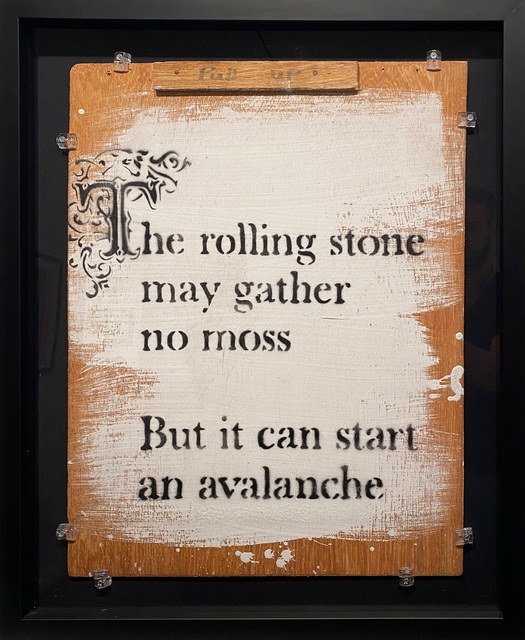
The Rolling Stone May Gather No Moss, 2005
58.4 x 44.5 cm (23 x 17 1/2 inches)
The sentence can be read politically. Individual action, however small, may initiate forces far greater than the person who began them. Revolutions, protests and social movements frequently start with isolated gestures that accumulate momentum.
It can equally be read as a warning against self-romanticization. The restless individual may interpret constant movement as independence, while remaining unaware of the disorder left behind.
The work is therefore among the most open-ended of the group. Unlike the more tightly comic conclusions of the other panels, the avalanche can signify either catastrophe or transformation. Banksy and Munnery leave the moral direction unresolved.
The Boundaries of the Series
Research suggests that Banksy also reproduced other Munnery aphorisms in related formats around the same period. These include statements such as:
“What do you get the man who has everything? Might I suggest a gravestone inscribed with the words: So What?”
“Men lie. Women wear perfume and make-up. And lie.”
“All men are brothers. Hence war.”
Some appear to have existed as wooden panels, stickers or street-based applications rather than as part of a consistently catalogued group. The exact boundaries of the collaboration therefore remain somewhat fluid.
Place Within Banksy’s Oeuvre
The series is unusual because it relies almost entirely upon language. Text has always occupied an important place in Banksy’s work, but it usually operates beside a recognizable figure or image. Here, the words become the image.
The absence of rats, policemen, children or protestors does not make the panels less recognizably Banksy. They retain the central mechanisms of his practice: appropriation, compression, contradiction, dark humor, found materials and distrust of authority. They also demonstrate that Banksy’s art does not depend upon a fixed visual iconography. His real medium is disruption. A familiar object, phrase or image is introduced and then subtly altered until its assumptions become visible.
In this series, the target is language itself. Proverbs promise order; Banksy and Munnery reveal disorder. Decorative typography offers authority; the content produces doubt. The panel appears to preserve a truth, but the sentence refuses to remain stable. The works can therefore be understood as verbal counterparts to Banksy’s altered oil paintings. In both cases, he adopts an existing cultural format and introduces a disturbance. A pastoral landscape receives a police cordon; a solemn proverb receives a punchline.
Rarity and Market Position
The works are unique rather than editioned and remain comparatively scarce within Banksy’s market. Their documented connection to Santa’s Ghetto places them within an important moment in the artist’s early exhibition history, while their unusual combination of text, collaboration and reclaimed materials distinguishes them from his better-known stencil paintings.They do not depend upon a famous recurring figure and were not developed through large print editions.
Their significance lies elsewhere: in their rarity, intellectual character and close relationship with the experimental culture surrounding Banksy in 2005. For collectors, they offer not simply a unique Banksy object but evidence of an unusually explicit creative collaboration.
The secondary-market history of works such as Do Not Punish Yourself, Many Drink to Forget and Sex, If You Want It Badly also confirms sustained interest in the group, although the panels remain sufficiently rare that direct price comparison is inherently limited.
Why the Series Matters
The Banksy–Munnery panels reveal a dimension of Banksy’s practice that is sometimes overshadowed by his iconic imagery. They demonstrate his ability to work not merely with pictures but with the structure, appearance and instability of language. They are also among his most successful collaborative works. Munnery’s writing and Banksy’s visual presentation remain distinct, yet each transforms the other. The aphorisms gain material presence and cultural authority; the painted panels gain rhythm, voice and comic timing.
More broadly, the series addresses the human appetite for simple truths. Proverbs, slogans and advertisements all promise to reduce complex experience to memorable language. Banksy and Munnery adopt those forms while refusing their reassurance.
Their commandments offer no salvation. They describe a world in which desire disappoints, habits replace intentions, institutions deceive and ambitions arrive in diminished form. Yet their humor prevents them from becoming merely cynical. Laughter provides a moment of recognition: we see our own contradictions compressed into a sentence.
Painted on salvaged wood and presented like fragments from an ancient book, the works appear to have survived from a civilization that understood human weakness perfectly but could offer no cure for it. They are battered tablets bearing the gospel according to disappointment—and all the more truthful for refusing to pretend otherwise.
Auction Results
Many drink to forget…, 2005
Estimated: HKD 2,000,000 – 3,000,000
Estimated: GBP 45,000 – 65,000
GBP 56,250 / USD 74,550
Banksy (b. 1975), Many drink to forget… | Christie’s
BANKSY (b. 1975)
Many drink to forget…, 2005
Spray paint on wood
43.5 x 121.8 cm (17-1/8 x 48 inches)
Provenance
Santa’s Ghetto, London
Private Collection
Christie’s, London, 30 June 2016, Lot 122
Acquired from the above sale by the present owner
XXXXXXXXXX
Sex If You Want it Badly, 2005
Estimated: HKD 400,000 – 600,000
Estimated: GBP 50,000 – 70,000
GBP 60,000 / USD 102,900
Sex If You Want it Badly, 2005
Santa’s Ghetto, London
Phillips London, 3 July 2014, Lot 177
Acquired from the above sale by the present owner
XXXXXXXXXX
Do Not Punish Yourself, 2005
Estimated: GBP 30,000 – 50,000
Do Not Punish Yourself, 2005
Santa’s Ghetto, London, December 2005
Private Collection
XXXXXXXXXX
You Can’t Fool All The People, 2005
Estimated: USD 25,000 – 35,000