BANKSY
Love Is In the Air (Flower Thrower), 2010
Spray-paint on canvas
84.5 x 84.5 cm (33-1/3 x 33-1/3 inches)
Signed and dated “BANKSY 2010” on the reverse
Provenance
Pest Control, London
Auction History
| Phillips London 30 June 2015 Est.: GBP 150,000 – 200,000 | Price Realized GBP 134,500 / USD 211,505 |
Catalogue Note
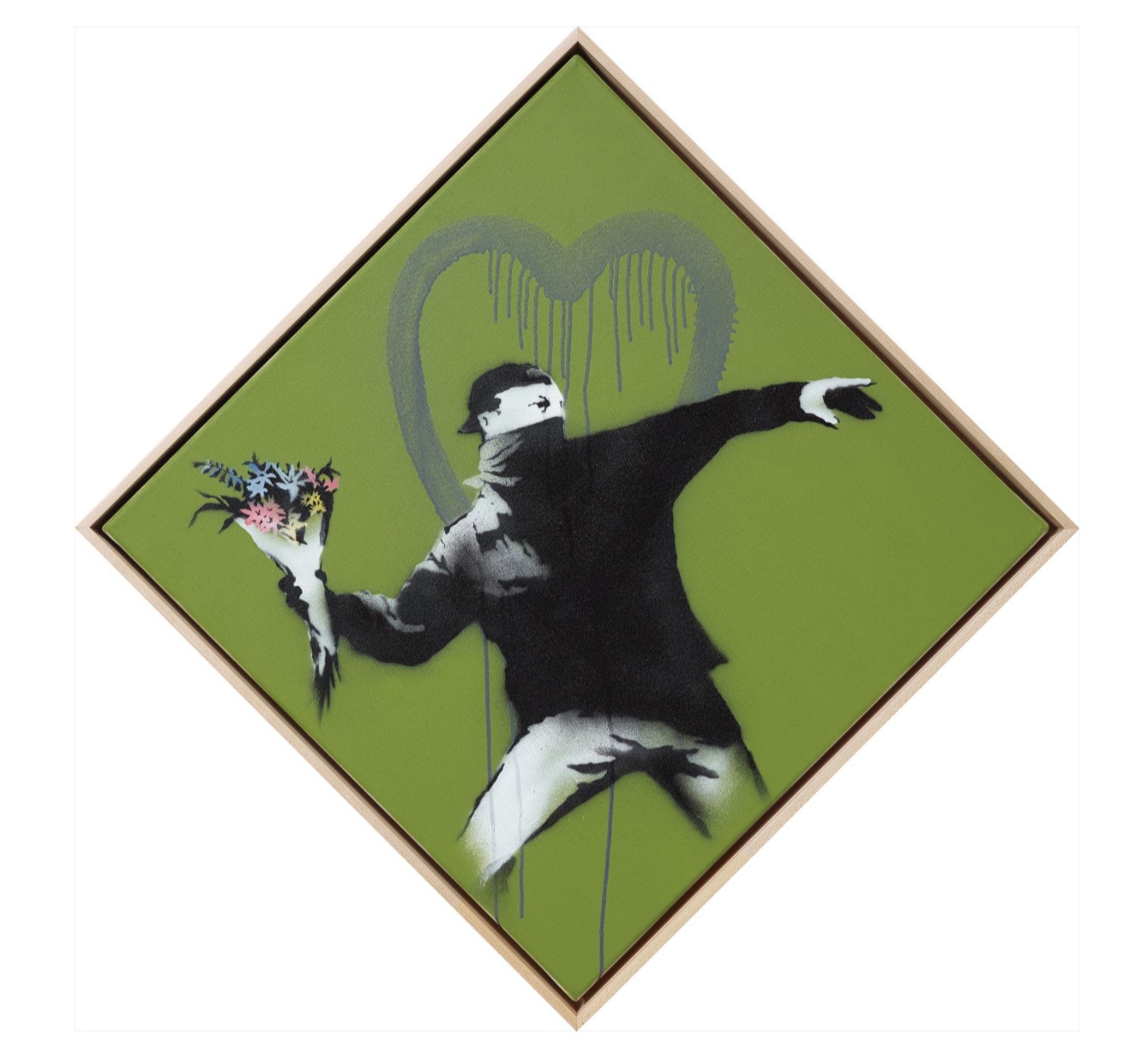
Created in 2010, this unique canvas represents one of the most sophisticated reinterpretations of Banksy’s iconic Love Is In The Air. While preserving the instantly recognizable silhouette of the masked protester preparing to throw a bouquet of flowers, Banksy reimagines the composition through a series of subtle yet significant interventions that transform both its visual rhythm and symbolic meaning.
The most immediate departure from the original mural is the unusual diamond-shaped format. Rotated forty-five degrees, the canvas introduces a dynamic sense of instability, reinforcing the tension already present in the protester’s pose. The figure appears suspended between action and balance, as though the entire composition has been set in motion. Rather than functioning as a simple support, the format becomes an active participant in the image, echoing the explosive gesture of the throw.
Equally striking is the luminous green background. Unlike the neutral walls on which the image originally appeared, this vibrant monochromatic field isolates the figure with extraordinary clarity. Green has long been associated with renewal, hope and life, qualities that resonate naturally with the bouquet replacing the expected weapon. At the same time, it evokes the artificial brightness of commercial signage and advertising, creating an unexpected dialogue between optimism and contemporary visual culture.
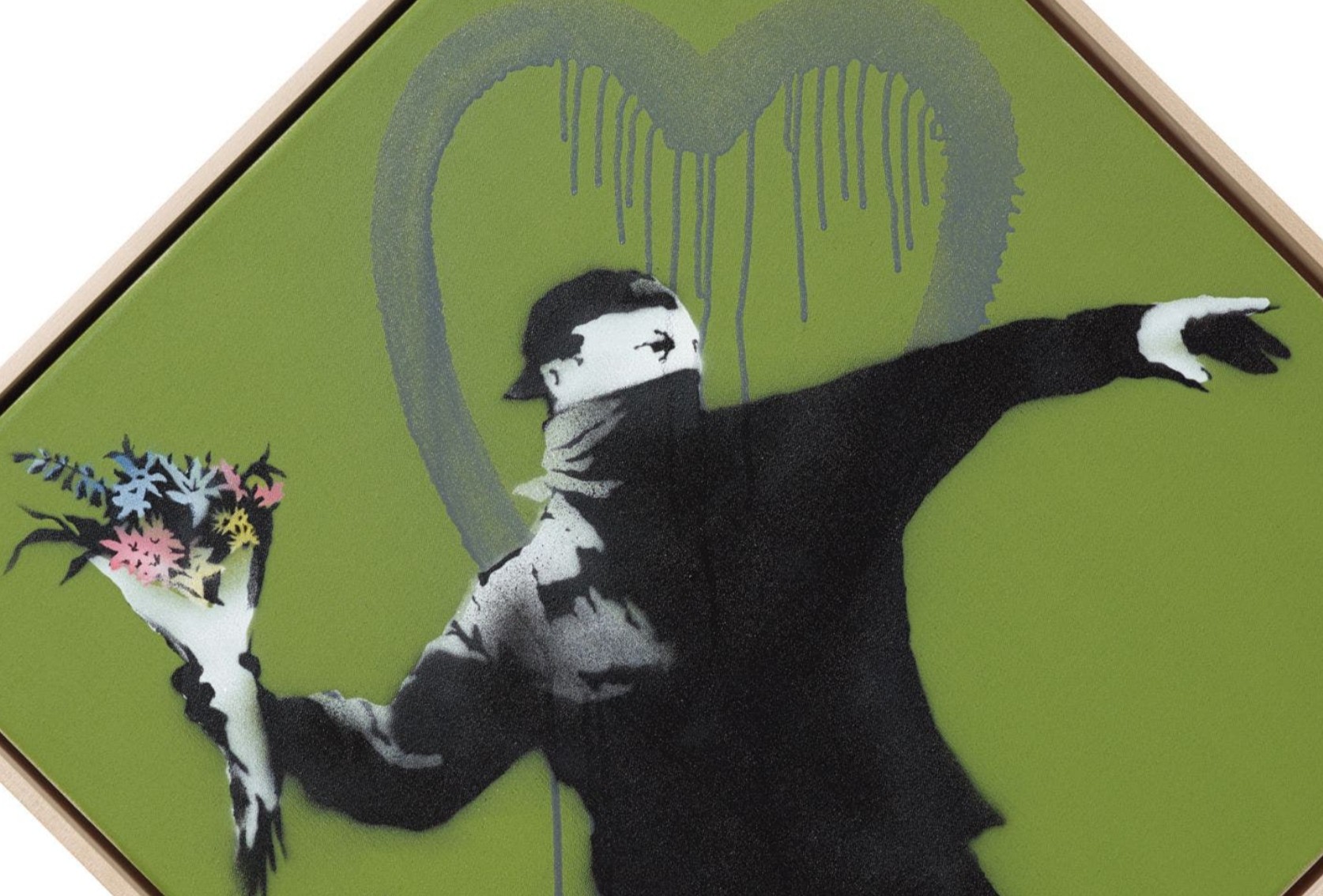
Perhaps the painting’s most remarkable intervention is the large dripping heart sprayed behind the protester. Unlike the bouquet, which belongs to the narrative, the heart occupies an entirely different pictorial space. It is not something the figure throws or even sees. Instead, it functions almost as an emotional aura surrounding the act itself. The gesture of resistance is literally framed by an image of love, suggesting that compassion is not simply the object being projected but the force motivating the action.
Banksy also departs from the familiar stencil by treating the bouquet with unusual painterly freedom. Rather than reducing the flowers to a simplified graphic symbol, he renders them as a lively explosion of color and organic form. The bouquet appears spontaneous and fragile, standing in deliberate contrast to the geometric precision of the protester’s black-and-white silhouette. This subtle shift reinforces one of Banksy’s central ideas: flowers derive their strength not from force but from their vulnerability.
Created several years after the original mural first appeared on Rivington Street, this unique canvas demonstrates Banksy’s continuing willingness to revisit his own imagery rather than merely reproduce it. Throughout his career, he has repeatedly returned to Love Is In The Air, exploring new formats, supports and conceptual variations. Here, the image evolves beyond its origins as street art into a carefully considered studio work that expands rather than repeats the original idea.
Ultimately, this painting suggests that resistance is not defined by anger alone. By surrounding the protester with symbols of growth, affection and hope, Banksy transforms an act of confrontation into an affirmation of humanity. Violence remains implied by the pose, but the emotional center of the composition has shifted toward the possibility of reconciliation.