Provenance
Acquired by the current owner directly from the artist
Auction History
| Dreweatts 26 February 2009 Est.: GBP 30,000 – 60,000 | Price Realized GBP 28,000 / USD 40,135 |
Catalogue Note
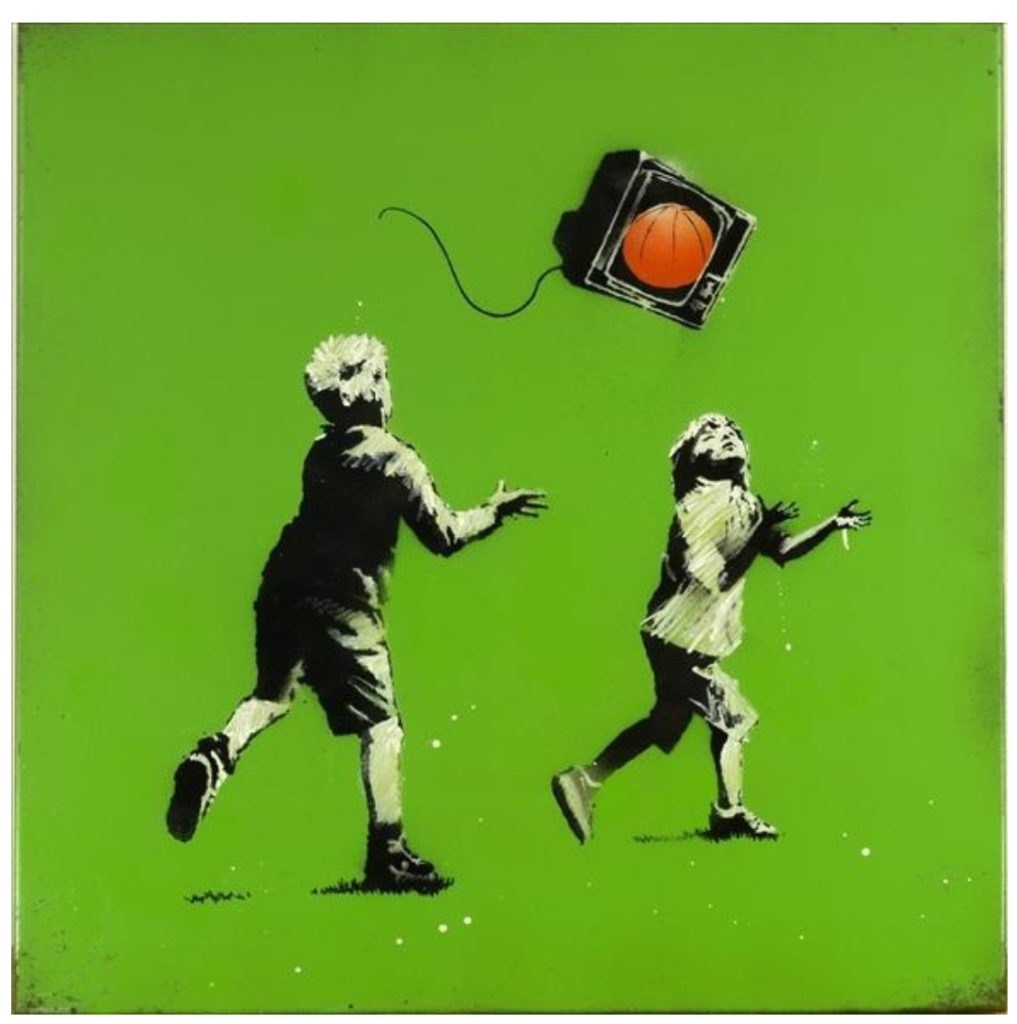
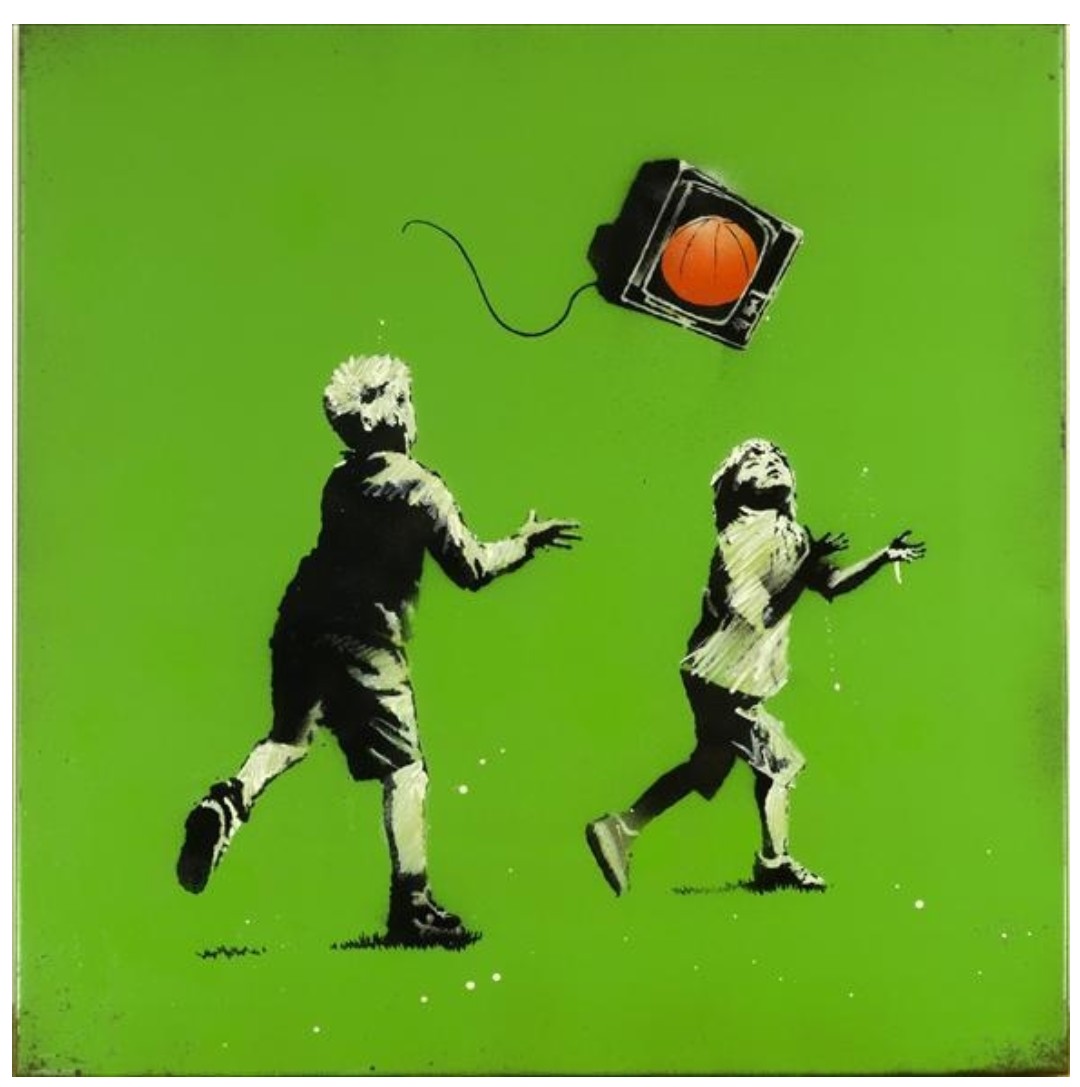
At first glance, No Ball Games depicts a familiar childhood scene. Two children run excitedly across an empty green field, their arms outstretched as they chase what appears to be a ball soaring through the air. Only upon closer inspection does the viewer realize that the object of their pursuit is not a toy at all, but an old television set suspended by its electrical cord, with a bright orange basketball replacing the screen.
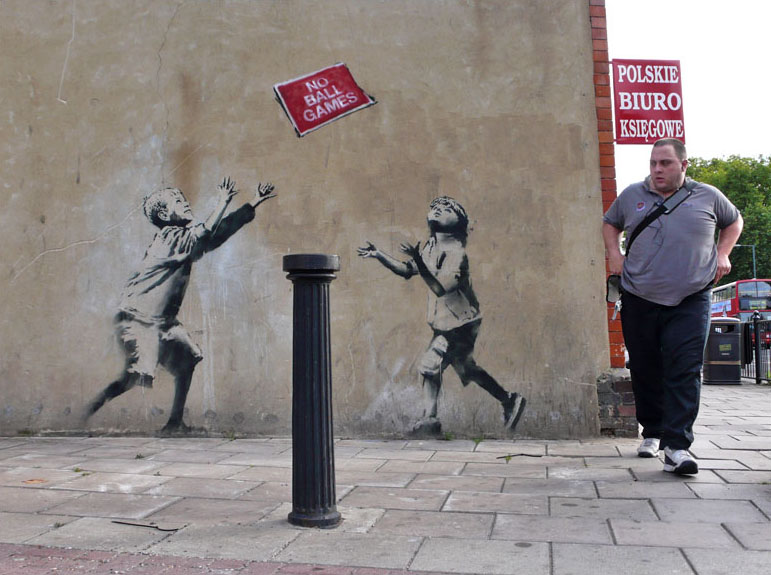
The substitution is instantly absurd yet profoundly revealing. Instead of playing with a ball, the children chase the television itself. Banksy suggests that entertainment has become inseparable from childhood, blurring the distinction between play and consumption. The television is no longer simply an object that delivers entertainment; it has become the game itself.
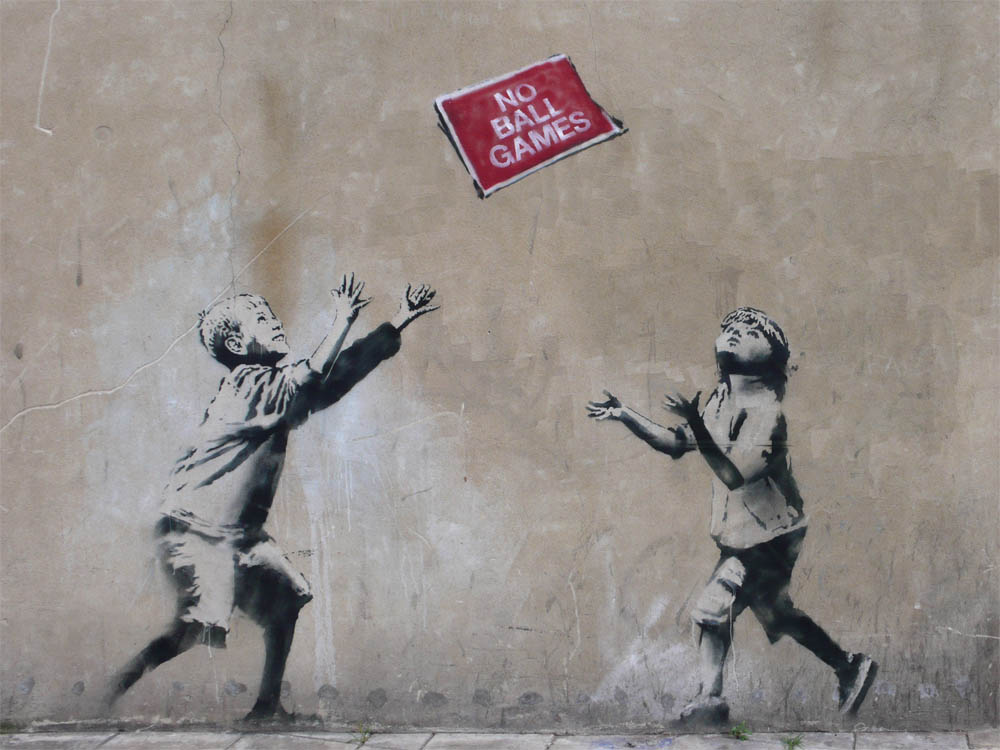
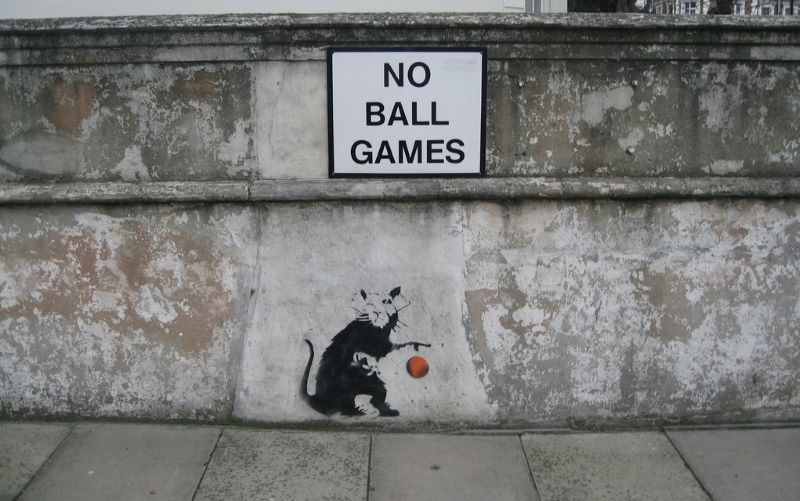
The title introduces another layer of irony. “No Ball Games” is perhaps the most familiar prohibition displayed in British housing estates and public parks. For generations, the sign symbolized adult authority restricting children’s freedom to play. Banksy turns that familiar warning on its head. The children are technically obeying the rule—they are not chasing a ball—but they have replaced it with something arguably far more invasive. The television has become an acceptable substitute for genuine play.
This inversion reflects one of Banksy’s recurring concerns: the gradual replacement of direct human experience by mediated experience. Childhood, traditionally associated with imagination, physical freedom and discovery, increasingly unfolds through screens, brands and electronic devices. Long before smartphones and social media came to dominate everyday life, Banksy anticipated a culture in which technology would quietly redefine how children interact with the world around them.
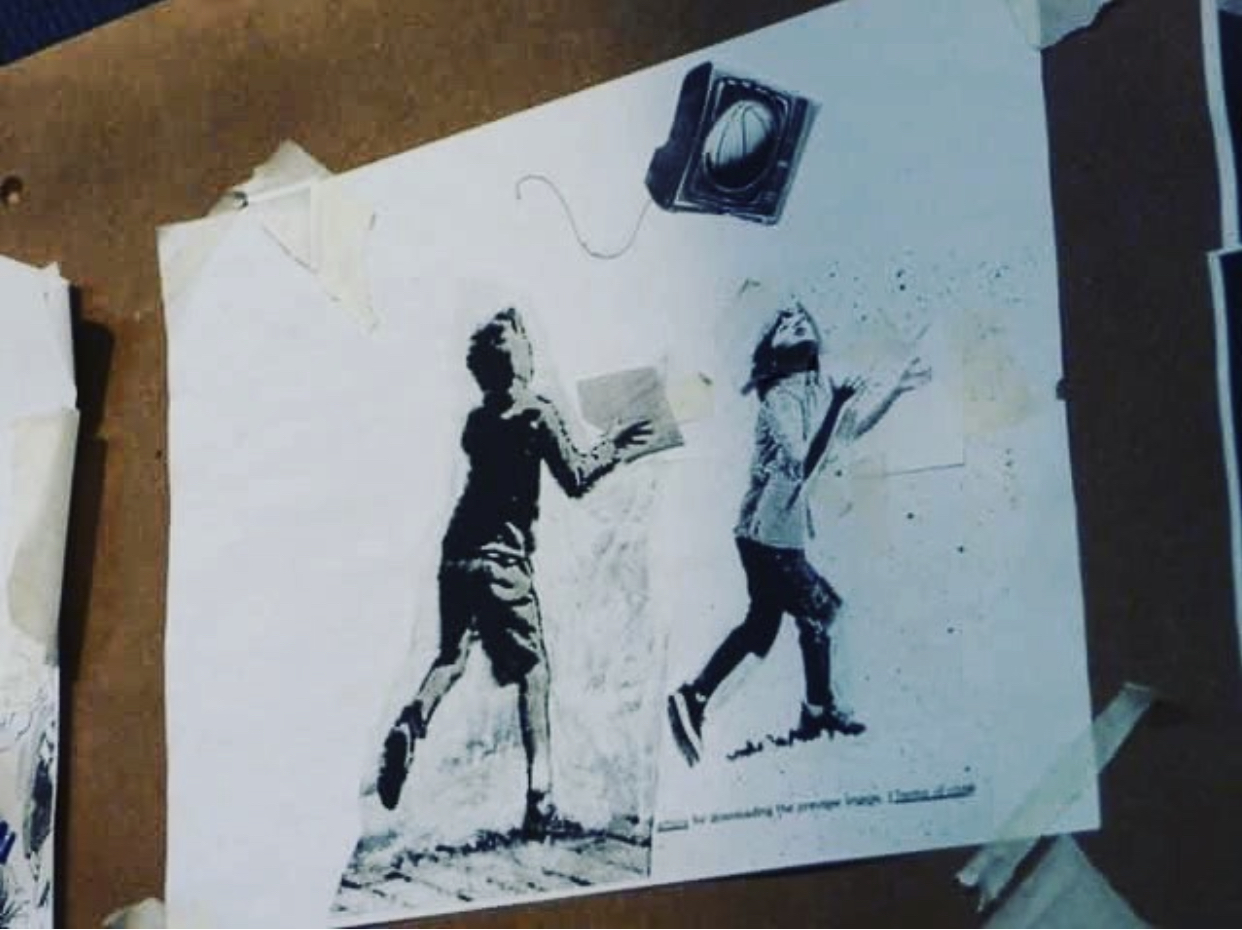
The basketball replacing the television screen is a particularly inspired visual device. It fuses two opposing forms of recreation into a single object. One encourages movement, physical engagement and spontaneous interaction; the other encourages passive observation. The hybrid object becomes an emblem of contemporary childhood, where the boundaries between active participation and digital entertainment have become increasingly blurred.
The stark fluorescent green background contributes significantly to the work’s impact. Devoid of landscape, architecture or context, the children appear suspended within an almost artificial environment. The colour recalls advertising, computer graphics and commercial design rather than nature itself. As in many of Banksy’s compositions, the absence of setting transforms the image into a universal allegory rather than a specific scene.
The use of found steel further reconnects the work with Banksy’s origins as a street artist. Unlike a conventional canvas, reclaimed metal carries the physical memory of the urban environment from which graffiti emerged. The support itself becomes part of the artwork’s meaning, preserving traces of the city while elevating them into the gallery. It is another example of Banksy’s remarkable ability to erase the traditional boundary between street intervention and fine art.
The provenance lends additional significance to this unique example. Acquired directly from Banksy by its first owner, the work belongs to a small group of pieces that remained outside the traditional gallery system during the artist’s rapid ascent. Such direct acquisitions capture a fascinating moment when Banksy’s works circulated through personal relationships rather than the global art market they would soon come to dominate.
Ultimately, No Ball Games asks a deceptively simple question: what has replaced childhood? The answer is neither entirely pessimistic nor nostalgic. The children continue to run with joy and excitement, but the object they pursue reveals how profoundly modern culture has reshaped the nature of play itself. In Banksy’s universe, the most effective social criticism rarely comes through anger or confrontation. Instead, it arrives disguised as an impossible image that suddenly feels uncomfortably familiar. Here, one obsolete television floating through the sky becomes a timeless reflection on entertainment, consumer culture and the quiet transformation of childhood itself.