
BANKSY
Arrow Head, 2009
Exhibited
Banksy vs. Bristol Museum, Bristol Museum, Bristol, 2009
Catalogue Note
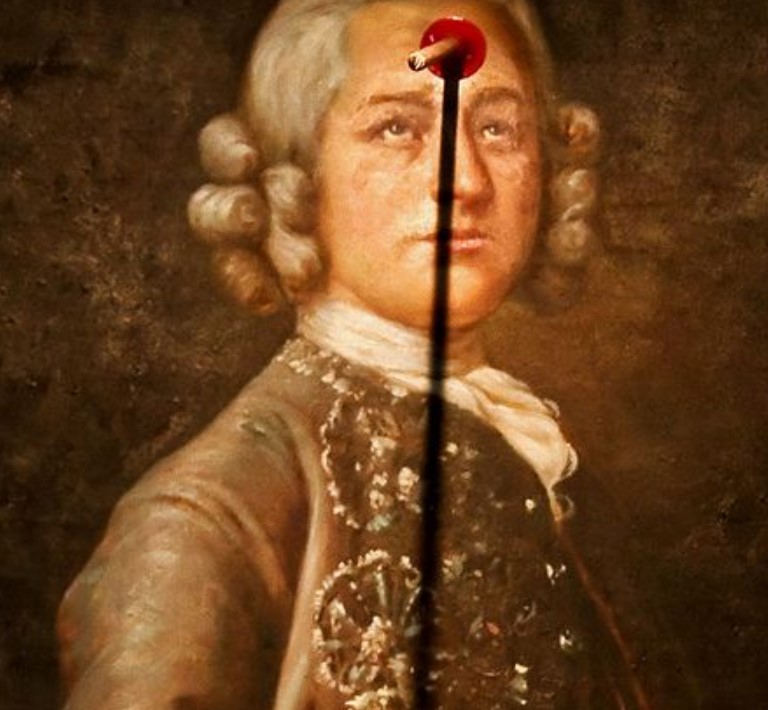
Among the altered paintings presented in Banksy vs. Bristol Museum, Arrow Head is perhaps one of the most economical demonstrations of the artist’s conceptual brilliance. A conventional eighteenth-century gentleman, elegantly dressed and painted in the refined manner of aristocratic portraiture, appears entirely unremarkable until the viewer notices a single arrow piercing his forehead. The intervention is almost absurd in its simplicity. Nothing else has been altered, yet the portrait has been completely transformed.
Like many works from Banksy’s Crude Oils series, Arrow Head relies upon the extraordinary power of minimal intervention. Rather than overwhelming the original composition, Banksy introduces only one carefully positioned element. The anonymous sitter retains his dignified posture, composed expression and impeccable attire, seemingly oblivious to the object embedded in his head. This curious indifference creates the painting’s unmistakable humor. The drama belongs entirely to the viewer, while the subject remains frozen in the calm decorum expected of eighteenth-century portraiture.
Yet the work extends beyond visual comedy. Portraits have traditionally served to preserve status, reputation and memory. They immortalize individuals at their most composed, projecting authority and permanence for future generations. Banksy interrupts this tradition with an object that instantly overwhelms everything else the portrait attempts to communicate. The sitter’s wealth, social position and carefully cultivated dignity become secondary. He is remembered for one extraordinary event rather than a lifetime of accomplishments.
In this sense, Arrow Head becomes a meditation on the fragility of reputation. Human identity, Banksy suggests, can be rewritten by a single incident, a single mistake, or a single image powerful enough to eclipse everything that came before it. The arrow functions not merely as a weapon but as a visual metaphor for the unpredictable moments through which history often chooses to remember us.

The intervention is also remarkably precise. Banksy positions the arrow so that it enters directly through the forehead, the traditional symbolic seat of intellect, judgment and identity. Whether interpreted as an attack on reason, authority or simply the absurdity of human vanity, the arrow immediately becomes the painting’s new focal point. The eye no longer studies the sitter’s face or clothing; it is irresistibly drawn toward the wound. The smallest alteration redirects the viewer’s gaze and, with it, the meaning of the entire composition.
Created for the landmark exhibition Banksy vs. Bristol Museum in 2009, Arrow Head exemplifies Banksy’s fascination with the power of economy. Few artists have demonstrated so convincingly that a single intervention can completely transform a historical painting without diminishing its technical beauty. Rather than competing with the original artist, Banksy enters into dialogue with him, allowing the past and the present to coexist within the same image.
Within Banksy’s oeuvre, Arrow Head stands alongside works such as Hanging Klansman, Flight to Egypt, The Gleaners, and Subject to Availability, where subtle modifications radically alter the narrative of familiar images. Together these works reveal one of Banksy’s greatest artistic strengths: his ability to demonstrate that meaning in art does not necessarily depend upon what is added, but upon where—and why—it is added.