ART BUFF
Description
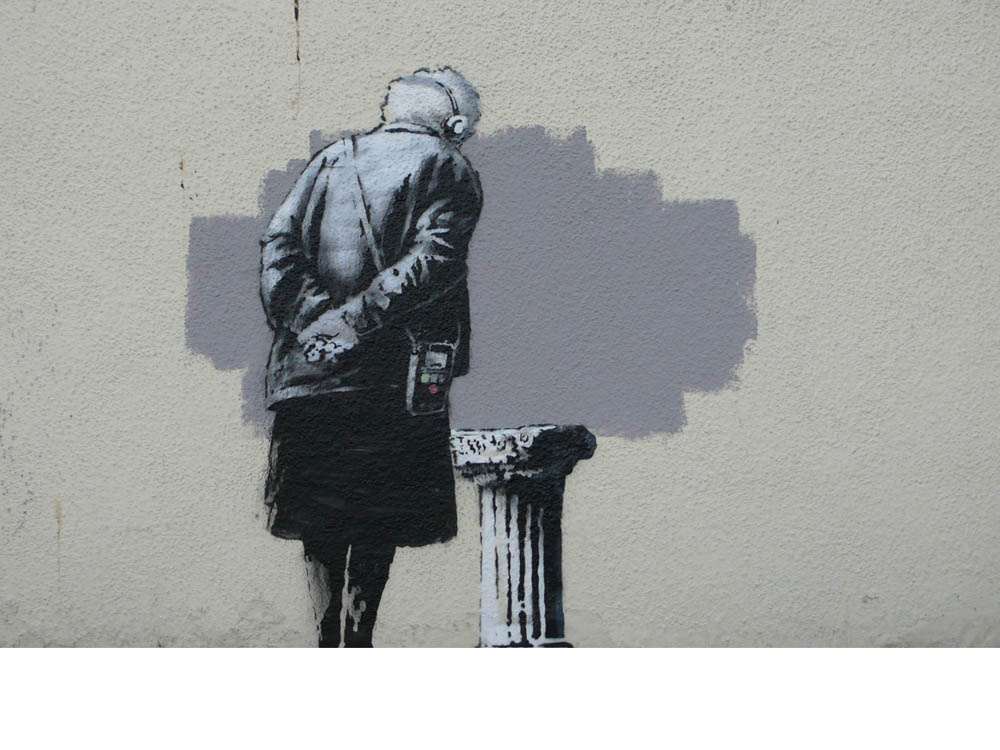
An elderly woman stands with her hands clasped behind her back, headphones over her ears and an audio-guide device hanging from one hand. She leans forward attentively toward a classical plinth, adopting the familiar posture of a museum visitor carefully examining a work of art.
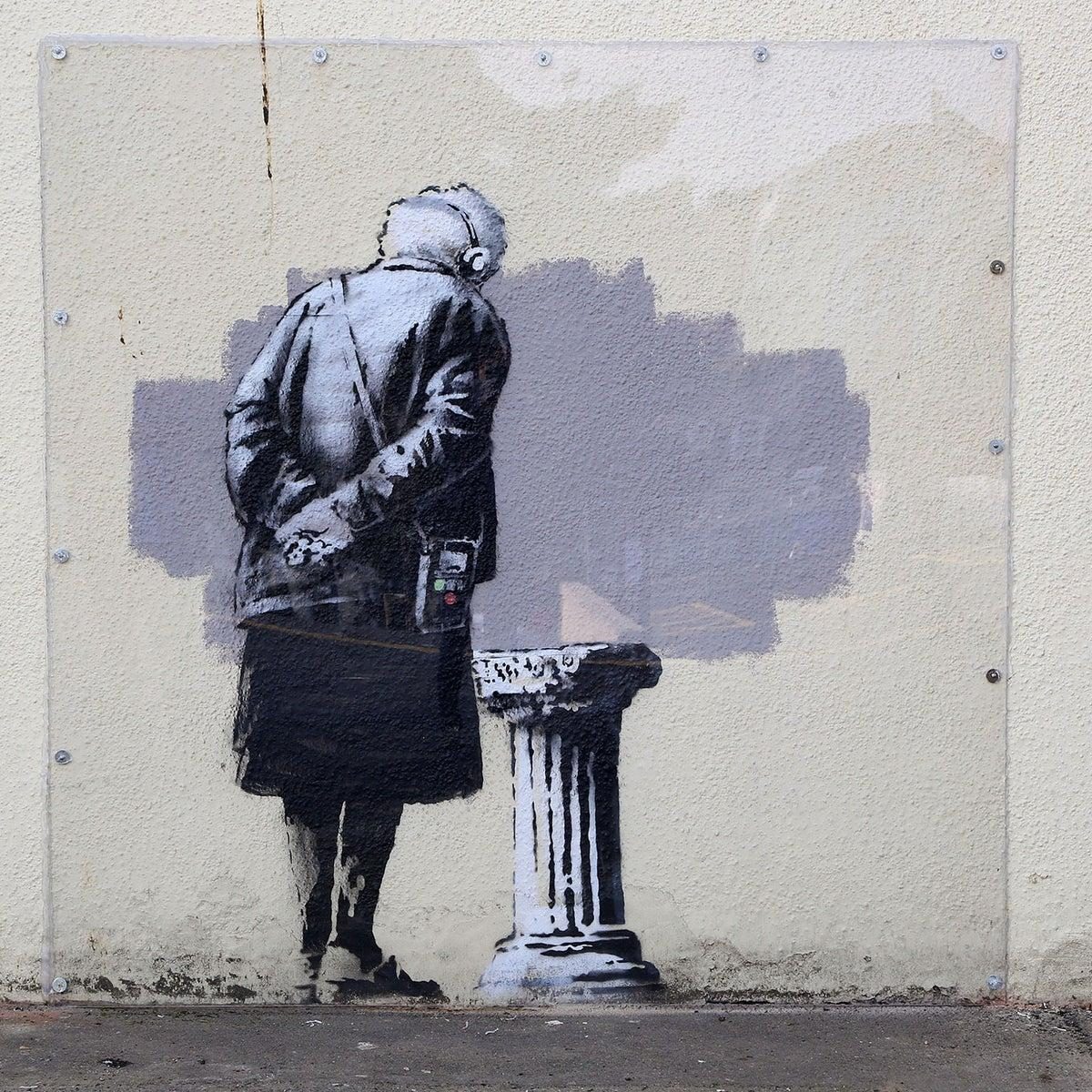
But there is nothing on the plinth. Instead, behind it is an irregular rectangle of grey paint—the unmistakable trace of graffiti that has been buffed, or painted over. The title Art Buff therefore contains the central joke: an “art buff” is an enthusiastic art lover, while in graffiti vocabulary to “buff” a wall is to erase the graffiti painted upon it.
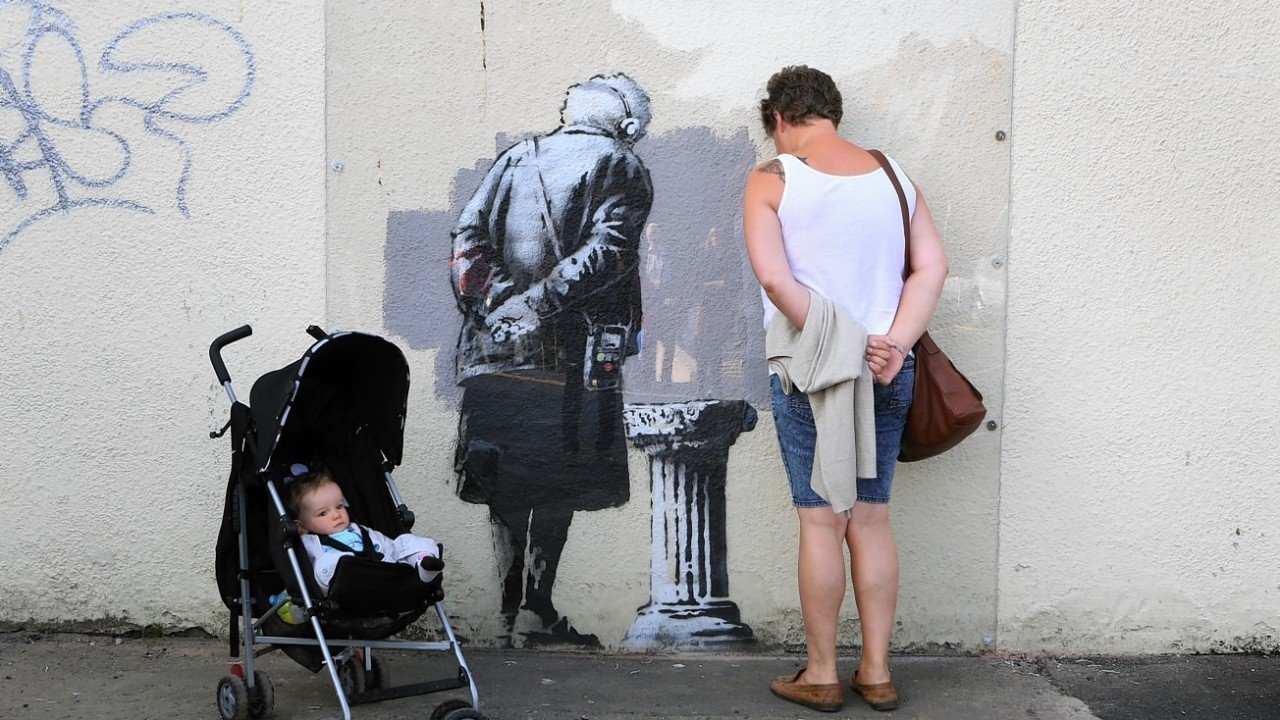
The erased mark has become the masterpiece. Banksy's visitor studies an act of graffiti removal with precisely the reverence normally reserved for an object in a museum.
Part of the Folkestone Triennial. Kind of.
Art Buff appeared in late September 2014, during the third Folkestone Triennial, a major exhibition of contemporary art installed throughout the seaside town. Banksy authenticated the intervention on his website with the characteristically ambiguous announcement:
“Part of the Folkestone Triennial. Kind of.”
Banksy had not been formally invited to participate. By placing his own work within the geographical territory of the exhibition, he effectively inserted himself into it without requiring the institution's permission.
The location and timing sharpen the work considerably. Art Buff collapses the distinction between sanctioned public art and unauthorized graffiti. Around Folkestone, officially commissioned artworks were being presented as culture; on this wall, Banksy presented the evidence of an erased piece of graffiti as something equally worthy of contemplation.
The work is therefore not simply a joke about contemporary art. It asks who decides when a mark on a wall becomes art—and who has the authority to erase it.
Art, Erasure and Vandalism
The grey rectangle is crucial. Rather than painting an imaginary artwork on the pedestal, Banksy incorporates a pre-existing act of municipal or private maintenance into his composition. Someone had already painted over graffiti; Banksy simply reframed the result.
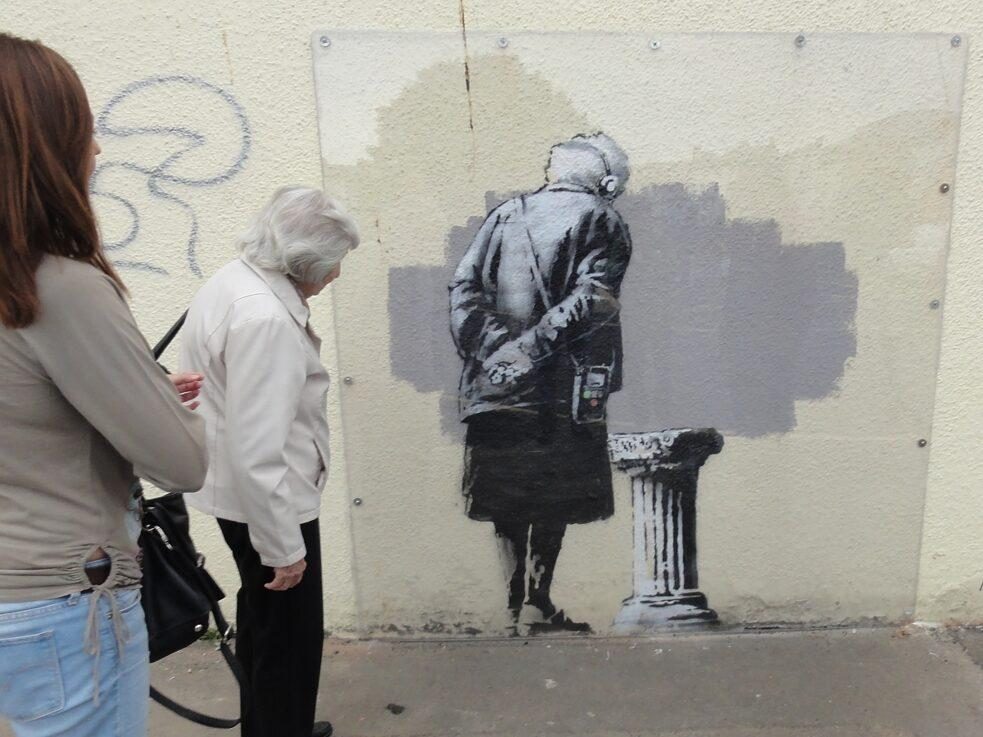
The intervention reverses the conventional hierarchy. The graffiti has disappeared, yet its erasure is now preserved inside a Banksy. What had been intended to restore the wall to anonymity becomes the most important visual element upon it.
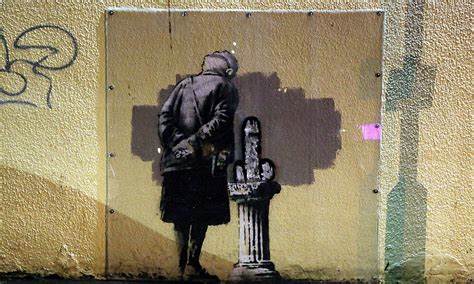
The irony deepened almost immediately. On 12 October 2014, someone spray-painted a large phallus onto the empty plinth. The Banksy had effectively invited another intervention, and within two weeks the empty pedestal had acquired an unauthorized sculpture of its own.
Removed, Shipped to America and Brought Home
In early November 2014, the section of wall containing Art Buff was physically cut from the building by order of the leaseholders, Dreamland Leisure. The work was taken to the United States and offered for sale in Miami, reportedly valued at around $750,000, but failed to find a buyer.
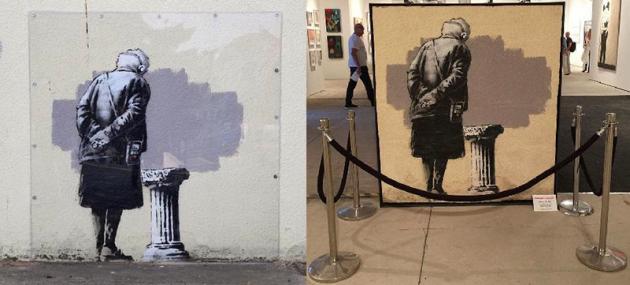
Its removal triggered a significant legal dispute. Creative Foundation—the organization behind the Folkestone Triennial—challenged the right of the tenant to remove and sell a work painted on a building it did not own outright.
On 11 September 2015, the High Court ruled that the tenant had no entitlement to the mural. Once the bricks had been severed from the building, ownership reverted to the freeholder; the work was ordered to be returned. The case became an important British legal precedent concerning the ownership of street art removed from private property.
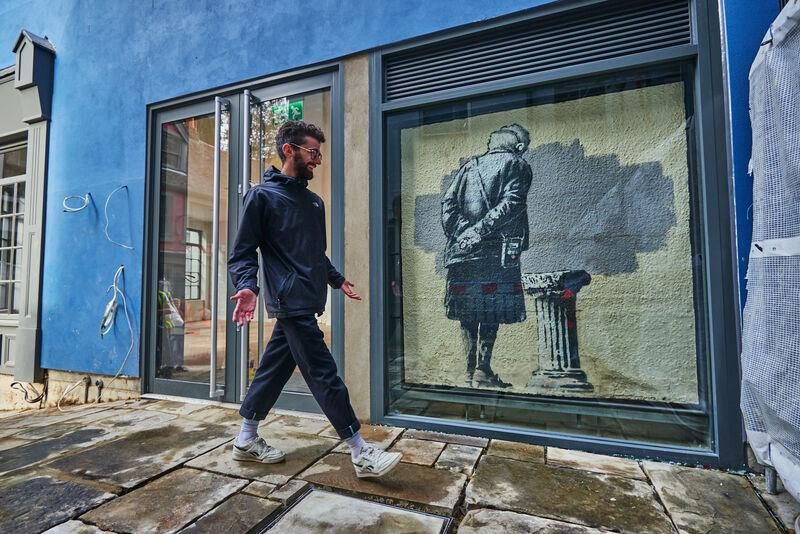
Art Buff eventually returned permanently to Folkestone. In 2020, it was installed in a purpose-built display in the courtyard of 69 The Old High Street, where it remains publicly accessible today.
The afterlife of Art Buff almost perfectly completes Banksy's original joke. A woman was painted contemplating the remains of erased graffiti as though she were visiting a museum. The wall was then cut out, transported across the Atlantic, fought over in the High Court, returned to Folkestone—and finally placed behind glass for people to contemplate as a work of art.
STAY INFORMED
Receive the latest news, exhibitions, artworks and market updates on Banksy.