BANKSY
Blessed Are The Children, 2009
122×54 cm (48 x 21-1/4 inches)
Exhibited
Banksy vs. Bristol Museum, Bristol Museum, Bristol, 2009
Catalogue Note
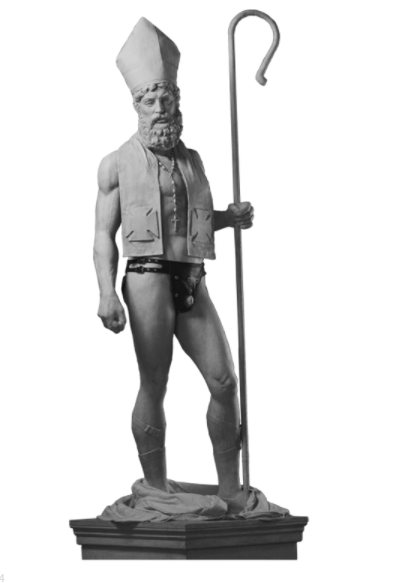
Banksy’s intervention is direct but carefully targeted. Rather than criticizing religious belief itself, he focuses on the abuse of institutional authority. The shepherd’s crook, long understood as a symbol of spiritual guidance and pastoral care, remains firmly in the figure’s hand. Yet the man who holds it no longer embodies protection. Instead, the attributes of office become unsettling reminders of trust betrayed.
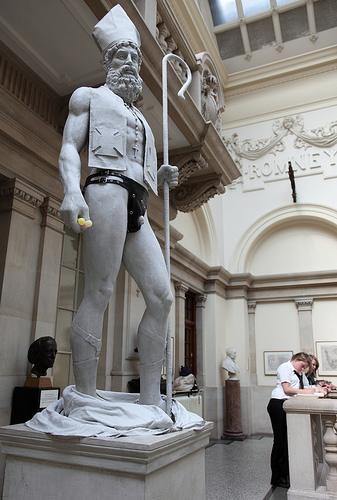
The sculpture derives much of its force from this inversion. Religious art has traditionally presented saints and clergy as moral exemplars worthy of admiration and imitation. Banksy leaves the classical form largely intact but quietly corrupts its meaning. The transformation is not simply physical; it is ethical. The authority represented by the sculpture has lost the moral legitimacy upon which it once depended.
Created in 2009, the work reflects a period when revelations of clerical sexual abuse and institutional cover-ups were receiving unprecedented public attention around the world. Rather than illustrating specific events, Banksy condenses a broader crisis into a single symbolic figure. The sculpture becomes less the portrait of an individual than an indictment of institutional failure and the devastating consequences of placing reputation above accountability.
Exhibited at Banksy vs. Bristol Museum, Blessed Are The Children belongs to a wider group of works in which Banksy reinterprets traditional cultural and religious imagery through minimal but conceptually powerful interventions. Like Toxic Mary, Injured Buddha and Paintpot Angel, it examines the relationship between spiritual ideals and human imperfection, questioning how institutions respond when those ideals are compromised. Ultimately, Blessed Are The Children is not an attack on faith but a demand that moral authority be matched by moral responsibility. Banksy reminds us that institutions entrusted with protecting the vulnerable lose their legitimacy the moment they fail to uphold that trust.