BOMB LOVE (BOMB HUGGER) (2000-2003)
Embracing the unthinkable
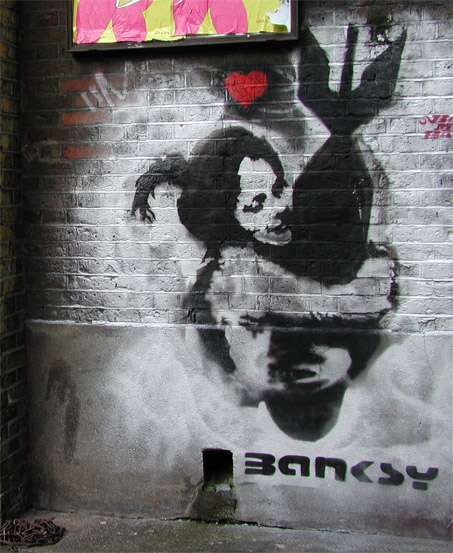
Few images encapsulate Banksy’s artistic philosophy as eloquently as Bomb Hugger. Created in 2002, the work depicts a young girl tenderly embracing an aerial bomb, her eyes closed in quiet affection as though holding a cherished toy or a beloved companion. The juxtaposition is immediate, unsettling and unforgettable. Innocence meets destruction, tenderness confronts violence, and fear gives way to compassion.
Like many of Banksy’s most enduring works, Bomb Hugger achieves extraordinary emotional impact through remarkable visual economy. There are no elaborate backgrounds, no political slogans and no explanatory text. A single embrace is sufficient to communicate an idea that remains as relevant today as it was more than two decades ago.
Far from glorifying conflict, the work invites us to reconsider our relationship with violence itself. By placing an instrument of war in the arms of a child, Banksy strips the bomb of its symbolic power. It ceases to represent strength or military superiority and instead becomes strangely vulnerable. The object designed to destroy life is transformed into something disarmed by compassion.
The Birth of an Icon
Bomb Hugger first appeared in 2002, at a time when the world was entering a new era of geopolitical uncertainty. The attacks of September 11, 2001 had profoundly altered international relations, and discussions surrounding military intervention, terrorism and national security dominated political discourse. Against this backdrop, Banksy produced one of his most quietly subversive images.
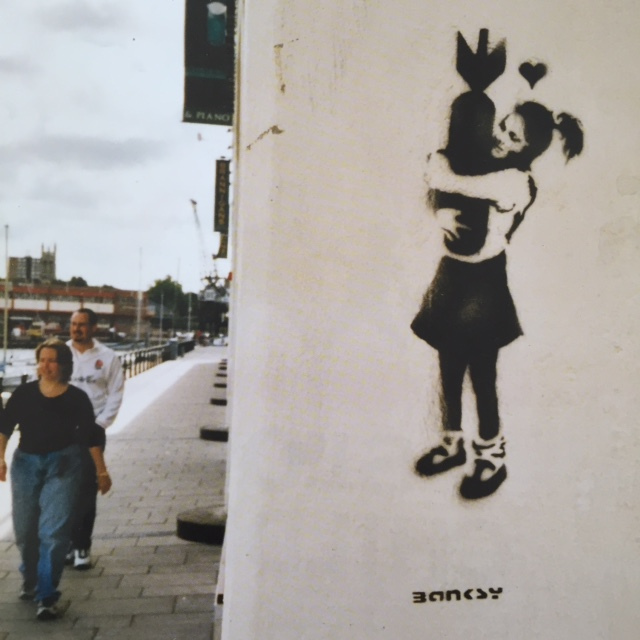
Rather than responding with anger or outrage, he offered an image of unexpected gentleness. The child’s embrace is neither naïve nor sentimental. It is deliberately paradoxical. Banksy reminds us that violence often persists because it is continually met with more violence. By imagining the impossible—a bomb being comforted rather than detonated—he proposes an entirely different response.
This ability to reverse expectations has become one of Banksy’s defining artistic strategies. Rather than illustrating conflict directly, he exposes its absurdity through inversion.
The Language of Contradictions
Throughout Banksy’s oeuvre, opposites constantly collide. Policemen kiss one another. Riot officers smile. Monkeys sit in parliament. Children play beside symbols of war. These contradictions are never merely visual jokes; they force the viewer to question assumptions that have become deeply ingrained.
Bomb Hugger may be the purest expression of this approach.
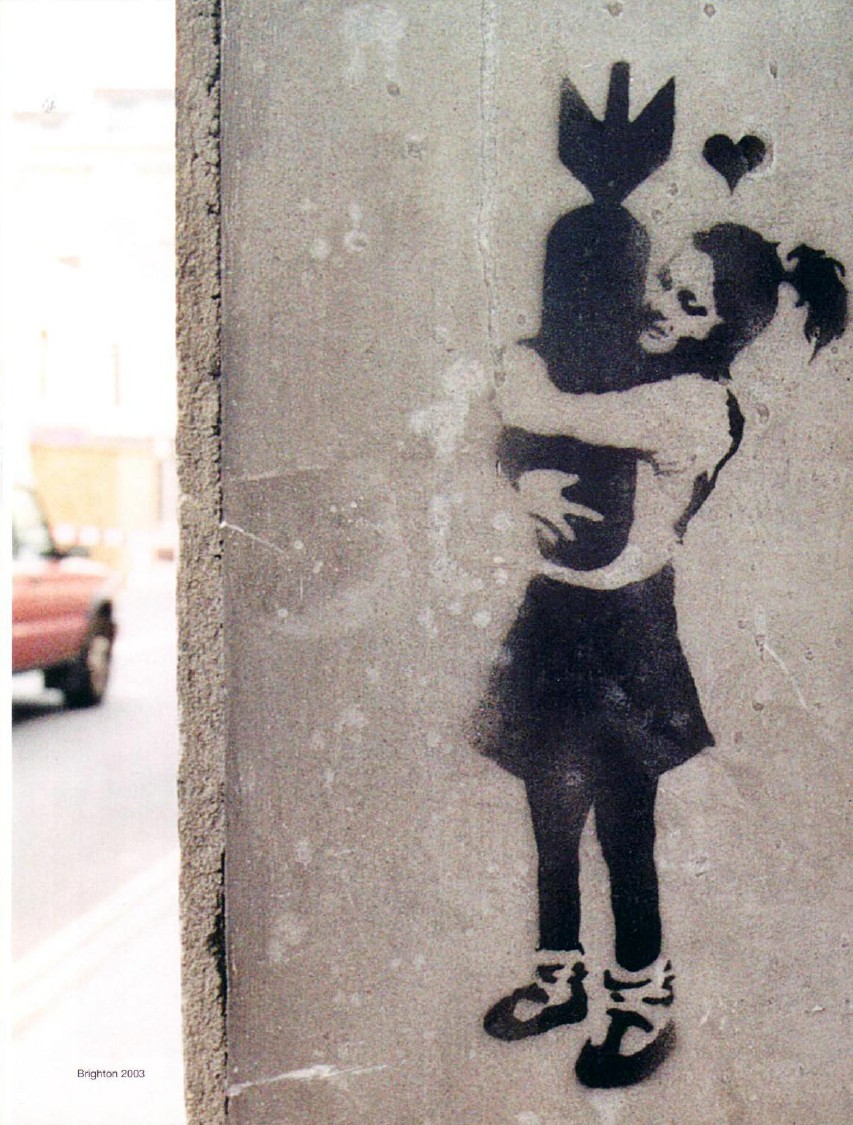
The bomb is perhaps the ultimate symbol of destruction. The child embodies innocence, hope and unconditional affection. Bringing the two together creates an image that should not exist, yet immediately feels meaningful. The contradiction encourages reflection rather than offering easy answers.
Banksy rarely tells viewers what to think. Instead, he constructs situations that expose the complexity of political and moral questions. Is the child attempting to comfort the bomb? To neutralize it? To reclaim it from those who created it? The ambiguity is precisely what gives the work its enduring power.
Within Banksy’s Oeuvre
Bomb Hugger belongs to a remarkable group of works in which Banksy contrasts innocence with violence. It naturally recalls Love Is in the Air, where flowers replace a Molotov cocktail, and Girl with Balloon, in which hope is represented by something as fragile as a drifting heart-shaped balloon. Together, these works reveal a recurring conviction that humanity’s greatest strength lies not in aggression but in empathy.
Visually, Bomb Hugger also demonstrates Banksy’s growing mastery of the stencil medium. The crisp black-and-white composition, interrupted only by subtle tonal contrasts, directs all attention toward the emotional relationship between the two figures. Nothing distracts from the central idea. Every line serves the narrative.
The image has since become one of Banksy’s most celebrated editions, reproduced in both signed and unsigned versions and sought after by collectors around the world. Yet its popularity has never diminished its meaning. If anything, the opposite is true. As global conflicts continue to dominate the headlines, Bomb Hugger has retained an extraordinary relevance, speaking as powerfully today as it did in 2002.
Legacy
There is a quiet optimism at the heart of Bomb Hugger. Banksy does not suggest that conflict can simply be wished away, nor does he ignore the brutality of war. Instead, he asks whether the cycle of violence might be broken by responses that seem almost impossible within the logic of conflict itself.
This is what makes Bomb Hugger one of Banksy’s defining images. Its message is not delivered through anger or accusation, but through an act of profound tenderness. In the arms of a child, the bomb becomes more than a weapon; it becomes a symbol of our own contradictions, our fears and our capacity to imagine a different future.
More than two decades after its creation, Bomb Hugger remains one of Banksy’s most poignant visual statements. It reminds us that the most radical gestures are not always those of confrontation. Sometimes, the most revolutionary act is simply an embrace.
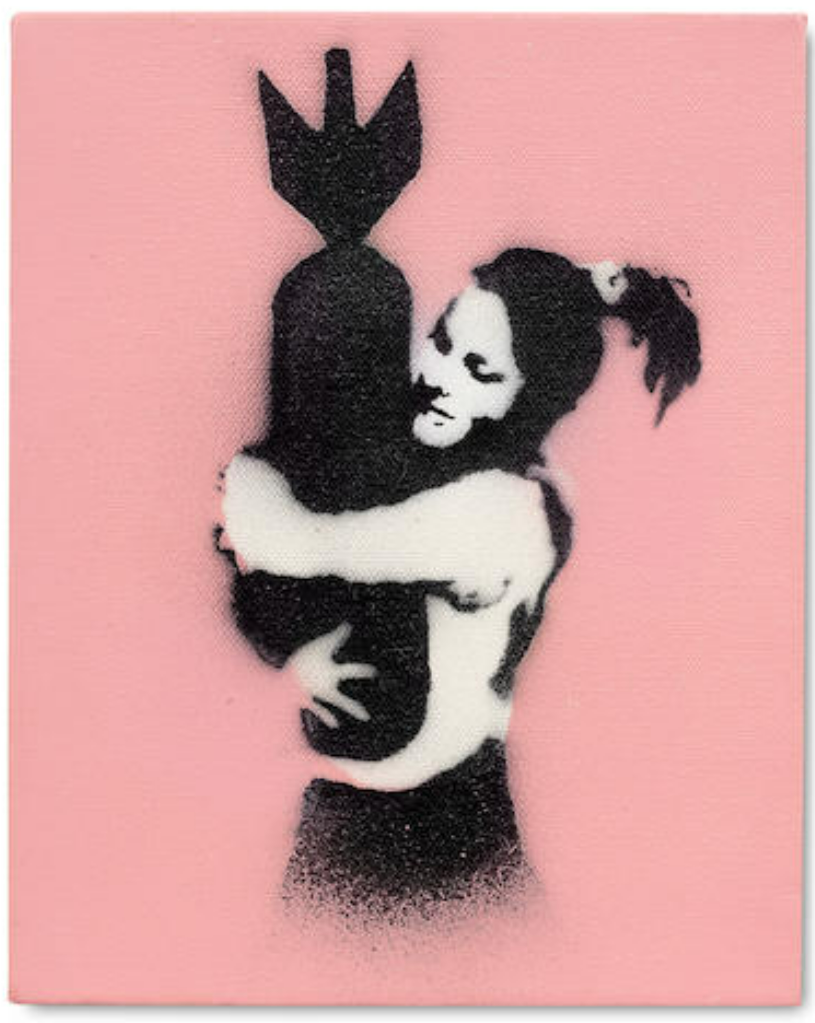
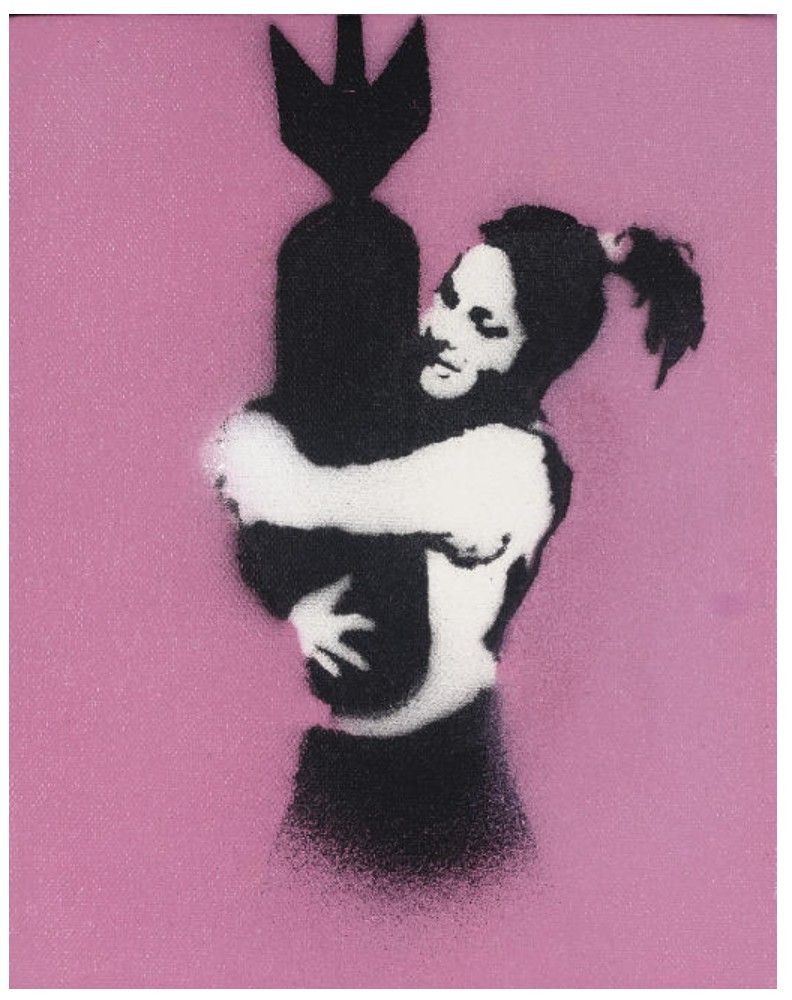
In Bomb Love, the girl is depicted with her hair in a ponytail, eyes closed, and a serene smile on her face as she hugs the bomb tightly. The bomb, rendered in stark black, contrasts sharply with the girl’s lighter tones, emphasizing the unsettling nature of the embrace. Banksy employed his characteristic stencil technique, allowing for rapid replication and a bold, graphic aesthetic. The image has been reproduced in various formats, including screen prints with vibrant bubblegum pink backgrounds, further enhancing the contrast between the subject’s innocence and the weapon’s menace.
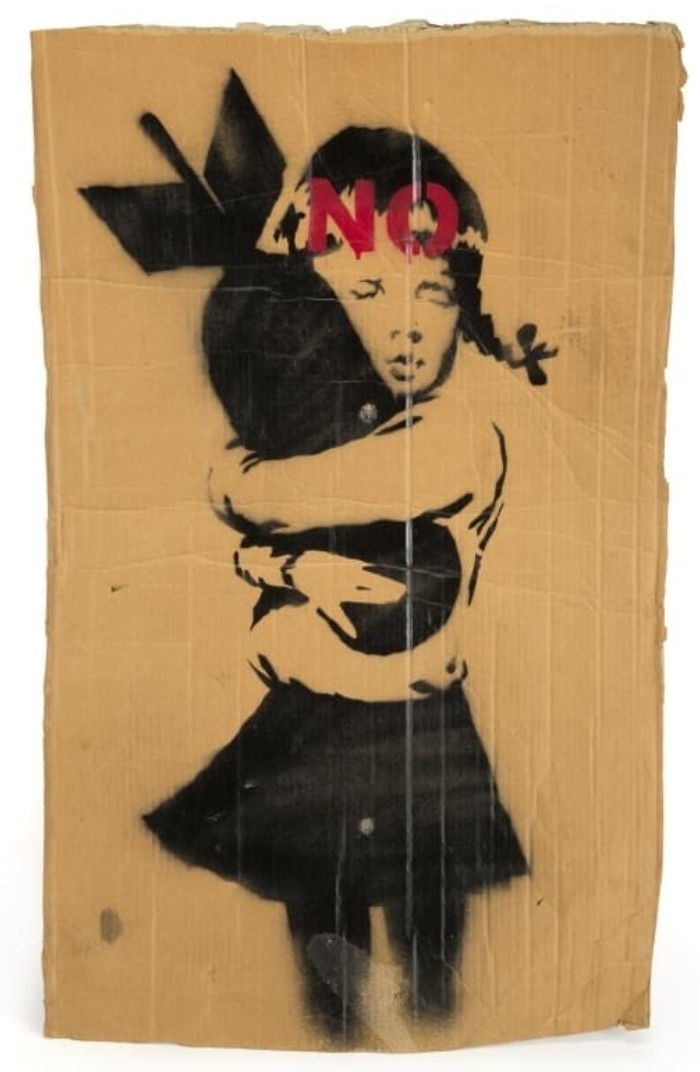
BOMB HUGGER, 2003 Aerosol on cardboard 34 1/2 by 21 1/2 inches
Bomb Love serves as a powerful critique of society’s desensitization to violence and the normalization of warfare. The image suggests a world where the lines between affection and aggression are blurred, prompting viewers to question the narratives that make such juxtapositions conceivable. The girl’s tender embrace of the bomb may also symbolize the way propaganda can dress instruments of war in the guise of benevolence, making them more palatable to the public.
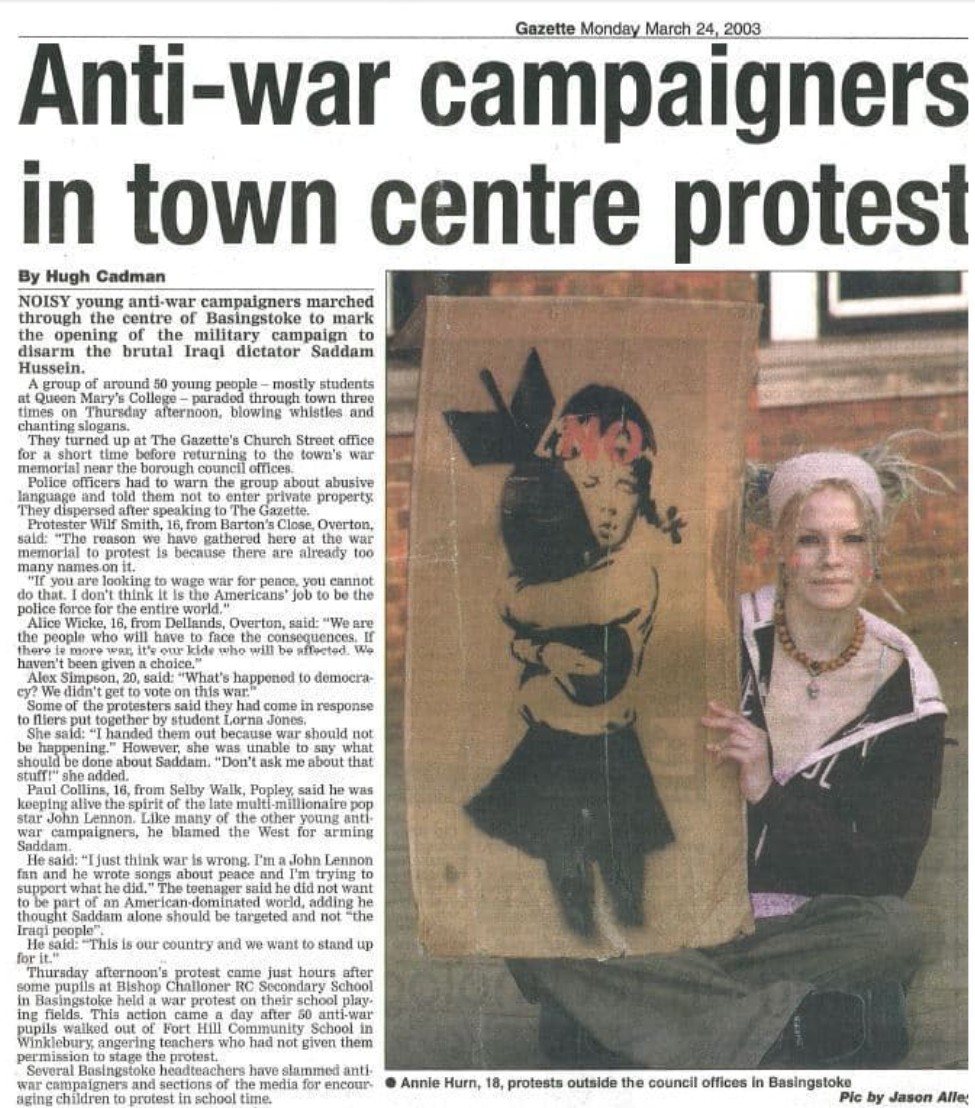
Since its inception, Bomb Love has become one of Banksy’s most iconic works, featured in exhibitions and protests alike. In 2003, during demonstrations against the Iraq War, the image was used on placards, underscoring its resonance as a symbol of anti-war sentiment. The artwork has also been included in Banksy’s publications, such as Wall and Piece, further cementing its place in contemporary art discourse. Over the years, original prints and canvases of Bomb Love have fetched significant sums at auctions, reflecting both its artistic value and cultural significance.
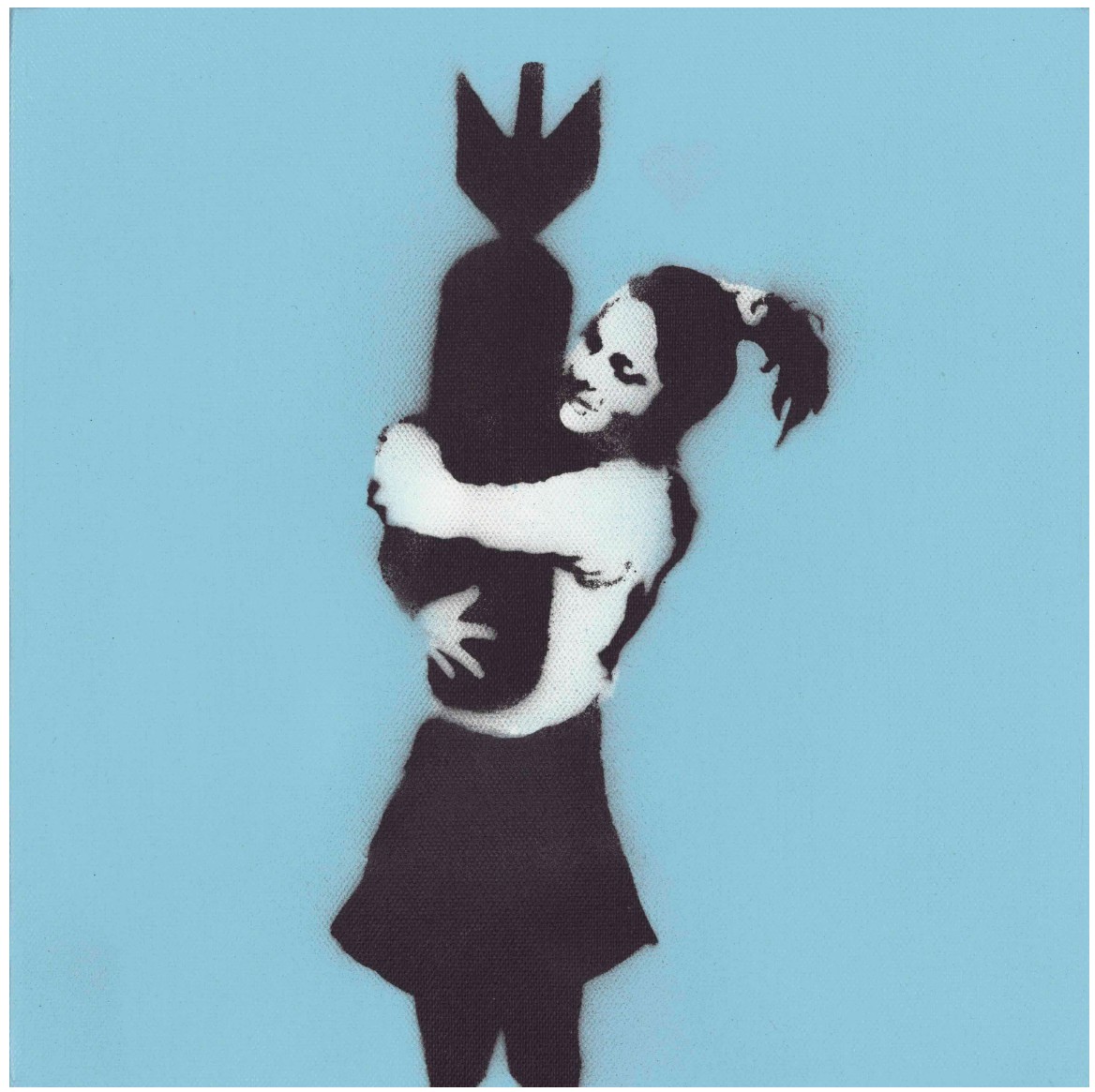
Through Bomb Love, Banksy masterfully conveys the absurdities of modern warfare and the contradictions inherent in society’s relationship with violence. The artwork’s enduring relevance lies in its ability to provoke thought and challenge viewers to reflect on the world around them.
Bomb Love (Pink)
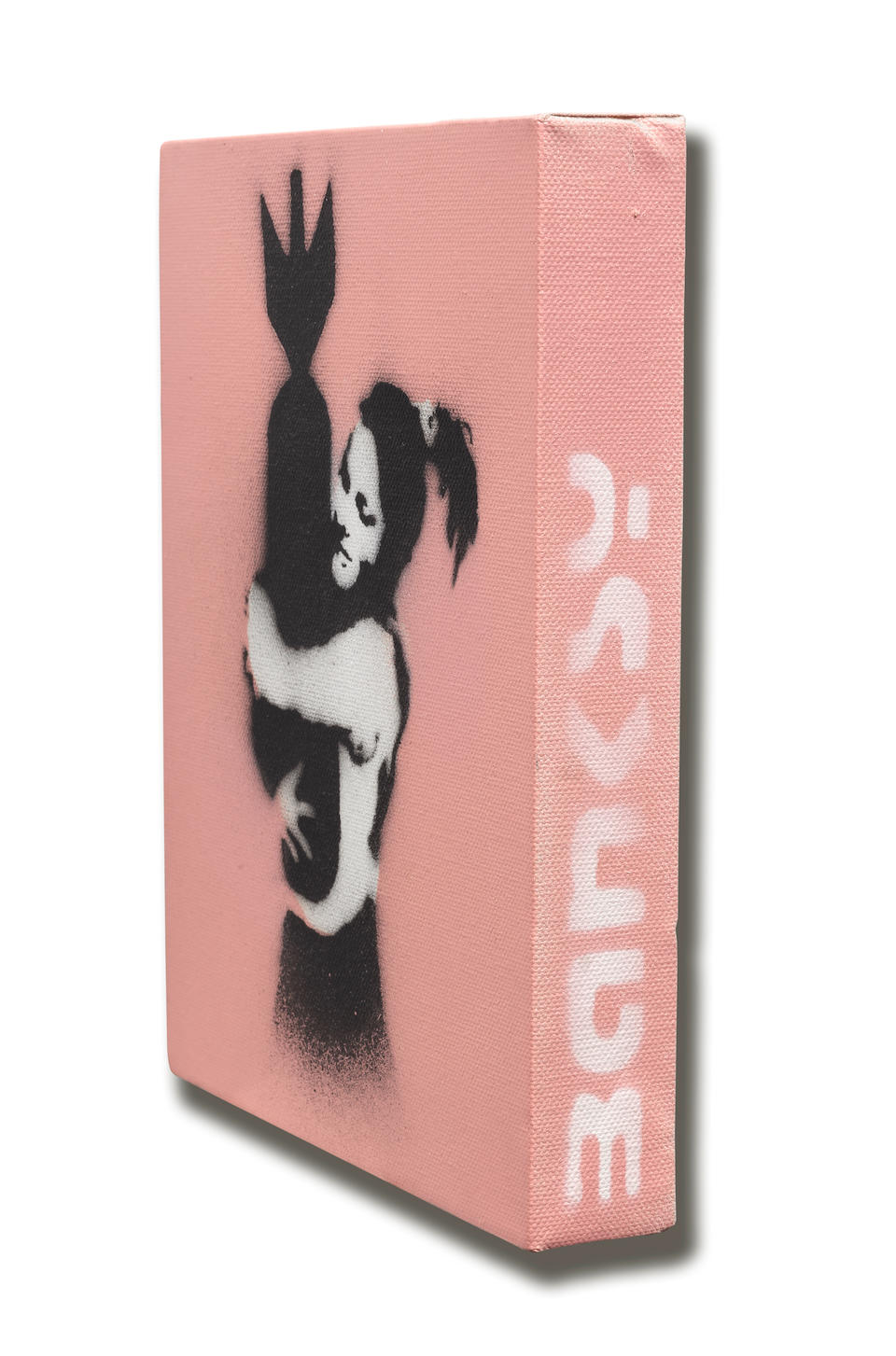
BANKSY Bomb Love, 2002 Spray paint on canvas 25.4 x 20.3 cm (10×8 inches) Tagged on the turnover edge
Bomb Love (Blue)
BANKSY (B. 1975) Bomb Hugger, 2002 Acrylic and spray enamel on canvas 30.5 x 30.5 cm (12×12 inches)
Bomb Love (White)
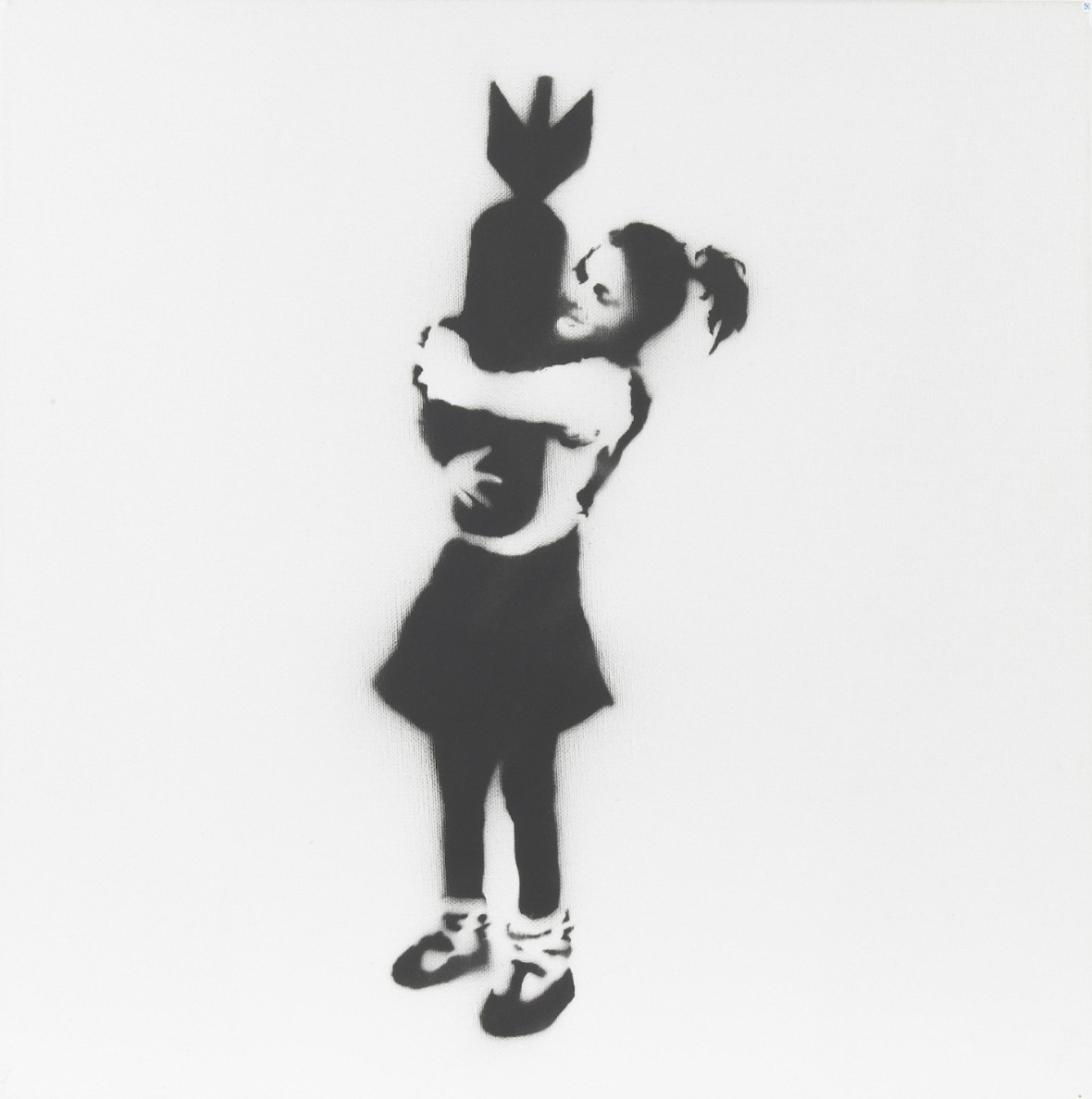
BANKSY
Further signed, dated, numbered /5, and inscribed “LA” on the reverse
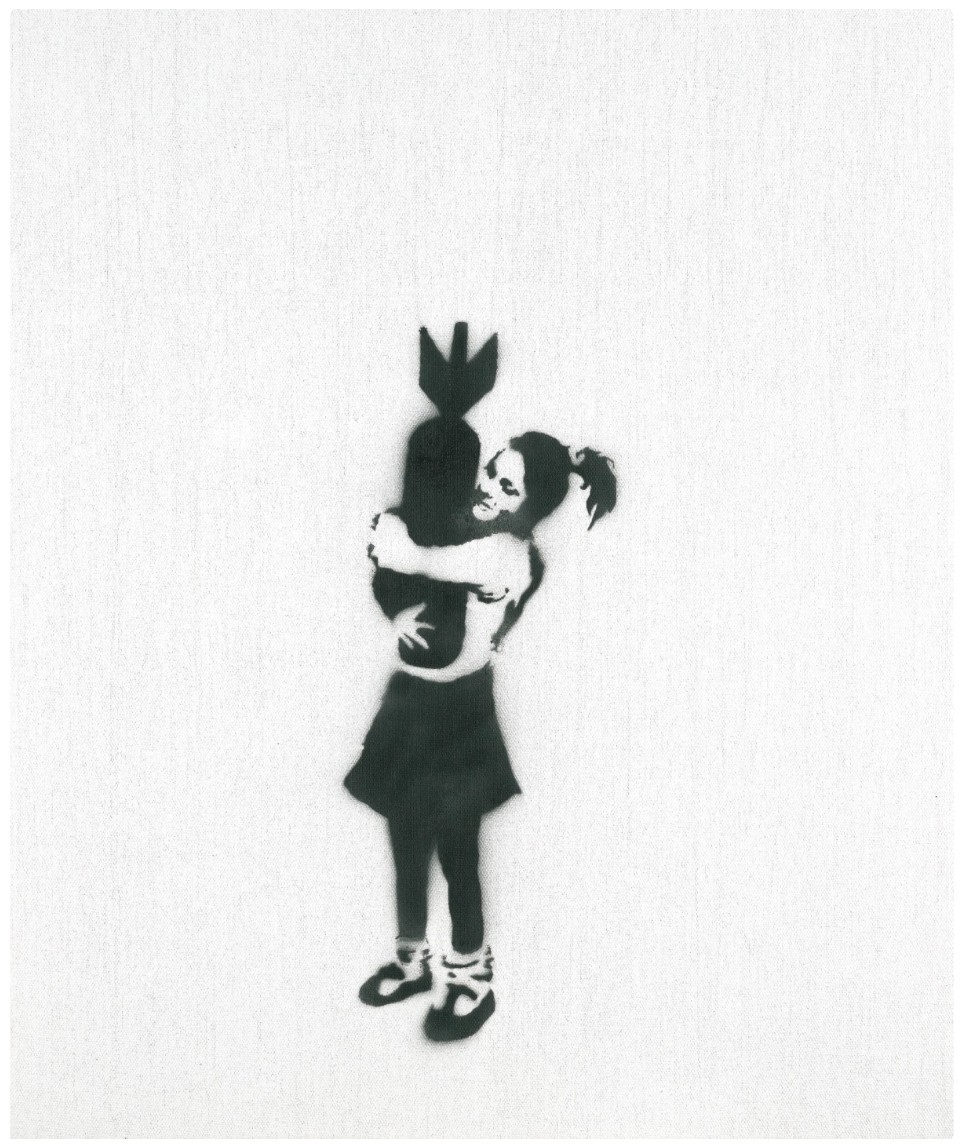
BANKSY Bomb Hugger, 2002
Acrylic and spray-paint stencil on canvas
Bomb Love (Wood)
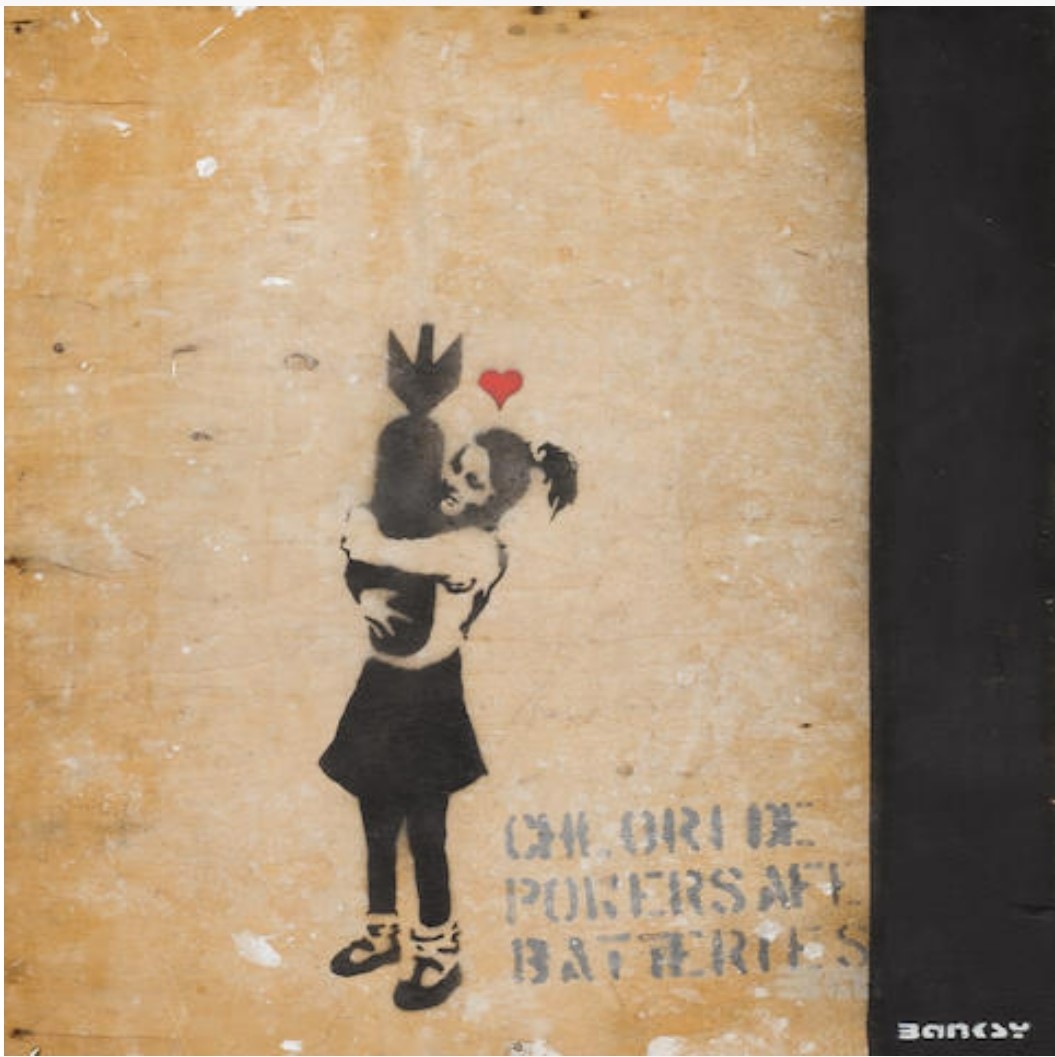
BANKSY Bomb Love, 2000 Stencil spray-paint on board 58.5 x 58.5 cm (23 1/16 x 23 1/16 inches)
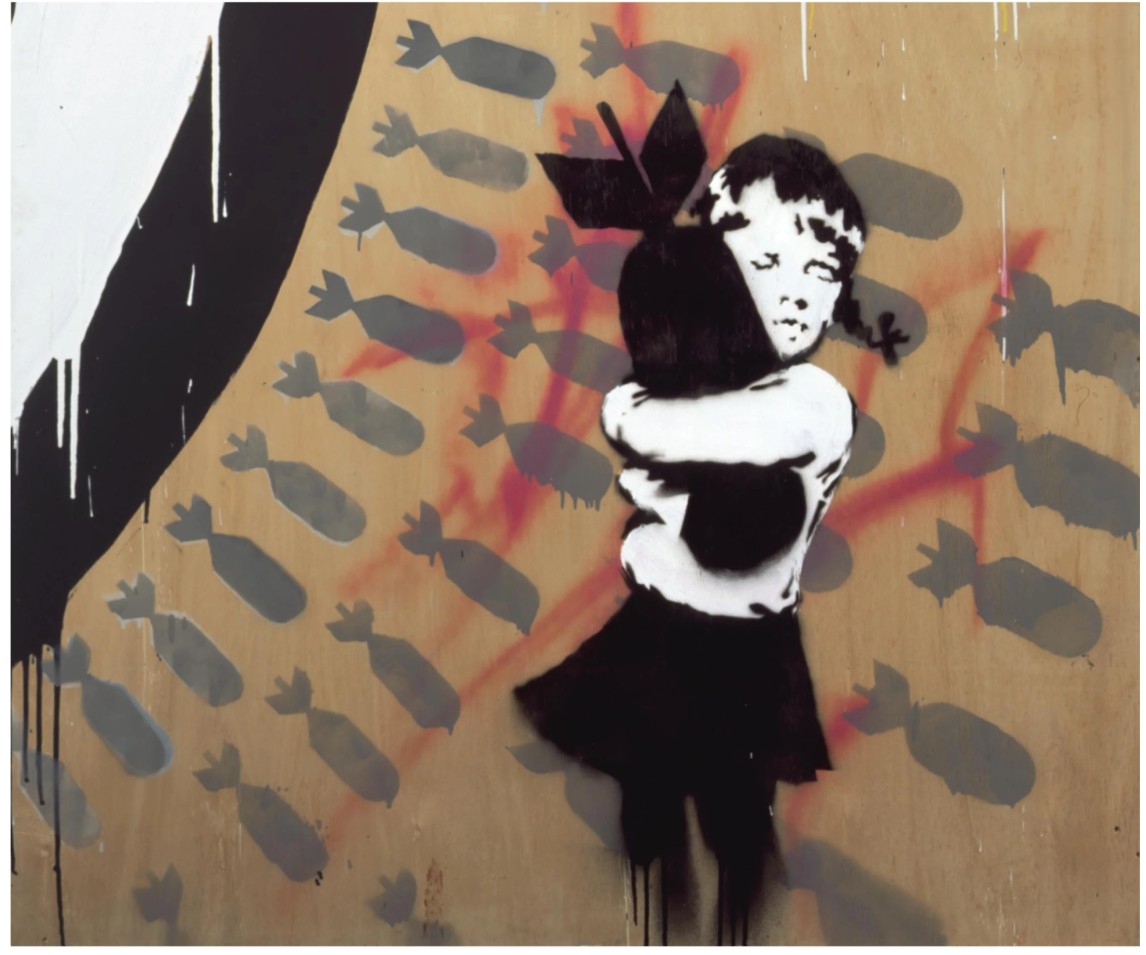
BANKSY Bomb Hugger, 2003 Spray paint and stencil on wood 120×99 cm (47 1/4 x 39 inches)
Prices are inclusive of buyer’s premium unless stated otherwise, as reported by the auction houses.
Bomb Love — Catalogue Entries
STAY INFORMED
Receive the latest news, exhibitions, artworks and market updates on Banksy.