BANKSY
Bomb Hugger, 2003
Spray paint and stencil on wood
120×99 cm (47 1/4 x 39 inches)
Provenance
Mondo Pop, Newton
Private Collection, San Francisco
Donated from the above to the present owners in 2006
Sotheby’s London: 11 February 2010
Estimated: GBP 25,000 – 35,000
Few images encapsulate Banksy’s artistic philosophy more completely than Bomb Hugger. Created in 2003, the work belongs to a remarkable period during which the anonymous Bristol artist was refining the visual language that would establish him as one of the defining figures of contemporary art. Executed shortly after the invasion of Iraq and at the height of global anxieties surrounding terrorism and armed conflict, Bomb Hugger transforms one of humanity’s most destructive inventions into an object of unexpected tenderness.
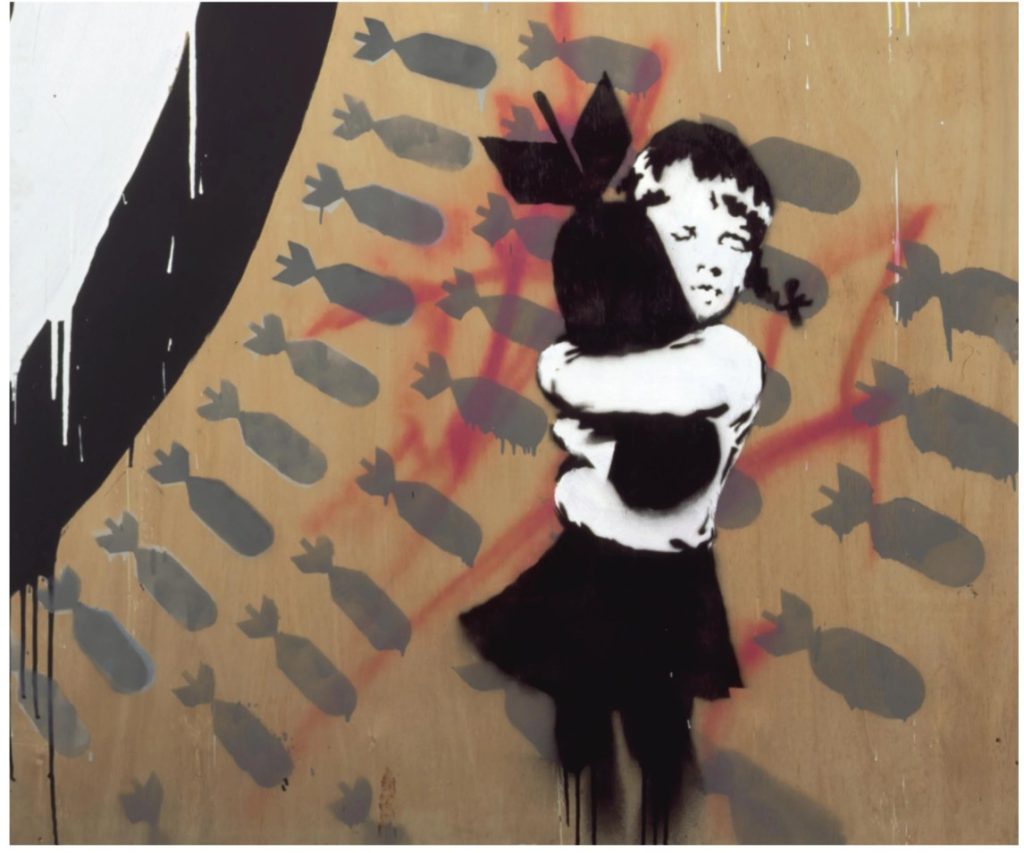
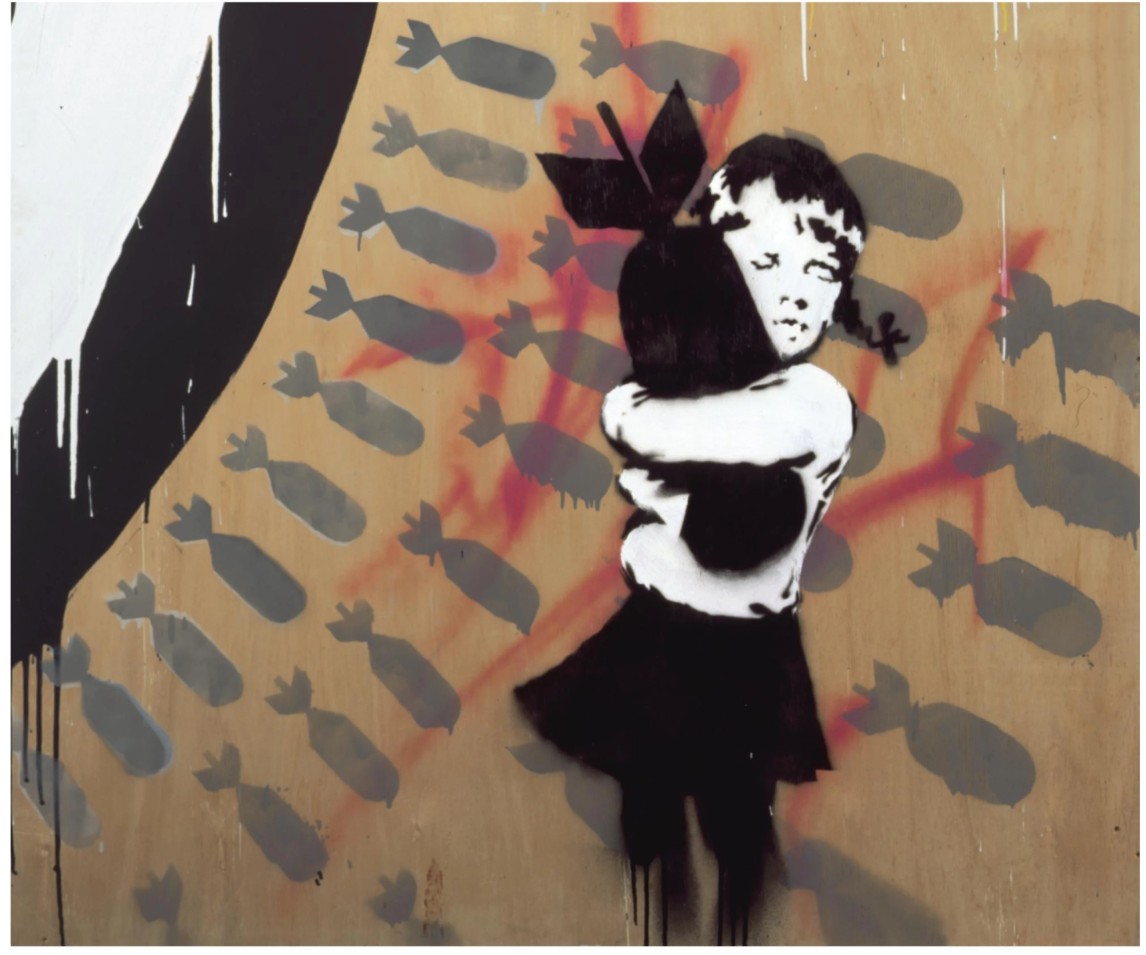
The composition is immediately arresting. At its center, a young girl embraces an aerial bomb with closed eyes and quiet serenity. Rather than recoiling in fear, she holds it as one might cradle a beloved toy, a treasured possession or a cherished friend. Behind her, a relentless rain of falling bombs fills the background, while gestural sprays of red paint evoke both violence and graffiti, situating the work somewhere between the realities of war and the visual language of the street. Like many of Banksy’s greatest images, its extraordinary power lies in the collision of two ideas that should never coexist.
Children occupy a privileged place within Banksy’s artistic universe. Again and again, they become moral witnesses to an adult world shaped by violence, greed and political failure. Whether reaching for a balloon, playing beside warning signs or embracing objects of destruction, they embody a humanity that has not yet been entirely corrupted by ideology or cynicism. The girl in Bomb Hugger belongs to this lineage.
Her expression is peaceful, almost meditative. She appears completely unaware of the bomb’s purpose, or perhaps entirely indifferent to it. This ambiguity is central to the work’s emotional force. Is she too innocent to recognize danger, or does she instinctively understand that compassion remains humanity’s only meaningful response to violence? Banksy deliberately refuses to answer. Instead, he invites us to confront the uncomfortable possibility that innocence sometimes perceives truths inaccessible to the adult world. Throughout art history, the embrace has symbolized affection, reconciliation and protection. Banksy appropriates this universal gesture only to direct it towards an object designed for mass destruction. The paradox is profoundly unsettling. A bomb exists to tear bodies apart; an embrace exists to bring them together. One represents death, the other connection.

The two become inseparable. This inversion would become one of Banksy’s defining artistic strategies. Rather than opposing violence with greater violence, he repeatedly proposes empathy as the most radical form of resistance. It is an idea that echoes throughout his oeuvre, from Love Is in the Air, where flowers replace Molotov cocktails, to Girl with Balloon, where hope appears more enduring than despair. Seen in this light, Bomb Hugger is not merely an anti-war image. It is a manifesto. Banksy suggests that the true opposite of violence is not victory but compassion.
There is, however, another, more unsettling interpretation. The girl may not simply be comforting the bomb; she may be comforting herself through it. Modern societies have long developed a troubling fascination with weapons. They are displayed in museums, celebrated in military parades, transformed into national symbols and endlessly reproduced through cinema, television and video games. Their destructive power is frequently aestheticized, detached from the human suffering they inevitably produce.
Banksy quietly exposes this contradiction. The bomb appears almost beautiful. Its smooth silhouette and simplified form possess the visual elegance of a modernist sculpture. Yet that aesthetic purity conceals an object capable of unimaginable devastation. The work therefore asks an uncomfortable question. Have we become so accustomed to the imagery of war that we no longer recognize its horror?

Although unmistakably contemporary, Bomb Hugger belongs to a long artistic tradition. Its emotional economy recalls Picasso’s Guernica, where the innocence of children becomes inseparable from the brutality of modern warfare. Like Picasso, Banksy avoids depicting battle itself. Instead, he focuses on its human consequences, reducing vast geopolitical conflicts to intimate moments of emotional truth.
There are also echoes of Cold War imagery. For decades, nuclear weapons existed as abstract symbols of mutual destruction—objects capable of ending civilization while remaining strangely distant from everyday experience. Banksy’s bomb possesses this same symbolic quality. It is less a specific weapon than a universal icon of humanity’s extraordinary capacity for self-destruction. Yet where twentieth-century artists often responded with despair, Banksy introduces tenderness. It is this emotional shift that makes the image uniquely his own.
At first glance, Bomb Hugger appears almost impossible to understand. Why would a child embrace the very object designed to destroy her? The answer lies not in the bomb but in the embrace. Banksy has never believed that art changes the world through slogans alone. Instead, he constructs visual paradoxes that quietly reshape the way we think. By inviting compassion into the very heart of destruction, Bomb Hugger reminds us that humanity’s greatest strength has never been its capacity to wage war, but its ability to imagine a world beyond it.
More than twenty years after its creation, the image remains one of Banksy’s purest artistic statements. It contains no elaborate symbolism, no complicated narrative and no explicit political manifesto. Only a child, a bomb and a gesture so profoundly human that it transforms an instrument of death into a timeless meditation on hope.