
Bomb Hugger
aka Bomb Love
Medium: Screenprint in colors on wove paper
Year: 2003
Sheet: 70×50 cm (27 1/2 x 19 3/4 inches)
Printer & Publisher: Pictures on Walls, London
Editions
Signed Edition: 150
Unsigned Edition: 600
Artist’s Proofs: 44 signed AP
Signature and Numbering
Numbered in pencil, lower right
Some with the publisher’s blindstamp, some without
Signature in pencil, lower right
The Quiet Normalization of Violence
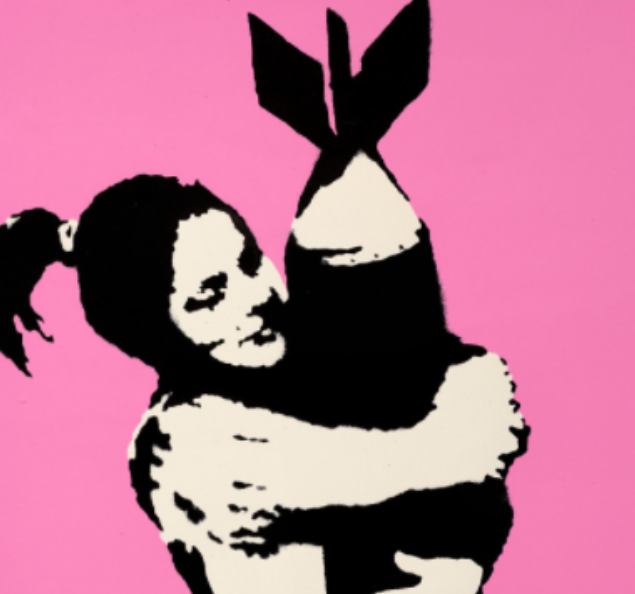
With Bomb Love, also known as Bomb Hugger, Banksy delivers one of his most disarmingly tender yet conceptually unsettling images. In contrast to more overtly confrontational works, this piece operates through emotional inversion: a child expresses affection toward an object designed for destruction. The result is not shock through spectacle, but a slower, more disturbing realization, that violence, when embedded deeply enough, can become familiar, even embraced. Bomb Love is pure Banksy: provocative, bitingly satirical, and yet tender… Always a strong opponent of mass media and casual consumerism, the senses that today’s youth are being sold aggression instead of innocence, war instead of play literally explodes from this print in a flash of bubble-gum bring pink.
“It takes a lot of guts to stand up anonymously in a western democracy and call for things no one else believes in like peace and justice and freedom.”
The bomb, by contrast, is heavy, industrial, and precise in its rendering. It retains all the visual markers of its purpose: there is no abstraction, no softening. The background is a vivid pink, creating a striking contrast: childhood softness against military form, and emotional warmth against mechanical violence. There is no movement, no context, no narrative. Only a single, suspended act: a child embracing destruction as if it were harmless.
The Internalization of Conflict
At its core, Bomb Love is not about war itself, it is more about how war enters the psyche. Indeed, the girl does not resist the bomb, nor does she fears it, she simply holds it.
 Bomb Hugger, Bristol, 1998
This inversion shifts the work away from external conflict and toward internal conditioning. The image suggests a world where violence is no longer questioned, where destructive systems are absorbed into everyday life, and where innocence adapts rather than rejects Importantly, the child remains visually untouched, there is no sign of distress, no visible corruption. The tension lies entirely in the gesture. What should be repelled is instead embraced. Banksy avoids drama. There is no explosion, no aftermath. And precisely for that reason, the work becomes more unsettling. It is not about violence occurring. It is about violence being normalized.

Banksy’s intervention is subtle but decisive. Banksy does not dramatize destruction, nor does he depict suffering. Instead, he presents a world in which destructive forces have become familiar enough to be embraced without hesitation. The image suggests that when violence becomes embedded in culture, it ceases to appear as violence at all. It becomes part of the emotional landscape. The innocence of the child is not erased. It remains intact, visually untouched. And this is precisely what makes the work so effective. The critique does not lie in corruption, but in coexistence. Innocence and violence occupy the same space, without conflict.
On a brighter note, one can also see Bomb Love is also a clear salute to the power of love, that can prevail over war and violence: perhaps this little girl could disarm a bomb through her loving embrace.
Childhood as a Recurrent Device
Bomb Love belongs to a broader group of works in which Banksy uses children to expose the contradictions of adult systems. The motif appears in variations, including images of children interacting with objects that resemble bombs disguised as everyday items, such as ice cream cones. These works extend the same logic: what should be associated with pleasure, safety, or innocence is subtly transformed into something dangerous.
Girl with Ice Cream on Palette, 2004
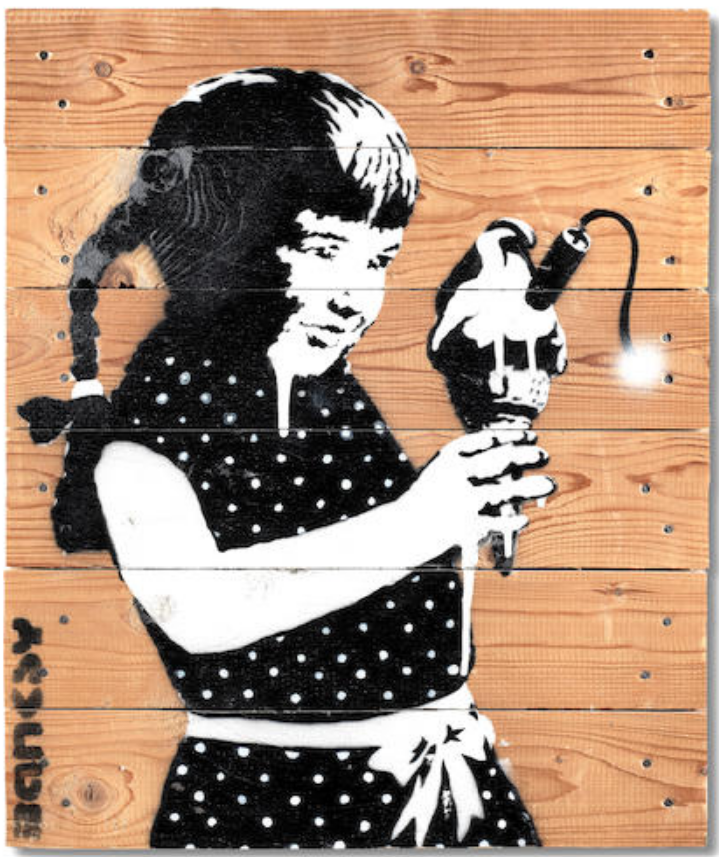
Murals and stencil variations reinforce this theme by placing similar figures directly within urban environments, where the contrast between childhood imagery and structures of power becomes even more immediate. The child becomes a recurring vehicle through which Banksy explores how societies transmit fear, conflict, and normalization across generations.
Bomb Love, 2002

Bomb Love was first shown at Existencilism, Banksy’s first exhibit in Los Angeles in 2002.
Bomb Hugger, 2002

The Lesson
Bomb Love endures because it does not rely on spectacle. It operates through precision, restraint, and emotional clarity. The image is immediately legible, yet its implications unfold slowly. It does not accuse. It reveals. Within Banksy’s broader body of work, it stands as one of the most refined expressions of a central idea: that the most profound transformations occur not in moments of visible conflict, but in the quiet acceptance of what should remain intolerable.
Bomb Hugger, 2002
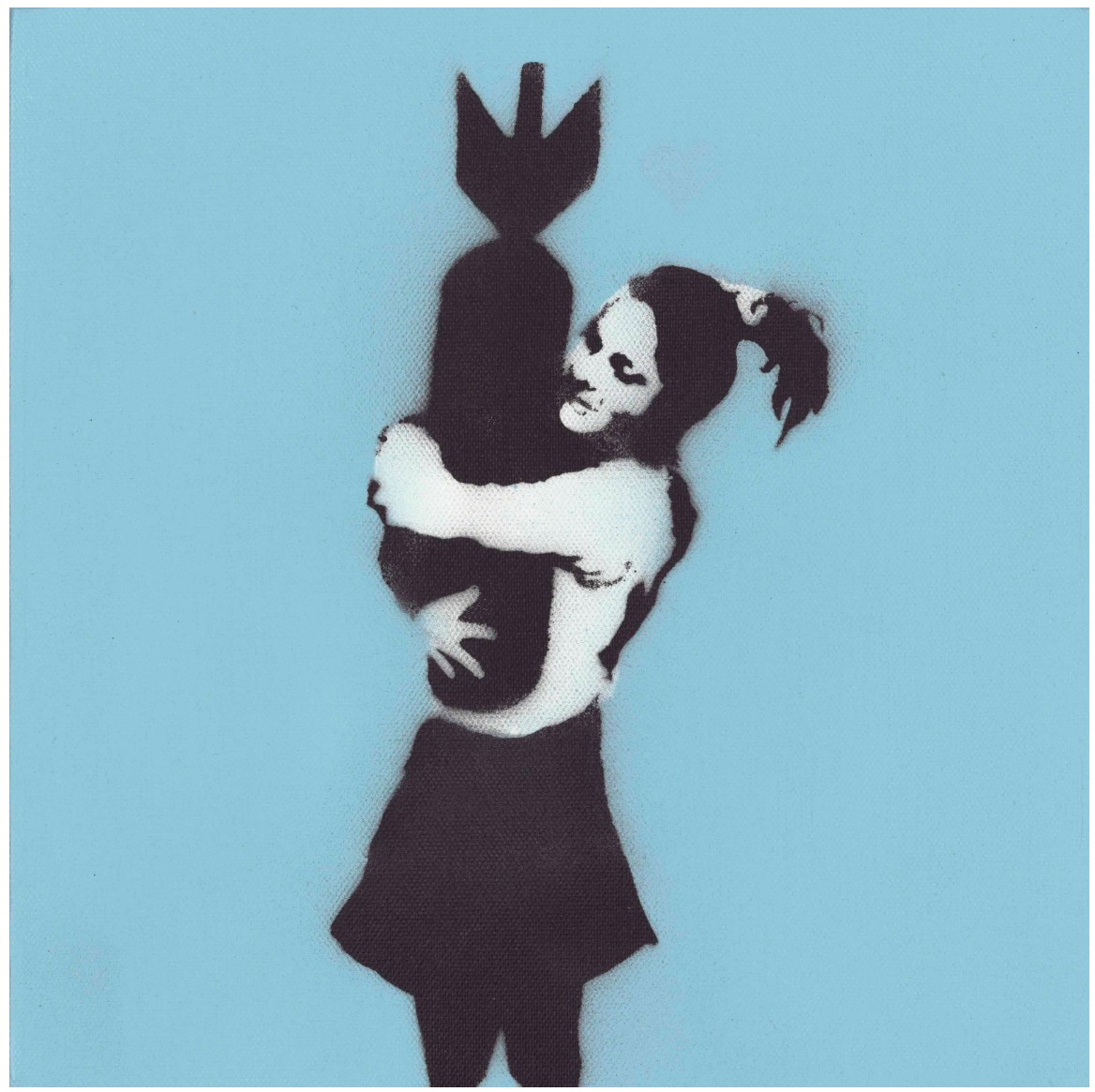
A child embraces a bomb. The gesture is gentle, almost loving. Nothing in the image resists this act. And in that absence of resistance lies the entire force of the work. Banksy does not ask us to confront violence directly. He asks us to recognize what happens when it becomes familiar enough to hold.
Auction Results
PLEASE CLICK BELOW FOR AUCTION RESULTS