BANKSY
Cardinal Sin, 2011
Sawn off statue, bathroom tiles and superglue
On Loan to Walker Art Gallery, Liverpool, England
Catalogue Note
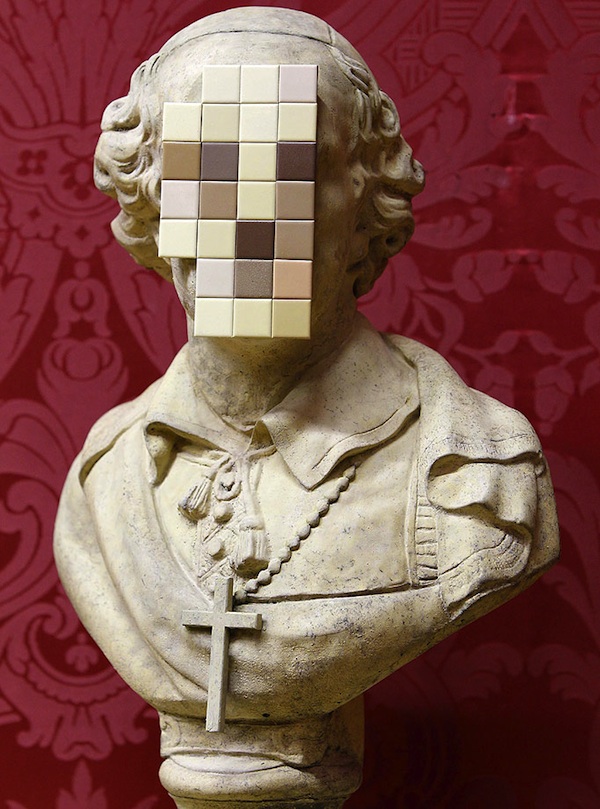
Created in 2011, Cardinal Sin stands among Banksy’s most powerful sculptural works and one of his most direct engagements with institutional authority. An eighteenth-century carved stone bust of a clergyman has had its face meticulously sawn away and replaced with a grid of white bathroom tiles, instantly recalling the pixelated censorship used to conceal the identities of criminals in newspapers and television broadcasts. The intervention is simple yet devastating, transforming a symbol of religious authority into an indictment of institutional failure.
Rather than attacking faith itself, Banksy targets the structures that protect power at the expense of accountability. The title operates as a double entendre. While “cardinal sin” traditionally denotes one of the gravest moral transgressions, it also points directly towards the senior clergy whose handling of decades of abuse scandals profoundly damaged the credibility of the Catholic Church. The work therefore condemns not only individual wrongdoing but also the culture of concealment that allowed it to persist.
“I’m never sure who deserves to be put on a pedestal or crushed under one.”
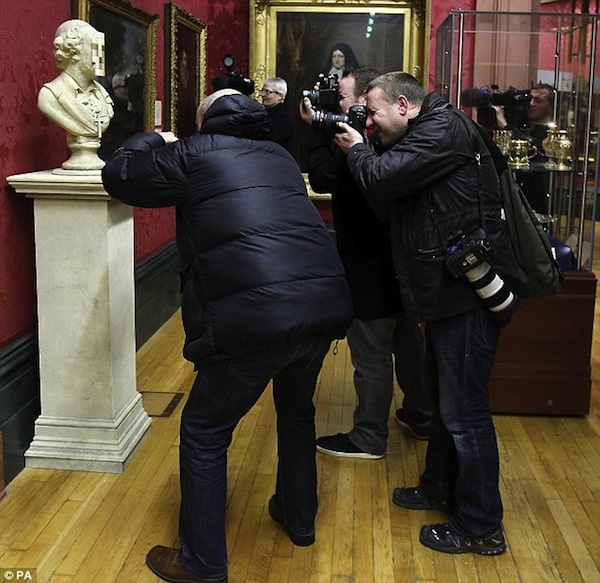
The use of ceramic bathroom tiles is particularly significant. Associated with cleanliness, hygiene and purification, they introduce a bitter irony into the sculpture. Instead of cleansing the institution, the tiles become a mask that conceals identity while drawing even greater attention to what has been erased. The face has not disappeared; it has been deliberately censored. Banksy suggests that concealment is itself a visible act.
The choice of an eighteenth-century devotional sculpture reinforces the work’s conceptual depth. For centuries, religious sculpture has sought to individualize saints, bishops and martyrs through carefully rendered facial expressions that embody compassion, wisdom and spiritual authority. By removing the very feature through which personality and humanity are communicated, Banksy symbolically strips the institution of its moral legitimacy while leaving its ceremonial authority intact. The cross remains around the cardinal’s neck, but the face capable of inspiring trust has vanished.
The sculpture’s installation at Liverpool’s Walker Art Gallery was equally significant. Rather than being displayed in a contemporary art museum, Cardinal Sin was placed among Old Master paintings and historic religious sculpture, allowing Banksy’s intervention to enter directly into dialogue with centuries of Christian visual culture. The juxtaposition transformed the work from an isolated act of protest into a meditation on the relationship between artistic heritage, religious authority and historical accountability.
Like many of Banksy’s strongest works, Cardinal Sin resists easy provocation. It is not an attack on belief, but on hypocrisy. Throughout his career, Banksy has repeatedly distinguished between ordinary individuals and the institutions that claim to represent them. Here, his criticism is directed not at Christianity itself but at the abuse of power carried out under its protection.