CRAYON SHOOTER
Crayon Boy
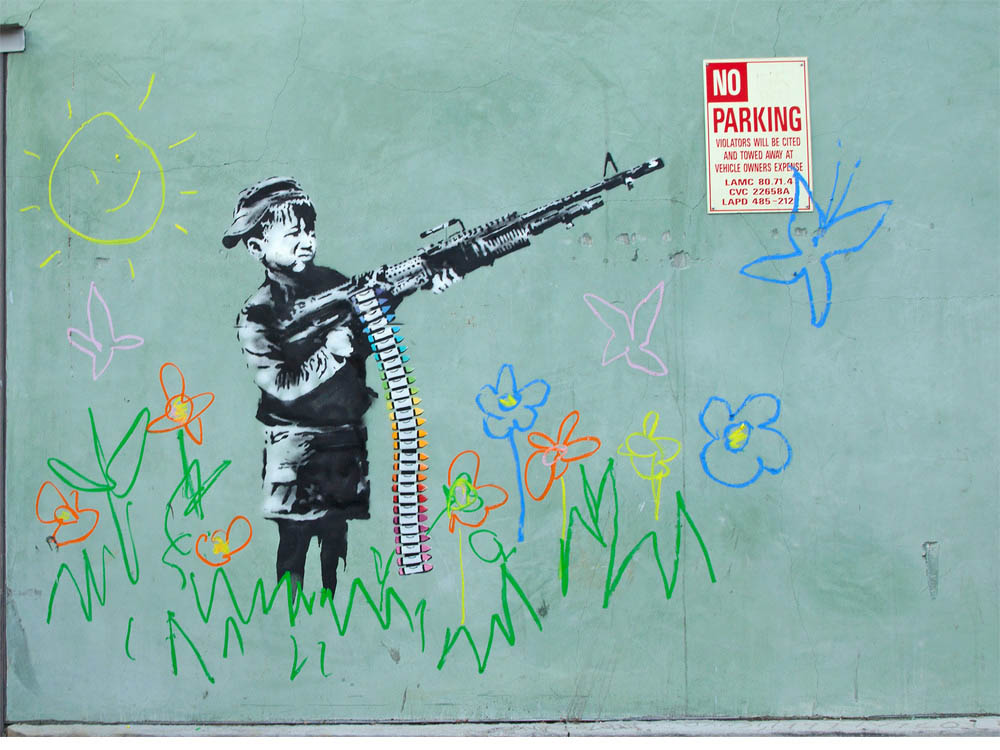
Crayon Boy, also known as Child Soldier or Crayon Shooter, appeared in Westwood, Los Angeles, in February 2011, during an intense period of activity by Banksy in the city immediately before the 83rd Academy Awards. Exit Through the Gift Shop, Banksy's first feature film, had been nominated for Best Documentary Feature, and in the weeks preceding the ceremony a succession of new Banksy works appeared across Los Angeles. Contemporary photographs document Crayon Boy by 17 February, approximately ten days before the Oscars.
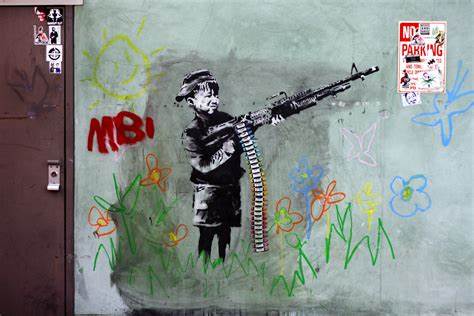
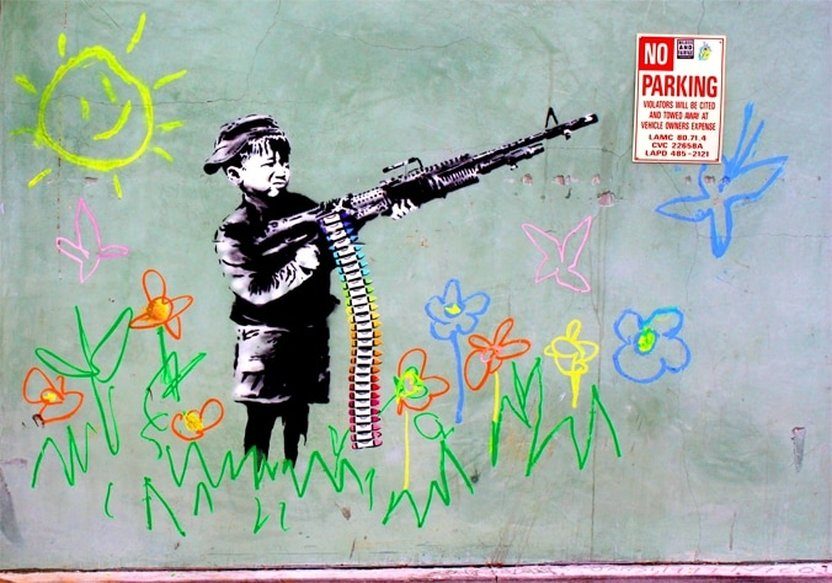
The mural depicts a young boy holding a large automatic weapon. His stance is remarkably assured: the gun is almost as substantial as his upper body, yet he handles it with the apparent familiarity of a trained soldier. Around him, however, Banksy introduced an entirely different visual vocabulary. Brightly colored flowers, butterflies and childlike marks interrupt the otherwise monochrome composition, while the ammunition associated with the weapon is transformed into colored crayons.
This contrast between the severity of the weapon and the innocence of the surrounding imagery provides the work with its central tension. Banksy does not remove the gun or disguise its threatening form. Instead, he changes what it fires. The transformation is small enough to preserve the disturbing silhouette of the armed child while fundamentally altering the meaning of the scene.
From Ammunition to Imagination
The substitution belongs to a recurring strategy within Banksy's work. In Love Is in the Air, the expected projectile in the hand of a masked rioter becomes a bouquet of flowers; in Bomb Hugger, a young girl embraces an object designed for destruction; and in Valentine's Day, the impact of a slingshot produces an explosion of red foliage. Banksy repeatedly retains the recognizable vocabulary of violence while replacing one crucial element with something associated with affection, innocence or creativity.
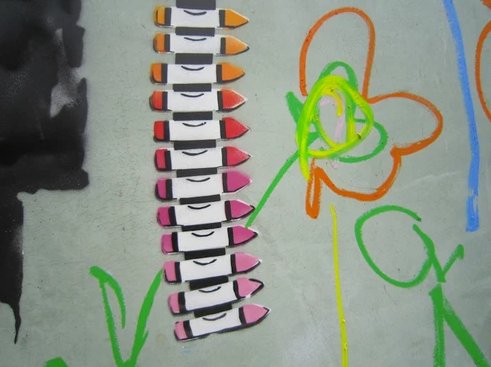
Crayon Boy develops this idea particularly effectively because the substitution concerns not merely an object but its potential consequence. A gun normally projects violence outward; Banksy's weapon instead appears to project color and imagination. The flowers and butterflies surrounding the child can consequently be understood as extensions of the crayons themselves, as though the destructive capacity of the weapon had been redirected towards drawing.
The image nevertheless remains deliberately uncomfortable. Banksy does not simply give the child a box of crayons. He allows him to retain the machine gun. Childhood and militarization therefore occupy the same figure, forcing the viewer to confront the distance between what children might create and the violence into which adults can initiate them.
Children have repeatedly provided Banksy with some of his most powerful protagonists because their presumed vulnerability makes their encounter with weapons particularly disquieting. Kids on Guns, Bomb Hugger and Girl with Ice Cream Bomb similarly place childhood innocence alongside instruments or environments of violence. In each case, the incompatibility between the two is precisely the point.
Los Angeles and the 2011 Oscar Campaign
The timing, however, is important. Banksy's February 2011 interventions effectively turned Los Angeles into an unofficial extension of the extraordinary publicity surrounding Exit Through the Gift Shop. Other works appeared around the city during the same period, including Crayon Foreclosure, This Looks a Bit Like an Elephant and Caution Fun!. The Los Angeles Times was already describing Banksy's continuing activity across the city in the days immediately preceding the Academy Awards.
The proximity to Hollywood introduces an interesting contradiction. Banksy had spent much of his career resisting conventional structures of cultural legitimacy, yet by February 2011 a film bearing his name was competing for one of the entertainment industry's most prestigious awards. Rather than simply participating in that spectacle, he simultaneously returned to the street. The new murals generated their own parallel form of attention outside the official machinery of the Oscars.
Crayon Boy should therefore be understood both as an independent anti-war image and as part of this concentrated Los Angeles intervention. Banksy was operating simultaneously within Hollywood's field of vision and outside its institutions, using the city's walls while the entertainment industry waited to discover whether it would give him an Oscar.
TAkeaways
Crayon Boy succeeds through an extremely economical transformation. Banksy leaves almost everything associated with the image of a child soldier intact—the stance, the weapon and the disturbing disproportion between the two—but changes the ammunition. That substitution is sufficient to redirect the entire composition.
The crayons are particularly effective because they represent one of childhood's simplest instruments of expression. A crayon leaves a mark rather than a wound; its purpose is to add color rather than remove life. The flowers and butterflies surrounding the boy make this alternative visible, suggesting the world that creative energy might produce when it is allowed to replace violence.
Within Banksy's wider oeuvre, the work therefore belongs to a sustained examination of how the instruments of aggression might be symbolically repurposed. Like the bouquet in Love Is in the Air, the crayons do not eliminate the original violent gesture; they expose it by offering another possible outcome. The weapon remains unmistakably a weapon, but Banksy changes what comes out of it.
STAY INFORMED
Receive the latest news, exhibitions, artworks and market updates on Banksy.