DON’T BELIEVE THE TYPE, 2001
Provenance
- Laz Inc., London
Auction History
Prices are inclusive of buyer’s premium unless stated otherwise, as reported by the auction houses.
Catalogue Note
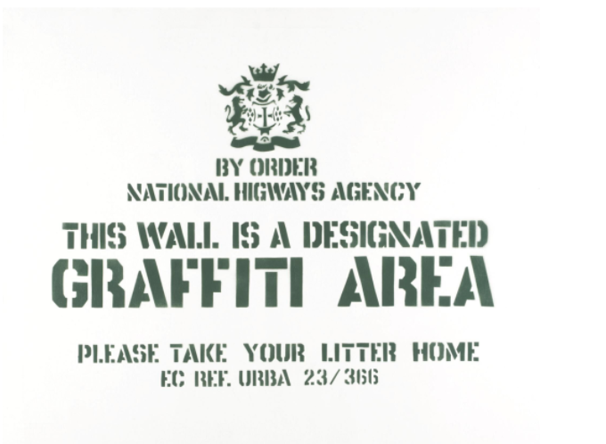
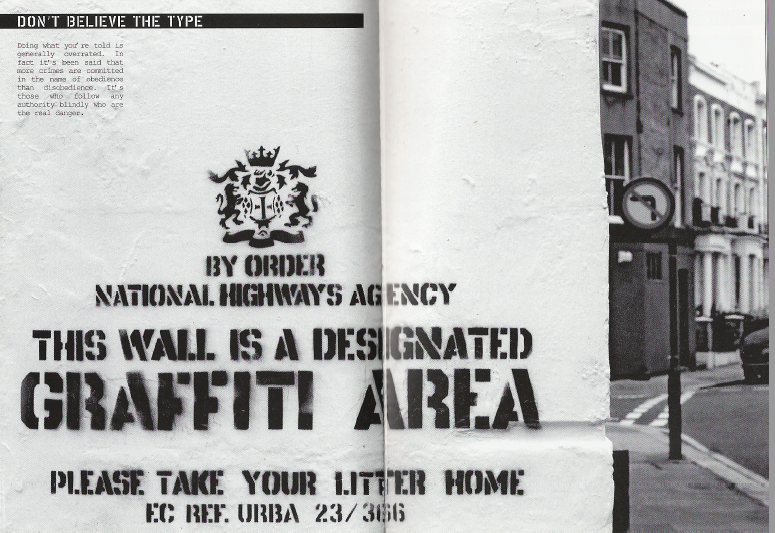
In Designated Graffiti Area, Banksy turns the language of authority into a canvas for satire. Stenciled in a font reminiscent of official notices, the text announces that the wall has been sanctioned by the “National Highways Agency” for graffiti use, complete with a crest and regulatory tone. Of course, no such agency order exists. The piece is a fictional sign that exposes the contradictions of institutionalizing rebellion.
Banksy, Banging Your Head Against A Brick Wall, November 2001
By mimicking bureaucratic language and offering a supposed stamp of approval, Banksy asks: what happens when street art (a practice rooted in defiance) is absorbed into the system it critiques? Can graffiti still be subversive if it becomes allowed, labeled, and framed?
The final line, “Please Take Your Litter Home,” adds a brilliant touch of deadpan British humor, suggesting that even vandalism must now follow public etiquette. In one stroke, Banksy highlights the absurdity of control, the sanitization of dissent, and the ever-blurring boundary between rule-breaking and cultural acceptance.
Designated Graffiti Area: When Banksy Turned a Wall into a Joke About Authority
In the early 2000s, a curious sign appeared on the side of a building in East London. It bore the stamp of authority: a crest, stenciled typography, and the unmistakable language of government regulation. It read:
BY ORDERNATIONAL HIGHWAYS AGENCYTHIS WALL IS A DESIGNATED GRAFFITI AREAPLEASE TAKE YOUR LITTER HOMEEC REF: URBA 23/3865
At first glance, passersby might have assumed it was real. But the combination of content and context made it unmistakably Banksy. The wall, located in a rundown area long tagged by local graffiti writers, had suddenly become a parody of permission, thanks to one of street art’s most clever provocateurs. The brilliance of Designated Graffiti Area lies in its mimicry. Banksy uses the visual codes of officialdom (crests, acronyms, formal phrasing) to create a faux government order. But rather than enforcing a prohibition, it grants a kind of absurd freedom: this wall is now a legal space to do illegal things. It’s a fake green light to break the rules: under the supervision of a made-up agency.
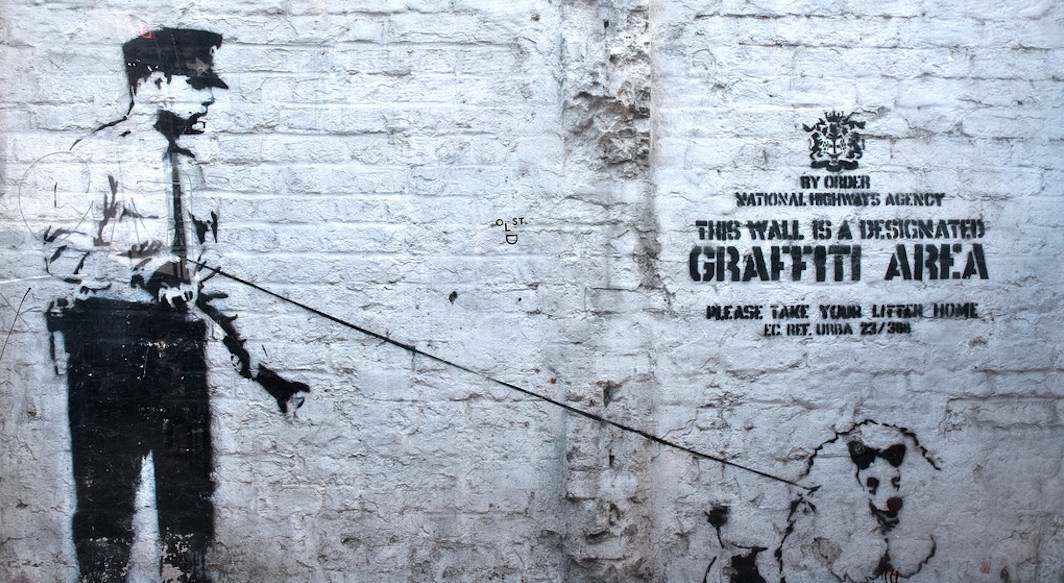
What followed is even more interesting. As soon as the sign appeared, the wall was covered in layers of graffiti, throw-ups, tags, and colorful chaos. The mere illusion of permission had transformed the wall into a magnet for expression. The mural became a social experiment: would people act differently if they thought the system allowed their defiance? Most probably Yes!
The paradox is the point. Graffiti is, by nature, illegal. It is an art form that operates outside the bounds of approval. The moment it becomes regulated, the risk is neutering its edge. Banksy plays with this tension, asking whether rebellion can be packaged, permitted, and still remain authentic. Designated Graffiti Area is not just a joke, it becomes an refined artistic critique of how institutions absorb culture, how rebellion becomes merchandise, and how authority always wants to frame what it cannot control.
STAY INFORMED
Receive the latest news, exhibitions, artworks and market updates on Banksy.