FESTIVAL, 2006
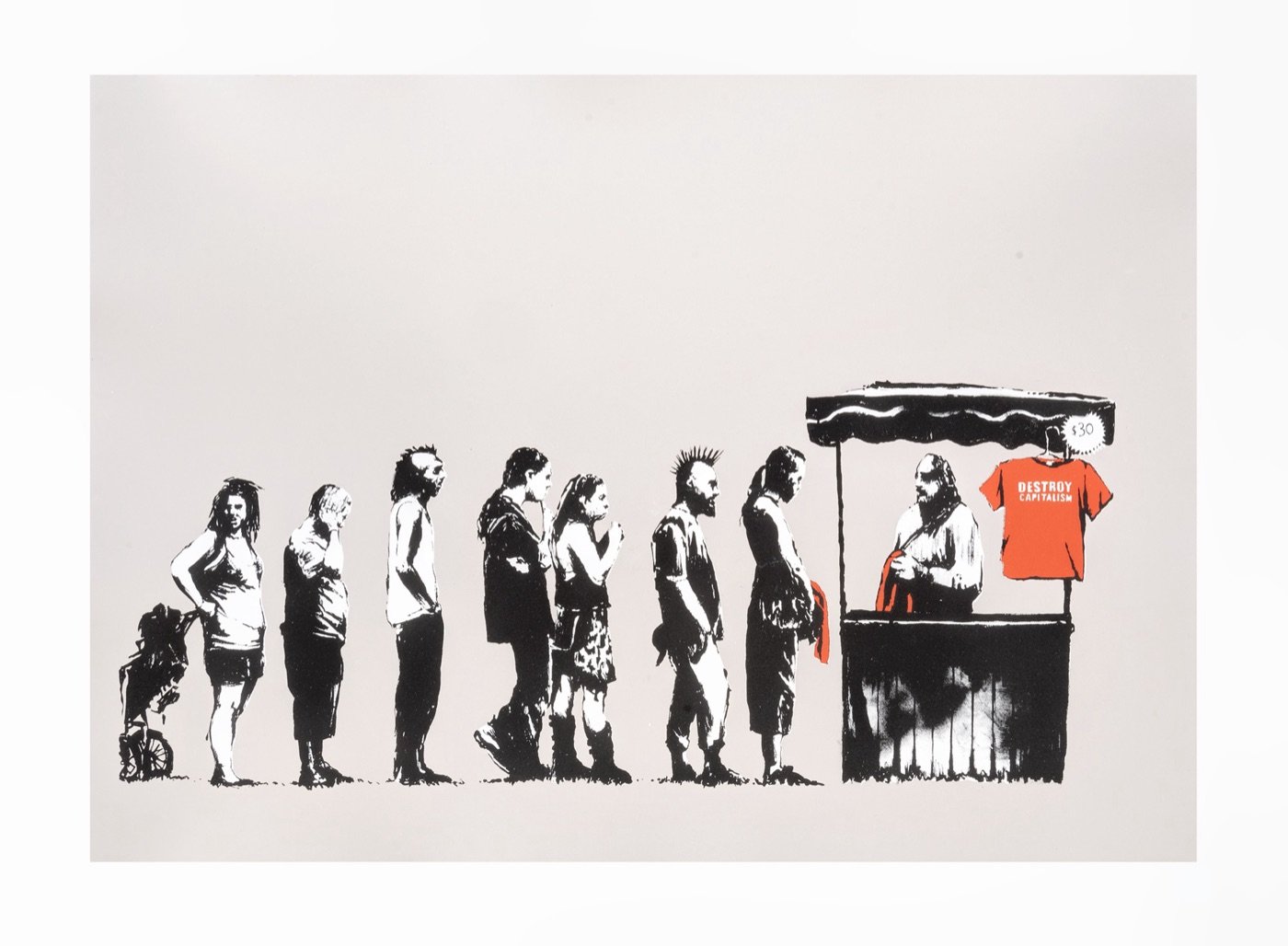
In Festival, Banksy delivers one of his most precise and quietly devastating critiques—not of power imposed from above, but of contradiction from within. The work exposes a paradox at the heart of counterculture: the moment rebellion becomes product. Created in 2006 and also known as Destroy Capitalism, Festival captures a scene that feels instantly familiar. A line of festival-goers, figures drawn from punk, goth, and alternative subcultures, wait patiently in front of a merchandise stand. What unfolds is not confrontation, but compliance. And therein lies the work's sharpest edge.
Selling Rebellion Back to Itself
The composition presents a horizontal procession of individuals, each carefully characterized through posture, clothing, and attitude. Mohawks, loose silhouettes, layered garments, these are not anonymous figures, but recognizable embodiments of subcultural identity. They stand in line. At the end of the queue, a vendor sells bright red t-shirts bearing the slogan: “DESTROY CAPITALISM.” Above it, a small but decisive detail: $30.
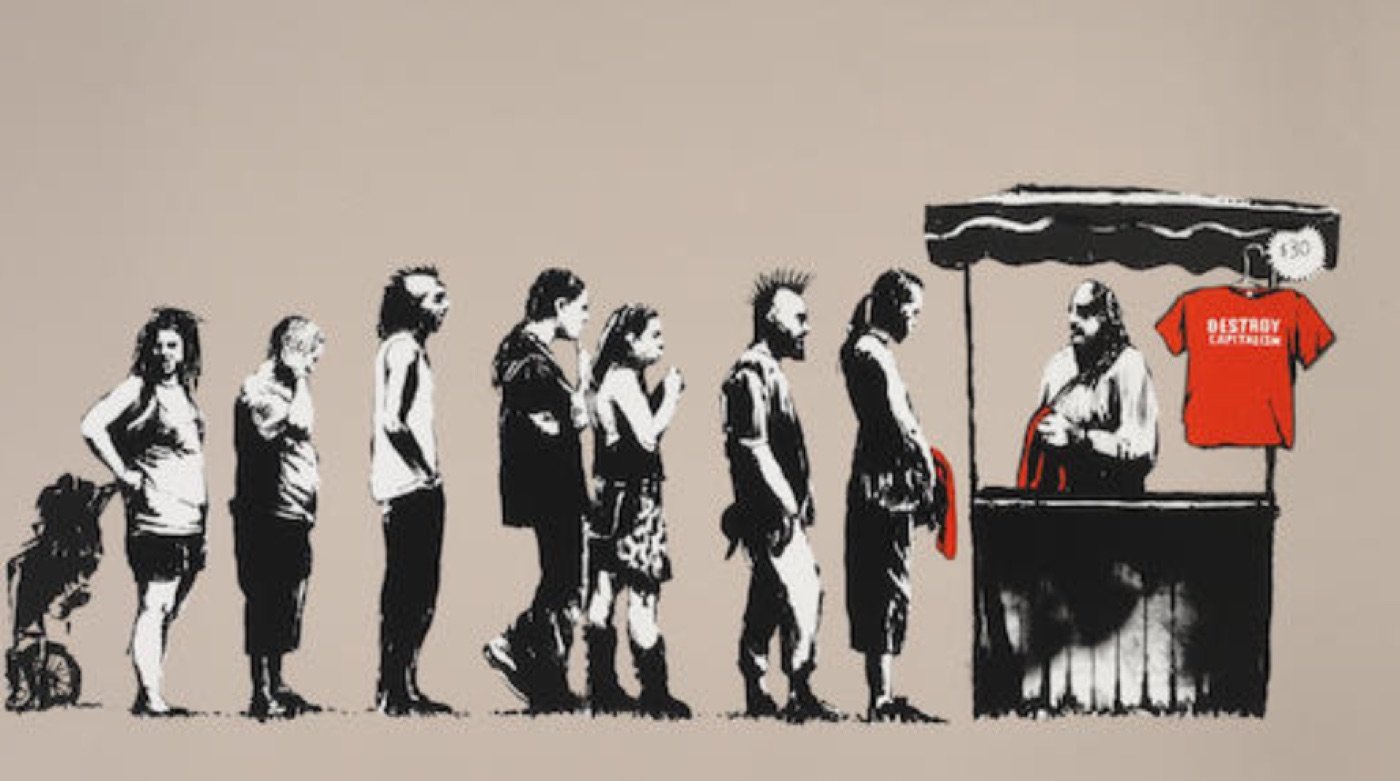
The irony is immediate, but not simplistic. The figures are not mocked: they are absorbed. The act of waiting, purchasing, participating, unfolds without resistance. Banksy constructs a closed loop. Those who position themselves outside the system, who define themselves through opposition, are here shown fully engaged within it. The slogan itself becomes merchandise, stripped of urgency and repackaged as identity.
The critique is not directed solely at capitalism, but at its extraordinary capacity to integrate dissent. Even rebellion, once visible, becomes something that can be priced, produced, and sold. The line does not break. Executed in Banksy's characteristic stencil style, the work relies on strong contrasts and minimal color. The monochrome figures emphasize uniformity despite their apparent individuality, while the red of the t-shirt isolates the message: both visually and conceptually. The composition is linear, almost mechanical. The queue itself becomes a structure, reinforcing the idea of order within supposed disorder.
When Irony Becomes Reality
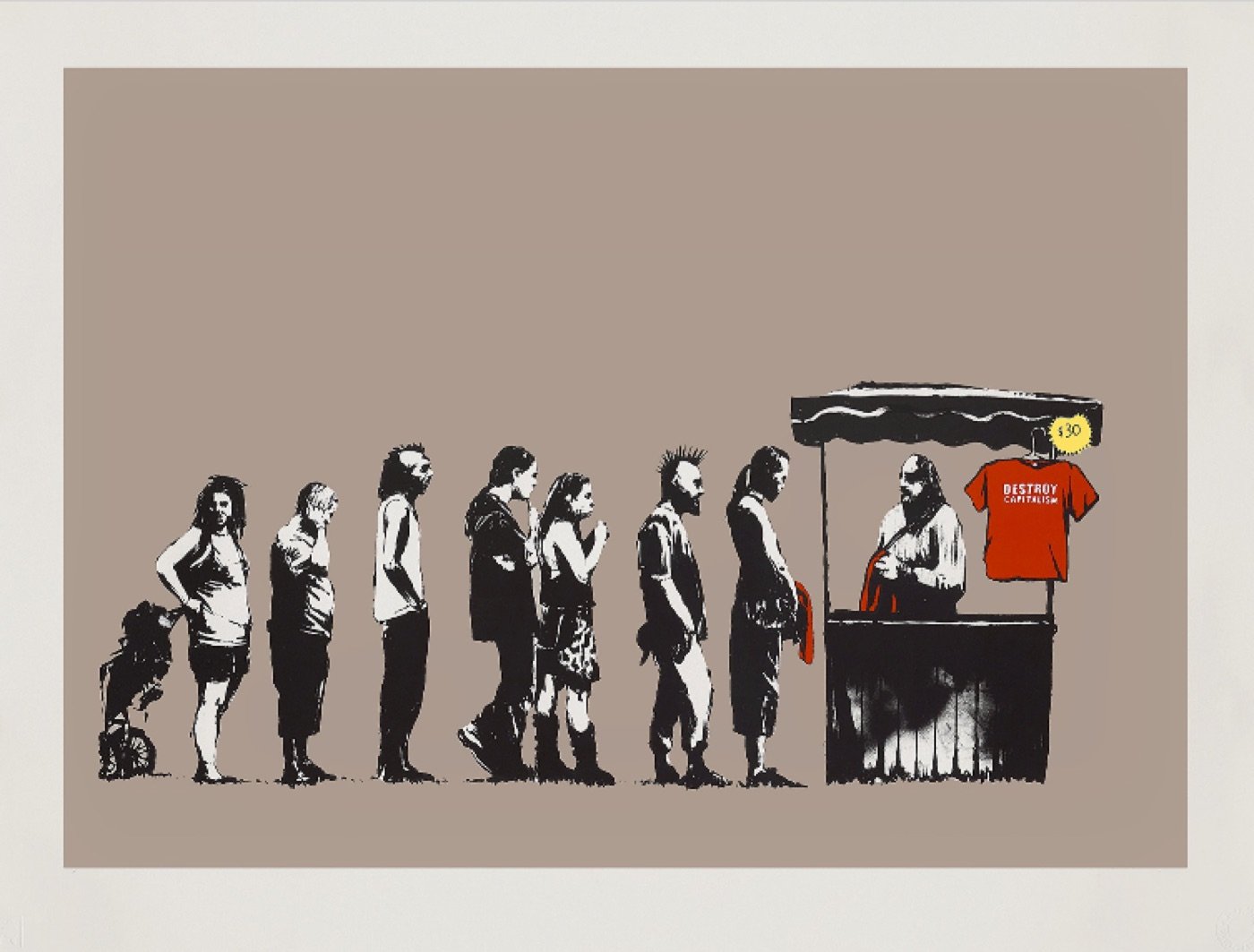
The work's meaning took on an unexpected extension in 2013, when Walmart, arguably one of the most visible embodiments of global capitalism, sold versions of Festival through its online marketplace, without authorization.
The gesture was almost too perfect. What Banksy had constructed as critique was absorbed in real time, not symbolically but literally. The system did not resist the message: it sold it. Festival is not simply a satire of hypocrisy. It is a more unsettling observation: that systems of power do not always need to suppress opposition. They can incorporate it.
Identity, resistance, and dissent become styles: choices within a broader framework that remains unchanged. The figures in the queue are not defeated. They are integrated. Among Banksy's prints, Festival stands out for its clarity and precision. There is no excess, no distraction—only a concept executed with exact control.
Barely Legal
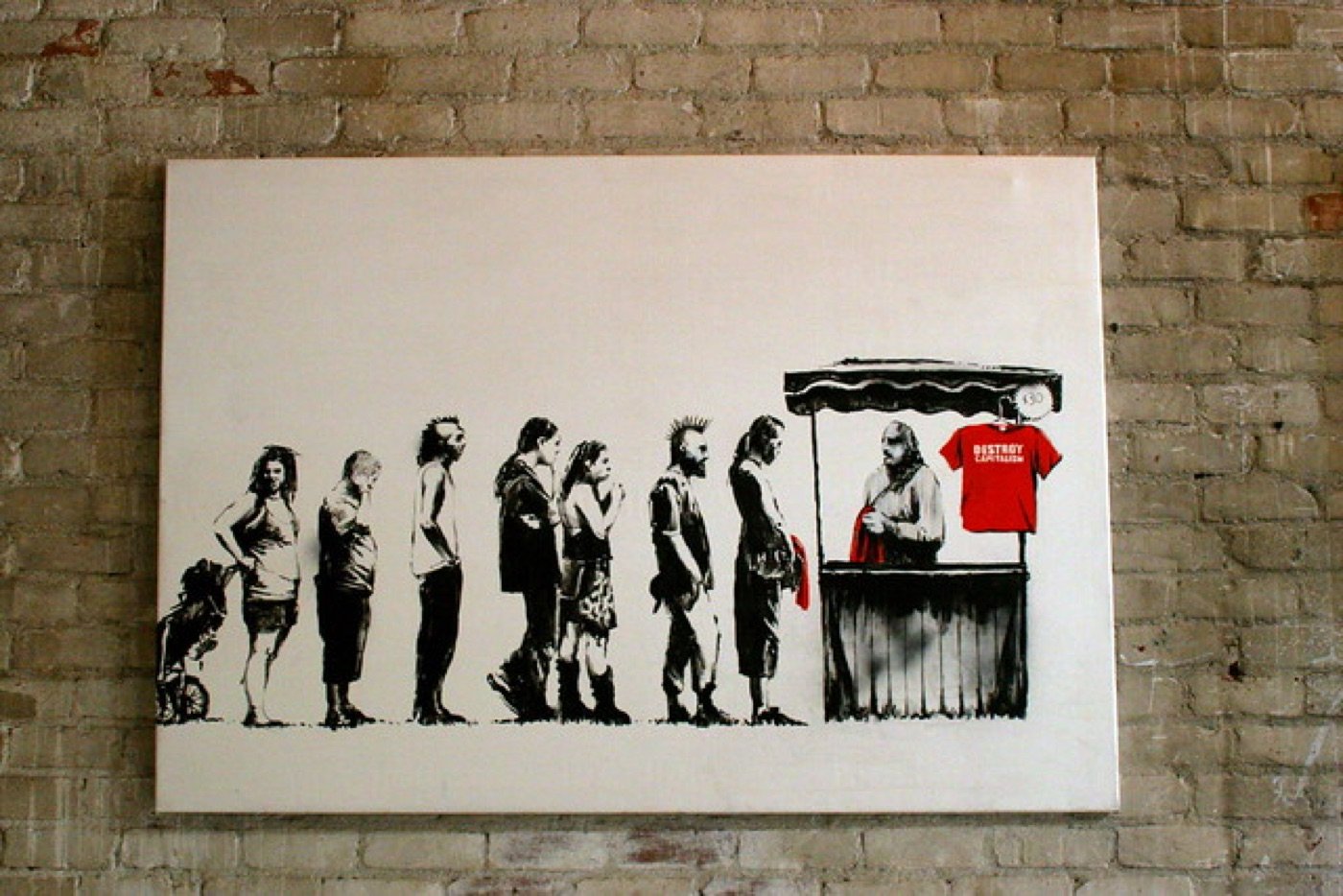
Festival is inseparable from Barely Legal, Banksy's landmark 2006 exhibition in Los Angeles: a moment where the artist stepped into the institutional and commercial art world without relinquishing his outsider position. Set within a raw industrial space, the exhibition blended spectacle and critique. A live-painted elephant, installations referencing poverty and excess, and a sharp focus on American consumer culture defined the show. It was theatrical, confrontational, and carefully controlled.
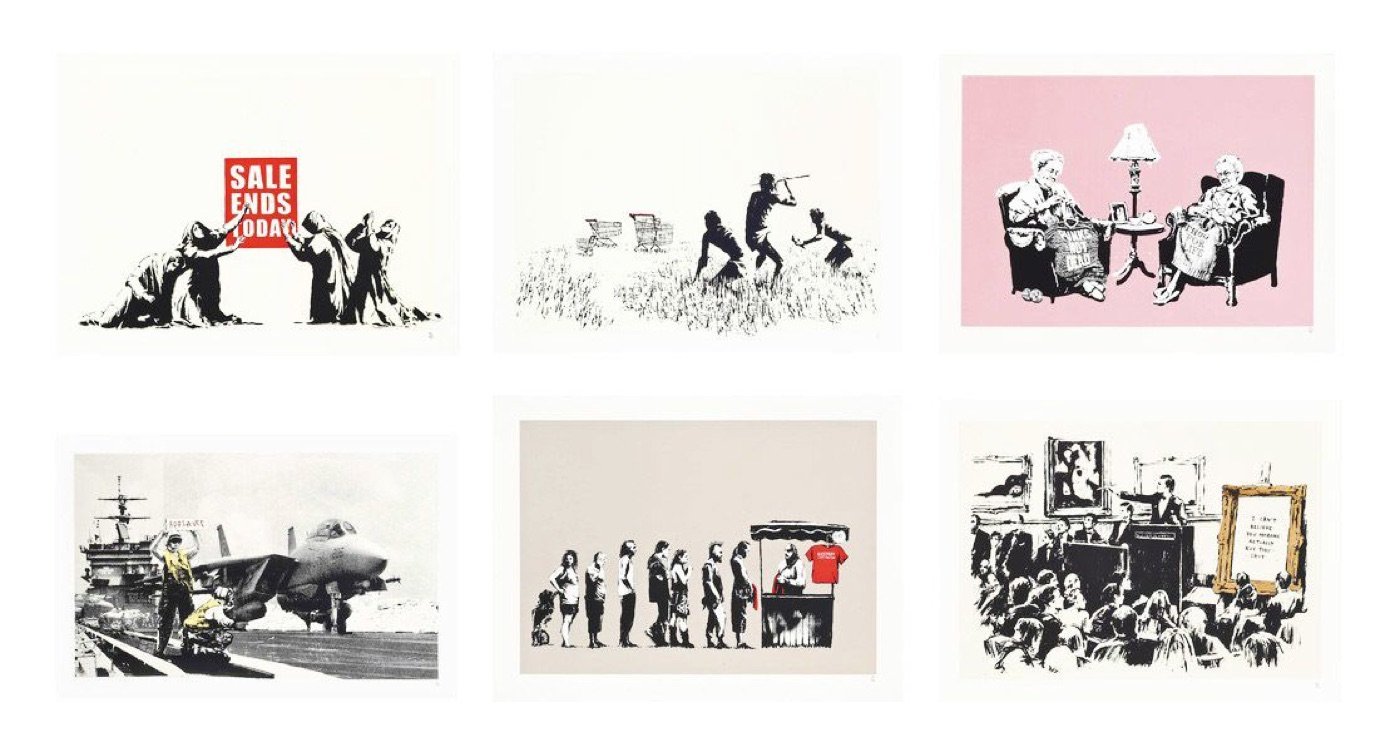
Variations
STAY INFORMED
Receive the latest news, exhibitions, artworks and market updates on Banksy.