BANKSY
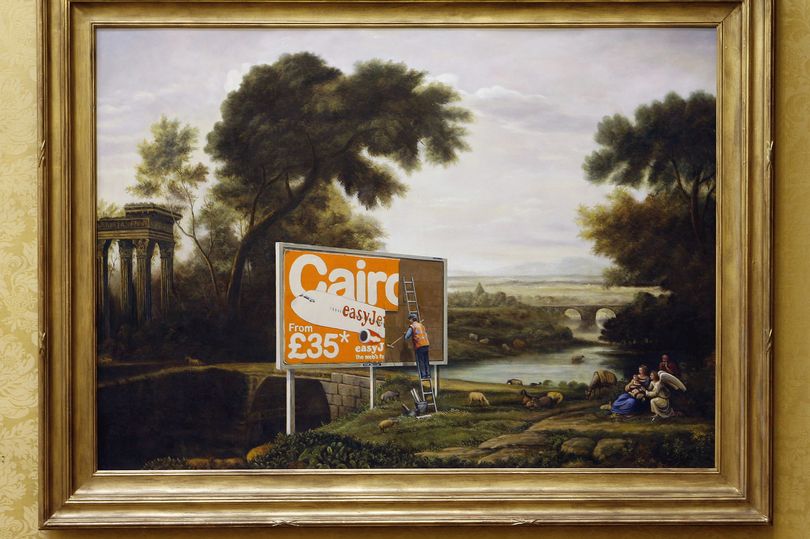
Flight To Egypt, 2009
Vandalized oil on canvas
173×125 cm
Exhibited
Banksy vs. Bristol Museum, Bristol Museum, Bristol, 2009
Catalogue Note
Few artists have demonstrated Banksy’s ability to insert contemporary society into the visual language of classical painting as seamlessly as Flight to Egypt. Based on Nicolas Poussin’s celebrated seventeenth-century depiction of the Holy Family fleeing to Egypt, Banksy interrupts the tranquil biblical landscape with a large EasyJet advertising billboard being installed by a workman. The intervention is characteristically minimal, yet its consequences are profound. A timeless scene of exile, faith, and divine protection suddenly collides with the language of low-cost tourism and commercial branding.
The contrast is immediately striking. Poussin’s original composition invites contemplation, presenting nature as a harmonious refuge for one of Christianity’s most significant narratives. Banksy introduces a contemporary intrusion that dominates the foreground, partially obscuring both the landscape and the sacred story unfolding behind it. The billboard becomes a literal barrier between the viewer and history, suggesting that commercial imagery increasingly occupies the visual space once reserved for culture, religion, and collective memory.
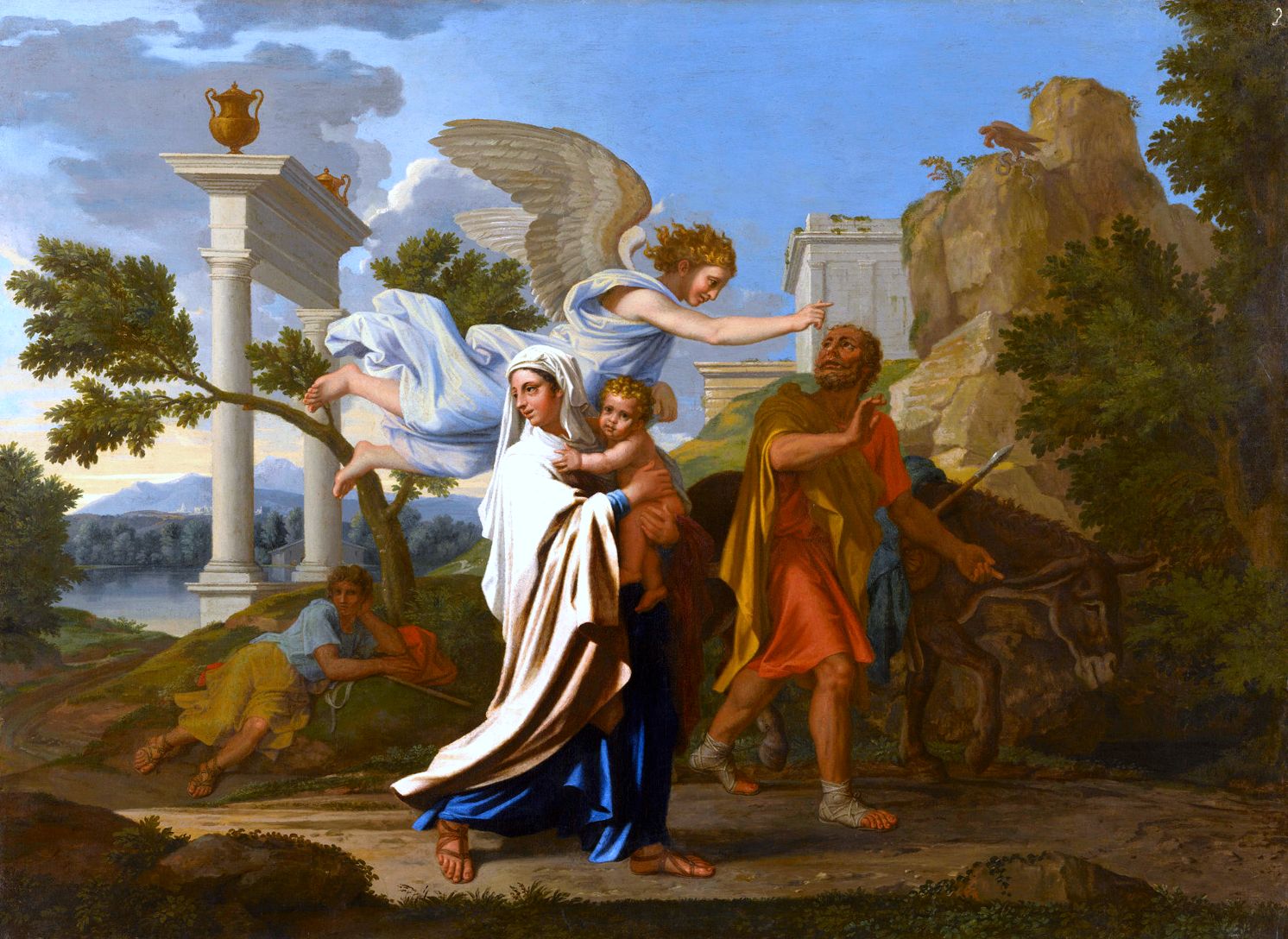
Fight Into Egypte by Nicolas Poussin – Œuvre appartenant au musée des Beaux-Arts de Lyon
As with many of the works from the Crude Oils series, Banksy demonstrates remarkable restraint. Rather than repainting the entire composition, he inserts a single object whose visual language feels entirely alien to the surrounding canvas. The crisp typography, vivid orange branding, and industrial steel supports clash violently with Poussin’s muted palette and classical serenity. The collision between these two worlds generates the work’s enduring tension. The billboard does not simply exist within the landscape; it overwhelms it.
Yet the choice of advertisement is particularly significant. The biblical Flight into Egypt tells the story of refugees escaping persecution, forced to leave their homeland to protect the infant Jesus from King Herod’s massacre of the innocents. Banksy replaces this desperate journey with the promise of effortless leisure travel. The slogan advertising inexpensive flights transforms an act of survival into a consumer choice, exposing the vast distance between voluntary tourism and forced migration. In doing so, the painting quietly asks whether contemporary society has become so accustomed to advertising that it risks trivializing even the most profound human experiences.
The work also reflects Banksy’s long-standing interest in the colonization of public space by commercial imagery. Throughout his career, he has repeatedly challenged the omnipresence of advertising, arguing that corporations occupy our visual environment without invitation. Here, the billboard literally colonizes a masterpiece of European painting, just as modern advertising increasingly colonizes our cities, landscapes, and everyday lives. The intervention becomes a visual metaphor for a culture in which commercial messages compete with—and often eclipse—history, spirituality, and art itself.
Created for the landmark exhibition Banksy vs. Bristol Museum in 2009, Flight to Egypt belongs to the artist’s mature series of altered oil paintings, in which historical masterpieces are subtly transformed through contemporary interventions. Unlike works that rely primarily on humor, this painting achieves its effect through quiet dissonance. Nothing is destroyed, yet everything has changed. A single billboard is sufficient to rewrite the emotional and symbolic meaning of an entire landscape.
Within Banksy’s oeuvre, Flight to Egypt stands alongside works such as Subject to Availability, Hanging Klansman, Home Sweet Home, and Devolved Parliament, all of which explore the uneasy coexistence of historical tradition and modern ideology. It demonstrates Banksy’s extraordinary ability to engage with the history of art while remaining unmistakably contemporary, revealing how the language of commerce has become one of the defining visual forces of the twenty-first century.