BANKSY
Flower Power, 1998
Easton, Bristol, 1998
Catalogue Note
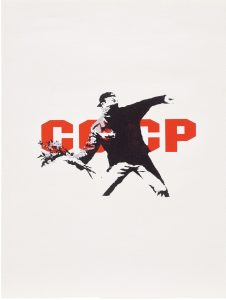
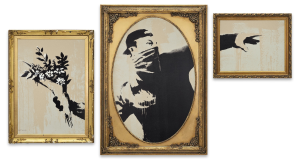
Painted in 1998, Flower Power is one of Banksy’s earliest large-scale canvases and introduces a theme that would become one of the defining threads running throughout his career: the confrontation between violence and peace. Years before Love Is In The Air (Flower Thrower) became one of the most recognizable images in contemporary art, Banksy was already exploring the revolutionary potential of flowers.
The composition depicts a violent street riot unfolding in the heart of a modern city. Masked protesters prepare to hurl bouquets rather than bricks or Molotov cocktails, while the ground itself is carpeted with brightly coloured flowers. Banksy transforms what should be an image of urban unrest into something unexpectedly lyrical, replacing the visual language of destruction with one of beauty and renewal.
The work deliberately recalls the countercultural ideals of the 1960s, particularly the anti-war slogan “Flower Power,” coined during protests against the Vietnam War. Yet Banksy avoids nostalgia. His protesters remain anonymous, masked and confrontational, suggesting that resistance itself has not disappeared—it has merely changed its weapons. Flowers become acts of defiance rather than symbols of surrender, proposing that compassion can possess a force every bit as disruptive as violence.
Already, Banksy demonstrates his remarkable ability to build complex political commentary from simple visual substitutions. Throughout his oeuvre, he repeatedly replaces instruments of conflict with objects of innocence: bouquets instead of bombs, balloons instead of flags, children instead of soldiers. Flower Power marks one of the earliest manifestations of this strategy and can be seen as a direct precursor to Love Is In The Air, where the single act of throwing flowers would become one of the defining images of twenty-first-century art.
Executed before Banksy had fully adopted the stark monochrome stencil aesthetic for which he later became famous, the painting combines expressive brushwork with carefully placed bursts of colour. The floral explosions punctuating the otherwise muted cityscape draw the viewer’s eye, suggesting that hope, however fragile, remains impossible to suppress. Even in the midst of conflict, beauty refuses to surrender.