Forgive us our trespassing
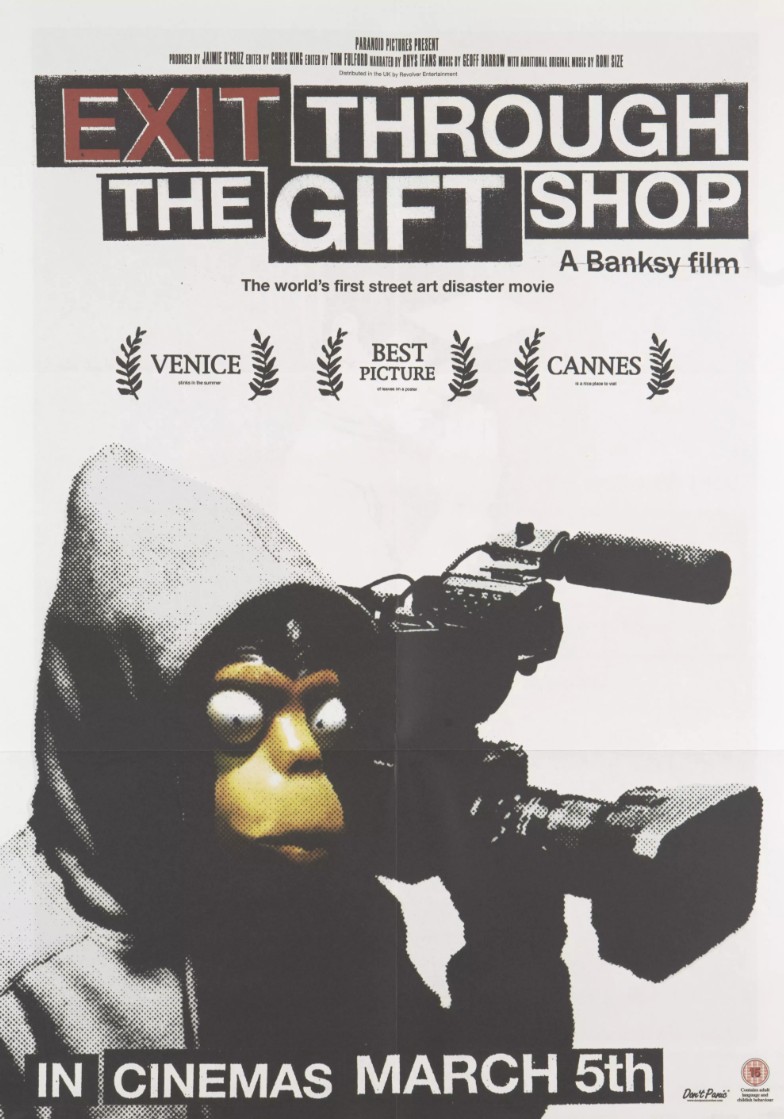
Two-sided promotional poster for the 2010 documentary Exit Through The Gift Shop
Year: 2010
Medium: Offset lithographic poster
Sheet: 59.5 x 42 cm
Edition: Unknown
Publisher: Don’t Panic
Description
Among Banksy’s most desirable promotional posters, Forgive Us Our Trespassing occupies a singular position. Produced in 2010 as a double-sided promotional poster for the release of Exit Through the Gift Shop, Banksy’s Academy Award-nominated documentary, it combines one of his most poignant religious images with the advertising campaign for the film that permanently transformed the public perception of street art. More than simple cinema memorabilia, the poster documents the precise moment Banksy evolved from an anonymous graffiti artist known within urban culture into an international cultural phenomenon whose work entered museums, auction houses and mainstream consciousness.
Unlike conventional movie posters, every element of this object reflects Banksy’s characteristic refusal to separate art from promotion. Even advertising becomes another canvas upon which he continues his artistic practice, blurring the distinction between collectible, artwork and marketing.
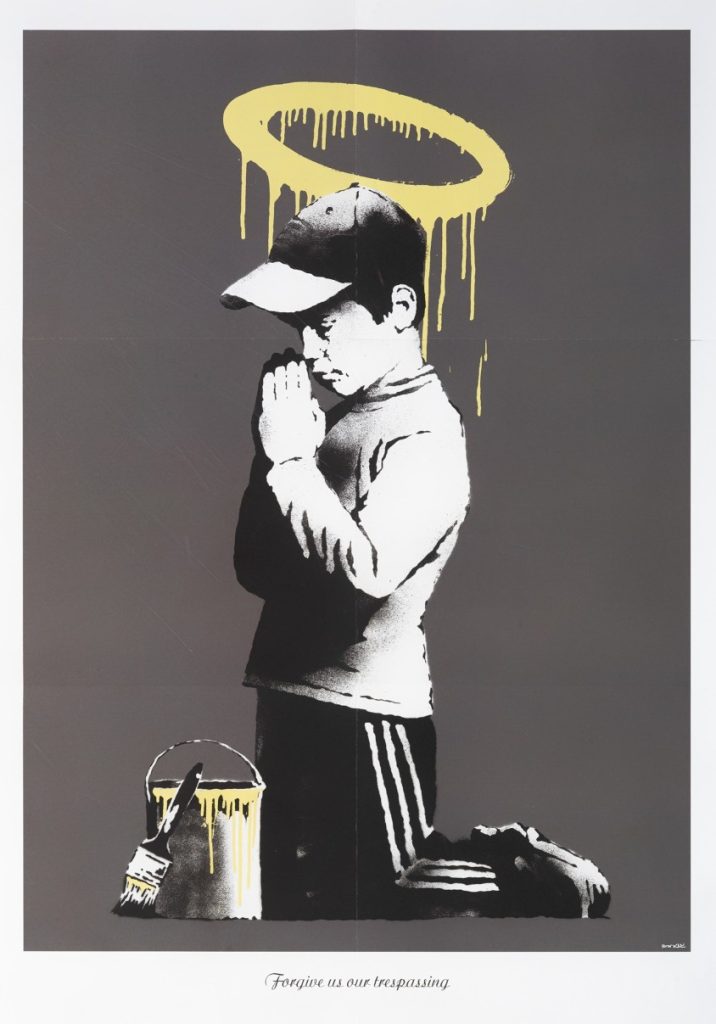
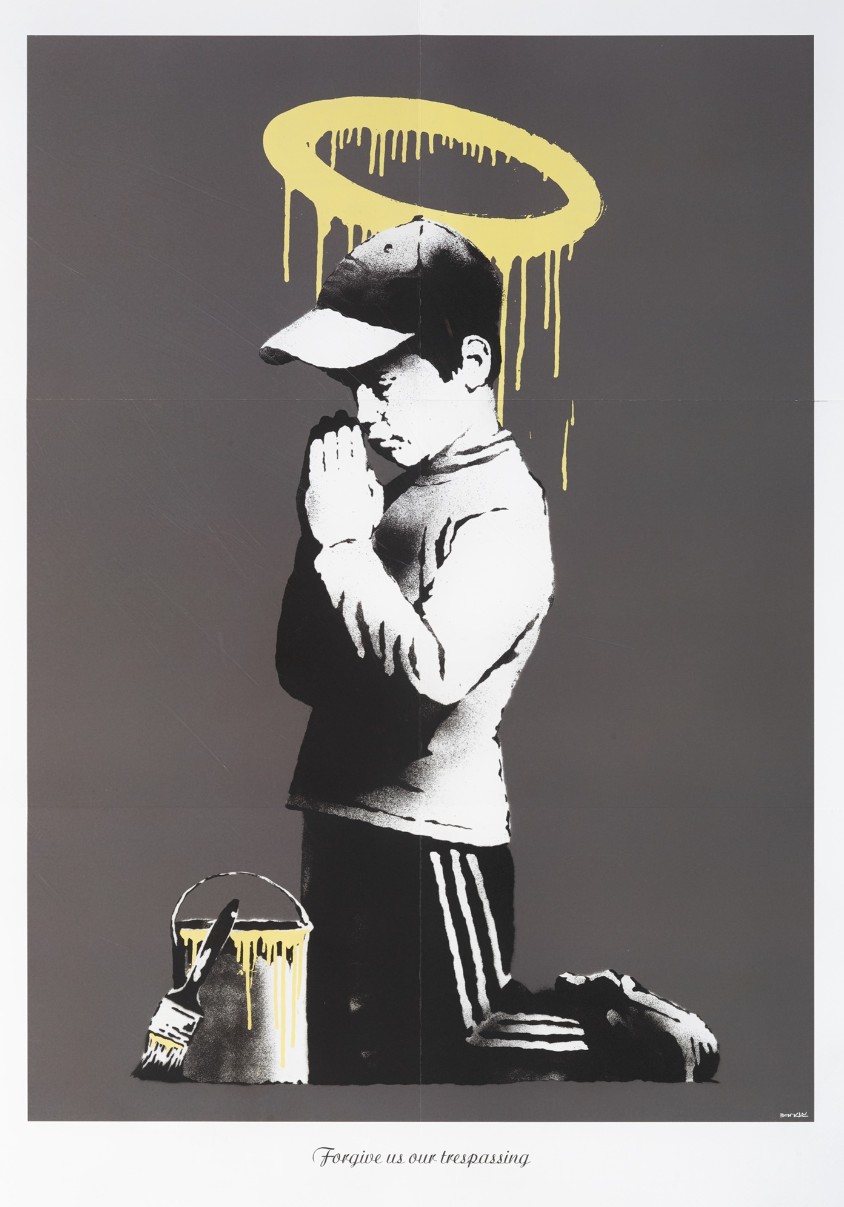
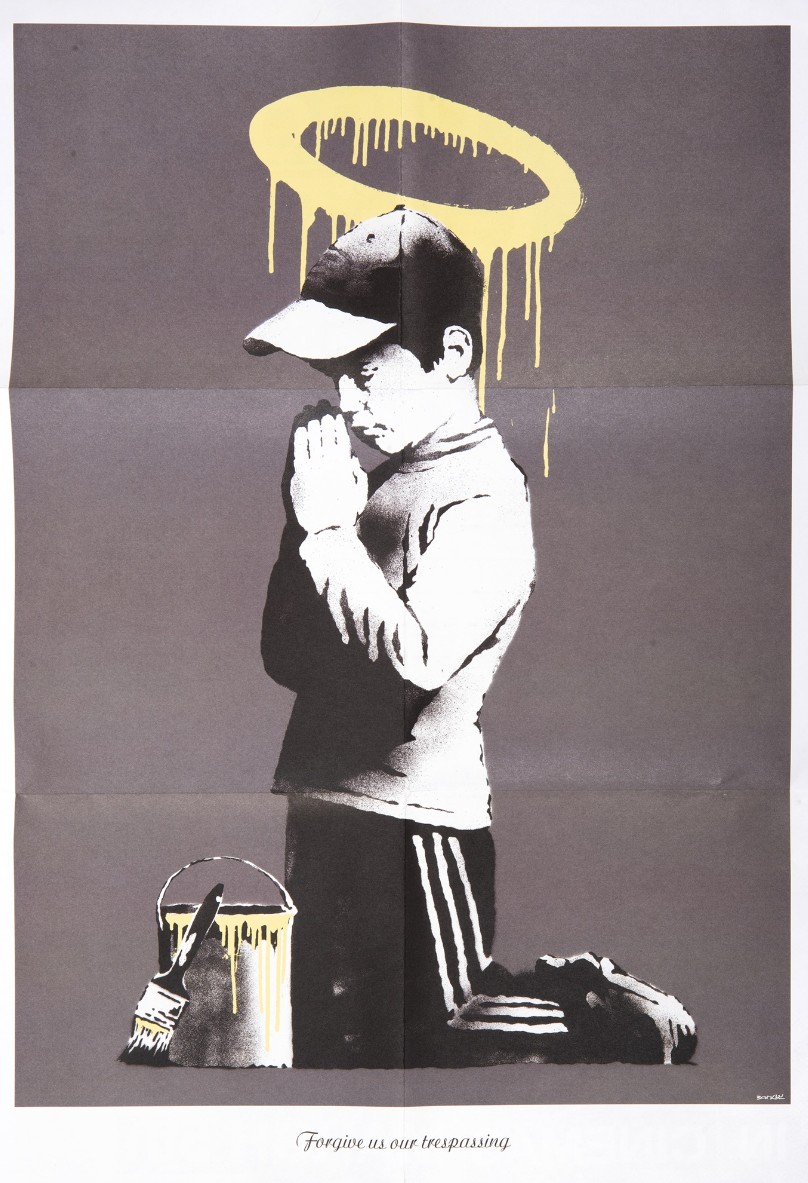
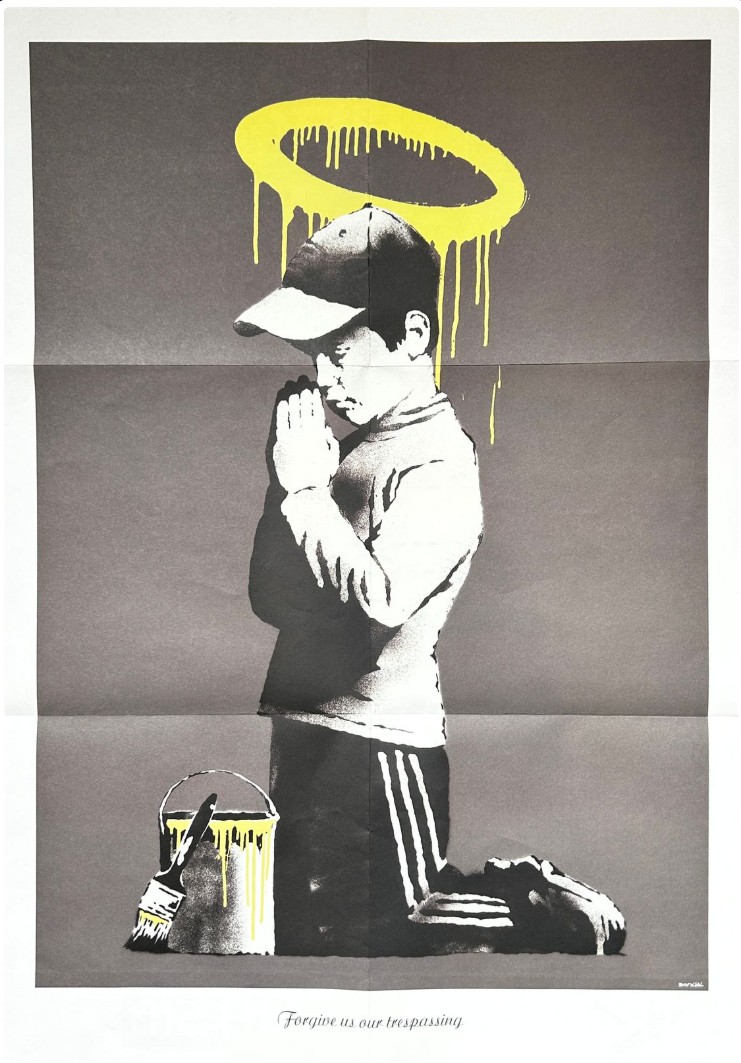
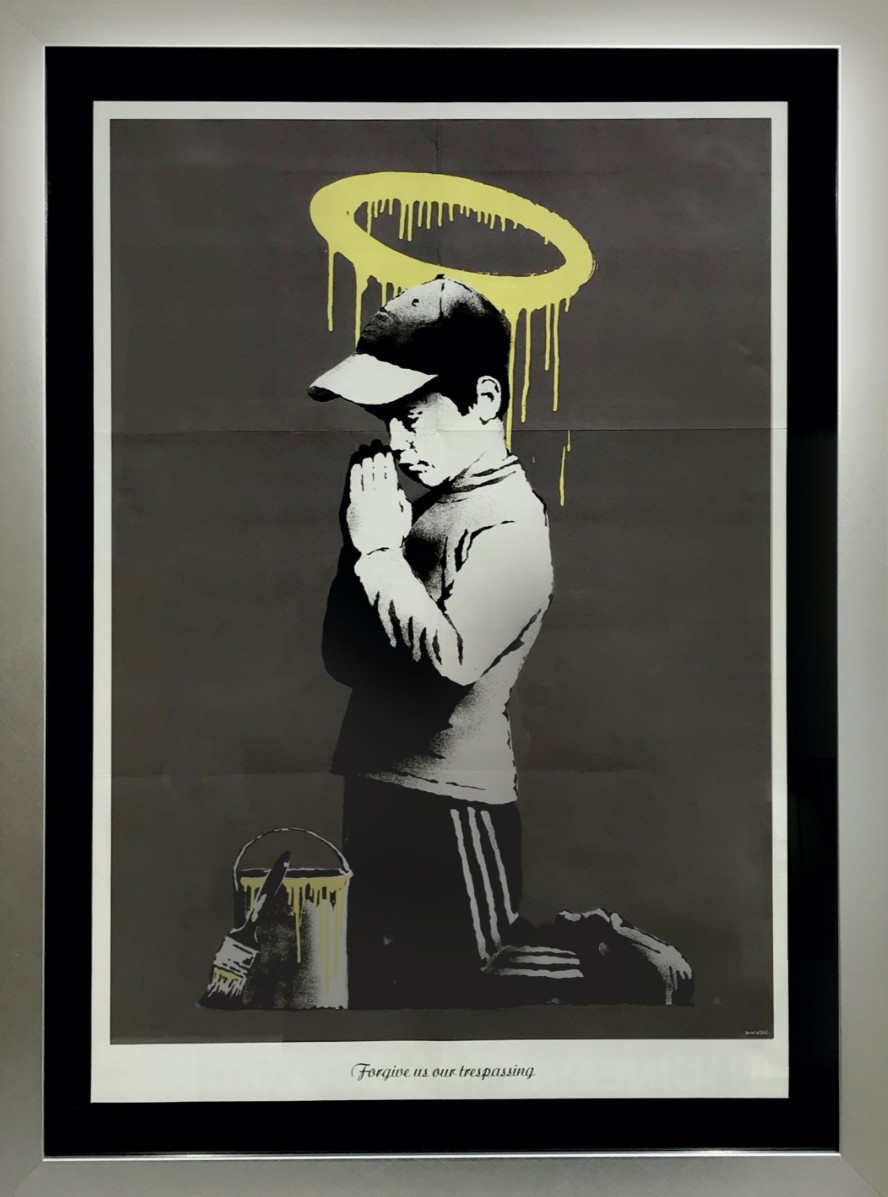
Printed as a two-sided offset lithographic poster, the recto reproduces Forgive Us Our Trespassing, one of Banksy’s most moving and contemplative images. A young boy kneels in prayer, dressed in everyday street clothing, his hands clasped before him while a dripping golden halo hovers above his head. Beside him rests a bucket of yellow paint and a brush—the humble tools responsible for creating his sanctity.
Below the composition appears the handwritten inscription “Forgive us our trespassing,” a subtle but significant alteration of the Christian prayer, replacing trespasses with trespassing. The change is almost imperceptible at first glance, yet fundamentally transforms the meaning of the phrase.
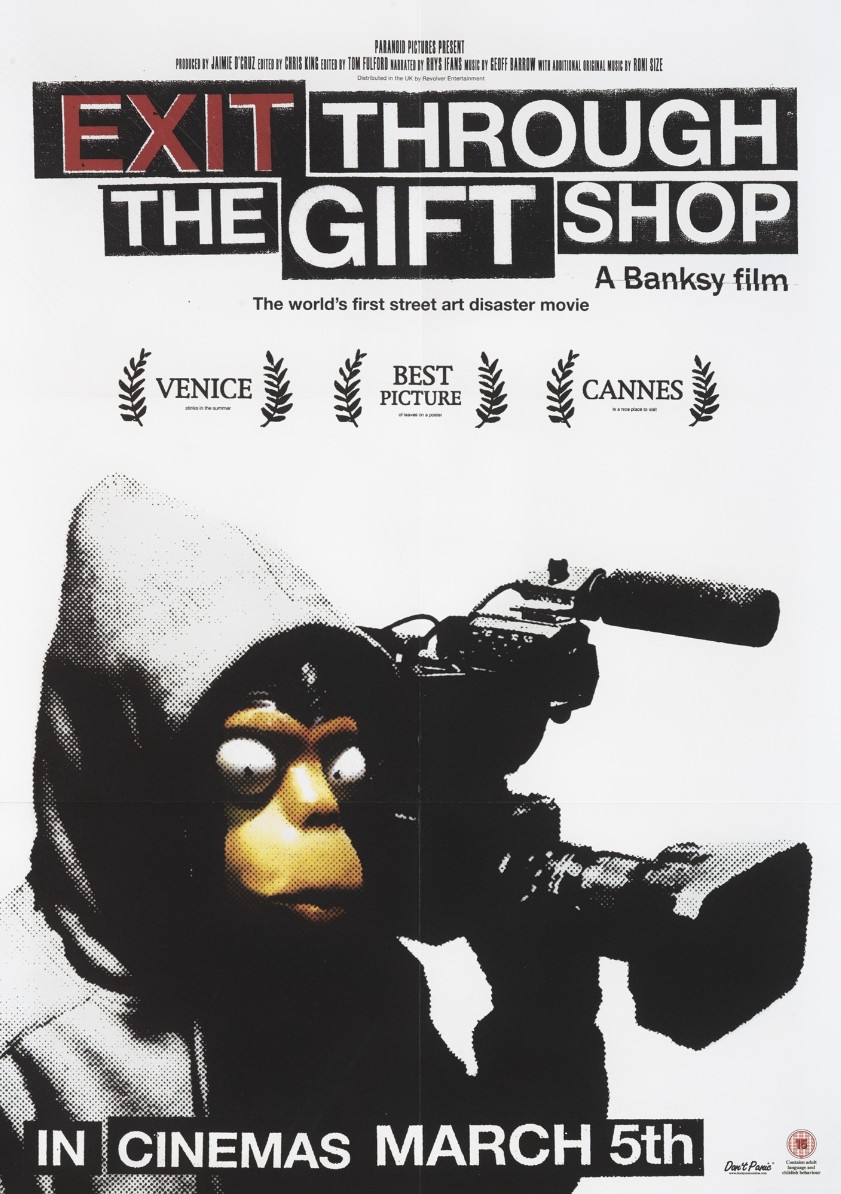
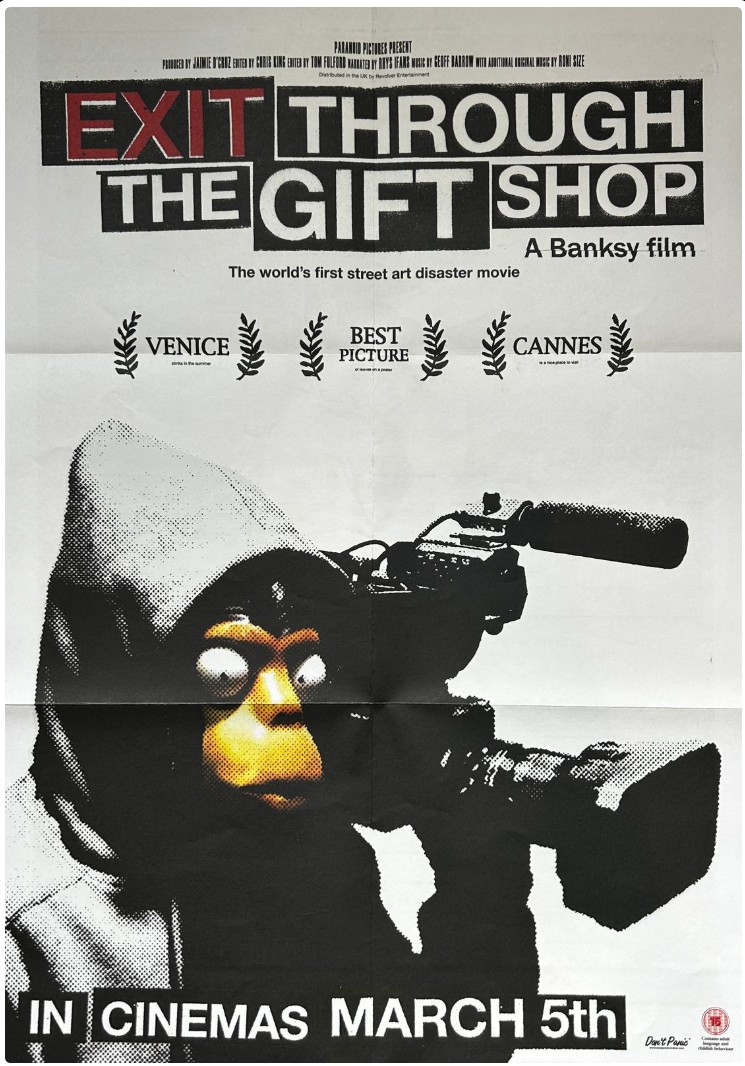
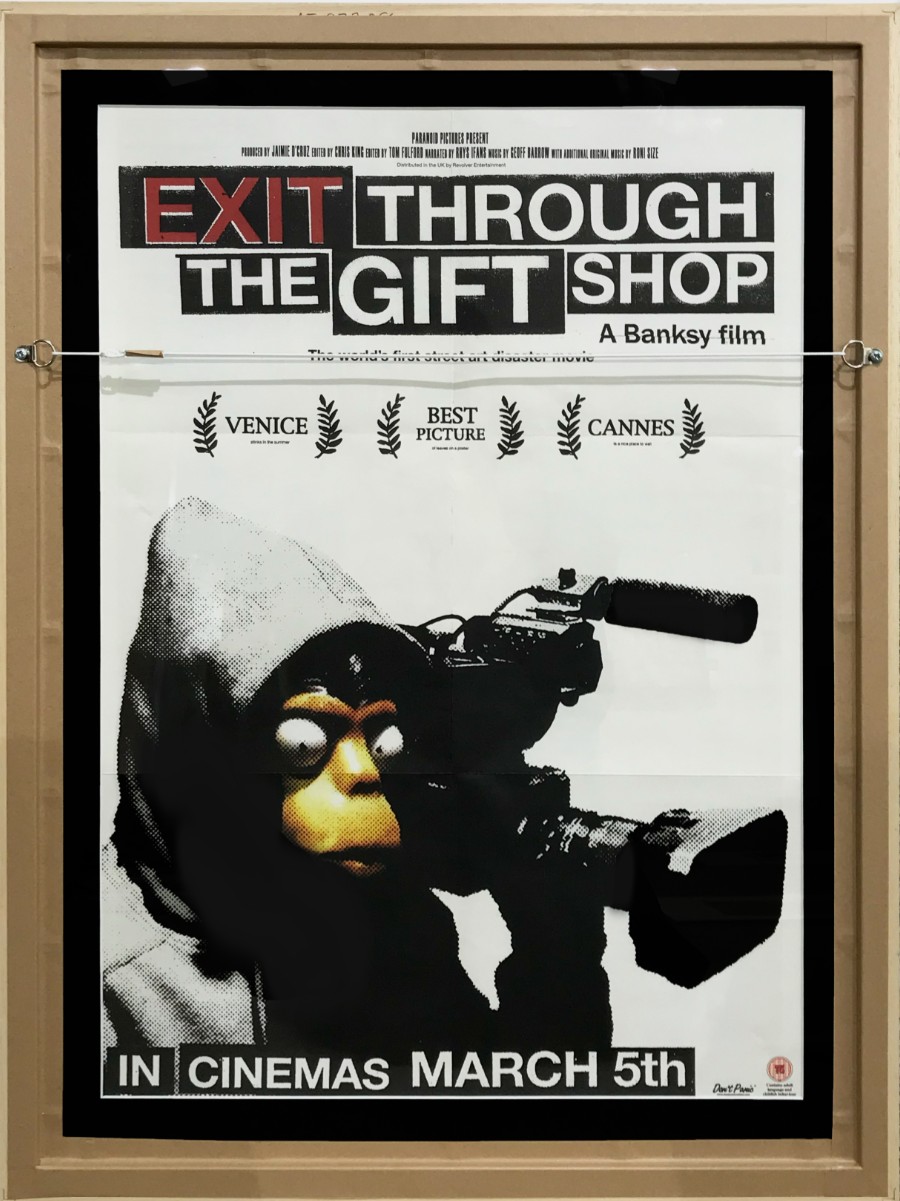
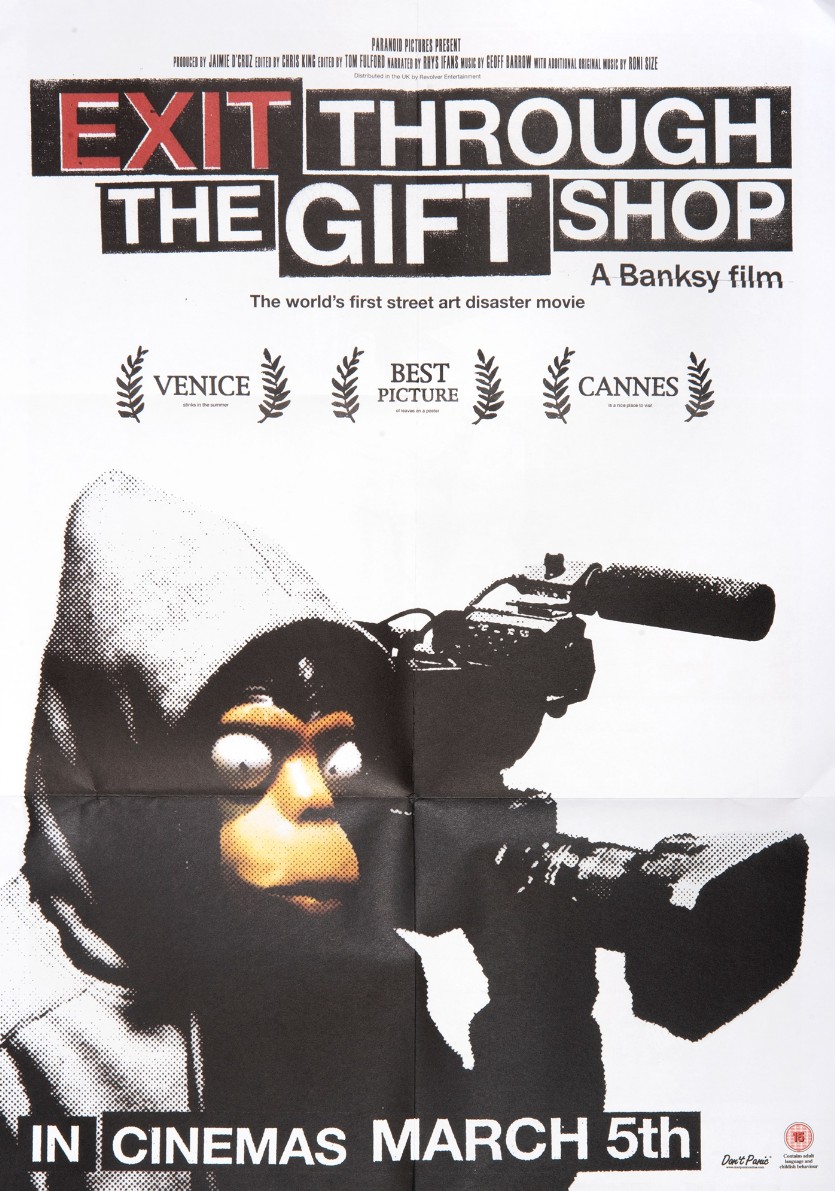
The reverse serves as the official promotional poster for Exit Through the Gift Shop, featuring Banksy’s famous image of a hooded monkey operating a professional video camera beneath the bold film title. Rather than using conventional Hollywood marketing imagery, Banksy once again employs one of his own iconic stencils to advertise the documentary, accompanied by the memorable subtitle: “The world’s first street art disaster movie.”
Context and Symbolism
Few works encapsulate Banksy’s own relationship with graffiti as eloquently as Forgive Us Our Trespassing. Throughout his career, Banksy has occupied a curious moral position. While openly admitting that graffiti involves illegal entry, unauthorized painting and damage to property, he has consistently argued that these actions can produce beauty, provoke dialogue and reclaim neglected public spaces.
The altered prayer becomes an extraordinary piece of linguistic precision. Rather than asking forgiveness for abstract moral failings, the boy prays specifically for trespassing: the very act upon which street art depends. The image acknowledges illegality without apology yet simultaneously reframes artistic intervention as something approaching a sacred vocation.
Banksy deliberately surrounds this apparent contradiction with religious iconography. The kneeling child evokes classical devotional painting, while the luminous halo traditionally reserved for saints drips like fresh spray paint. Holiness itself appears freshly applied, as though sanctity were another stencil executed upon the urban landscape.
The paint bucket reinforces this inversion. Instead of representing vandalism, it becomes an instrument of redemption. Creation, not destruction, is presented as the artist’s true purpose.
This duality has characterized Banksy’s work since the beginning of his career. He repeatedly asks viewers whether legality alone determines morality, or whether beauty, compassion and social commentary possess a legitimacy capable of transcending the law itself.
The Original Mural
Forgive Us Our Trespassing first appeared in Salt Lake City, Utah, in 2010, during Banksy’s celebrated American tour that also gave rise to many of his most iconic U.S. murals. Executed as a monumental stencil on the side of a building, the composition immediately stood apart from Banksy’s more overtly satirical works. Rather than targeting politicians, consumerism or state authority, it presented an unusually contemplative scene centred on innocence, faith and redemption.
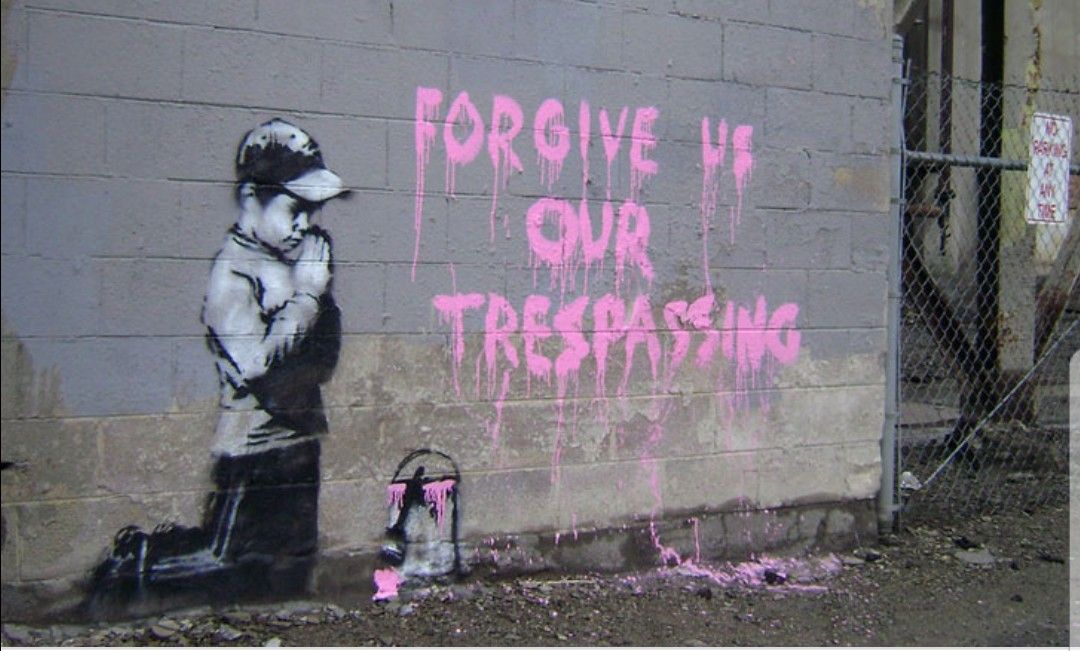
Forgive Us Our Trespassing, Salt Lake City, Utah
The mural acquired an even greater dimension when Banksy enlisted more than one hundred local volunteers—many of them young people—to help paint the immense golden halo above the kneeling child. This collaborative gesture transformed the work into a genuine community project, blurring the traditional distinction between artist and audience. It also echoed one of the central ideas behind street art itself: that public art belongs to the public.
The original mural quickly became one of Banksy’s best-known American interventions and has since been recognized as one of the defining images from his 2010 U.S. campaign. Unlike many of his murals, whose impact depends largely on irony or visual shock, Forgive Us Our Trespassing derives its emotional power from quiet introspection. It demonstrates Banksy’s remarkable ability to combine religious iconography, social commentary and urban culture into an image that is both immediately accessible and profoundly symbolic.
A Manifesto for Street Art
Few Banksy images function so clearly as an artistic manifesto.
Throughout history, religious institutions have commissioned paintings to communicate spiritual ideas to the public. Banksy suggests that contemporary cities have become the new cathedrals, their concrete walls replacing stained glass as surfaces upon which society’s moral conversations are conducted.
The praying child becomes a surrogate for every anonymous graffiti writer who has ever climbed a wall at night armed with nothing more than paint and conviction. Banksy neither glorifies nor condemns the act. Instead, he asks whether creativity itself deserves understanding before judgement.
It is an unusually introspective work for an artist better known for biting satire. Rather than mocking politicians, corporations or institutions, Banksy momentarily turns the question upon himself. If graffiti constitutes trespassing, can artistic intention justify civil disobedience? The poster never answers the question directly, preferring instead to leave viewers suspended between legality and legitimacy.
Exit Through the Gift Shop: A Turning Point
The reverse of the poster is equally significant.
Released in 2010, Exit Through the Gift Shop remains one of the most influential documentaries ever produced about contemporary art. Ostensibly following French amateur filmmaker Thierry Guetta—later transformed into the spectacularly successful Mr. Brainwash. The film gradually becomes an exploration of authorship, celebrity, authenticity and the mechanisms through which the art market manufactures value.
Whether documentary, satire or elaborate performance piece, the film fundamentally altered the public understanding of street art. Overnight, artists previously known mainly within urban subcultures entered museums, auction houses and popular culture. Banksy himself became one of the most recognizable yet simultaneously invisible artists in the world.
The poster therefore commemorates one of the defining moments in Banksy’s career. It captures the instant at which the artist began interrogating not only public space but also the commercial structures surrounding contemporary art itself—a critique that would later culminate in projects such as Dismaland, Gross Domestic Product, The Walled Off Hotel, and ultimately Love is in the Bin.
Production and Collectability
Unlike Banksy’s numbered editions, this poster was produced as promotional material rather than as a fine art print. Yet its importance has steadily increased precisely because it documents one of the artist’s most historically significant projects.
Collectors particularly value examples retaining both pristine images, as the object was designed to function on either side. The unknown edition size, combined with its close association with Exit Through the Gift Shop, has contributed to growing interest among collectors seeking material directly connected to Banksy’s exhibitions, films and cultural interventions rather than his traditional print editions. Its dual identity, as both artwork and film poster, places it within a distinctive category of official Banksy collectibles that continues to receive increasing scholarly and market attention.
Few promotional posters transcend their original purpose. Forgive Us Our Trespassing achieves precisely that by becoming an artwork in its own right.
On one side stands one of Banksy’s most philosophical images, transforming the humble act of graffiti into an almost spiritual meditation on creation, forgiveness and artistic freedom. On the other lies the promotional campaign for the film that irrevocably changed the history of street art and redefined Banksy’s place within contemporary culture.
Together they form a remarkably coherent object. One side asks whether art can justify trespassing; the other explores what happens when that same art enters the global marketplace. Between them lies the central paradox that has defined Banksy’s entire career: an anonymous graffiti writer whose greatest acts of rebellion ultimately transformed the very institutions he set out to challenge. For that reason, this double-sided poster is far more than cinema ephemera—it is one of the most intellectually compelling and historically significant collectibles ever officially associated with the artist.
Selected Auction Results
WORK IN PROGRESS
International Art Center: 28 April 2026
Estimated: NZD 2,000 – 5,000
NZD 2,500 / USD 1,475
BANKSY (British b. 1974)
Forgive Us Our Trespassing
Offset lithographic poster and original envelope
Limited edition
XXXXXXXXXX
Roseberys London: 7 March 2023
Estimated: GBP 300 – 400
GBP 1,300 / USD 1,540
BANKSY (British b.1974- )
Forgive us our trespassing, 2010
Offset lithographic poster
Published by Don’t Panic
XXXXXXXXXX
Tate Ward Auctions: 22 May 2022
Estimated: GBP 200 – 400
GBP 688 / USD 870
BANKSY (British 1974-)
‘Forgive Us Our Trespassing’, 2010
Offset lithograph in colors
Two-sided promotional poster for the 2010 documentary Exit Through The Gift Shop
XXXXXXXXXX
International Art Center: 1 December 2021
Estimated: NZD 3,000 – 5,000
NZD 11,000 (Hammer)
NZD 13,340 / USD 9,125
AUCTION RECORD FOR FORGIVE US OUR TRESPASSING
BANKSY (British b. 1974)
Forgive Us Our Trespassing, 2010
Framed double sided offset lithograph
Signed in plate
XXXXXXXXXX
Tate Ward Auctions: 24 November 2020
Estimated: GBP 300 – 500
GBP 2,000 / USD 2,645
BANKSY (British 1974-)
‘Forgive Us Our Trespassing’, 2010
Offset lithograph in colors
Two sided promotional poster for the 2010 documentary Exit Through The Gift Shop