FUCK THE POLICE, 2000

Provenance
- Private Collection, New York (acquired directly from the artist)
- Christie’s, New York, 14 May 2008, lot 464
- Private Collection, New York
- Sotheby’s, London, 11 February 2015, lot 363
- Private Collection
- Sotheby’s, Hong Kong, Private Sales
- Private Collection (acquired from the above)
- Bonhams, London, 3 October 2019, lot 29
- Private Collection, Los Angeles
- Andipa Gallery, London
- Acquired from the above by the present owner
Auction History
Prices are inclusive of buyer’s premium unless stated otherwise, as reported by the auction houses.
Catalogue Note
Set against a stark white background, a tense police officer has drawn his baton. He looks beyond confines of the board, but it is instantly apparent what, or better who, he is looking for. “Fuck the police” is written in crude red letters on the wall behind him. The officer is too late, the message is clear, and the culprit seems to have escaped, leaving his mocking anti-authoritarian slogan for everyone to see.
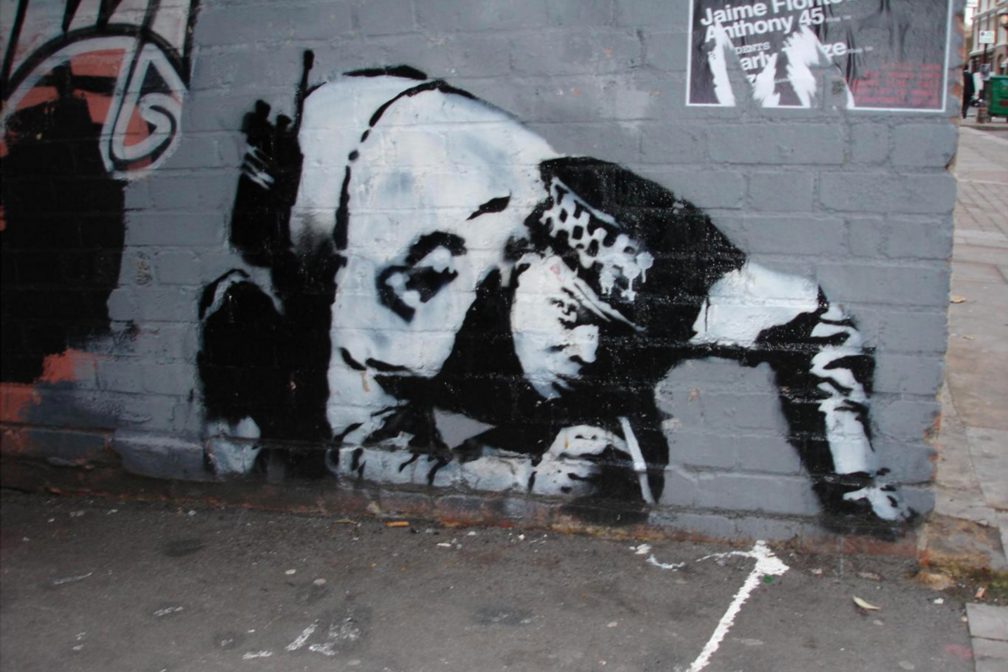
Untitled (Fuck the Police) from 2000 is a striking, early example of what was to become one of Banksy’s most iconic motifs. Banksy’s relationship with law enforcement is understandably difficult and the theme spreads throughout his career, most famously in 2005 with The Kissing Coppers on the wall of the Prince Albert Pub in Brighton and the Snorting Copper in London’s East End.
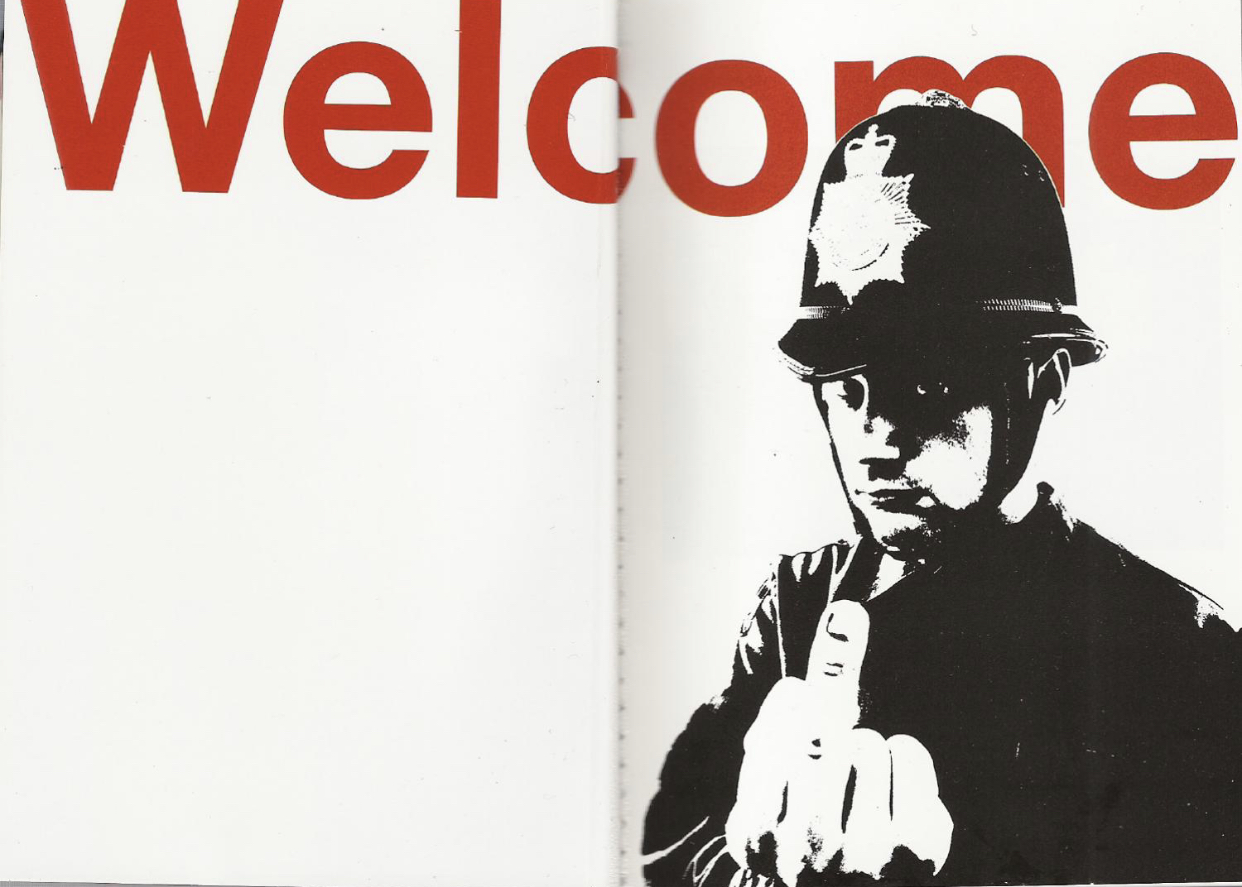
Like many of the artist’s best works Untitled (Fuck the Police)‘s success lies in its stark simplicity, rendered in black and red against the white board, the image possesses a visual immediacy and clean aesthetic that is key to its popularity. Irreverent, bold and responsive to the ever-evolving socio-political landscape, Untitled (Fuck the Police) exemplifies the clarity and wit of Banksy’s guerilla art approach. With gritted teeth and hands tightly clasping his baton, the police officer scornfully stares beyond the borders of the picture. As if just having arrived at the scene, the perpetrator has evaded capture, leaving the bemused officer comically juxtaposed with the brazen red text: ‘Fuck the Police’.
Satirizing familiar elements of popular culture to create novel, subversive imagery, the police force is among the motifs that Banksy has repeatedly returned to and ridiculed. Working under the cover of darkness and adopting an anonymous persona to avoid arrest, by its very nature Banksy’s graffiti has and continues to entangle the artist with law enforcement: a criminality that the street artist responds to with derisive irony. Executed in 2000, the present work represents an early example of Banksy’s iconic policemen rendered in the artist’s signature black-and-white stencil technique: an organisation that Banksy has continued to playfully mock since Untitled (Fuck the Police). Usually caught unaware, Banksy’s police are accompanied by poodles rather than guard dogs (Graffiti Area, 2003), mocked by children with paper bags (Police Sniper and Paper Bag Boy, 2007) or most notoriously, depicted in moments of unexpected intimacy (Kissing Coppers, 2004).
Banksy came of age within the political turbulence and strong countercultural impulses of the 1980s in Bristol, a historic port town where graffiti, community activism, rave culture, and American hip-hop’s raw social critique had gained increasing popularity. Simple, direct, and carrying a deeper message about power, police brutality, and the oppressed condition of those living under authoritarian structures, Banksy’s slogan here directly echoes N.W.A’s powerful 1988 track ‘F*k Tha Police’ and its exposure of the injustices faced daily by young Black men in urban communities, and fits within a broader landscape of hip-hop’s outspoken and revolutionary treatment of these themes from artists including Public Enemy and KRS-One. Among a generation that was fundamentally anti-establishment, Banksy witnessed, alongside the Hartcliffe and Poll Tax Riots, draconian police measures like Operation Anderson in Bristol. At the time of the largest anti-graffiti crackdown, on the 20 March 1989, police conducted seventy-two raids on suspected graffiti artists’ homes. It was because of similar encounters with the police that at eighteen Banksy conceived his signature stencil method. In flight from officers, the artist noticed the stenciled plate on the fuel tank beneath the vehicle he was hiding:
“I realized I had to cut my painting time in half or give it up altogether.”
From the very outset of his career, Banksy’s work was closely entangled with the police, graffiti – a fundamentally illegal act – offering a platform and a means of speaking truth to power and undermining the very structures that seek to maintain order on their terms.
STAY INFORMED
Receive the latest news, exhibitions, artworks and market updates on Banksy.