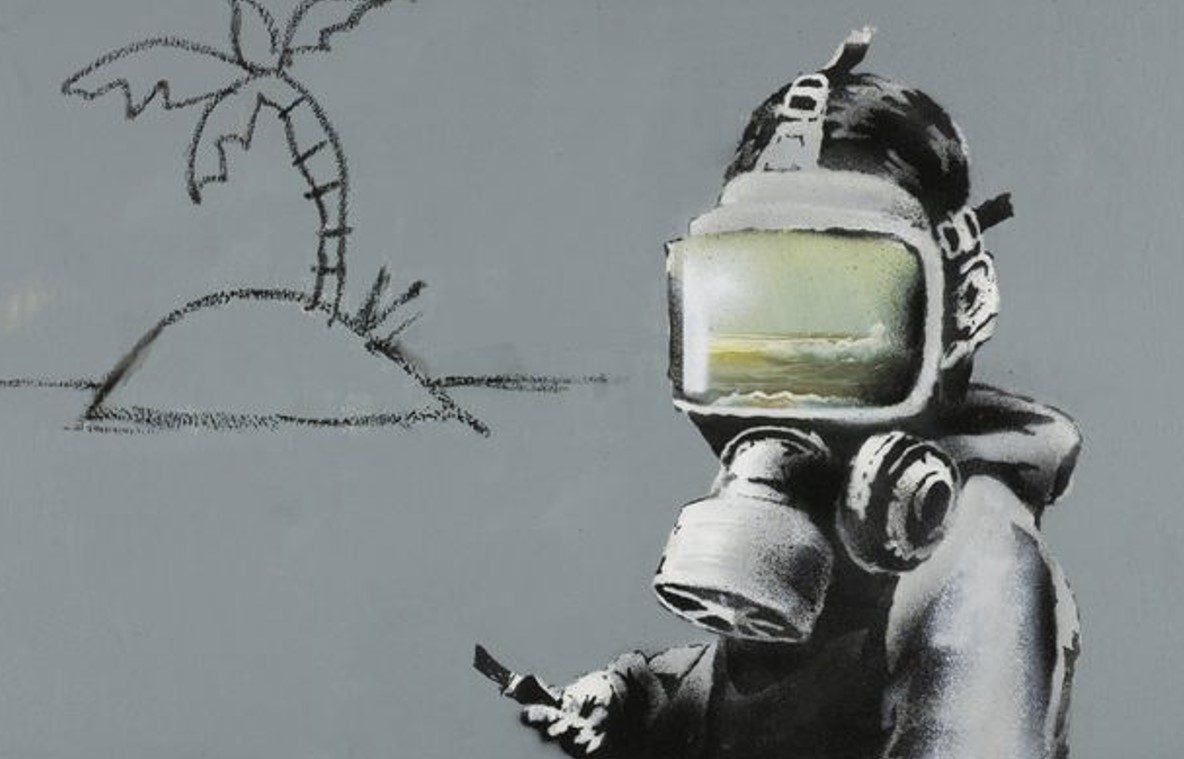
Gas Mask Boy,2010
Acrylic and spray-paint stencil on canvas
70x100 cm (27 9/16 x 39 7/16 inches)
Signed “BANKSY” lower right
Catalogue Note
Banksy constructs the work around the opposition between imagination and experience. The chalk drawing possesses all the simplicity of a child’s vision of paradise, reduced to the most elementary forms. Yet the child himself appears incapable of inhabiting such a world. Encased within protective equipment designed for toxic environments, he belongs instead to a reality defined by contamination and fear. The drawing therefore becomes less a playful sketch than a quiet expression of longing.
The reflective visor introduces another layer of complexity. Rather than mirroring the viewer or the room around the child, it contains the image of an apparently untouched landscape. Banksy deliberately leaves its meaning unresolved. It may represent memory, hope or simply an imagined world that now exists only behind a protective barrier. In either case, nature is no longer experienced directly. It has become something observed through glass.
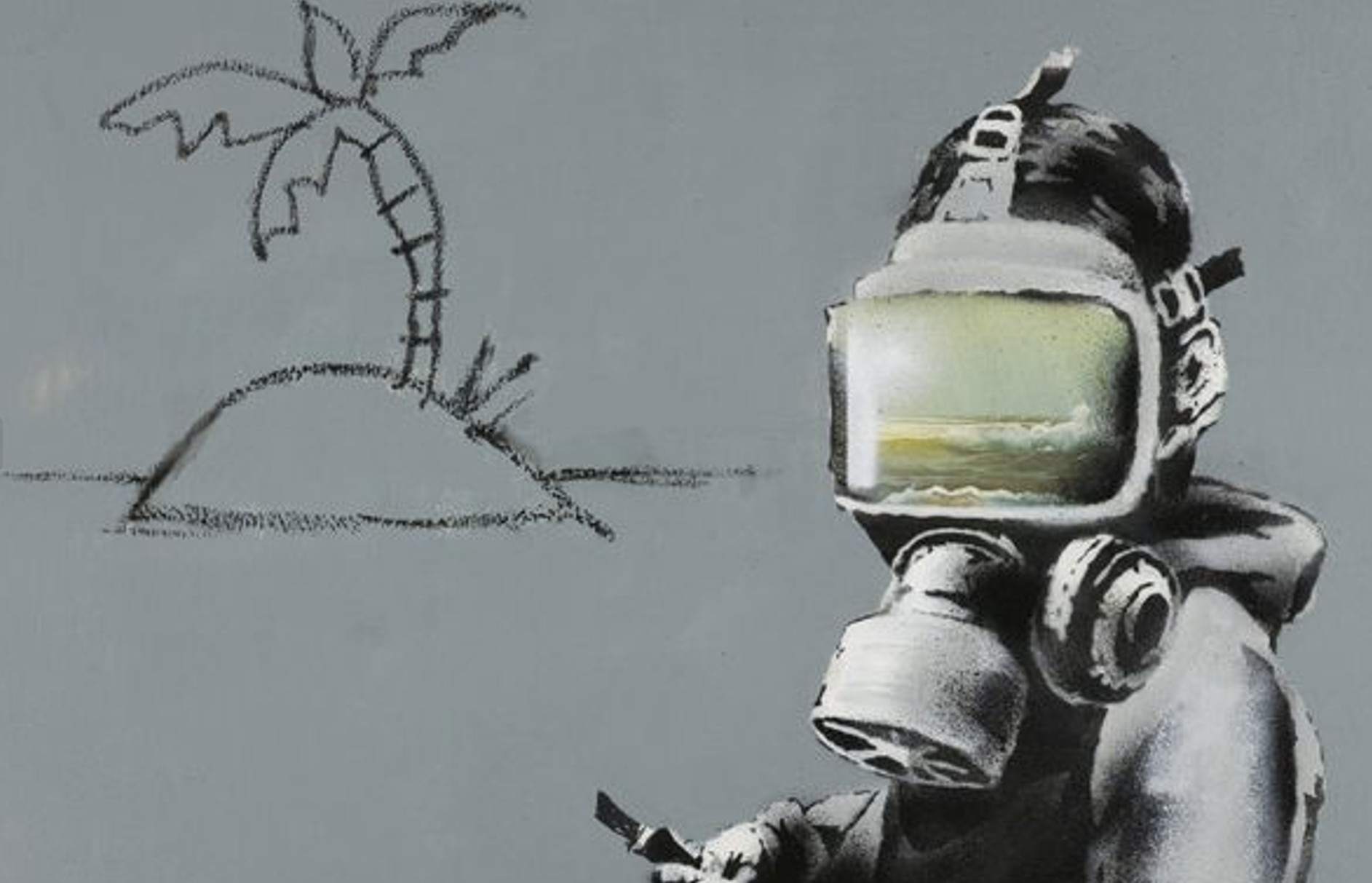
Like many of Banksy’s children, the boy is not portrayed as a victim but as an observer adapting to circumstances beyond his control. Throughout his career, Banksy repeatedly uses children to reveal the contradictions adults have learned to accept. Here, the gas mask has become so ordinary that the child continues drawing without apparent concern. The extraordinary has quietly become everyday.
Executed in 2010, Gas Mask Boy belongs alongside works such as Toxic Mary, Peasant Woman with Rifle, Napalm and I Hate Mondays, in which Banksy examines the long-term consequences of political, military and environmental decisions on future generations. Rather than illustrating catastrophe itself, he depicts the quieter reality of learning to live within its aftermath.
Ultimately, Gas Mask Boy is not a painting about pollution alone. It is about the fragile relationship between hope and reality. Banksy suggests that while imagination survives even in the darkest circumstances, the fact that a child must dream of paradise while wearing a gas mask is itself an indictment of the world adults have created.