Auction History
| Phillips New-York 14 November 2008 Est.: USD 100,000 – 150,000 | Price Realized USD 158,500 |
Catalogue Note
By 2006, Girl and Balloon had already become one of Banksy’s defining images. First appearing as a mural on London’s South Bank in 2002, the composition distilled an extraordinary range of emotions into a deceptively simple scene: a young girl reaches toward a heart-shaped balloon drifting just beyond her grasp. Whether the balloon is being released or pursued remains deliberately ambiguous, allowing the image to oscillate between hope and loss, innocence and acceptance. It is this emotional openness that has made Girl and Balloon one of the most universally recognized works of contemporary art.
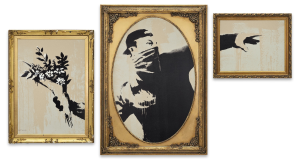
This rare diptych transforms the familiar composition into something altogether different. Divided across two canvases, the physical separation between the girl and the balloon becomes part of the work’s meaning. The empty space that interrupts the image is no longer merely background but a metaphor for absence itself—the distance between aspiration and reality, childhood and adulthood, desire and fulfillment. By fragmenting his most iconic visual, Banksy invites the viewer to contemplate not only what connects the two halves, but also what permanently divides them.
Created during the period that followed Barely Legal, when Banksy was increasingly translating his celebrated street imagery into unique studio works, this painting demonstrates how a familiar stencil could evolve through subtle compositional changes. Rather than simply reproducing the mural, Banksy uses scale, format and negative space to create a more contemplative object, one that rewards prolonged viewing while preserving the direct visual impact that made the original so enduring.
Few images have enjoyed a comparable afterlife. Girl and Balloon has become a universal symbol of hope, resilience and the fragility of happiness, culminating in its transformation into Love is in the Bin following the now legendary shredding at Sotheby’s in 2018. This early two-panel version occupies an important place within that history, capturing the moment when Banksy began exploring how his most celebrated icon could move beyond the street and into the language of unique contemporary painting, without ever losing the emotional immediacy that first made it unforgettable.