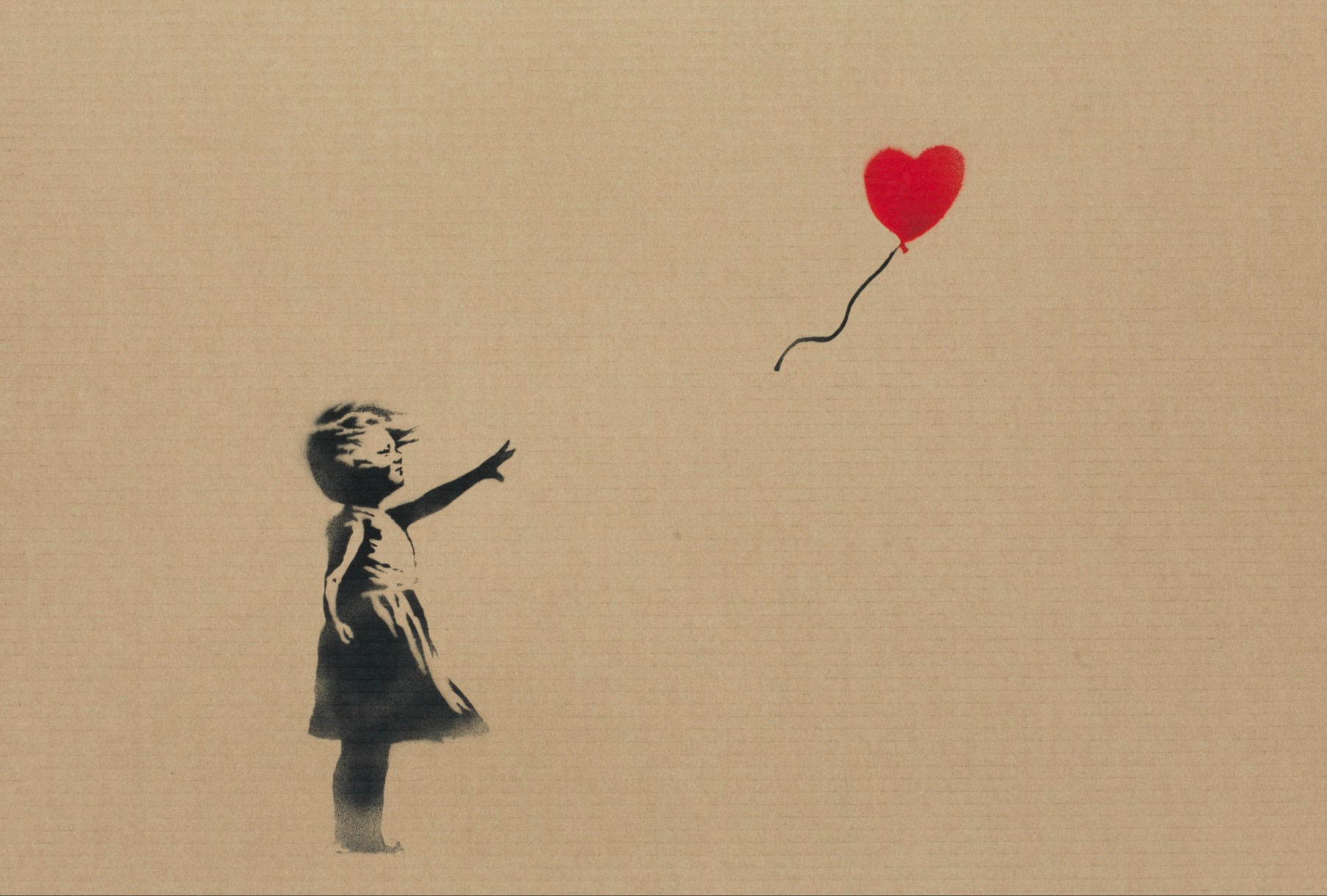
Stencil spray paint on cardboard, in integral frame
54×74 cm (21 1/4 x 29 1/8 inches)
Signed and inscribed For Mike. Thanks on the reverse
Gift from the artist to the present owner in 2009
Auction History
| Bonhams London 29 March 2012 Est.: GBP 15,000 – 25,000 | Price Realized GBP 73,250 / USD 116,315 Bonhams Girl and Balloon 2009 |
Catalogue Note
Few images have become as universally associated with Banksy as Girl and Balloon. First appearing as a mural on London’s South Bank in 2002, the image has evolved into one of the defining icons of contemporary art, its simple composition becoming synonymous with hope, innocence and the fragile nature of love. Yet this unique 2009 version occupies a particularly fascinating place within the artist’s oeuvre, not because it reinvents the image itself, but because it fundamentally redefines the object upon which it exists.
Rather than spraying the stencil onto canvas or paper, Banksy chose the cardboard backing of an inexpensive IKEA frame. The decision is immediately striking. An image that has since become one of the most celebrated and valuable works of contemporary art is deliberately executed on one of the cheapest and most disposable materials available. The cardboard is not disguised or elevated. On the contrary, Banksy embraces its ordinary character, allowing the support to become an integral part of the work’s meaning.
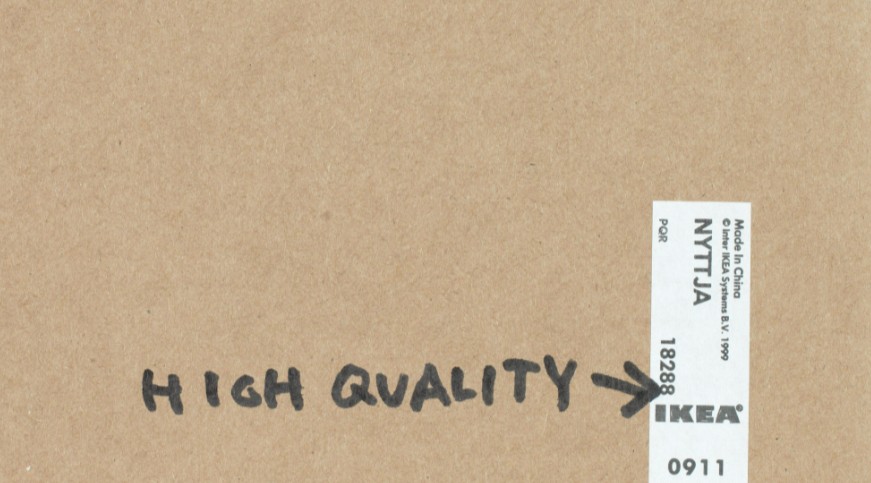
This choice perfectly encapsulates one of the artist’s lifelong preoccupations: the arbitrary relationship between artistic value and material value. Throughout his career, Banksy has repeatedly questioned why identical images can acquire dramatically different significance depending upon where they appear. A stencil sprayed illegally onto a crumbling wall may eventually be protected behind sheets of Perspex, while the cardboard backing of a mass-produced frame becomes the support for an artwork worth many times the value of the object itself. In Banksy’s world, value is never inherent; it is created through context.
The irony becomes even richer through the artist’s handwritten intervention on the reverse. On the IKEA label, Banksy has inscribed the word “Quality,” transforming a routine manufacturing label into one of his characteristic conceptual jokes. The inscription quietly mocks conventional assumptions about craftsmanship and authenticity. The cheapest component of an inexpensive frame is suddenly elevated into a unique work of art, inviting viewers to reconsider what quality truly means. Is it determined by the material itself, the skill of its maker, the reputation of its creator, or simply the way society chooses to value it?
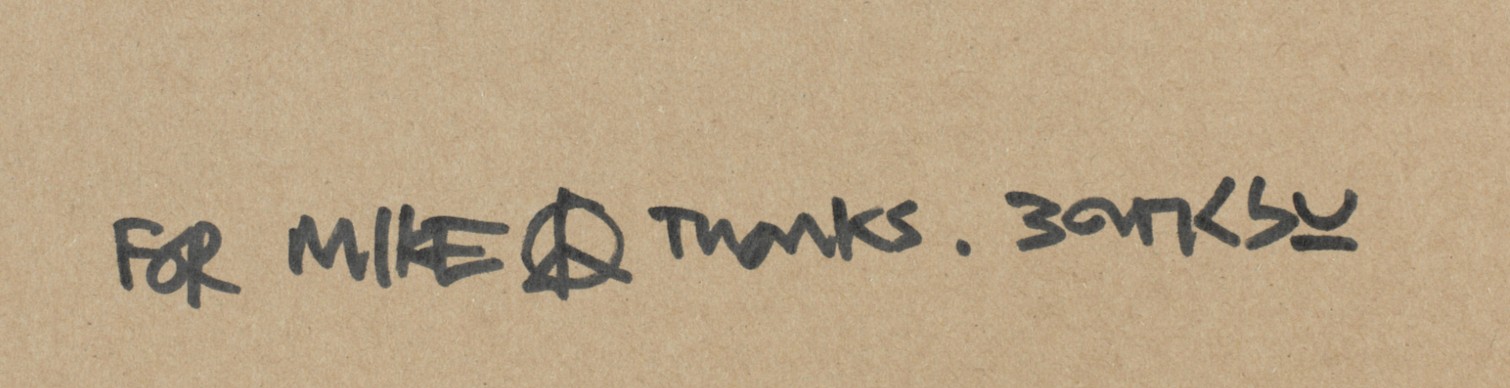
The work also carries an unusually intimate provenance. Signed and inscribed “For Mike. Thanks” on the reverse, it was gifted directly by the artist to its original owner in 2009. This personal dedication reinforces the work’s unique character, reminding us that before Girl and Balloon became an international symbol and a multimillion-pound phenomenon, it remained an image Banksy was willing to give away as a gesture of friendship.
Created several years before Love is in the Bin transformed the image into a global media event, this work already anticipates many of the questions that would later define Banksy’s practice. It challenges conventional distinctions between precious and ordinary objects, between permanence and disposability, and between artistic intention and market value. Long before the image famously escaped its frame at Sotheby’s, Banksy had already begun questioning the physical object that surrounds the artwork itself.
Within Banksy’s oeuvre, this unique Girl and Balloon represents far more than a rare variant of an iconic composition. It is a quiet meditation on value, authenticity and the extraordinary ability of art to transform the most ordinary materials into objects of lasting cultural significance. Executed on the cardboard backing of a flat-pack picture frame, the work demonstrates that the power of an image has never depended upon the luxury of its support. Indeed, Banksy suggests precisely the opposite: sometimes the humblest materials reveal the most profound ideas.