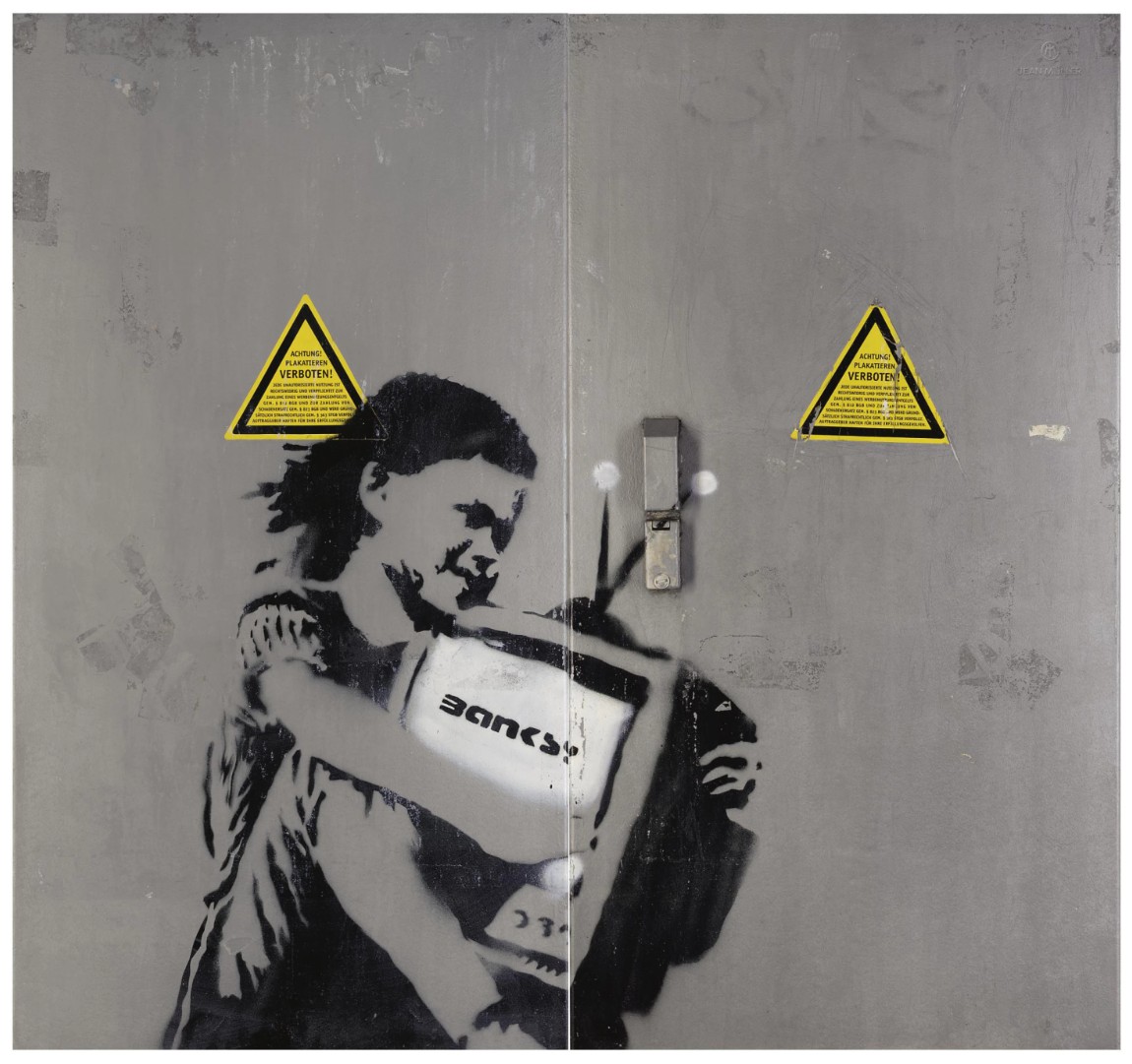
Girl with TV, 2004
Private Collection, Berlin
Acquired directly from the above by the present owner
Auction History
| Sotheby’s London 12 December 2007 Est.: GBP 40,000 – 60,000 | |
Catalogue Note
Executed in 2004, Girl with TV is one of Banksy’s earliest and most prescient reflections on the relationship between childhood, mass media, and consumer culture. A smiling young girl embraces an old television set with the affection normally reserved for a favourite toy or a cherished companion. The image is immediately disarming, yet characteristically for Banksy, its apparent innocence conceals a far darker observation: technology has begun to replace direct human experience as the object of childhood fascination.
The industrial support is fundamental to the work’s meaning. Rather than transferring the stencil onto a conventional canvas, Banksy painted directly onto a pair of weathered steel doors, preserving the original lock and warning signs. These utilitarian elements are not incidental; they become active participants in the composition. The untouched hazard stickers hovering above the child transform into visual warnings, suggesting that the greatest dangers are not always physical but psychological. Long before smartphones and social media became ubiquitous, Banksy was already questioning the growing influence of screens over everyday life and the subtle mechanisms through which media shapes behavior, desire and perception.
The television itself becomes a powerful symbol of mediated reality. Rather than looking outward toward the world, the child clings to the device that interprets it for her. Banksy’s signature, boldly sprayed across the television screen, further complicates the image. It functions simultaneously as an act of artistic ownership and as a playful intervention into one of the twentieth century’s most influential communication tools, reclaiming a medium traditionally dominated by commercial interests and institutional narratives.
Like Girl with Balloon, Girl with Ice Cream Bomb, and Jack and Jill, Girl with TV belongs to Banksy’s wider exploration of childhood as a mirror through which adult society is judged. Children, in Banksy’s universe, embody possibility, sincerity and imagination, yet they are repeatedly confronted by the structures adults create—war, consumerism, surveillance and media. Here, the threat is not overt violence but something quieter and perhaps more pervasive: the gradual replacement of curiosity, creativity and lived experience by passive consumption.
More than two decades after its creation, Girl with TV feels remarkably prophetic. In an era defined by smartphones, algorithms and constant connectivity, Banksy’s simple image has evolved into a profound meditation on modern life. The smiling child no longer merely hugs a television; she anticipates an entire generation raised in the embrace of the screen.