 BANKSY
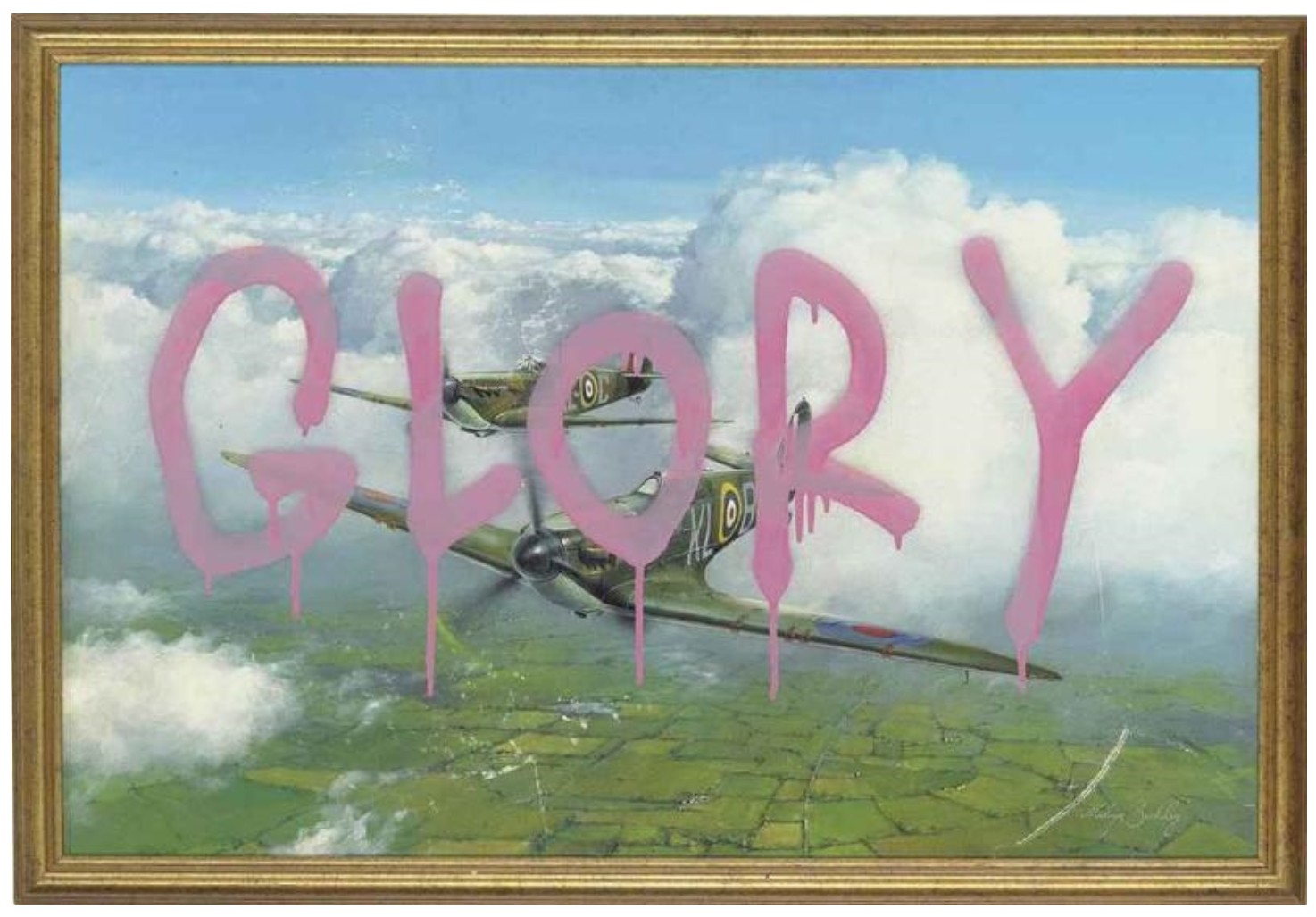
Glory, 2003
Spray paint on found lithographic print in artist’s frame
56.1 x 82 cm (22-1/8 x 32-1/4 inches)
Titled, signed and post-dated 05 on the reverse
Provenance
Lazarides Inc., London
Acquired directly from the above by the present owner
Exhibited
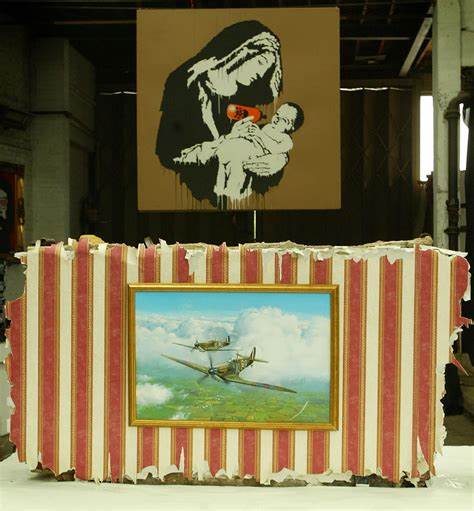
London, Kingsland Road, Turf War, July 18th-20th 2003
Auction History
| Sotheby’s London 26 June 2013 Est.: GBP 40,000 – 50,000 |
Price Realized |
Catalogue Note
Created for Turf War, Banksy’s landmark 2003 exhibition in East London, Glory is a quintessential example of one of the artist’s most enduring artistic strategies: the appropriation of found imagery. Rather than producing a composition from scratch, Banksy intervenes directly upon an existing lithographic print depicting two Royal Air Force Spitfires soaring above the English countryside. Across this heroic wartime scene, he sprays a single word in dripping pink graffiti: “GLORY.”
The intervention is striking in its simplicity. The original image embodies the traditional mythology of military heroism, recalling the Battle of Britain and the romanticized narrative of courage, sacrifice and national pride that occupies a central place in British collective memory. The aircraft appear majestic against the expansive sky, symbols of victory and patriotic resilience. Banksy neither removes nor alters this imagery; instead, he overlays it with a gesture borrowed from the language of the street.
The choice of the word “Glory” is deliberately ambiguous. At first glance, it appears to reinforce the heroic subject of the print. Yet its execution immediately undermines that reading. Rendered in oversized pink spray paint with exaggerated drips, the word resembles a hastily executed graffiti tag rather than an official tribute. The contrast between the carefully painted aviation print and the raw immediacy of the stencil transforms the meaning of both.
As is often the case with Banksy, the work functions through irony rather than direct condemnation. Rather than criticising war explicitly, he questions the language through which war is remembered. “Glory” becomes less a celebration than an uncomfortable question: who defines glory, and at what human cost? The painting invites the viewer to consider how military history is often filtered through ideals of honor, heroism and national identity, while the brutality and tragedy of conflict recede into the background.
The use of pink is equally significant. Traditionally associated with softness, innocence or even frivolity, the color stands in deliberate opposition to the masculine symbolism of fighter aircraft and military power. It strips the word of solemnity, introducing an unexpected vulnerability that subtly destabilizes the heroic narrative without resorting to overt political rhetoric.
Glory also belongs to a pivotal moment in Banksy’s career. By 2003, he was increasingly moving beyond the street to experiment with altered paintings, found objects and unique studio works. This approach would later culminate in celebrated series such as Crude Oils, where historical paintings are similarly interrupted by contemporary interventions. In many respects, Glory anticipates that entire body of work. It demonstrates that Banksy’s real medium is not spray paint itself but juxtaposition: the collision between established cultural imagery and the visual language of graffiti.
Within Banksy’s oeuvre, military iconography occupies a recurring place. Works such as Bomb Love (Bomb Hugger), Love Is in the Air (Flower Thrower), Happy Choppers, and Flying Copper similarly transform symbols of conflict into vehicles for humor, tenderness or contradiction. Glory is perhaps one of the earliest and most distilled expressions of that theme. There is no explosion, no victim and no protester—only a single word whose apparent certainty dissolves under closer inspection.
Exhibited at Turf War in July 2003 and acquired directly from Steve Lazarides, Banksy’s photographer and early dealer, Glory is both historically important and visually immediate. It encapsulates the artist’s remarkable ability to challenge deeply rooted cultural narratives with the lightest of interventions. A single sprayed word is sufficient to transform a patriotic aviation print into a meditation on memory, heroism and the uneasy relationship between national myth and historical reality.