Share on twitter
Share on facebook
Share on pinterest
Share on email

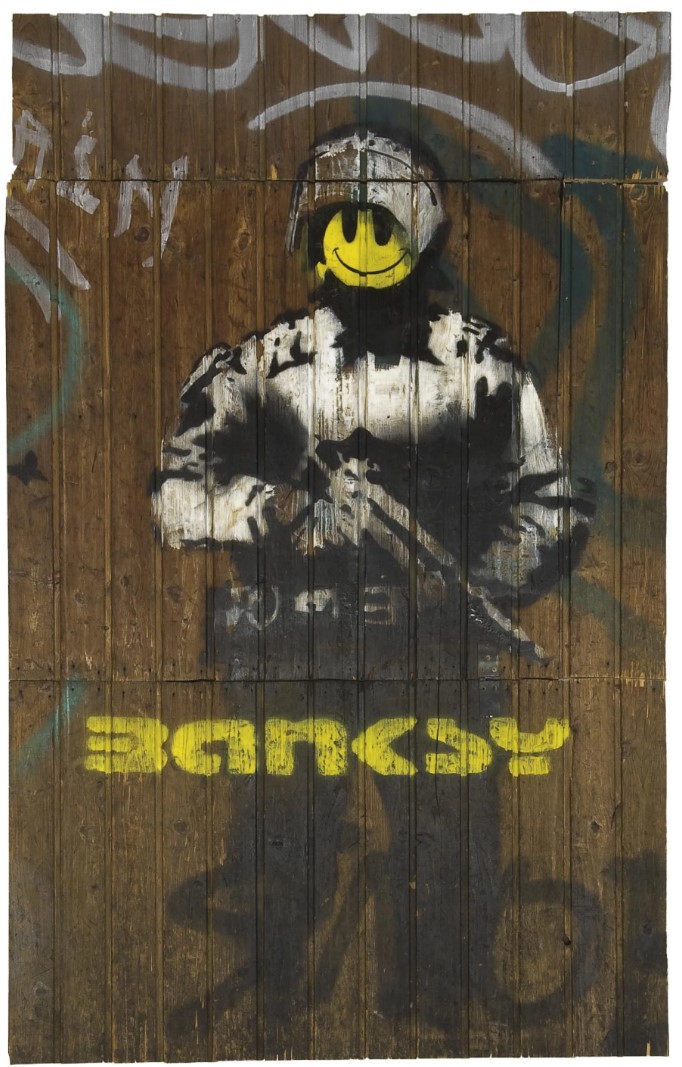
Happy Copper, 2003

BY

BANKSY
Happy Copper
, 2003
Spray-paint on wooden panel in three parts
187×112 cm (73 1/2 x 44 inches)

Provenance
Acquired directly from the stallholder by the present owner

This work was executed in 2003 on a stall at the Viennese Naschmarkt

Auction History

Sotheby’s London
12December 2017
Est. GBP 70,000 – 100,000

Price Realized
GBP 84,500 / USD 173,110
(#187) Banksy


Catalogue Note

‘The Greatest Crimes in the world are not committed by people breaking the rules but by people following the rules.’

Executed directly onto the wooden façade of a market stall at Vienna’s historic Naschmarkt in 2003, Happy Copper occupies a unique place within Banksy’s early oeuvre. Unlike studio canvases that reinterpret his street imagery, this work is an authentic fragment of the urban environment for which it was originally conceived. The weathered timber, layers of graffiti, stains and scars are not incidental imperfections but essential components of the artwork, preserving the physical history of its public life.

Dominating the composition is one of Banksy’s most recognizable figures: the smiling riot policeman. Clad in body armor and gripping an assault rifle, the officer should embody state authority and intimidation. Yet his face has been replaced by an oversized yellow smiley, one of the defining symbols of late twentieth-century popular culture. The result is both humorous and profoundly unsettling. The smile promises reassurance while the weapon communicates precisely the opposite.

This collision between innocence and coercion became one of Banksy’s defining visual strategies. Rather than depicting violence directly, he exposes the contradictions hidden beneath its presentation. The policeman does not appear overtly threatening; instead, authority has been disguised as entertainment, suggesting that modern systems of control often rely less on fear than on carefully constructed public perception.

 Banksy, Cut It Out, December 2004

Created during Banksy’s prolific period of anti-authoritarian imagery, Happy Copper belongs to the same family of works as Flying Copper, Riot Copper, Smiley Copper and Toxic Mary, all of which question the uneasy relationship between institutional power and public trust. The iconic smiley face, borrowed from the optimistic visual language of rave culture, becomes an instrument of irony. Happiness itself has become part of the uniform.

The choice of support amplifies that message. The rough timber boards retain their original graffiti, faded paint and accumulated wear, reminding us that this image once existed within the unpredictable life of the street rather than the controlled environment of a gallery. Banksy frequently insisted that the city itself was his preferred exhibition space, where works could be discovered accidentally, altered by others or disappear altogether. Here, that ephemerality survives in the material itself.

Perhaps most remarkably, Happy Copper preserves the dialogue between graffiti and architecture that defines Banksy’s finest street works. The vertical planks interrupt the figure, knots in the wood disrupt the stencil, while the pre-existing markings become an accidental backdrop, making the smiling officer appear to emerge organically from the urban fabric rather than simply resting upon it.

Ultimately, Happy Copper is more than one of Banksy’s most celebrated police images. It is a rare survivor from the street, carrying with it the texture, history and unpredictability of its original environment. The work reminds us that Banksy’s greatest achievement was never simply creating memorable images, but transforming ordinary public spaces into places of reflection, humor and quiet resistance. Here, the street itself remains inseparable from the art.


Gallery

wpChatIcon
wpChatIcon