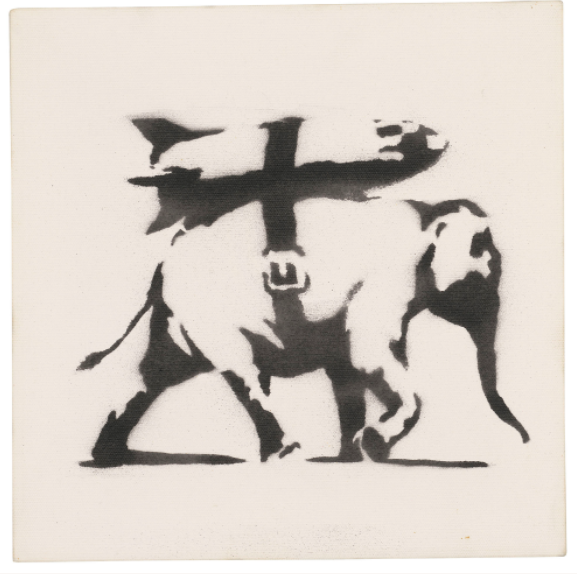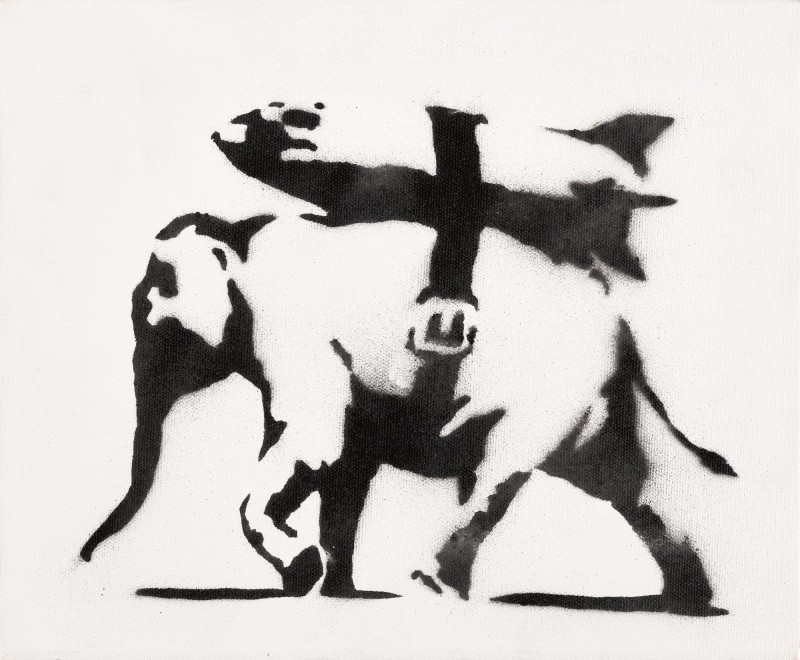
Heavy Weaponry
Year: 2003
Medium: Spray-paint on canvas
Dimensions: 25.4 x 30.3 cm (10×12 inches)
Edition: 25
Stenciled “BANKSY” in red spray paint on the lateral edge
Further dated and numbered on the stretcher
Some elephants are walking towards the right, others towards the left
Among Banksy’s early originals, Heavy Weaponry occupies an important position because it introduces one of the artist’s recurring visual strategies: taking an animal, stripping it of its natural symbolism, and forcing it into the machinery of human behavior. Rats become revolutionaries, monkeys become politicians, cows become agents of absurdity, and here, an elephant becomes an unwilling participant in warfare. At first glance the image appears almost comical. Executed in Banksy’s iconic black stencil language, a large elephant walks slowly across the composition with a missile strapped to its back. The visual contradiction immediately creates humor. Elephants are typically associated with memory, wisdom, patience and immense physical presence. Missiles belong to a world of destruction, speed and technological violence. Like many of Banksy’s strongest images, the work provokes laughter before producing discomfort. Because beneath the absurdity lies something considerably darker.
The Gentle Giant Turned Into a Weapon
Throughout human history elephants have occupied a strangely contradictory place in culture. They have been revered as symbols of wisdom and spiritual power, while simultaneously serving as instruments of war. The image immediately recalls the military elephants used by ancient civilizations. From the armies of India to the forces of Hannibal Barca crossing the Alps, elephants were transformed into living machines of combat. Massive and intimidating, they functioned as psychological weapons designed to create fear among opposing armies.
Banksy appears to revive this ancient image, but with a contemporary update. The armored elephant of antiquity becomes an elephant carrying a missile. The spear becomes modern military technology. Two thousand years later humanity may have changed its tools, but perhaps not its instincts. The work quietly suggests that civilization often presents itself as progress while endlessly repeating familiar patterns.

The Elephant in the Room
There may also be another level hidden within the image itself. The elephant has long existed in language as a metaphor for ignored truths. The phrase “the elephant in the room” refers to an obvious problem everyone sees yet no one wishes to discuss.
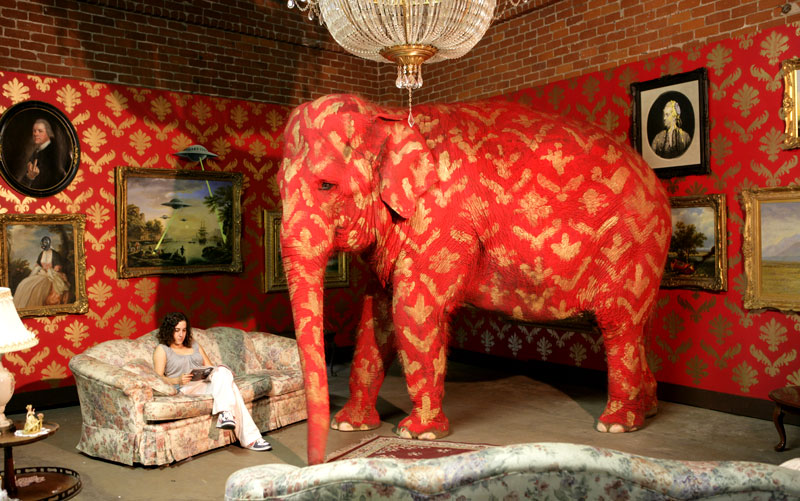
An Elephant in the Room, Barely Legal, Los Angeles, 2006
In Heavy Weaponry, Banksy could be confronting precisely such an uncomfortable reality. War often operates through abstraction. Governments speak of strategy. Media discusses operations. Statistics replace people. Political language sanitizes destruction. Meanwhile the actual consequences remain standing directly in front of society, enormous and impossible to ignore. Like an elephant in the room. Banksy simply straps a missile to it so no one can pretend not to see it anymore.
Against the Commodification of Conflict
Around the early 2000s, anti-war sentiment occupied a central place within Banksy’s practice. Heavy Weaponry emerged during a period defined by intense geopolitical tension. The invasion of Iraq in 2003, global debates surrounding military intervention and growing skepticism toward governmental narratives formed an important backdrop to many of Banksy’s works from this period. Unlike traditional protest art, Banksy rarely presents direct political slogans.
Instead he uses humor and visual compression. The elephant itself becomes a vessel for criticism. Military activity increasingly appeared intertwined with economics, industry and media spectacle. Wars often seemed to possess their own markets, infrastructure and systems of consumption. The missile attached to the elephant therefore becomes something larger than a weapon. It becomes a product. Something manufactured. Something distributed. Something sold. Banksy repeatedly returns to this theme across his practice: systems of violence becoming normalized forms of commerce.
Echoes of Picasso and Goya
The work also belongs within a long artistic tradition of representing war through symbolic imagery rather than direct documentation. One inevitably thinks of Pablo Picasso and his monumental Guernica.
Picasso avoided literal depictions of battlefield events and instead used animals (bulls, horses and fragmented figures) to express the psychological violence of war. Banksy adopts a similarly indirect approach. Rather than depicting soldiers or explosions, he gives us an animal carrying the burden of human conflict.
There are also echoes of Francisco Goya, whose series The Disasters of War exposed the irrationality and brutality hidden behind military heroism. Both artists understood that war often reveals less about power than about human absurdity. Banksy merely translates this language into the vocabulary of the street.
Simplicity as Strategy
Visually, Heavy Weaponry demonstrates Banksy at his most economical. The composition is almost radically stripped down. Large sections of negative space surround the elephant. Details are reduced to essentials. The missile itself appears almost secondary. Nothing distracts from the central idea. This reduction recalls the effectiveness of political posters and advertising imagery. Banksy frequently borrows from the visual logic of mass communication because such images are designed to operate instantly. One does not analyze the image first. One understands it immediately. Only afterward do its implications begin to unfold.
Part of the power of Heavy Weaponry comes from its refusal to become overtly tragic. Banksy understands that humor lowers defenses. The image initially resembles a cartoon. There is something undeniably ridiculous about a large elephant carrying military hardware. Yet absurdity itself becomes the criticism. Because perhaps the image is not absurd at all. Perhaps the truly absurd thing is humanity’s endless ability to transform almost anything—animals, technologies, ideologies, even progress itself—into instruments of conflict. Banksy simply reveals this reality with his characteristic economy. An elephant. A missile. Nothing more. And somehow, almost everything is already there.