Horse with Scythe, 2006
Barely Legal, Los Angeles, 2006
Catalogue Note
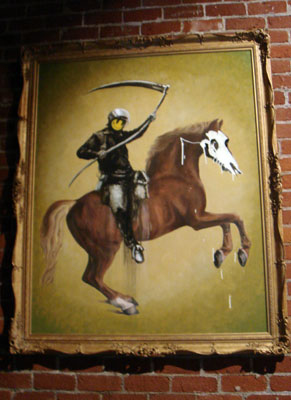
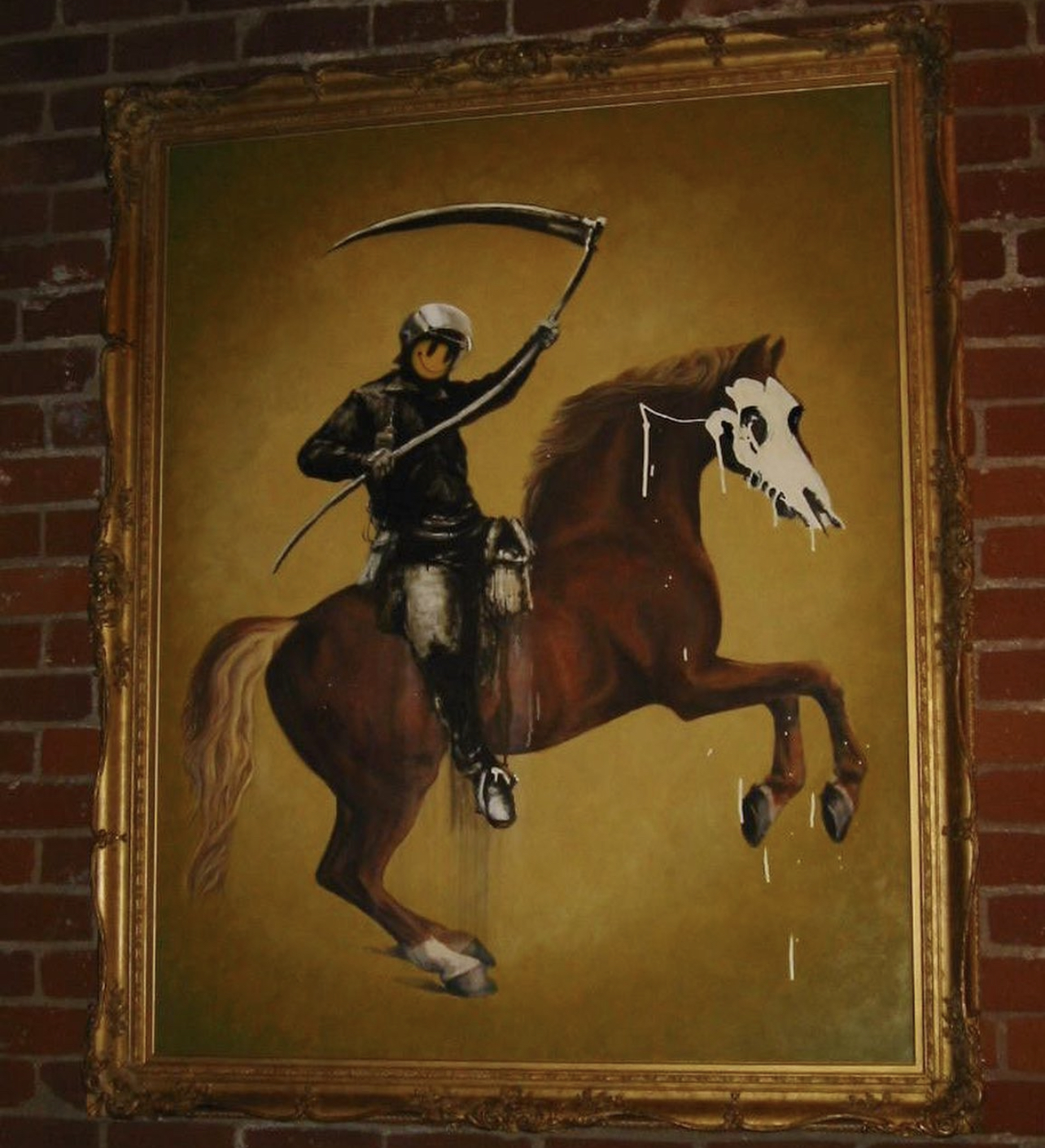
The work is built upon a series of contradictions. The smiley face, one of the defining symbols of rave culture and carefree optimism, masks a figure whose weapon is traditionally associated with death itself. Likewise, the horse remains powerful and elegant, but its skeletal head reminds us that mortality already rides alongside it. Banksy transforms what could have been a terrifying apocalyptic figure into something strangely comic, exposing the absurdity that often accompanies violence and authority.
The smiley itself occupies an important place within Banksy’s visual vocabulary. Throughout his career he repeatedly used the symbol to question the comforting language of advertising and popular culture. Here, the cheerful yellow face functions almost like a corporate logo pasted onto a machine of repression. It suggests that modern systems of authority increasingly present themselves with reassuring imagery while exercising very real power beneath the surface. Violence has learned to smile.
The mounted figure also recalls Banksy’s long-standing fascination with riot police and law enforcement. Beginning with Rude Copper in 2002 and continuing through works such as Flying Copper, Stop and Search, and SWAT Van, Banksy consistently portrays agents of authority as simultaneously intimidating and faintly ridiculous. In Horse with Scythe, that evolution reaches an almost mythical dimension. The modern policeman is transformed into an allegorical horseman, no longer merely enforcing order but embodying the timeless relationship between state power and fear.
The horse itself deserves equal attention. Throughout Western art history, horses have traditionally symbolized nobility, conquest and military glory. Banksy deliberately undermines this heroic tradition by replacing the animal’s head with a dripping skull. Rather than charging triumphantly into battle, the animal appears already dead, as though the mythology of military heroism has long since expired. It is a powerful reminder that beneath every romantic narrative of conquest ultimately lies mortality.
The scythe reinforces this reading. Unlike a sword, it is not a weapon designed for combat but an agricultural tool transformed into the universal emblem of death. Banksy deliberately blurs those meanings. The same instrument that harvests wheat also harvests lives. It becomes an unsettling metaphor for modern conflict, where ordinary technologies and institutions are repeatedly adapted for violence.
Created for Barely Legal, the painting perfectly embodies the exhibition’s broader themes. Much of the Los Angeles exhibition explored the uneasy coexistence of spectacle and catastrophe, celebrity and war, consumer culture and social injustice. Horse with Scythe distills those concerns into a single unforgettable image, balancing dark humour with genuine existential unease. Like many of the exhibition’s finest works, it refuses to offer a clear moral lesson, instead inviting viewers to confront the strange normality with which contemporary society accepts images of conflict and control.
Within Banksy’s oeuvre, Horse with Scythe also marks an important transition. His early street works often relied upon direct visual jokes that could be understood instantly by passers-by. By 2006, however, his compositions had become increasingly layered, borrowing from the language of allegory and art history. Here, the references extend beyond graffiti into medieval iconography, political satire and classical symbolism. The result is a work that functions simultaneously as street art, history painting and modern allegory.
Ultimately, Horse with Scythe suggests that the modern apocalypse no longer arrives as a terrifying monster emerging from the shadows. Instead, it smiles reassuringly beneath a bright yellow face. Banksy reminds us that power rarely presents itself as frightening; it arrives dressed as entertainment, optimism or security. Beneath that cheerful mask, however, the ancient horseman still rides.