BANKSY
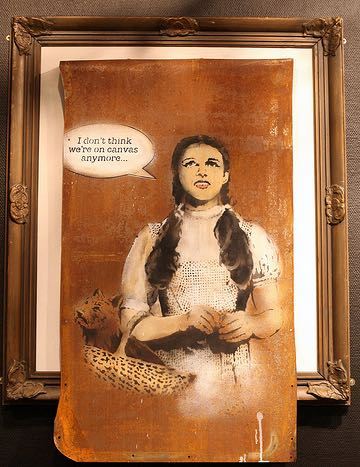
Dorothy, 2009
Spraypaint and oil on found metal
127 x 95.7 cm (50 x 37-3/4 inches)
Banksy vs. Bristol Museum, Bristol Museum, Bristol, 2009
Catalogue Note
The sentence immediately recalls one of the most recognizable lines in cinema history. In the original film, Dorothy’s realization that she is “not in Kansas anymore” marks her passage from ordinary reality into a fantastical new world. Banksy alters just one word. By replacing Kansas with canvas, he shifts the reference away from geography and towards painting itself. The journey is no longer from one place to another, but from one artistic medium to another.
This subtle substitution becomes the conceptual foundation of the entire work. Dorothy is no longer trapped within the conventions of traditional painting. Instead of appearing on a stretched canvas, she materializes upon a weathered sheet of industrial metal, a surface carrying its own history of corrosion, decay and use. The support is not simply an alternative material; it becomes part of the narrative. Like Dorothy stepping into the unfamiliar landscape of Oz, the image itself has entered an entirely new artistic world.
Banksy’s choice of found metal is particularly significant. Throughout art history, paintings have traditionally been associated with permanence, refinement and carefully prepared supports. Rusted metal represents precisely the opposite. Scarred by time and exposed to the elements, it belongs to the language of industry rather than the academy. Yet Banksy does not conceal these imperfections. He embraces them, allowing the oxidized surface to remain visible as an active component of the composition. The found object is elevated into fine art without ever abandoning its humble origins.
The work also occupies a fascinating position within Banksy’s broader practice. By declaring that the image is “not on canvas anymore,” Banksy quietly acknowledges his own artistic evolution. Having begun as a street artist working directly on walls, trains and urban architecture, he had progressively expanded into found objects, altered oil paintings, sculpture and installation. Dorothy’s observation therefore becomes unexpectedly autobiographical. Banksy himself is no longer confined to canvas—or indeed to the street—but is freely navigating between artistic disciplines while refusing to recognize conventional boundaries.
Created for the landmark exhibition Banksy vs. Bristol Museum in 2009, Dorothy perfectly captures the experimental spirit that defined the exhibition. Many of the works challenged accepted distinctions between painting, sculpture, installation and found objects, encouraging visitors to reconsider not only what art represents but also what art can physically be.
Within Banksy’s oeuvre, Dorothy stands alongside works such as The Gleaners, Girl and Balloon (2009 cardboard version), Love is in the Bin, and Peckham Rock in questioning the traditional relationship between image and support. Each demonstrates that for Banksy the surface is never merely a vehicle for the artwork; it is part of the artwork’s meaning. In Dorothy, a single altered quotation quietly announces that the artist has stepped beyond the limits of the canvas and has no intention of returning.