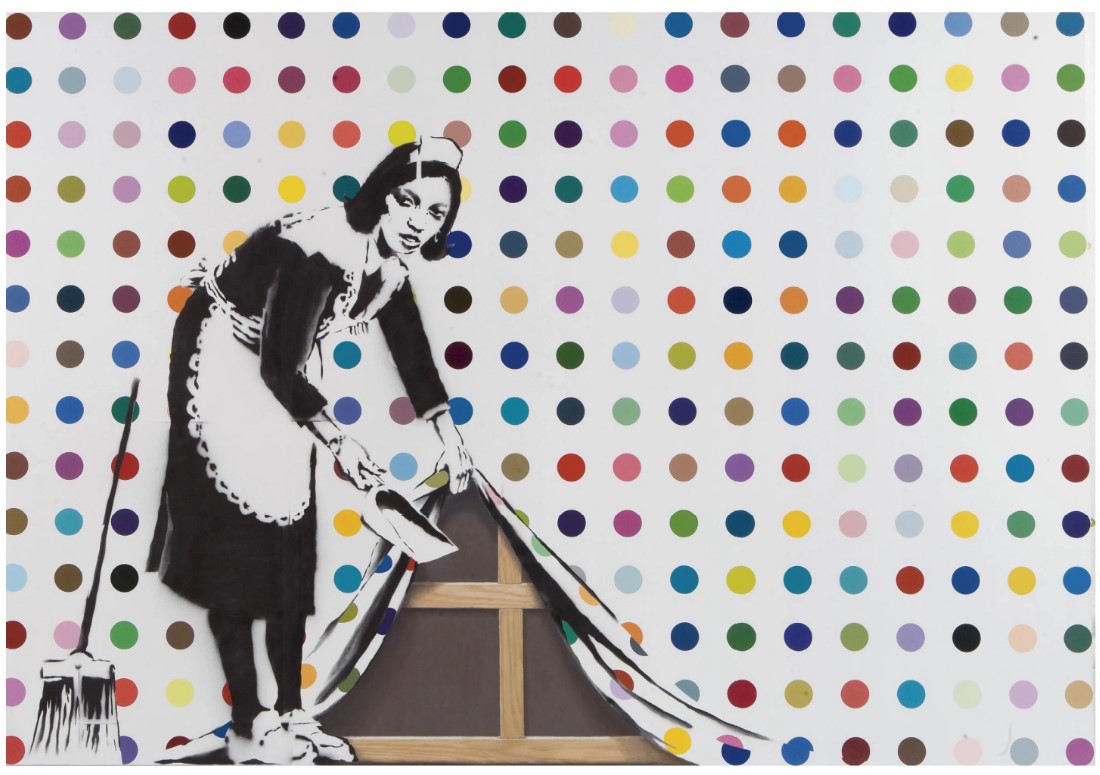
KEEP IT SPOTLESS, 2007
Auction History
Prices are inclusive of buyer’s premium unless stated otherwise, as reported by the auction houses.
Catalogue Note
Keep It Spotless is one of Banksy’s most important appropriations of another contemporary artist’s work. Created by intervening directly upon a monumental Damien Hirst Pharmaceutical spot painting, the work superimposes Banksy’s maid onto Hirst’s meticulously ordered field of colored circles. The figure lifts the painted surface as though it were a curtain, revealing a dark void beneath it into which she appears to sweep accumulated dirt. Rather than merely placing one image over another, Banksy creates the illusion that Hirst’s painting itself is a material surface capable of being lifted, disturbed and cleaned. Sotheby’s catalogued the resulting work as “Banksy (defaced Hirst)”, an unusually apt description of its deliberately unstable authorship.
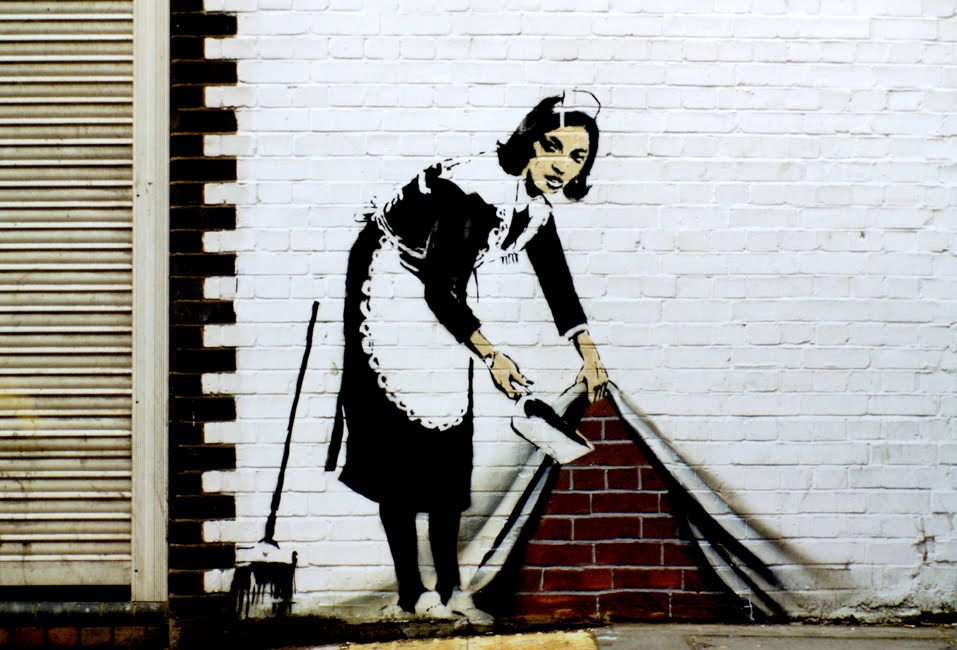
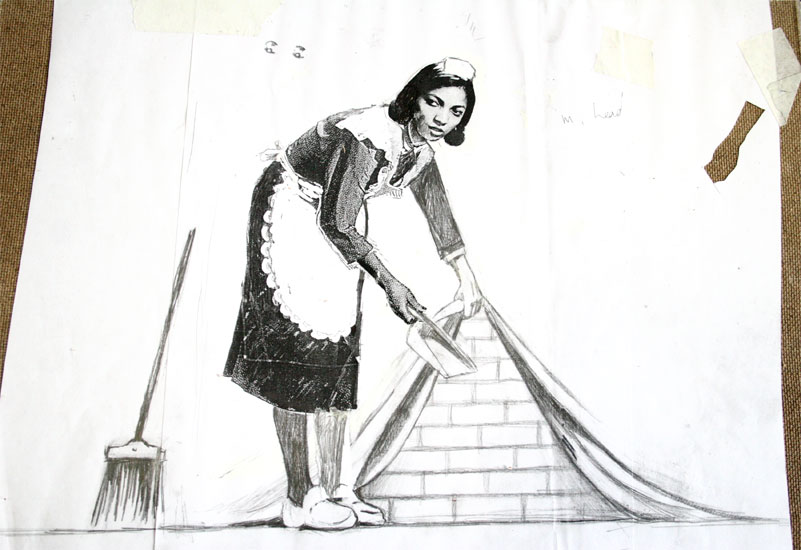
The maid derives from Sweep It Under the Carpet, which Banksy had placed on London walls the previous year. Banksy identified her as Leanne, a maid who had cleaned his motel room in Los Angeles, explaining that portraiture had historically been reserved for “popes and princes” and that he instead wanted to portray an ordinary working woman. In Keep It Spotless, however, her role changes considerably. She has moved from the street onto the work of one of the most commercially successful artists of his generation, transforming an invisible service worker into an active participant in—and disruptive presence within—the contemporary art market.
‘In the bad old days, it was only popes and princes who had the money to pay for their portraits to be painted, this is a portrait of a maid called Leanne who cleaned my room in a Los Angeles motel. She was quite a feisty lady.’
The encounter between the two visual languages is particularly effective. Hirst’s spots embody repetition, immaculate finish and systematic order; Banksy introduces labor, dirt and concealment. The maid does not destroy that ordered surface but temporarily peels it aside, exposing what the pristine painting ostensibly hides. The title compounds the contradiction. “Keeping it spotless” can mean maintaining immaculate appearances, but Banksy turns cleanliness into an act of concealment: disorder is not eliminated but simply swept somewhere it can no longer be seen. In this respect, the work extends the central metaphor of Sweep It Under the Carpet while making the art object itself the thing beneath which uncomfortable realities can disappear.
The work also occupies an exceptional place in Banksy’s early market history. Offered as lot 34 in Sotheby’s (RED) auction in New York on 14 February 2008, with an estimate of $250,000–350,000, it sold for $1.87 million, establishing a new auction record for Banksy that would stand for more than eleven years. The result added another layer to an already self-referential work: Banksy had taken the work of an art-market superstar, “defaced” it with the image of a largely invisible worker, and in doing so created an object whose value vastly exceeded its estimate. Keep It Spotless therefore operates simultaneously as appropriation, social metaphor and commentary on the mechanisms through which contemporary art manufactures authorship and value.
About Damien Hirst Spot Paintings
Damien Hirst is one of the most successful and controversial living British artists. He created his very first spot painting while he was still a student in 1986 at London’s Goldsmiths College. Today, there are about 1000 spot paintings in the world of different sizes, shapes, and colors, most of them have been painted by Hirst‘s Gallery Assistants.
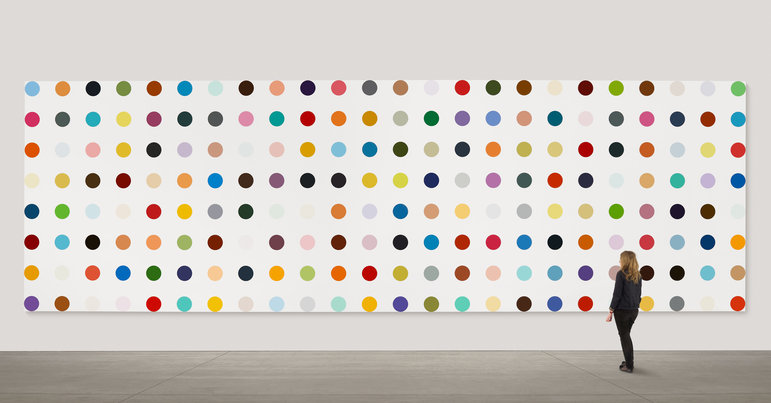
Spot paintings are monochromatic canvases featuring orderly rows of perfectly rounded, glossy spots painted in a range of different bright colors, and with different sizes. On January 2012, Damien Hirst’s spot painting show was opened on all of Gagosian Gallery’s eleven locations in New York, London, Paris, Los Angeles, Rome, Athens, Geneva and Hong Kong. More than 150 private individuals or public institutions from twenty countries provided their paintings to create this single exhibition in different countries.
More than 300 paintings were shown, from the first spot, created by Hirst in 1986, to the smallest spot painting comprising half a spot and measuring 1 x 1/2 inch (1996); to a monumental work comprising only four spots, each 60 inches in diameter; and up to the most recent spot painting completed in 2011 containing 25,781 spots that are each 1 millimeter in diameter, with no single color ever repeated. The exhibition preceded the first major museum retrospective of Hirst’s work opening at Tate Modern in London in April 2012.
Those visitors who manage to see all eleven galleries spread on three continents until February 10, 2012, received a signed spot print by Damien Hirst with a personal dedication.
STAY INFORMED
Receive the latest news, exhibitions, artworks and market updates on Banksy.